Most investors watching a possible SpaceX Tesla merger are asking whether Tesla shareholders would vote yes. JPMorgan analyst Rajat Gupta thinks they are watching the wrong gate: in a note published on 21 October 2026, he argued that the harder approval sits in Beijing, not with Tesla’s own share register.
That is a bold call, because the vote is no formality. Elon Musk himself has described the threshold as “quite a high hurdle.”
The question is live. Musk confirmed on SpaceX’s Q3 2026 earnings call this week that special committees at both companies are reviewing a possible combination. If you hold Tesla, or have been watching SpaceX since its IPO, your money is exposed to how this plays out. No terms are agreed, and no deal is guaranteed.
Here is a framework for judging three things: how much weight China clearance deserves, whether a TikTok-style workaround would actually help, and what JPMorgan’s assumed terms would mean for what you end up owning.
Why could Beijing matter more than Tesla’s own shareholders?
Gupta’s note, reported secondhand by Investing.com because the primary document is not public, names two principal hurdles: Tesla shareholder approval and Chinese regulatory clearance. He ranks China first. The case for that ranking only becomes clear once the vote is given its due.
The shareholder vote
Any deal needs the affirmative vote of 50% of all outstanding shares, not just half of those cast. Abstentions and shares that never vote effectively count as a no.
Elon Musk on the vote threshold Musk called the requirement “quite a high hurdle,” according to TechCrunch and CBS News.
Musk holds about 19.9% of Tesla’s vote after exercising 303,960,630 options in June 2026, against roughly 82% of SpaceX’s voting power. As a conflicted party, he sits outside both special committees. Tesla’s proxy dated 19 October contained no merger proposal, so a separate shareholder process would be needed.
Daunting, but visible. You can count the votes.
The China gate
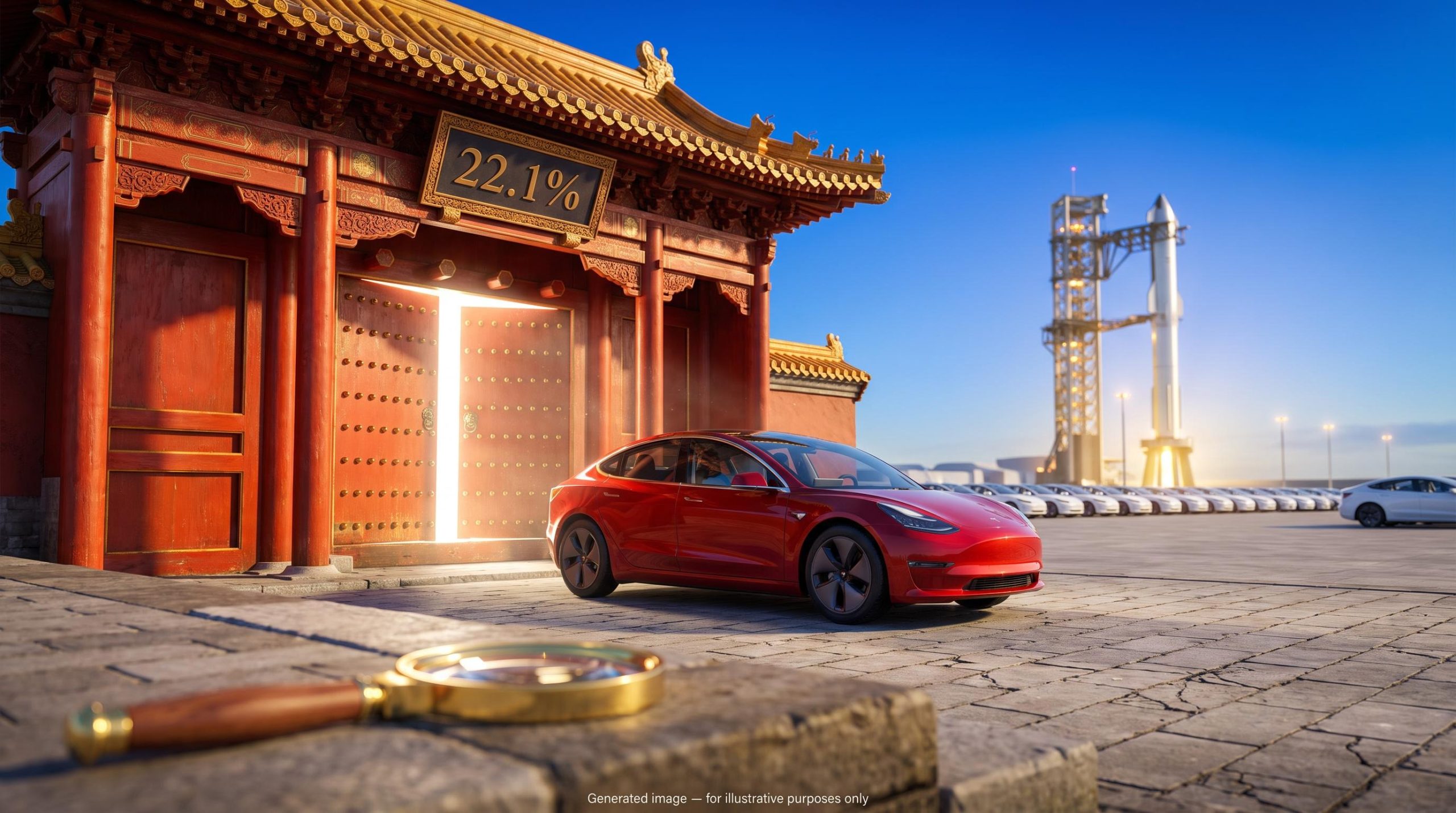
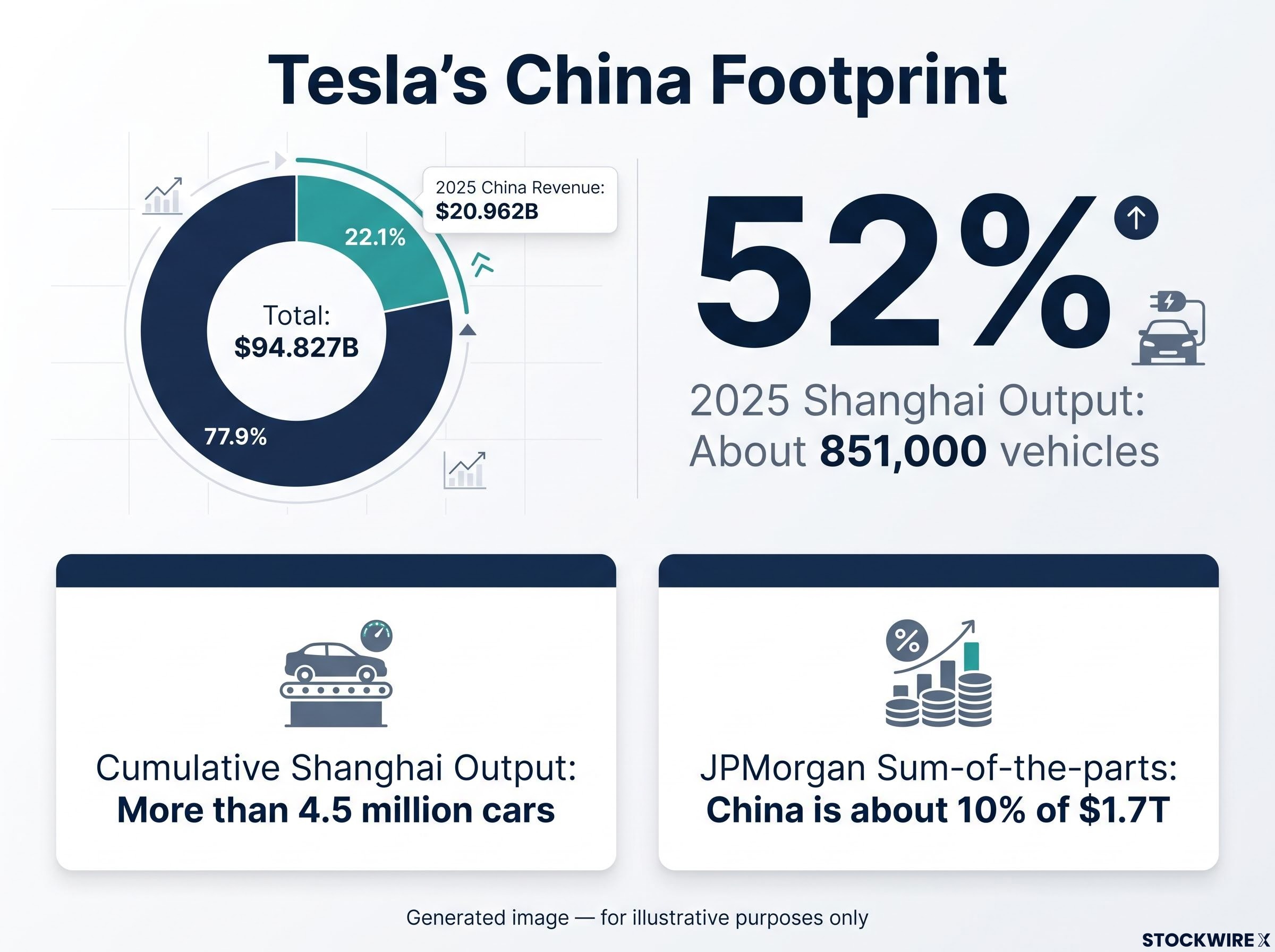
China is harder to count. Tesla booked $20.962 billion of revenue there in 2025, about 22.1% of its $94.827 billion total (JPMorgan rounds to about 20%). JPMorgan says China is an even larger share of EBIT, meaning earnings before interest and tax, and of free cash flow, although the exact share has not been publicly quantified.
| Metric | Figure | Why it matters |
|---|---|---|
| China revenue share (2025) | $20.962B, about 22.1% | Roughly a fifth of sales, a larger slice of profit |
| Shanghai output (2025) | About 851,000 vehicles, roughly 52% of deliveries | Domestic factory and export base in one |
| Tesla market capitalisation | About $1.48T | Sets the base for any premium |
| China share of JPMorgan sum-of-the-parts | About 10% of $1.7T | Small in valuation, large in operations |
Shanghai has built more than 4.5 million cars cumulatively. That operational weight is why China’s State Administration for Market Regulation (SAMR), the country’s merger-control authority under the Anti-Monopoly Law, would almost certainly have a say. SAMR can approve, impose conditions or block, and it pursued Qualcomm over Autotalks after that deal closed without Chinese approval.
Separate national-security and data reviews add another layer. SpaceX carries US defence and government contracts, Starlink has no operating approval in China, and Tesla handles connected-car data there. If you hold Tesla, a China problem strikes the core of the earnings base, so a vote that looks winnable can still leave the deal stranded.
Because China supplies a disproportionate share of profit, any royalty-style restructuring would land on automotive margins and free cash flow, the same metrics that drove the sharp reaction to Tesla’s last earnings report.
When big ASX news breaks, our subscribers know first
What is a TikTok-style ring-fence, and would it satisfy regulators?
JPMorgan’s suggested workaround borrows a shape from the US TikTok arrangement. A ring-fence is a legal structure that separates one part of a business into its own entity with distinct ownership and control.
Under this version, Tesla’s China operations would move into a distinct Chinese entity, with a China-based consortium holding more than 50%. Beijing would keep control. Tesla would earn royalties by licensing its brand, walled-off Full Self-Driving (FSD) software and possibly future Optimus robot arrangements, rather than owning the business outright.
The TikTok comparison is an analogy used in reporting, not a confirmed template. And it comes with a price.
| Owned operation (today) | Ring-fenced licence (proposed) |
|---|---|
| Tesla controls the Chinese business | Consortium holds more than 50% |
| Tesla keeps operating profit | Tesla earns licensing royalties |
| Direct say over data and technology | Beijing retains control of the entity |
Even then, approval is not assured. Chinese authorities could still examine:
- whether Tesla retains effective control behind the structure
- whether licensing gives access to sensitive technology
- who controls vehicle and customer data
- whether it is a genuine divestiture or a ring-fence on paper only
For you as a holder, the point is earnings quality. A ring-fence could turn owned Chinese profit into a thinner royalty stream, and that changes what that slice of Tesla’s valuation is worth.
Beijing’s regulatory gatekeeping over foreign-linked capital deals is selective rather than closed, and approvals tend to hinge on compliance quality and control structure, which is exactly what a ring-fenced Tesla China entity would be tested on.
What deal terms is JPMorgan assuming, and who holds control?
None of the following figures is confirmed. They are Gupta’s working assumptions, reported secondhand, and they read best as building blocks:
- A 30-35% premium to Tesla’s market capitalisation, which Gupta calls typical for deals this size.
- An all-stock offer, paid in SpaceX shares rather than cash.
- SpaceX valued at roughly $2.0 trillion, up about 10% since its IPO.
- A combined value near $3.5 trillion.
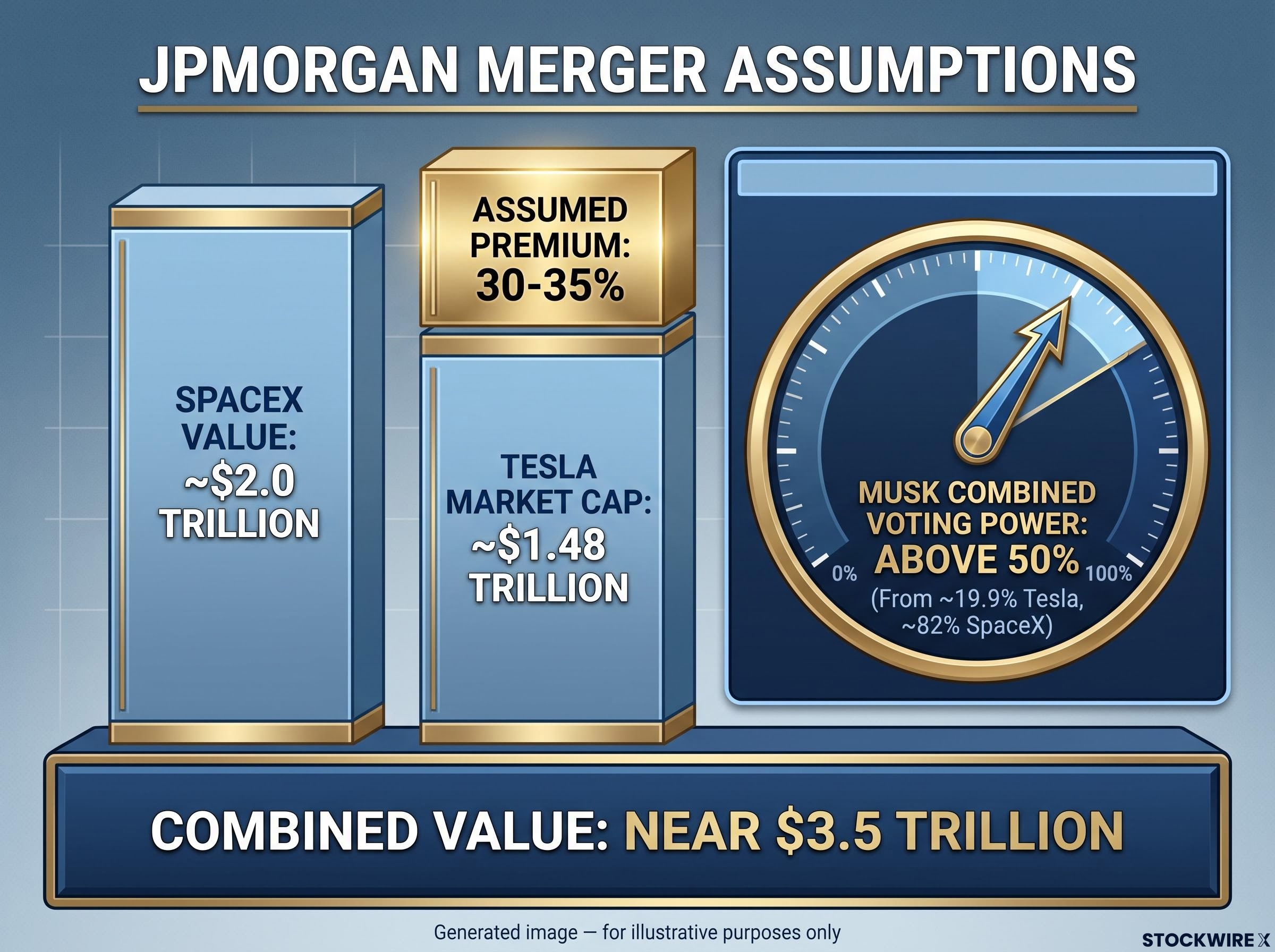
The premium range points to a merger-of-equals shape, and that shape carries the real consequence. In Gupta’s framework, Musk would stay above 50% of the combined group’s voting power.
His June option exercise fits that reading. Tesla issued him about 286.43 million restricted shares that carry votes now but vest in January 2028, and JPMorgan interprets the move as preparation for a vote.
Why the committees matter
Musk sits on both sides of any negotiation. He runs Tesla, holds about a fifth of its vote and controls SpaceX, which creates an incentive to favour terms that suit SpaceX.
Elon Musk on the talks Musk said the committees have not agreed on terms and there is no guarantee a deal will happen.
The independent committees exist to negotiate without him, test whether the exchange ratio is fair, hire independent advisers and build a record that conflicts were addressed. Ties already run deep: SpaceX has bought Tesla Megapacks and Cybertrucks, and Tesla invested $2 billion in xAI, now part of SpaceX. No named proxy adviser or securities lawyer has publicly weighed in yet.
The independent board committees at both companies were confirmed on 20 October, and their work on exchange ratio fairness and conflicts will shape whether any proposal ever reaches a Tesla shareholder vote.
In an all-stock deal, the exchange ratio and Musk’s voting position decide what you actually own afterwards. Judge any offer on ratio fairness and governance, not on the headline premium.
How should investors weigh the strategic case against the risks?
The bull case deserves a fair hearing. Musk and JPMorgan point to shared engineering talent, common AI infrastructure, overlapping robotics and autonomy work, and the planned Terafab chip facility in Texas, alongside SpaceX’s mass-to-orbit and satellite connectivity.
Each strength has a matching risk, and which one matters depends on what you hold.
| Perspective | Case for | Main risk |
|---|---|---|
| Strategic | Vehicles, robotics and AI joined to launch and connectivity | A sprawling group that may be hard to integrate |
| AI and Terafab | Shared compute and supply-chain control | Capital absorbed by AI spend; overruns and export controls |
| Tesla holder | Access to SpaceX and xAI assets | Loss of pure-play EV and robotics exposure |
| SpaceX holder | Tesla manufacturing, batteries and autonomy | Inheriting auto economics and China exposure |
| Governance and regulatory | Committees and a separate vote as safeguards | Musk concentration across Tesla, SpaceX, xAI and X; China remedies |
The research has limits worth naming: the primary JPMorgan note is not public, the China EBIT share is unquantified, and every figure reflects information available as of 21 October 2026. Watch for:
- committee outcomes or any recommendation on terms
- a proxy filing that sets out a merger vote
- signals on how Tesla might structure its China business
Ask yourself whether your position is a bet on the EV business, on Musk’s AI ambitions, or both. The answer tells you which row of that table to read first.
The merger has become a mainstream institutional investment narrative, with some allocators holding Tesla largely for the SpaceX link, so a China-driven stall would hit more than the earnings base.
What the China question changes, and what it does not
The shareholder vote is hard but visible. China is less predictable, and it could force a restructuring of the business that generates a large share of Tesla’s profit. The strategic logic of combining the two companies stands or falls independently of both hurdles.
Every term discussed here remains a JPMorgan assumption, and Musk has been clear that nothing is agreed. That argues for patience over prediction.
Before changing a position, track committee developments and any sign of how a Chinese structure might look, and size your holding to the uncertainty rather than to the headline.
This article is for informational purposes only and should not be considered financial advice. Investors should conduct their own research and consult with financial professionals before making investment decisions. Past performance does not guarantee future results, and the projections and forward-looking statements discussed are speculative and subject to change.