Earnings season has a way of exposing the gap between what a business is actually worth and what the market is willing to pay for it on any given morning. When guidance lands even slightly below inflated expectations, the selling can be indiscriminate.
That gap widened sharply across August and September 2026, when three of the most closely watched names on the Australian technology and infrastructure roster suffered brutal double-digit sell-offs immediately after posting their full-year figures.
PEXA Group, Seek, and SiteMinder each shed a significant chunk of their market value in a matter of days. Local investors who had held these positions through prior volatility were left staring at losses and asking whether something had fundamentally broken.
According to research house Morningstar, the answer is no. Its analysts have kept high fair value estimates in place across all three, arguing the market has confused temporary pain with permanent damage.
What follows is a framework for telling those two things apart. This covers why each of these heavily discounted businesses fell, what Morningstar sees that the broader market appears to be missing, and where the genuine risks still sit for undervalued ASX shares that carry an economic moat.
How Morningstar separates cyclical noise from structural decline
The starting point for Morningstar’s contrarian calls on all three stocks is a single concept: the economic moat.
An economic moat is a durable competitive advantage that protects a company’s profits from rivals over long periods. Think of it as the structural reason a business can keep earning strong returns while competitors struggle to catch up. Morningstar grades these advantages as wide, narrow, or none.
Morningstar formalised economic moat sources into five distinct categories, including network effects, switching costs, and efficient scale, with businesses that combine multiple reinforcing sources considered materially more durable than those relying on a single driver.
This distinction matters enormously during earnings volatility, because a moat is what allows a business to absorb a temporary shock without losing its long-term earning power. A regulatory review or a soft year of demand dents the near-term numbers. It does not necessarily dismantle the advantage underneath.
High-quality, cash-generative technology franchises are especially vulnerable to being punished when a single growth metric stumbles. The market tends to extrapolate one weak quarter of guidance into a permanent trajectory, pricing in a worst-case scenario overnight.
Morningstar’s methodology works in the opposite direction. Its analysts model a company’s cash flows across an explicit 10-year forecast period, which means one disappointing year of guidance carries far less weight in the valuation than a wholesale change to the business model.
Recent history offers a cautionary tale for anyone who sold in a panic. Between August 2025 and March 2026, the S&P/ASX 200 Information Technology Index endured a punishing 48% drawdown, a stretch some analysts have referred to as a “SaaSpocalypse.” Profitable, cash-generative software names were dumped alongside their unprofitable peers, then rebounded strongly once fundamentals reasserted themselves and sentiment normalised.
All three companies profiled here carry either a narrow or wide moat rating, which is precisely why Morningstar is willing to look past the near-term wreckage.
| Company | ASX Ticker | Close Price (11 Sept 2026) | Morningstar Fair Value | Moat Rating |
|---|---|---|---|---|
| PEXA Group | PXA | $6.80 | $10.50 | Wide |
| Seek | SEK | $12.39 | $25.00 | Narrow |
| SiteMinder | SDR | $2.71 | $7.50 to $11.00 | Narrow |
The difference between the two moat grades comes down to durability:
- Wide moat: A competitive advantage Morningstar expects to persist for at least 20 years, typically underpinned by structural factors like a monopoly position or entrenched network effects.
- Narrow moat: A defensible but less durable edge, expected to hold for around 10 years, where competitive pressure remains a realistic long-term threat.
Understanding whether a sell-off reflects a temporary guidance downgrade or a genuinely broken business gives you the confidence to hold, or add to, quality assets while the rest of the market is heading for the exit.
When big ASX news breaks, our subscribers know first
PEXA Group and the anatomy of a regulatory panic
PEXA’s full-year numbers were, on their own terms, perfectly healthy. For the 12 months to 30 June 2026, revenue rose 7% to $406.9 million, while free cash flow jumped 39% to $93.5 million. Full-year EBITDA from continuing operations climbed 12% to $152 million.
None of that mattered to the market. PEXA shares fell roughly 17% in the wake of the results, as investors fixated on a cautious outlook and a growing regulatory shadow.
The IPART regulatory threat
The trigger was FY27 guidance that pointed to transfer volumes declining by 10% to 15%, dragging EBITDA down around 14% to approximately $130 million at the midpoint.
Layered on top of that soft outlook is a specific regulatory threat. In New South Wales, the pricing regulator IPART released a draft report proposing to cut PEXA Exchange’s regulated revenue requirement by about 20% from 1 July 2027. The mechanism would be one-off reductions of roughly 33% to 36% to single and multiple-title transfer transaction fees.
PEXA has pushed back on the regulator’s approach.
PEXA has argued that its cost base is not being calculated correctly, and that any pricing determination must account for the sharp fall in transfer volumes already flagged in its own guidance.
This is where the moat reasserts itself. PEXA operates a natural monopoly over Australia’s property settlement exchange, the kind of entrenched position that has historically weathered regulatory resets and returned to intrinsic value once the new pricing regime is fully understood.
PEXA’s monopoly position was further reinforced in March 2026 when ARNECC announced it would not proceed with the Interoperability Program, eliminating the most credible near-term competitive threat to its 90% share of Australian property settlement volumes.
Morningstar’s read is that the market has overcorrected. Its analysts revised their near-term volume decline forecast from 5% to 8%, but still expect transfer volumes to recover to prior baseline levels by FY30, drawing a parallel to a comparable housing correction previously seen in New Zealand. In their view, the housing volume recovery eventually offsets the regulated fee cuts.
The proposed New South Wales cuts show you exactly how regulatory risk materialises in a monopoly business. The judgement you have to make is whether that risk permanently impairs the franchise, or whether property settlement volumes simply revert to their long-run average, as Morningstar expects.
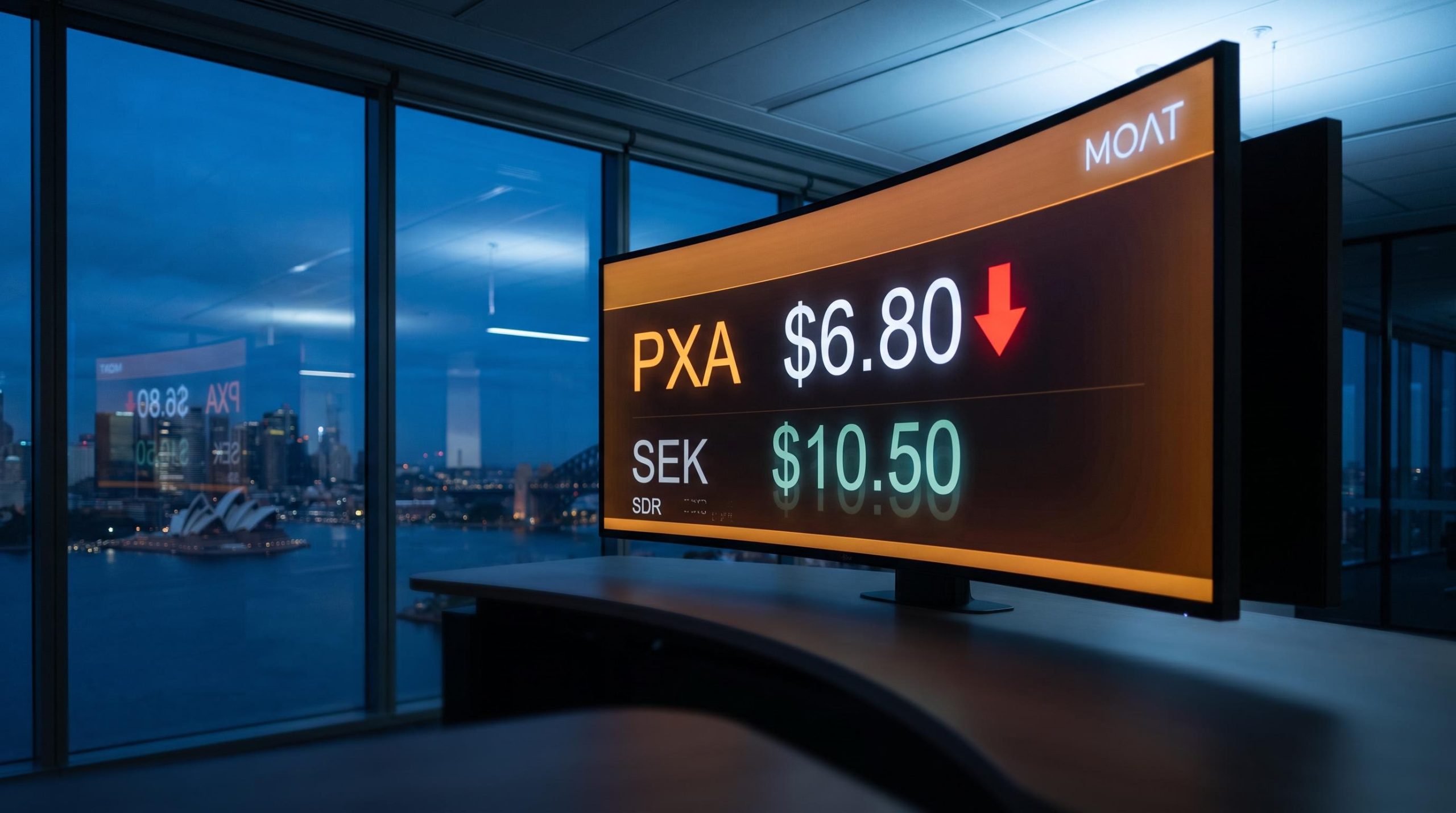
The valuation gap frames the stakes. At a market price of $6.80 against a fair value estimate of $10.50, the shares trade at roughly a 35% discount. The question is whether that 17% post-earnings fall represents genuine capital destruction or a temporary mispricing of a wide-moat monopoly.
Seek and the debate over artificial intelligence disruption
On the surface, Seek’s reaction looked like a straightforward miss. Dig into the results, and the picture becomes far more interesting.
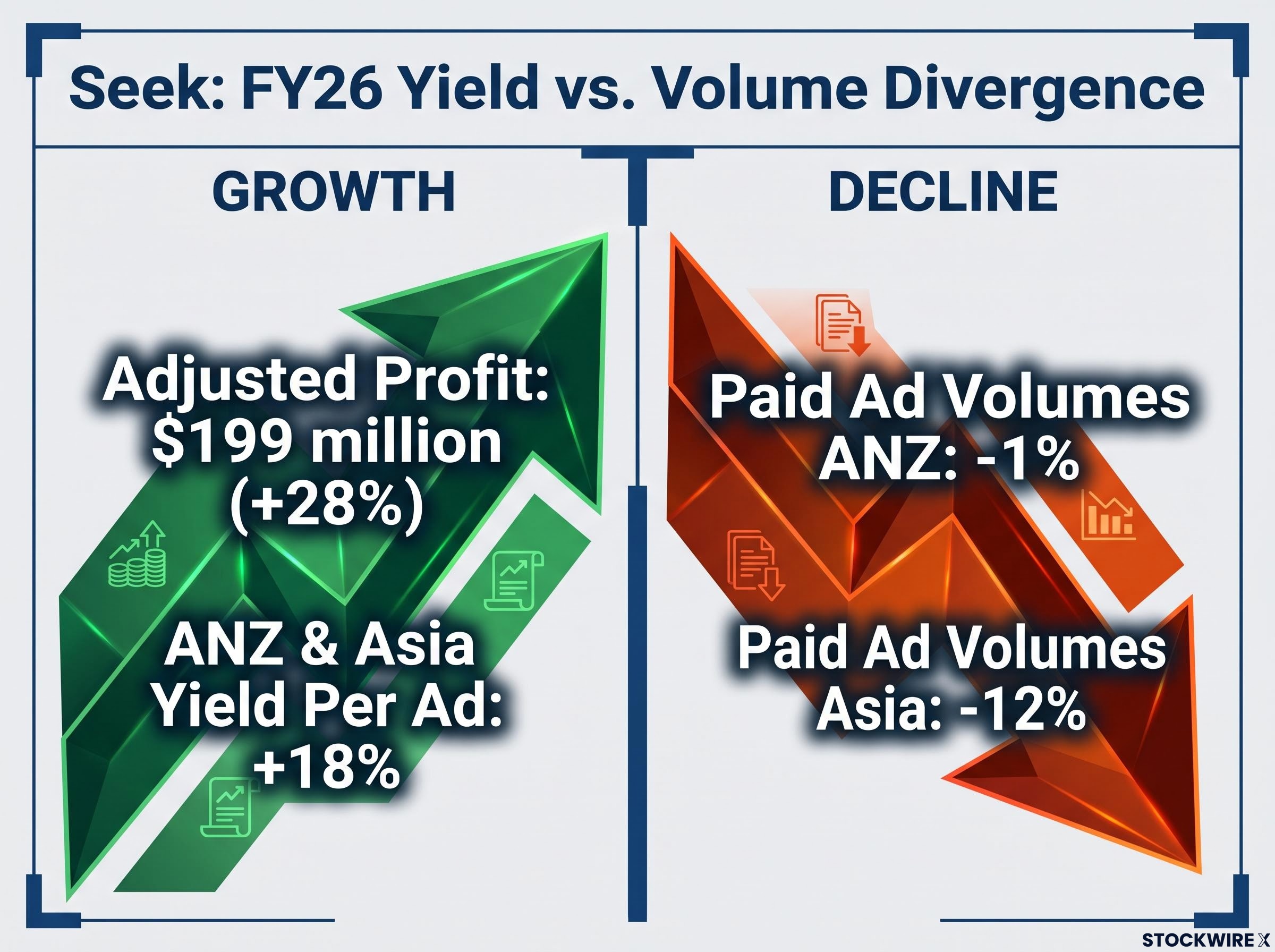
For the year to 30 June 2026, adjusted profit rose 28% to $199 million, and the yield per advertisement across ANZ and Asia climbed 18%. That yield strength is the crux of Morningstar’s thesis, because it shows employers are still paying more for each listing even as the number of listings falls.
The volume figures explain the market’s nerves. Paid ad volumes slipped 1% in ANZ and fell a more alarming 12% in Asia. When FY27 revenue guidance landed at just 5% growth (a range of $1,210 million to $1,280 million), it fell dramatically short of the 14% acceleration Morningstar had previously modelled.
The shares dropped roughly 14% in response, leaving them at a 40% to 50% discount to Morningstar’s $25.00 fair value estimate.
The real argument among analysts is about what those falling volumes actually mean. One camp sees a normal cyclical hiring cooldown. The other worries about permanent structural decline driven by new competition. The two views lead to wildly different conclusions:
- The bearish AI view: Artificial intelligence disintermediates job boards entirely, or drives structurally higher unemployment that permanently shrinks listing volumes, eroding Seek’s core market.
- Morningstar’s bullish AI view: As employers drown in high volumes of AI-generated, low-quality applications, a platform that can use AI to surface genuinely suitable candidates becomes more valuable, not less. It is a capability employers will pay a premium for.
Morningstar attributes Seek’s weakness to temporary cyclical factors, contrasting a cooling public sector hiring cycle in Australia against the strong AI-sector hiring lifting US rival Indeed. Its analysts expect yield to keep growing at a high single-digit rate on continuing efficiency gains.
The divergence between falling volumes and rising yields tells you something important about where the value sits. Employers are still willing to pay up for quality candidate matching, which means the investment case here rests on pricing power rather than on a booming job market. If that pricing power holds, the volume story becomes a cyclical footnote rather than the main event.
SiteMinder and the cost of resetting growth expectations
SiteMinder was punished for a very specific sin: it walked back its most ambitious target. Nothing in the underlying results suggested the business was faltering.
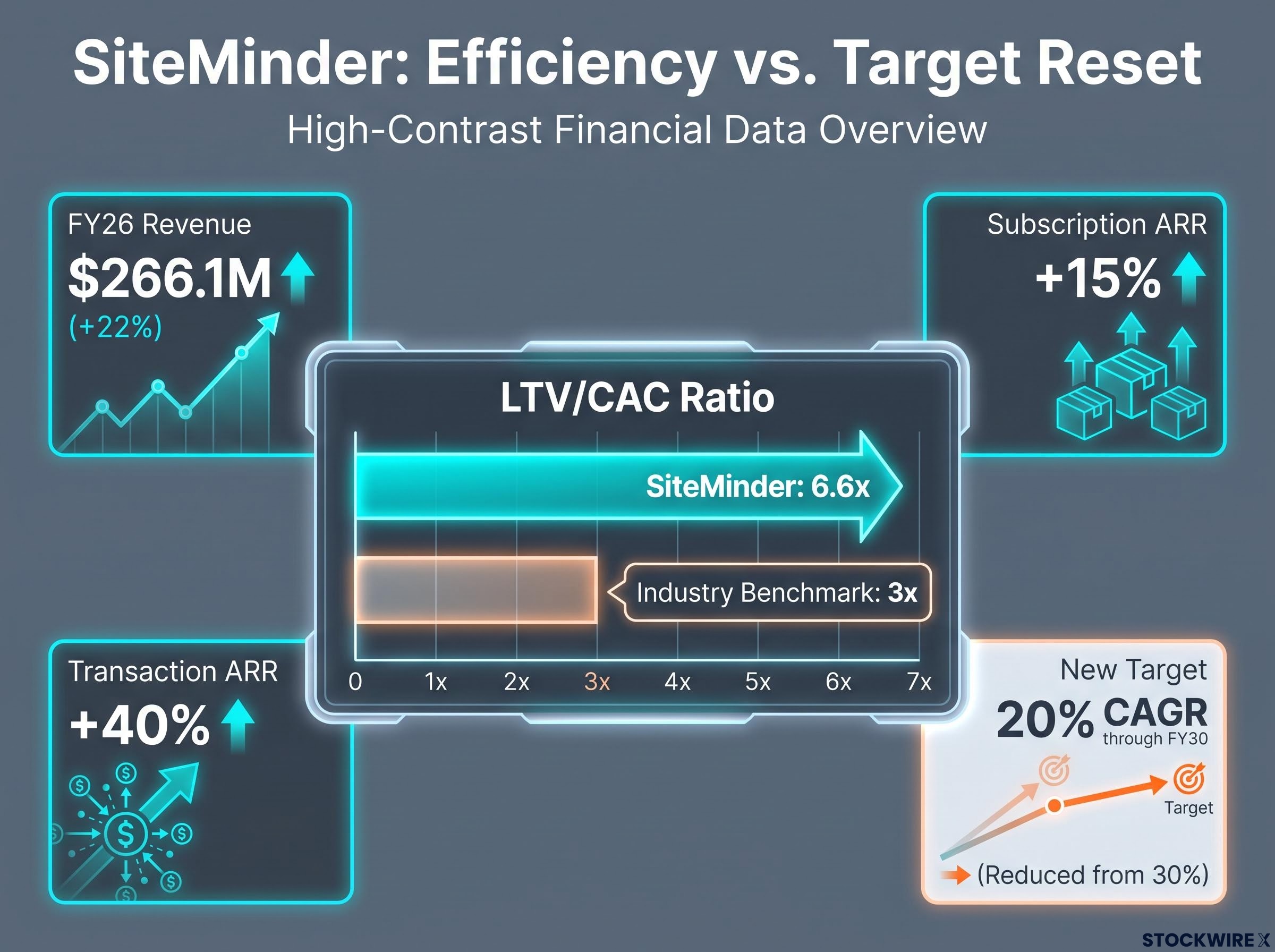
The FY26 numbers were, if anything, strong. Constant-currency revenue grew 22% to $266.1 million, up from 19% the year before. Subscription annual recurring revenue rose 15%, while transaction annual recurring revenue surged roughly 40%.
Customer acquisition efficiency remained the standout. SiteMinder’s lifetime value to customer acquisition cost (LTV/CAC) ratio, a measure of how much profit each customer generates relative to the cost of winning them, sits at 6.6 times. That is more than double the industry benchmark of 3 times, and it points to genuinely efficient growth economics.
Execution risk and the Smart Platform pivot
The sell-off, a fall of nearly 15%, was triggered by management withdrawing its previous medium-term goal of accelerating revenue growth to 30%. In its place came a target of at least a 20% compound annual growth rate through FY30, with adjusted EBITDA margins projected to reach the mid-20% range by then.
The irony is that Morningstar never expected the business to hit 30% in the first place, having modelled a peak in the mid-20s. Even so, its analysts treated the revision as a net negative and trimmed their own forecast to a 16% revenue CAGR across the explicit 10-year window.
The bigger concern sits with execution and disruption risk. As SiteMinder pivots toward transaction-based revenue through its Smart Platform, the business is changing shape in ways that carry real uncertainty. There is also the sector-wide fear that large online travel agencies and AI-enabled search could eventually bypass traditional channel managers and commoditise SiteMinder’s core software.
That combination pushed Morningstar to lift its Uncertainty Rating on the stock from High to Very High, though its analysts still regard the negative AI narratives as overdone and see no large-scale disintermediation on the horizon.
For long-term holders, the two signals need to be weighed together. Management pulling back from its 30% ambition is a clear flag of near-term caution. A LTV/CAC ratio of 6.6 times tells you the underlying engine remains exceptionally profitable, which is why Morningstar’s fair value range of $7.50 to $11.00 sits so far above the $2.71 close on 11 September 2026.
Looking past the near-term earnings noise
The common thread linking PEXA, Seek, and SiteMinder is that each faced a specific, identifiable near-term headwind that triggered an immediate valuation reset. A regulatory review, a cyclical hiring cooldown, and a walked-back growth target are very different problems, but the market treated all three the same way: sell first, ask questions later.
Morningstar’s central argument rests on history. Wide and narrow moat businesses have repeatedly recovered strongly once temporary regulatory, cyclical, or guidance shocks are fully digested, converging back toward their intrinsic value rather than staying permanently depressed.
A margin of safety framework calibrated to business quality, requiring a steeper discount for cyclical or leveraged businesses and a narrower one for high-moat, predictable cash generators, is exactly the lens through which the discounts on PEXA, Seek, and SiteMinder translate into a potential buying opportunity rather than a value trap signal.
That does not make any of these a certainty. The IPART cuts could bite harder than expected, Seek’s Asian volumes could prove structural, and SiteMinder’s Very High uncertainty rating exists for a reason. The task for investors is to weigh those steep discounts against the explicit risks laid out here, rather than against the raw shock of the price drop.
For investors wanting to build a systematic process around quality and valuation, our dedicated guide to moat-focused investing on the ASX covers how the VanEck Morningstar Wide Moat ETF combines a quality screen with a valuation discipline, buying wide-moat companies only when they trade at a discount to fair value.
This article is for informational purposes only and should not be considered financial advice. Investors should conduct their own research and consult with financial professionals before making investment decisions.
Past performance does not guarantee future results. Financial projections are subject to market conditions and various risk factors, and forward-looking statements are speculative and subject to change.