#
Saudi Arabia woke on Monday with no functioning oil export pathway. Houthi forces sealed off the Bab el-Mandeb strait, and diplomatic talks over the Strait of Hormuz collapsed before they began.
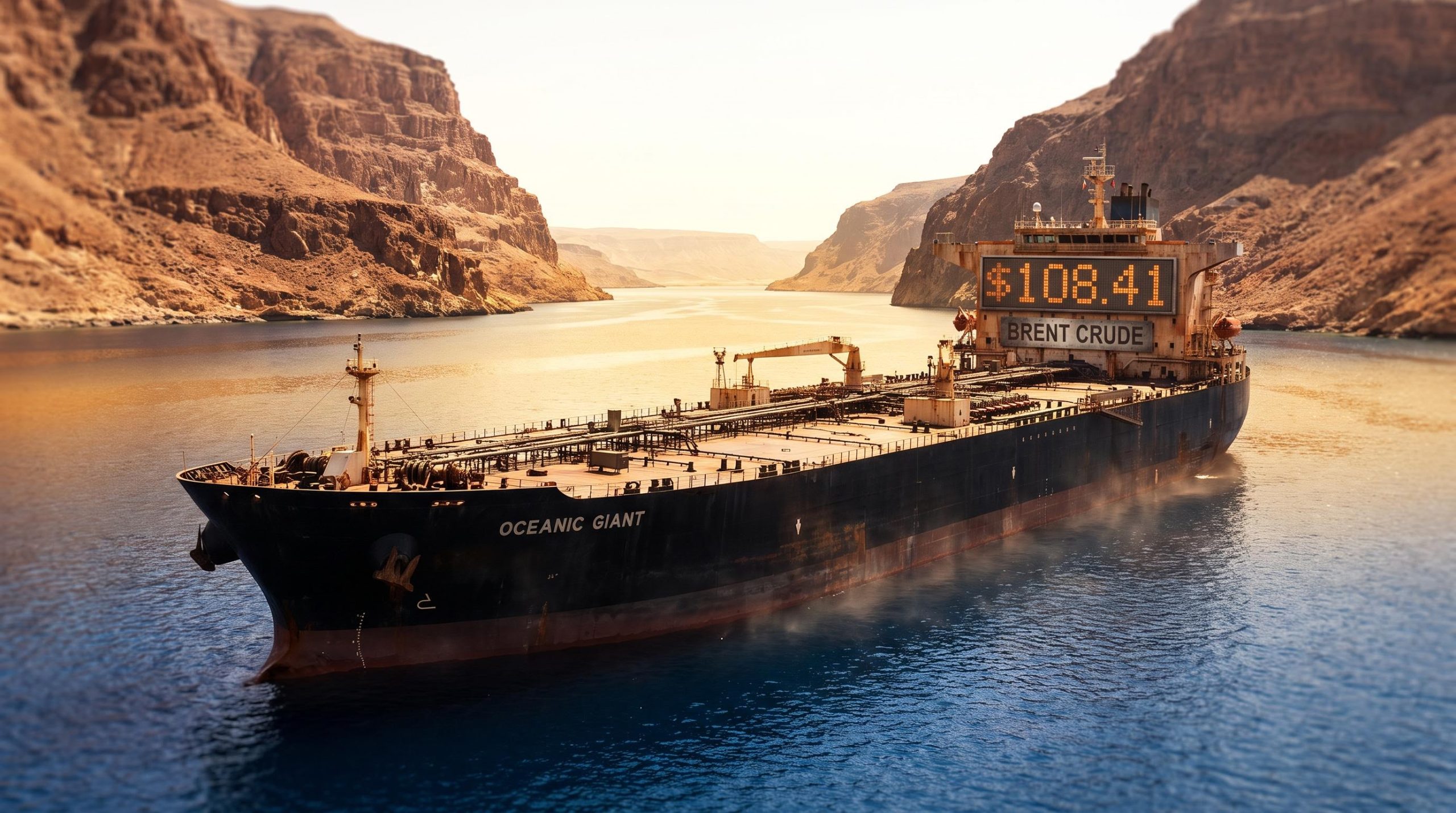
Brent crude surged 3.5% to an intraday high of $108.41 per barrel on 14 September 2026, the latest move in a crisis that has carried oil from roughly $66 in March to triple digits today. The simultaneous disruption of both major Gulf export corridors is without precedent in the current conflict, and the indefinite postponement of Iran-Gulf negotiations removes the only near-term diplomatic off-ramp that markets had priced in.
Here is what the closure of both corridors actually means for crude supply, and what the analysts most closely watching this situation are projecting.
Saudi Arabia’s last oil escape route just closed
Since the Strait of Hormuz was heavily restricted on 2 March 2026, Saudi Arabia has leaned on a single workaround to keep crude moving. The East-West pipeline, running from the eastern oilfields across to the Red Sea port of Yanbu, carried roughly five million barrels per day and effectively bypassed the eastern chokepoint entirely.
The Hormuz shipping crisis had already reduced commercial transits to just 3-14 vessels per day against a pre-war baseline of 120-140, with war-risk insurance running at approximately 30 times normal rates, conditions that made the East-West pipeline bypass load-bearing for global supply well before today’s shutdown.
That bypass is now gone.
Saudi Arabia confirmed it shut down the East-West pipeline after a fresh round of Houthi missile and drone strikes on Aramco infrastructure. With the Bab el-Mandeb strait blockaded and the pipeline offline, the western route that had been absorbing displaced Hormuz flows no longer functions.
The attacks that forced the shutdown have been building for months. Confirmed Houthi strikes on Aramco facilities span July through September 2026 and targeted:
- Aramco facilities in Abha and Najran (southern Saudi Arabia)
- The Jazan refinery and Jazan City industrial complex
- Energy installations at Yanbu on the Red Sea coast
The campaign also reached shipping. On 24 August 2026, the Houthis fired a ballistic missile at the Bahri-operated supertanker “Amzan” in the Red Sea, a vessel capable of hauling two million barrels of crude. All crew were reported safe.
ANZ analysts assessed that Saudi Arabia has lost its western export alternative, characterising the development as likely to sustain upward momentum in oil prices in the near term. That assessment is the structural fact underneath today’s price move.
What it means for you is straightforward. The closure of the East-West pipeline leaves Saudi Arabia with effectively no functioning export corridor on either its eastern or western flank. This is a physical supply constraint that rerouting alone cannot resolve, which is why today’s spike reads as consequence, not sentiment.
When big ASX news breaks, our subscribers know first
How Brent got to $108: a crisis that has been building since March
Today’s number did not arrive out of nowhere. It sits at the end of a six-month escalation sequence, and the shape of that path matters more than the single figure.
When Hormuz was first restricted on 2 March 2026, transit volumes collapsed and Brent leapt from roughly $66 to around $121 per barrel. As alternative routes and partial supply adjustments took hold, prices eased back to about $97 during an interim reopening, then settled further. By mid-August, CNBC reported Brent at $89.07 and WTI at $82.57, with trading dominated by Hormuz shipping concerns and stalled diplomacy.
Then the Bab el-Mandeb blockade and the collapse of talks reversed that moderation.
| Date | Brent Price | Key Driver |
|---|---|---|
| 2 March 2026 | $66 to $121 | Hormuz heavily restricted |
| Interim period | ~$97 | Partial reopening, rerouting |
| Mid-August 2026 | $89.07 | Hormuz concerns, stalled diplomacy (CNBC) |
| 14 September 2026 | $108.41 | Bab el-Mandeb blockade, talks postponed |
The projections split across a wide range. Goldman Sachs has flagged that unless exports through Hormuz restart, the market could be heading toward $120 by year-end, with a full-closure scenario modelled at $100 to $150 per barrel. Consultant Paisie, cited by Reuters, put Brent at $115 to $120 if Bab el-Mandeb flows are shut, as refiners compete for limited supply and freight and insurance costs climb.
Capital Economics sits at the other end, projecting the low-$90s even without a Hormuz disruption, reflecting a view that demand growth, high interest rates, and rerouting options temper the upside.
The escalation path tells you something the headline figure alone does not. Markets have already absorbed and partially discounted this crisis once, easing Brent from $121 back to the high-$80s. That means today’s spike reflects a genuinely new development rather than the same risk being repriced, which is the distinction that separates a durable supply signal from a precautionary premium that could unwind.
Goldman Sachs estimates approximately $14 per barrel of the current crude price is a geopolitical risk premium rather than a reflection of underlying supply and demand fundamentals, a figure that can collapse within 24 hours of a credible de-escalation signal and that sets the ceiling on how much price relief a diplomatic breakthrough would deliver.
Why two closed corridors are worse than the sum of their parts
Each of these chokepoints does a different job, and understanding the division of labour is the key to reading the current price floor.
Hormuz is the primary eastern gateway through which Gulf producers ship crude to global buyers. Bab el-Mandeb links the Red Sea to Europe and beyond, and it was the alternative route that softened Hormuz’s impact through the spring and summer. The East-West pipeline fed crude to Yanbu, and Bab el-Mandeb carried it onward.
That is why the second closure does not simply double the problem. It removes the buffer that made the first one manageable.
A Northeastern University commentary described a Bab el-Mandeb blockade as a “Strait of Hormuz redux,” arguing that coordinated closure of both chokepoints produces a “correlated global supply chain crisis” involving higher energy prices, elevated freight costs, and inflation. The adaptation mechanisms that worked for one closed strait are not sufficient for both at once.
The IEA Oil Market Report for September 2026 explicitly flags the protracted diplomatic standoff and renewed attacks across both the Gulf and Bab el-Mandeb chokepoint as the central variables driving its supply and price forecasts, lending institutional weight to the dual-corridor disruption thesis.
The workarounds that remain each carry a limitation:
- Rerouting tankers around Africa: adds significant voyage time and cost per shipment
- Greater use of the SUMED pipeline: capacity is finite and cannot absorb full Gulf volumes
- Reliance on non-Gulf producers: limited spare capacity to offset displaced barrels
- Strategic petroleum reserve releases: a short-term measure, not a structural fix
IMF commentary cited by CES Intelligence notes that while producers can begin rerouting within days, it may take weeks for alternative routes to fully absorb displaced flows. That gap between fast start and slow absorption is where the price pressure lives.
“The risk of deeper disruption and shortages against the possibility of a resolution where the Strait of Hormuz is reopened and oil prices fall sharply,” said Bjarne Schieldrop, analyst at SEB, describing how markets were pricing dual scenarios in mid-August.
Here is what this framework gives you. The competing analyst forecasts differ less on demand and more on how quickly alternative routes can absorb millions of barrels per day. The workarounds that kept Brent in the high-$80s are no longer available simultaneously, which means the floor under current prices sits higher than the market experienced across the April to August window.
Talks postponed indefinitely: what the diplomatic collapse means for resolution
The one release valve markets had priced in disappeared on Sunday.
Oman’s Foreign Minister Sayyid Badr Albusaidi confirmed on 13 September 2026 that the meeting scheduled for the following day in Salalah, intended to discuss a temporary shipping lane through Hormuz, had been postponed indefinitely. He stated the delay was made “in the interests of consensus.” Iran’s state news agency IRNA reported the postponement came at the request of regional countries.
This is not the mere absence of good news. It reverses an assumption markets had already built in.
Prior word of the scheduled meeting had moderated oil’s weekly gains, as investors bet that negotiations could ease supply concerns. The postponement pulled that assumption back out, and the price responded accordingly.
Diplomatic resolution scenarios have repriced Brent both directions throughout this conflict: the May 2026 episode where crude fell nearly 5% on deal optimism before Reuters characterised negotiations as near collapse illustrates the pattern the current market is repeating, with prices adjusting to anticipated agreements before the underlying conditions exist.
What no replacement date means for the risk premium
The Oman Foreign Ministry framed the delay as an effort to ensure “appropriate conditions for a constructive dialogue,” and stressed that Muscat remains committed to promoting talks. The meeting has been delayed, not cancelled outright.
But no replacement date has been announced. That single fact is the operative one.
For anyone positioning around a diplomatic resolution as the most likely near-term scenario, the timeline has now been removed. The geopolitical risk premium built into current oil prices has no identified exit date, which changes how you should think about position duration in energy markets. Prices are unlikely to fall sharply in the short term, even if they may ease over a longer horizon, because the Hormuz waterway is expected to remain disputed with no scheduled path to a settlement.
What changes from here, and what does not
The structural position as of 14 September 2026 is clear. Brent sits at $108.41, both major export corridors are disrupted, Saudi Arabia’s East-West pipeline shutdown is confirmed, and there is no diplomatic timeline for Hormuz.
What is uncertain is which analyst scenario materialises, and that depends on variables that are not yet resolved. Goldman Sachs sees a $120 year-end trajectory without a Hormuz restart, while Capital Economics sees the low-$90s if adaptation proceeds smoothly. The gap between those two is wide because the outcome hinges on developments that remain open.
For prices to ease materially, one of three things would need to change:
- A negotiated reopening of Hormuz, which requires Oman-mediated dialogue to resume and produce an agreement.
- A de-escalation of Houthi activity in the Bab el-Mandeb strait, reopening the western corridor.
- A significant scaling of alternative supply routes, which IMF commentary suggests could take weeks to fully absorb displaced flows.
The read you should take is that waiting for the next signal from Oman is more informative than reacting to daily price moves. Oman has stated it remains committed to dialogue, which preserves optionality for a downward revision, but until a replacement meeting date appears, the bull case ($100 to $150 Brent) and the bear case (low-$90s on adaptation) both remain live. Monitor the diplomatic track, OPEC+ production decisions, and whether African rerouting absorbs flows fast enough to restrain freight and insurance costs.
For investors tracking how triple-digit Brent translates into sector-level exposure, our deep-dive into downstream supply impacts covers jet fuel loadings, cost pass-through into consumer goods earnings, and which equity categories faced the first wave of margin compression as crude sustained above $100.
This article is for informational purposes only and should not be considered financial advice. Investors should conduct their own research and consult with financial professionals before making investment decisions. Past performance does not guarantee future results. Financial projections are subject to market conditions and various risk factors, and forward-looking statements are speculative and subject to change based on market developments.