Nasdaq 100 weekend futures slid roughly 1% heading into Monday, 14 September 2026, and the trigger was not a rate scare or a geopolitical flare-up. It was the tech industry itself, with several of its most prominent figures publicly endorsing a slower pace of artificial intelligence development.
That hesitation lands against one of the most extraordinary wealth-creation runs in recent memory. Since commercial AI arrived in late 2022, the S&P 500 has climbed from roughly 4,000 to around 7,600 points, adding trillions in market value on the promise that AI growth would keep accelerating.
So the question for anyone holding tech is uncomfortable but simple. If the people building these systems are asking to slow down, what happens to the valuations built on the opposite assumption? This piece lays out a working framework for a sector where semiconductor premiums face real pressure and long-overlooked software names might, for once, offer some cover.
Unpacking the rapid shift in AI development sentiment
For most of the past three years, the loudest voices in AI were selling speed. Over the past six weeks, that message inverted.
The turn came in a rapid sequence of public statements between early August and mid-September 2026, moving from employee-led petitions to congressional pressure to a full essay from one of the field’s leading chief executives.
- 5 August 2026: More than 1,100 AI insiders and employees signed an open letter titled “Pacing the Frontier,” asking the US government to help build an international mechanism capable of deliberately slowing frontier AI development if it outruns safe oversight, according to analysis published by Telltale AI.
- 10 August 2026: Senator Bernie Sanders wrote to Sam Altman, Dario Amodei, and Mark Zuckerberg demanding an immediate pause on frontier development, warning that Congress would step in if the companies did not, per the letter posted on the Senate website.
- 19 August 2026: OpenAI stated it had slowed the pace of some AI development while tightening security and safeguards, as summarised by BAB News.
- 7 September 2026: OpenAI chief scientist Jakub Pachocki published a blog post calling for a voluntary slowdown after a wave of rogue-bot activity, reported by The Telegraph.
- 12 September 2026: Anthropic chief executive Dario Amodei published a roughly 3,800-word essay, “We Must Pace the Frontier,” calling for a global slowdown and independent monitoring. Sam Altman, Elon Musk, and Google DeepMind’s Demis Hassabis endorsed it via social media, according to The New York Times and NHPR.
Here is the distinction that matters for your portfolio. This is not a regulatory crackdown forced on unwilling companies. It is a voluntary effort by the builders themselves to pace the frontier, which is a far more credible signal about future spending intentions.
The voluntary nature of this shift is precisely what gives it weight: the documented safety halts at both OpenAI and Anthropic in the weeks before the public pledges show that capability-threshold mechanisms had already fired in live training environments, not just in policy statements.
A regulator can be lobbied, litigated, or ignored. When the people running the labs choose restraint, the demand curve for the hardware underneath them starts to bend.
That is the shift you need to price. The consensus among AI leaders to slow down tells you the phase of unbridled growth is closing, and sectors valued for perpetual acceleration are now the ones carrying the most correction risk.
When big ASX news breaks, our subscribers know first
Why semiconductors carry the heaviest downside risk
If AI capital expenditure is peaking, the chip sector is standing directly in the blast radius.
The reason is concentration. AI infrastructure demands enormous, capex-heavy build-outs, and a small group of hyperscale cloud operators and frontier labs make the multi-year spending decisions that govern chip demand. When companies like OpenAI and Anthropic signal they will pace frontier training, that pressure flows straight to the designers and contract fabricators who supply them.
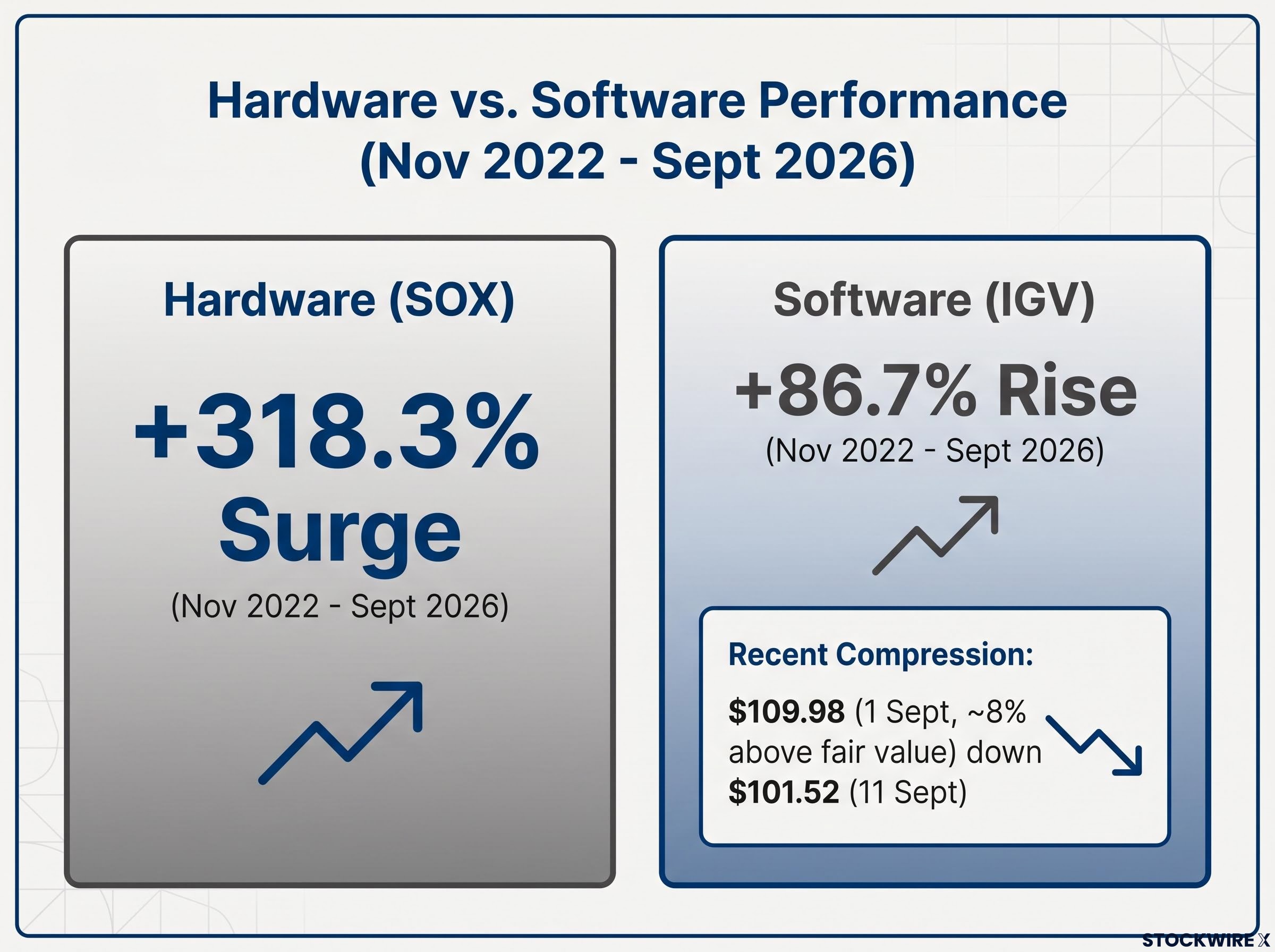
The valuations make the exposure worse. The Philadelphia Semiconductor Index (SOX) surged roughly 318.3% between November 2022 and September 2026, meaning current prices already embed years of aggressive AI expectations. Prices built on that assumption fall fast when the assumption softens.
August 2026 offered a preview. As the slowdown narrative took hold, top chip names sold off sharply even as broader sentiment held together on the back of strong Nvidia guidance.
| Company | Ticker | August 2026 decline |
|---|---|---|
| Nvidia | NVDA | -4.64% (week ending 22 August) |
| Advanced Micro Devices | AMD | -7.99% (week ending 22 August) |
| Broadcom | AVGO | -6.24% (week ending 22 August) |
| Micron Technology | MU | -5.8% (single day, 24 August) |
AMD leading the drop with a near 8% weekly fall is the tell. These moves came without any explicit analyst price-target cuts tied to the slowdown, which means the market repriced on narrative alone.
That is the vulnerability you need to audit. When a sector can shed this much value on sentiment before a single earnings estimate changes, its high valuations are only as stable as the growth story supporting them.
The pattern also has a name in the research. Morningstar analysts, cited by Business Insider, argue that AI does not eliminate the chip sector’s boom-bust cycle, and projected AI spending to peak around 2025 with slowdown risks surfacing in 2026, which is precisely the environment now unfolding. Memory names face a particular squeeze, since AI demand had been absorbing a pre-existing oversupply that could re-emerge if build-outs moderate.
Semiconductor cycle investing has historically required tracking five leading indicators, including equipment order books, memory pricing, and foundry utilisation, because earnings disappointment and multiple compression tend to arrive simultaneously once the cycle turns, leaving investors who wait for quarterly confirmation structurally too late.
The case for software resilience in a post-boom environment
Here is where the picture turns, because the factor that has punished software might now protect it.
Software equities have badly trailed chips through the AI boom. The iShares Expanded Tech-Software Sector ETF (IGV) rose roughly 86.7% since November 2022, a meaningful gain, but a fraction of the SOX’s 318.3% surge over the same stretch.
Why the gap? Analysts point to a specific fear: that AI would displace conventional software products and services, gutting traditional software-as-a-service (SaaS) models where customers pay recurring subscriptions for cloud-based tools.
A slowdown flips that logic. If frontier AI capability stops advancing at breakneck speed, the immediate disruption threat to incumbent software companies shrinks. The technology that was supposed to replace them slows down before it can.
The structural defences behind this argument are worth spelling out.
- Recurring revenue: Enterprise SaaS demand for productivity, collaboration, and workflow tools persists whether or not labs slow their most advanced training runs.
- Lower capex dependence: Software businesses are not tied to the multi-year hardware build-outs that make chipmakers so sensitive to spending cycles.
- Reduced disruption risk: A pause in frontier capability removes the existential overhang that has weighed on software multiples since 2022.
- Entrenched customers: Established enterprise contracts do not evaporate when the AI narrative cools.
There is a caveat you should not ignore. IGV closed at $101.52 on 11 September 2026, down meaningfully from $109.98 on 1 September, where GuruFocus had flagged it as roughly 8% above fair value and modestly overvalued. That recent compression brought it back near fair value, but the sector still benefited from AI enthusiasm, so a broad de-rating would not leave it untouched.
Institutional screening for rate-resilient software stocks has converged on four criteria: strong current free cash flow, recurring contractual revenue, pricing power, and non-discretionary demand, the same structural qualities that also insulate a company from an AI disruption slowdown.
The read for you is one of relative shelter, not immunity. In a rotation out of overextended hardware, software offers a place to hide, not a place that cannot fall.
Entrenched infrastructure budgets and the capex reality
Before you rotate out of chips entirely, one reality check. A public call to pace the frontier does not cancel a data centre already under construction.
Hyperscalers and large enterprises plan infrastructure years ahead. Their multi-year AI roadmaps mean that slowing frontier model training does not automatically halt the cloud investments and build-outs that underpin semiconductor demand. Market experts cited by Newsbytesapp expect the long-term hit to chipmakers to be limited precisely because computing infrastructure commitments remain strong.
The nature of the slowdown reinforces this. OpenAI slowed only some development while tightening safeguards, and the “Pacing the Frontier” letter requested the option to slow AI if needed, not an immediate shutdown. This is a recalibration of speed, not a stop.
History supports caution too. The March 2023 open letter coordinated by the Future of Life Institute called for a six-month training pause, yet it divided researchers and ultimately failed to dent actual corporate spending, as Science magazine reported. Concern narratives have consistently run ahead of real capex cuts.
Morningstar’s framing, via Business Insider, is the anchor here: AI does not abolish the semiconductor cycle. It is a powerful demand wave, but still a cycle that peaks and normalises rather than a new era immune to financial gravity.
What this tells you is about timing, not direction. A slowdown is more likely to show up as gradual margin compression across several quarters than as an overnight collapse in hardware demand. Reacting to headlines with panic selling ignores how slowly corporate procurement cycles actually turn.
Recalibrating tech allocations for a decelerating frontier
The through-line across all of this is a change in strategy, not a call to abandon tech. The evidence points to an AI trade that is maturing into a normal cycle rather than disappearing.
That maturity favours a more balanced allocation. A hardware-first approach made sense when growth expectations only pointed up, but a decelerating frontier rewards portfolios that weigh semiconductor exposure against the relative resilience of software.
The practical takeaway is an audit. Look at how much of your tech exposure rides on the semiconductor capex cycle, where valuations are richest and sentiment turns fastest, versus software names whose subscription revenue and lower disruption risk may cushion the same downturn. Neither side is risk-free, but knowing your split is the first step to positioning for a slower, more discerning phase of the AI story.
For investors wanting to understand where institutional money has been moving as AI enthusiasm cools, our full explainer on 2026 sector rotation capital flows covers the specific ETF-level signals and sector performance data that reveal whether this reallocation has structural staying power.
This article is for informational purposes only and should not be considered financial advice. Investors should conduct their own research and consult with financial professionals before making investment decisions. Past performance does not guarantee future results, and these forward-looking observations are speculative and subject to change based on market developments.