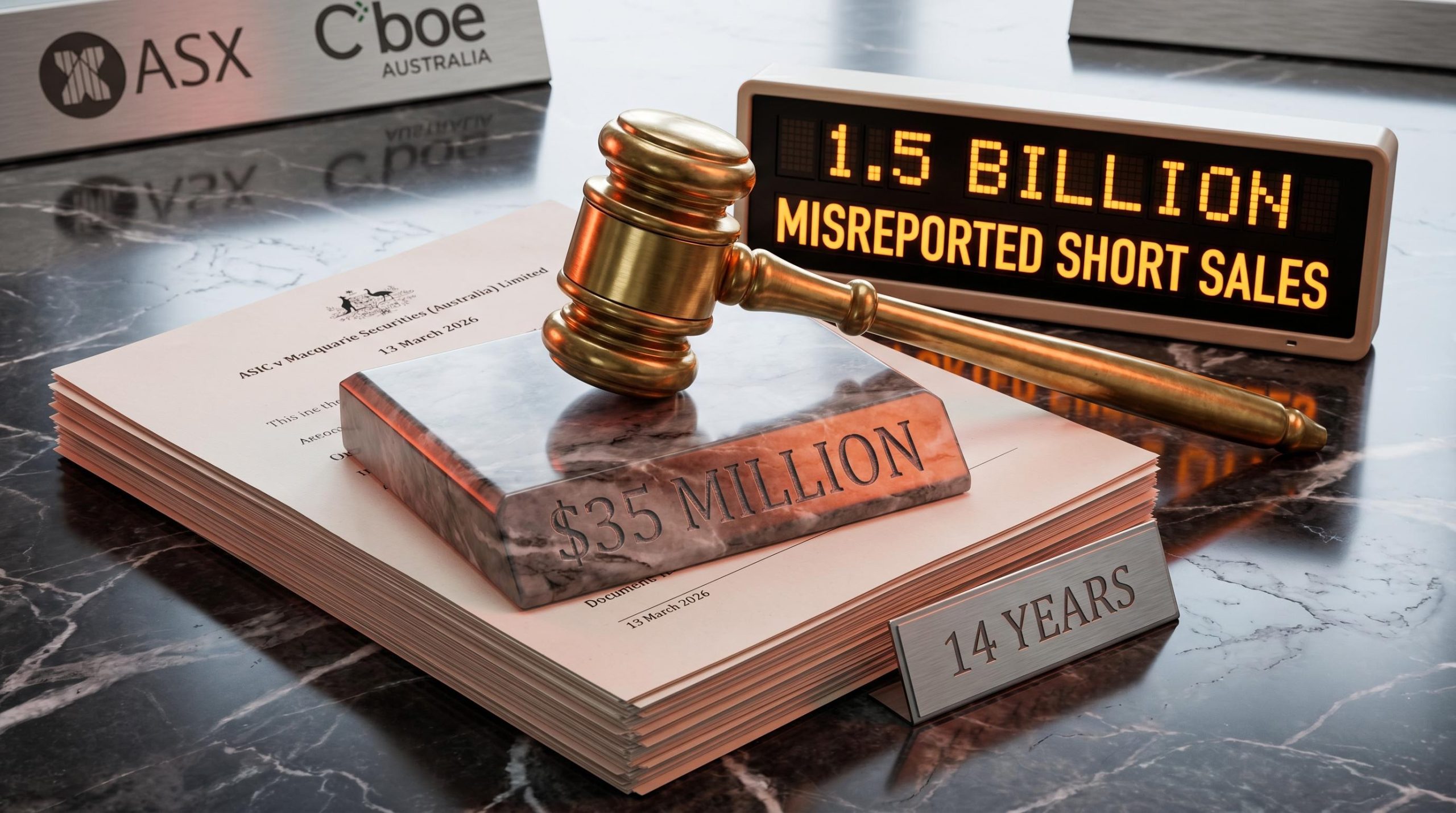
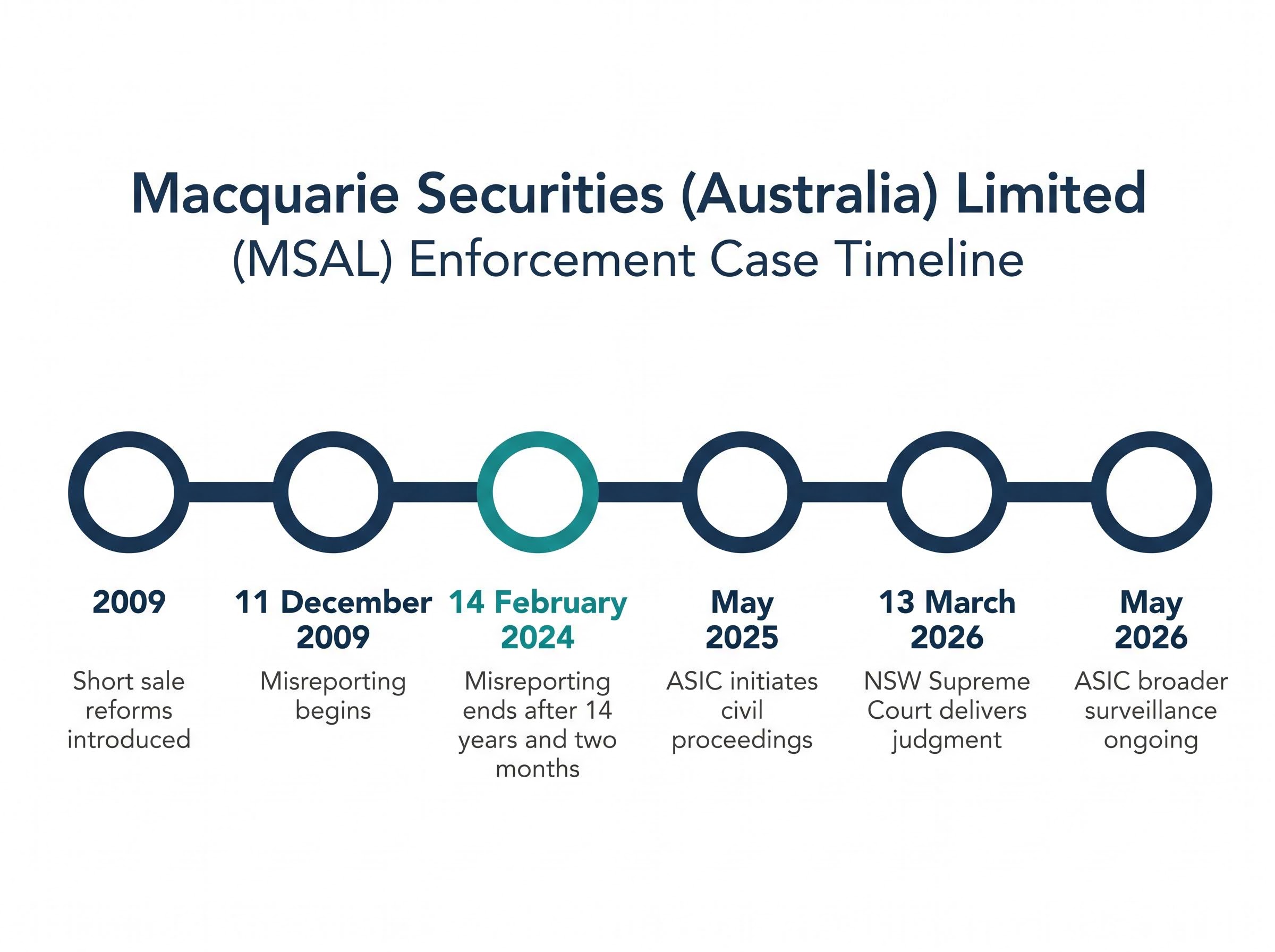
ASIC’s first short sale reporting enforcement action has concluded with a $35 million penalty against Macquarie Securities (Australia) Limited (MSAL), closing a case built on failures that persisted for more than 14 years and potentially encompassed 1.5 billion misreported transactions. The NSW Supreme Court delivered its ruling in In the matter of Macquarie Securities (Australia) Limited [2026] NSWSC 202 on 13 March 2026, roughly ten months after ASIC initiated civil proceedings in May 2025. The judgment is more than a headline figure. It is a declaration that systemic control failures at major market participants carry legal consequences, reputational costs, and ongoing remediation obligations.
What follows examines what the ruling actually established, why the failure persisted for so long despite internal reviews, how commentators are divided on whether $35 million is a genuine deterrent, and what the judgment signals for compliance standards across Australia’s financial services sector.
A landmark ruling that sets a new compliance benchmark
The “first-ever” designation matters. Before this case, ASIC had never brought an enforcement action specifically targeting short sale reporting failures. The ruling gives the regulator a reference point, courts a calibration standard, and the industry a clear signal that this category of obligation now carries enforcement risk.
ASIC oversight of market infrastructure has intensified across multiple fronts in 2025-2026, with ASX Limited itself subject to a separate regulatory inquiry that concluded in April 2026 and resulted in a $150 million capital charge, governance reforms, and a mandatory program reset deadline agreed with both ASIC and the Reserve Bank of Australia.
The court found five contraventions across three provisions of the Corporations Act 2001:
- Section 798H(1)(b): Requires compliance with market integrity rules, including accurate reporting of short sales to market operators
- Section 912A(1)(h): Mandates that financial services licensees maintain adequate risk management systems
- Section 1041H: Prohibits misleading or deceptive conduct in connection with financial services
These are not variations on a single breach. They describe layered failures: a broken reporting system, an inadequate risk framework to catch it, and conduct that misled the market as a consequence.
The $35 million civil penalty was agreed between ASIC and MSAL and endorsed by Justice Nixon as proportionate to the gravity of the conduct.
ASIC’s official media release on the ruling confirms the five contraventions found by the court, the agreed penalty structure, and ASIC’s characterisation of the case as a market integrity matter with implications beyond MSAL itself.
Justice Nixon characterised the penalty as providing the “necessary sting” for both specific and general deterrence, finding it “just and appropriate” given the duration, scale, and impact of the conduct.
When big ASX news breaks, our subscribers know first
How a reporting failure ran undetected for more than a decade
The misreporting began on 11 December 2009 and continued until 14 February 2024, a span of approximately 14 years and two months. MSAL admitted to at least 73 million misreported short sales. ASIC estimated the broader range at between 298 million and 1.5 billion transactions.
The failures were systemic and unintentional, arising from deficiencies in technology systems, processes, and controls rather than deliberate concealment. The court identified four categories of internal failure:
- Inadequate risk management systems
- Absence of supervisory policies and procedures
- Insufficient organisational and technical resources
- Failure to deliver accurate data to market operators
What makes the duration so striking is that multiple internal reviews were conducted across the relevant period. None of them surfaced the problems. The question is not merely how a reporting system broke; it is how an institution of this scale reviewed its own operations repeatedly and still failed to detect misreporting on this magnitude.
The regulator’s verdict on institutional responsibility
ASIC Chair Joe Longo framed the case as something more than a technical systems issue. His characterisation pointed to ignored warning signs and risks that were allowed to go unaddressed, a standard of conduct he described as falling well below what is expected of one of Australia’s largest financial services organisations.
That framing is deliberate. MSAL’s size did not insulate it from scrutiny; it amplified the significance of the failure. A smaller firm with the same deficiencies would not have generated 73 million misreported transactions. Scale made the consequences systemic.
What short sale reporting actually does, and why accuracy matters
Short selling is the sale of a financial product the seller does not currently hold, typically undertaken to benefit from a price decline. Because short selling can amplify downward price pressure, Australian regulators introduced mandatory reporting requirements as part of the 2009 short sale reforms.
Under Market Integrity Rule 63 (MIR 63), governed by ASIC Regulatory Guide 196, market participants must report short sale activity to ASX and Cboe Australia. This data serves a specific surveillance function: regulators, investors, and listed companies rely on aggregate short sale figures to assess market sentiment, identify emerging risks, and detect potential manipulation, particularly during periods of volatility.
ASIC Regulatory Guide 196 sets out the obligations market participants must meet when reporting short sale activity, including the specific notification requirements to market operators that MSAL’s deficient systems repeatedly failed to satisfy across the 14-year period.
When that data is corrupted at scale, the downstream harm is concrete. MSAL acknowledged its misreporting caused disruption to ASX and Cboe Australia surveillance operations and could mislead multiple categories of market participants:
ASX short interest data carries a four-business-day publication lag under ASIC disclosure rules, meaning the aggregate figures that investors, listed companies, and regulators rely on to assess market sentiment reflect positions that are already several days old by the time they are published.
- Market operators conducting surveillance
- Individual investors making trading decisions
- Listed companies monitoring short interest in their securities
- Regulators assessing market conditions
- The general public relying on published market data
ASIC has stated that reliable regulatory data reporting underpins confidence in the integrity of Australia’s financial markets.
This is why ASIC treated the case as a market integrity matter, not a paperwork failure. Corrupted short sale data does not sit in a filing cabinet; it flows into the decisions of every participant who relies on the accuracy of reported market activity.
The $35 million question: deterrent or wrist slap?
The penalty attracted immediate scrutiny from both directions.
Global Trading characterised the $35 million figure as a “wrist slap,” noting it represents approximately 0.002% of Macquarie’s revenue base relative to $736.1 billion in assets under management for Macquarie Asset Management as of 31 December 2025.
That criticism has weight. For an institution of Macquarie’s scale, $35 million (approximately US$24 million at current exchange rates, per Grip Global Relay) does not threaten financial stability or materially affect earnings.
The counterargument focuses on what accompanied the penalty. Justice Nixon explicitly found the amount proportionate to the gravity of the conduct. Analysts at Grip Global Relay argued that the penalty, combined with court declarations and the independent expert order, sends a genuine signal against systemic failure.
| Perspective | Key Argument | Supporting Evidence |
|---|---|---|
| Critical view | Penalty is financially immaterial to a firm of Macquarie’s scale | $35M represents ~0.002% of revenue base; $736.1B AUM dwarfs the figure |
| Proportionality view | Penalty plus non-financial orders deliver genuine deterrence | Court declarations create reputational exposure; independent expert imposes ongoing scrutiny and cost |
| Consensus assessment | Deterrent effect derives from the structure of orders, not the dollar figure alone | First-ever enforcement action sets Section 798H benchmark; MSAL also ordered to pay ASIC’s legal costs |
The resolution of this tension may lie in the non-financial orders. Court declarations create permanent reputational exposure. The independent expert review imposes ongoing operational cost and third-party scrutiny that MSAL cannot control. For compliance professionals watching this case, those structural consequences may prove more instructive than the headline number.
ASIC civil penalties across different regulatory domains have followed a pattern of agreed contraventions, court-endorsed proportionality findings, and non-financial remediation orders running alongside the headline figure, a structure also evident in the Federal Court’s March 2026 ruling against Binance Australia Derivatives for retail client misclassification.
What the ruling demands of Australia’s financial institutions
ASIC’s enforcement posture now centres on four compliance priorities that every market participant should treat as operative expectations:
- Fit-for-purpose reporting systems capable of meeting market integrity rule obligations, not merely good-faith effort
- Robust governance frameworks around MIR 63 reporting to ASX and Cboe Australia
- Proactive internal auditing of short sale reporting accuracy
- Heightened senior accountability for systemic failures that persist undetected
The independent expert model imposed on MSAL is being watched closely. Compliance professionals have noted it as a structure other firms may voluntarily adopt to demonstrate proactive governance, rather than waiting for a regulator to impose it.
Self-reporting incentives have also sharpened. Firms that identify and disclose failures before regulatory action will likely receive more favourable treatment than those who do not. MSAL’s cooperation with ASIC throughout proceedings, and the agreed penalty model that resulted, illustrates that dynamic.
Early industry responses and the compliance ripple effect
Media reports indicate that internal short sale audits were conducted at other major market participants following the ruling, and Capital Brief noted that mid-tier brokers had begun system upgrades in anticipation of increased ASIC scrutiny. The Australian Financial Markets Association (AFMA) recommended adoption of MIR-compliant technology stacks in 2026 guidance.
No confirmed public announcements from specific peer institutions had been made by May 2026, and no formal statements from the Financial Services Council or AFMA directly referencing the MSAL case have been verified. The industry response, while reportedly underway, remains largely behind closed doors.
ASIC’s broader surveillance of short sale reporting across the industry is ongoing as of May 2026.
A precedent that will outlast the penalty
The ruling’s lasting significance is the benchmark it establishes for Section 798H breaches in Australia. Before 13 March 2026, there was no enforcement precedent for short sale reporting failures. Now there is one, complete with a penalty calibration, a remediation order structure, and a judicial finding on what constitutes proportionate consequences for systemic control failures.
MSAL’s cooperation with ASIC, its confirmation of system improvements, and Macquarie Group’s acknowledgment of the judgment represent the cooperative enforcement model ASIC prefers. That model works when backed by genuine remediation, and the independent expert review (ordered by the court and underway as of May 2026) ensures accountability extends beyond the judgment date. No appeals have been reported.
The cooperative enforcement model, where an institution acknowledges contraventions, cooperates with regulatory proceedings, and accepts agreed penalties endorsed by a court, has produced outcomes across ASIC cases in 2025 and 2026 that consistently reward early engagement over contested litigation.
ASIC Chair Joe Longo has emphasised that market participants need to be closely watching their systems and controls, framing the case as carrying lessons for every institution operating in Australian markets.
As ASIC’s broader surveillance of short sale reporting continues across the industry, the question for every major market participant is not whether they will face scrutiny, but whether their systems will withstand it.
This article is for informational purposes only and should not be considered financial advice. Investors should conduct their own research and consult with financial professionals before making investment decisions.