The Korean won has climbed about 16% against the US dollar from its early-July low. Most central banks would lean against a rally that size. The Bank of Korea, which raised rates twice this year partly to steady a weak currency, now appears to welcome even more strength, and that makes the outlook for the won harder to read than the headline move suggests.
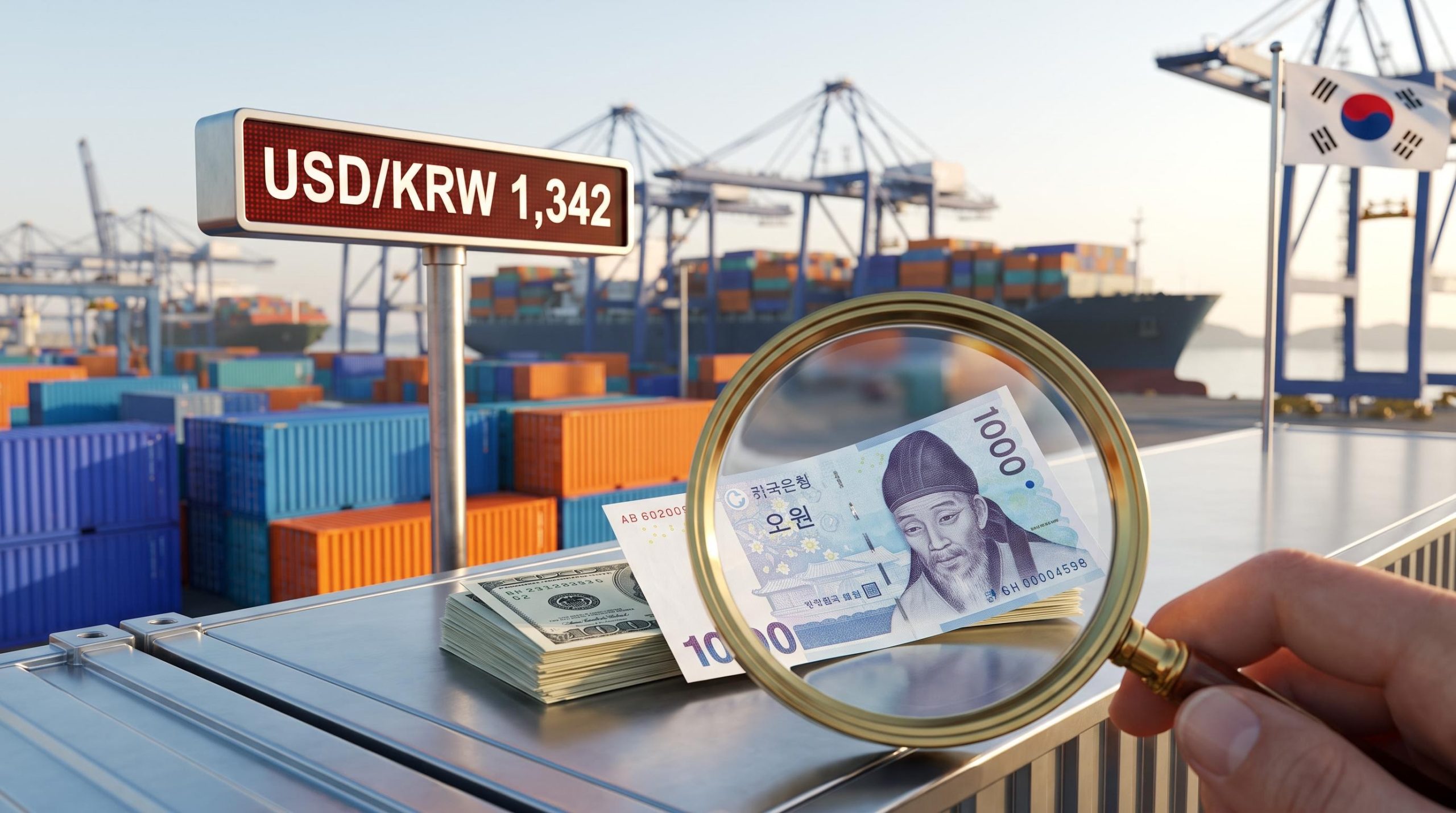
The Bank of Korea (BoK), the country’s central bank, meets on 22 October 2026. It lifted its benchmark rate by 25 basis points in July, from 2.50% to 2.75%, and again in August to 3.00%. A basis point is one-hundredth of a percentage point. USD/KRW, the number of won one dollar buys, sat near 1,342 on 13 October.
Meanwhile, Korea’s finance ministry has been cutting the supply of Korea Treasury Bonds (KTBs), the government debt that anchors domestic borrowing costs.
The most likely result next week is a hold at 3.00% with a hawkish bias, meaning policymakers keep the door open to further hikes. Here is a framework for reading how rate decisions, bond supply and currency flows push on each other, and where the risks to that picture sit.
What is driving the won’s 16% rally, and how durable is it?
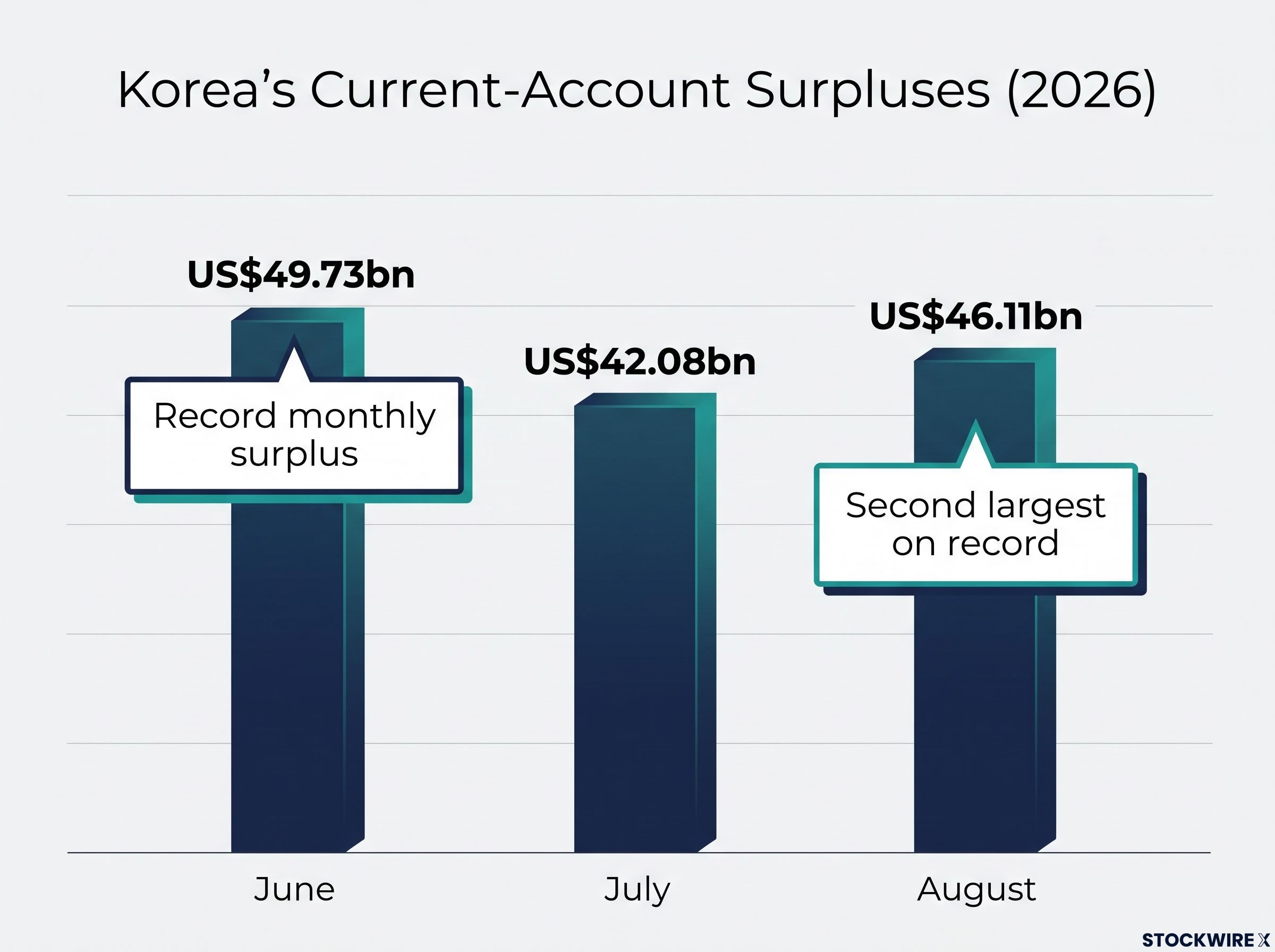
Start with the trade figures, because the rest of the story builds on them. Korea posted a current-account surplus of US$49.73bn in June, a record. The current account measures money flowing in from exports, income and transfers, minus what flows out.
| Month (2026) | Surplus (US$bn) | Note |
|---|---|---|
| June | 49.73 | Record monthly surplus |
| July | 42.08 | Still elevated |
| August | 46.11 | Second largest on record |
Those dollars matter once they need converting. Exporters pay wages, taxes and suppliers in won, so they sell dollars to buy it. That selling is the engine, and Commerzbank credits it alongside the narrower rate gap with the US.
Six forces now reinforce one another:
- Record surplus: more dollars earned abroad means more dollars sold for won at home.
- Semiconductor and AI cycle: chip exports hit US$12.1bn in the first 10 days of October, up 170.9% year on year, within total exports of US$26.1bn (up 102.0%).
- Exporter repatriation: companies bringing earnings home add direct selling pressure on USD/KRW.
- Narrower rate gap: two hikes improved the relative return on won assets.
- Policy acceptance: Governor Shin Hyun-song‘s stated comfort with appreciation removed fear of official resistance.
- Bond-market stabilisation: issuance cuts calmed yields and signalled support for market stability.
HSBC Global Investment Research called the surplus a “game changer” for the won, pointing to export earnings being recycled into investment, bonuses, shareholder returns and taxes. Ashok Bhundia of the Institute of International Finance highlighted how far the won has diverged from the Japanese yen despite overlapping export structures. That gap points to something specific to Korea’s chip cycle.
Structural or cyclical?
Both. The surplus, the conversion habit and domestic recycling of chip profits look like medium-term supports that will not vanish in a month.
Exporter repatriation flows are harder to reverse on a single headline than speculative positioning, because they follow corporate cash cycles; that is why the surplus conversion habit looks like a medium-term support.
The scale of the move is another matter. Joey Chew, head of Asia FX research at HSBC, has warned that the export upswing is narrowly based, with an abrupt end to the AI boom as the main risk.
What this tells you is that the rally rests on real cash, not sentiment, but much of that cash comes from one industry. How far you trust the won’s strength depends on how far you trust the chip cycle.
When big ASX news breaks, our subscribers know first
How do rate hikes, bond supply and the currency push on each other?
The basic link is simple. Raise rates, and holding a currency pays more, so demand for it tends to rise. A hike also signals that the central bank will act against inflation and disorderly weakness.
The complication is that hikes can lift longer-term borrowing costs too. Korea’s 10-year KTB yield climbed to about 4.60% before the government stepped in, a level that threatened bond-market liquidity and household budgets.
The chain ran like this:
- The BoK hikes, lifting the policy rate to 3.00%.
- The won gains support from higher relative returns and a clear policy signal.
- Domestic bond yields rise, tightening financial conditions.
- The finance ministry cuts bond supply and plans buybacks.
- Yields fall, easing pressure without undoing the hikes.
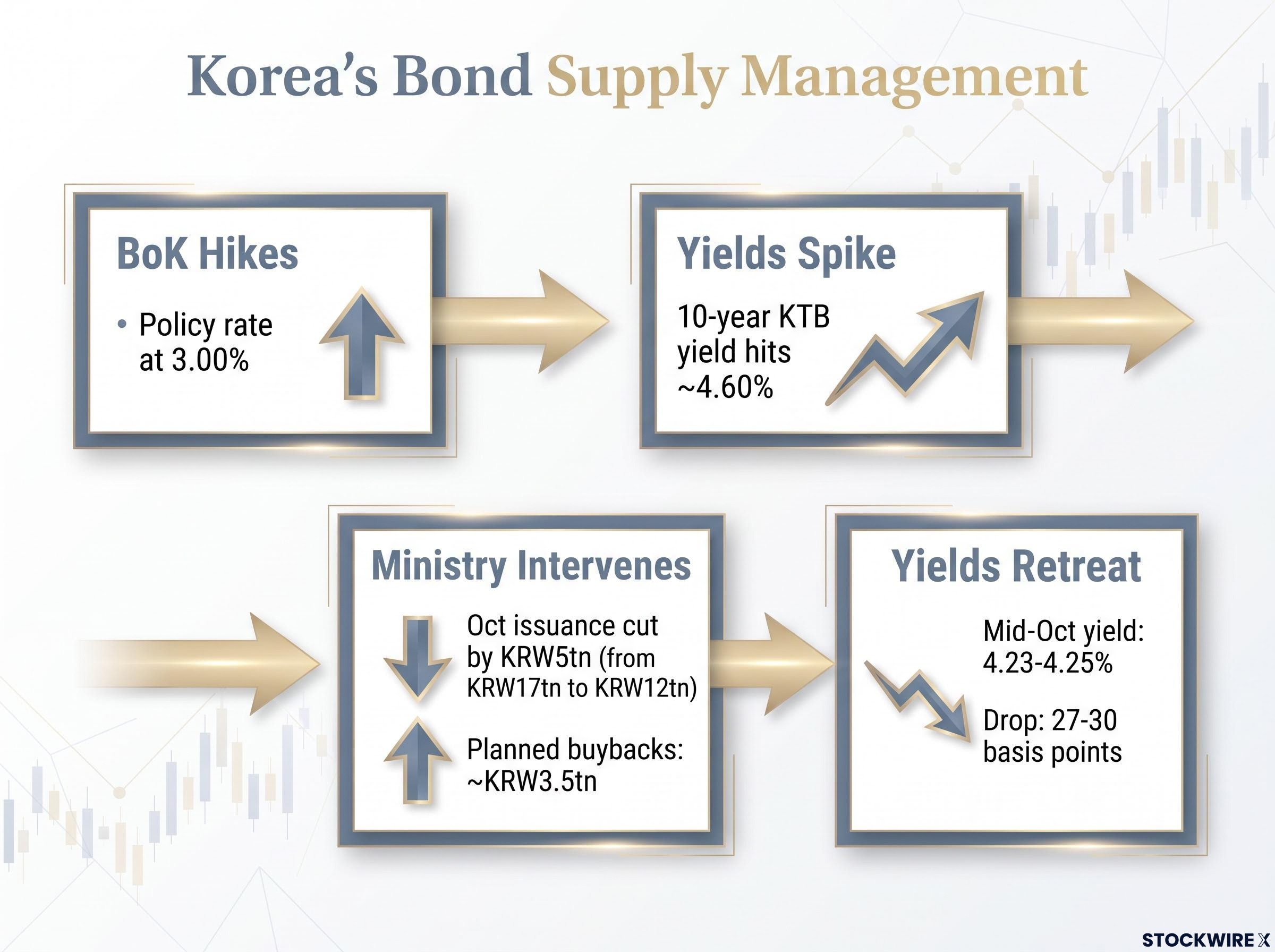
On 1 October, the Ministry of Economy and Finance cut October competitive Treasury-bond issuance by KRW5tn, from KRW17tn to KRW12tn, funded by excess tax revenue. It also planned about KRW3.5tn of buybacks across 2-, 3-, 5- and 10-year maturities.
The asymmetric policy mix The BoK can pause to observe the effect of two hikes. The finance ministry eases bond-supply pressure. The stronger won helps contain imported inflation. Each lever covers a weakness in the others.
Why the supply cut matters for yields
When a government issues bonds, investors must absorb that new debt. Longer-dated bonds carry more duration, which is sensitivity to interest-rate moves, so heavy long-term issuance demands a higher yield as compensation. Cutting issuance reduces that load, and buybacks add a buyer to the market.
The result showed quickly. The 10-year yield fell to roughly 4.23-4.25% by mid-October, a drop of about 27-30 basis points, although sources differ slightly on the starting point and the size of the fall. Local media cited by Commerzbank report further options: KRW5tn cuts at each of the November and December auctions, or KRW5tn in total through December.
Lower yields would normally soften a currency. Not here. The won is trading on trade flows more than yields, so the two can move in opposite directions.
The read for you is that falling KTB yields signal supply management, not a weakening growth or currency story. The cut may only postpone pressure if global yields rise again.
Why Governor Shin may pause on 22 October, and why a pause is not a pivot
The case for holding is straightforward. The BoK has delivered two hikes, it has not yet seen their full effect, the won is stronger and yields are lower. Commerzbank expects a hold at 3.00%.
| Date | Move | Rate after | Vote | Key rationale |
|---|---|---|---|---|
| 16 July 2026 | +25bp | 2.75% | 7-0 | Stabilise the won, counter persistent inflation |
| 27 August 2026 | +25bp | 3.00% | 6-1 (Hwang Kun-il for a hold) | Pre-emptive move to stop inflation expectations spreading |
Then the conditions arrive. Commerzbank describes the stance as hawkish, and Shin has said policy stays restrictive until inflation clearly converges on the 2% target.
Governor Shin’s position, as relayed by Commerzbank Further won strength would be beneficial: it would tilt activity toward the domestic economy, ease the unevenness of AI-driven growth, improve household purchasing power and reduce imported inflation.
The BoK’s August forecasts show why a hold is not a victory lap. It projects headline inflation of 2.7% in 2026 and 2.3% in 2027, with core inflation at 2.5% in both years. Shin has also cautioned that stronger demand could add to cost pressures from higher crude prices.
Expectations had pointed higher before the summer. In a Reuters poll ahead of the July decision, 28 of 31 economists expected another hike by the end of Q4, and the median pointed to a possible 3.25% in Q1 2027. That is a forecast, not a commitment, and the BoK has kept language that allows further increases.
A hold with a hawkish bias also has to be squared with swap markets, which have priced the policy rate well above the committee’s own modal projection and leave Korean fixed income exposed if the two views converge.
If the BoK holds, you should treat it as a pause to observe rather than the end of tightening. Pricing the decision as a dovish turn risks misjudging both the next move and the won’s reaction.
What could break the won’s run?
Every pillar of the bullish case has a crack worth watching.
| Risk | Channel | Effect on won |
|---|---|---|
| AI and chip concentration | Weaker capex, chip prices or China demand shrink the surplus | Removes the main source of dollar selling |
| Oil and Middle East conflict | Higher energy prices keep inflation above target | Could force a hike or unsettle markets |
| Household debt | Higher rates raise debt-service burdens | Limits how far the BoK can tighten |
| Bond-market stress | Rising global yields overwhelm supply cuts | Raises the risk premium on Korean assets |
| Foreign-equity outflows | Capital leaving Korea offsets trade inflows | Can weaken the won despite a surplus |
Shin has acknowledged the last risk before. When the won was weak, he linked it to foreign-equity outflows that offset a large surplus. In remarks published by the Bank for International Settlements, he also flagged housing and household-debt risks.
The durability debate splits the major banks:
- Bull case (HSBC, Commerzbank): the surplus and repatriation channels give the won meaningful support.
- Bear case (Citi): a weaker won requires a prolonged US rate advantage, a sharp fall in China-related demand and Korea’s trade surplus, or a BoK easing cycle.
- Middle ground (Bloomberg Intelligence): Stephen Chiu says the rally has slowed but the won remains resilient near 1,340, with strength against the yen expected to persist through year-end.
A 16% rise also leaves the won open to profit-taking and a renewed dollar rally. Authorities still hold further bond-supply cuts and buybacks in reserve, but those address yields, not chip demand.
The chip cycle driving the rally is also its main single point of failure. For your own view, semiconductor export data deserves as much attention as the BoK’s statement.
The concentration risk is no longer theoretical, as the recent chip sector selloff showed how quickly export controls and multiple compression can hit high-flying semiconductor names that underpin Korea’s surplus.
What the pause changes, and what it leaves open
The evidence points to a hold at 3.00% with a hawkish bias. Chip-driven surplus flows, exporter conversion and official tolerance for appreciation support the won, while bond-supply management keeps yields in check.
After 22 October, five variables matter most: semiconductor export prints, oil prices, inflation readings against the BoK’s 2.7% forecast, further bond-supply decisions and any renewed equity outflows.
If inflation or oil surprises, the BoK may have to choose between another hike and a longer pause. Hold your view of the won with those conditions attached rather than as a settled call.
Investors exploring how the won compares with regional peers will find our full explainer on the won’s Asia FX outperformance, which sets out the chip investment pipeline behind it.
Past performance does not guarantee future results. Financial projections are subject to market conditions and various risk factors. These statements are speculative and subject to change based on market developments and policy decisions.
This article is for informational purposes only and should not be considered financial advice. Investors should conduct their own research and consult with financial professionals before making investment decisions.