
Markets are still pricing at least one more Federal Reserve rate hike this year, but ING’s FX strategy team thinks that confidence is misplaced. The most recent CPI data tilted toward the dovish side without providing a definitive verdict, yet it has barely dented market conviction, and the dollar remains firm on expectations the data flow may ultimately fail to support.
That gap between what the market believes and what ING’s models show is not abstract. Their short-term fair-value framework puts EUR/USD between 1.160 and 1.165, above where the pair is currently trading. Their 6-12 month strategic targets sit between 1.20 and 1.22. The divergence between current pricing and ING’s valuation work is the tension at the centre of this US Dollar forecast.
Here is a clear framework for understanding where ING sees the dollar heading, why the timing depends almost entirely on the Fed’s next communication moves, and what specific levels and events to track as the calendar moves toward late August 2026.
Why ING thinks the market has the Fed wrong
The consensus view is straightforward: as of mid-August 2026, markets comfortably price at least one more Fed rate hike this year, and that expectation has been the dollar’s primary support structure. The logic runs that inflation remains sticky enough to keep the Fed in tightening mode, and the dollar benefits as long as that expectation holds.
The dollar rebound signals that drove the DXY to a 13-month peak in late June 2026 were dominated by the rate-differential pillar, meaning Fed communications are doing the heaviest lifting in sustaining current dollar levels, and any pivot toward neutrality would compress the yield advantage underpinning the rally.
The recent data tells a less confident story. ING notes that the latest CPI print arrived with a soft bias rather than a firm directional signal, and PPI data compounded rather than clarified the uncertainty. The broader 2026 framework ING operates from, a US growth slowdown paired with a softening labour market, supports eventual rate cuts, not additional tightening.
The FOMC July 2026 statement confirmed the Committee held rates steady while retaining language that left the door open to further tightening, the precise ambiguity ING’s team argues markets have interpreted more hawkishly than the underlying data warrants.
“Pressure against $ building from all sides.” — ING FX strategy team
ING characterises the dollar outlook as “broadly bearish,” driven by high US asset valuations, domestic fiscal and political uncertainties, and a balance of risks that skews to the downside. The over-pricing of Fed hawkishness is not a minor technical detail. It is the load-bearing assumption holding the dollar at elevated levels, and if that assumption cracks even slightly, the repricing could be fast.
When big ASX news breaks, our subscribers know first
What ING’s fair-value models say about EUR/USD right now
ING runs short-term fair-value models driven primarily by interest-rate swap differentials and other macro inputs. These models do not predict where a currency pair will trade next week. They estimate where the pair should trade given the current state of its underlying drivers, providing a reference point for judging whether the market price contains an embedded premium or discount.
Francesco Pesole, ING FX strategist, points out that the bank’s models currently put EUR/USD short-term fair value in the 1.160-1.165 range. The pair’s position below that band indicates a degree of euro undervaluation, suggesting the market price carries a hawkish premium that a clear policy catalyst has yet to test.
The EUR/USD range dynamics through early August reflect a broader structural pattern where positive eurozone data surprises are being systematically discounted by persistent safe-haven dollar demand, providing granular market structure context for why the pair remains below ING’s fair-value band despite the valuation gap.
ING stresses this is not a stand-alone trade trigger. It tilts the odds toward euro strength once the dollar’s hawkish premium begins to fade, but the timing of that fade depends on what the Fed communicates next. For you, the practical value of a fair-value gap like this is as a reference point: if EUR/USD stays below 1.160 while rate differentials hold steady, ING’s case for undervaluation actually strengthens.
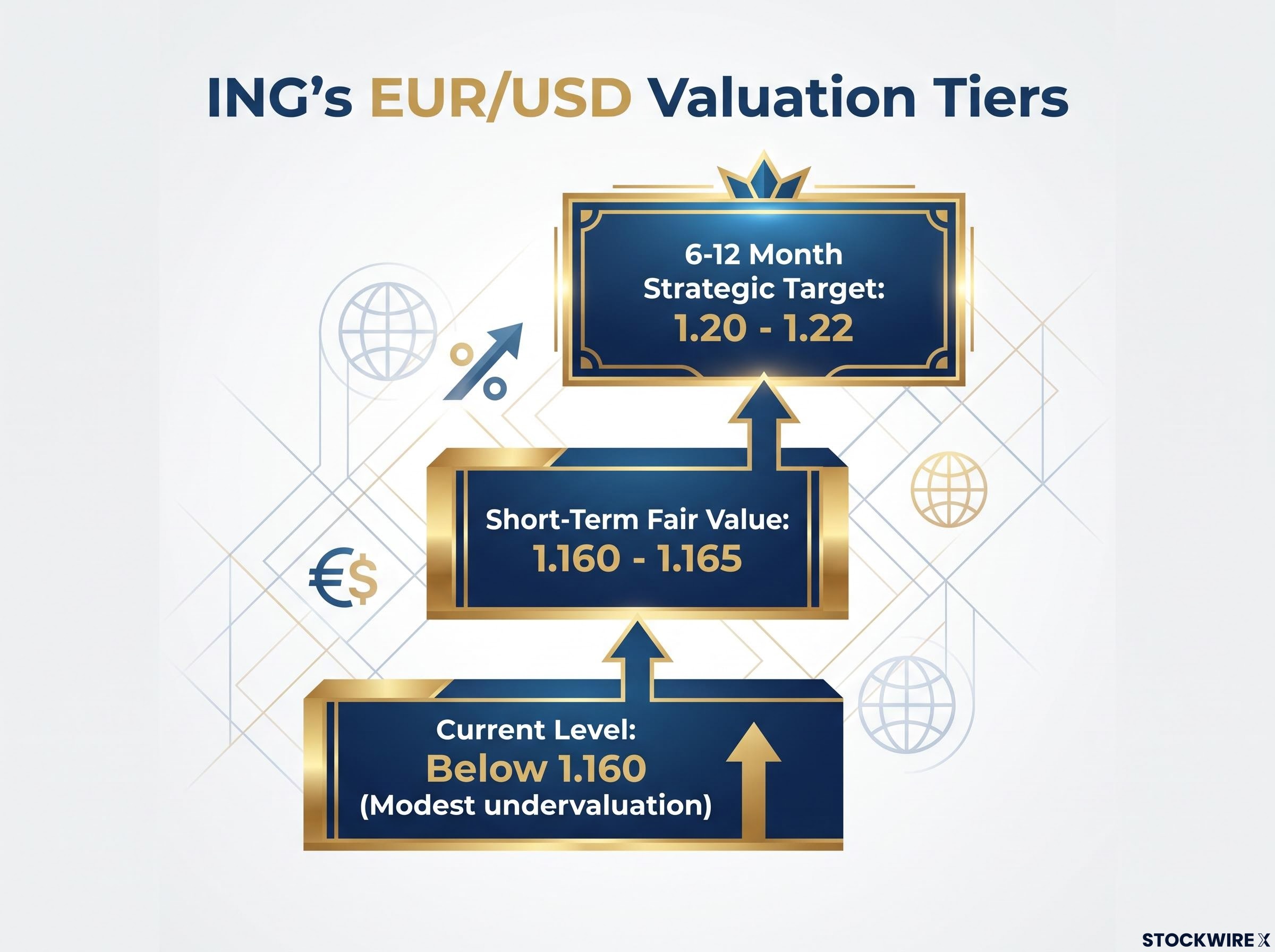
| Reference Point | Level | What It Signals |
|---|---|---|
| Current trading level | Below 1.160 | Embedded hawkish premium; modest euro undervaluation |
| Short-term fair value (ING models) | 1.160-1.165 | Where EUR/USD should trade given current rate differentials |
| 6-12 month strategic target | 1.20-1.22 | Cyclical dollar decline as US growth cools and eurozone improves |
The longer-horizon picture
ING’s strategic target of 1.20-1.22 over the next 6-12 months requires two conditions: US rate cuts materialising as the growth slowdown deepens, and eurozone economic performance holding or improving. The team is explicit that this is a directional bias with deliberately moderate conviction on timing and magnitude, not a call for extreme dollar weakness. They frame the outlook as a “dollar dip, not a collapse.”
What low FX volatility is telling you (and what it is not)
On the surface, FX markets look calm. Following the recent CPI and PPI releases, FX volatility has compressed, and ING considers this suppression likely to continue for at least a few more weeks. Summer trading and the absence of major data surprises have reinforced the quiet, leaving the Dollar Index and pairs like EUR/USD range-bound.
ING reads this differently from the surface. Their framing is that the quiet period represents a delay of the bearish dollar thesis, not a denial of it. EUR/USD sitting in a range while their models flag short-term undervaluation is not a market at peace. It is a market waiting for a catalyst to resolve a building tension.
For you, the low-volatility environment carries three practical implications:
- Directional dollar trades may take longer to pay off; the bias can be right, but the timing is hostage to catalysts.
- Options pricing reflects the subdued volatility, making defined-risk structures relatively cheap for those who want exposure to upcoming Fed events.
- Prolonged ranges can precede sharp breaks; quiet conditions often mask accumulating pressure that a clear policy signal releases.
Misreading calm markets as directionally neutral can leave you caught off-side when a policy signal arrives. The distinction ING draws is between a market that has resolved and one that is simply waiting. This one is waiting.
The catalyst sequence: Fedspeak, then Jackson Hole
ING identifies two distinct gates the dollar thesis must pass through before the end of August 2026, and they are not equal in weight.
- Fedspeak between now and 27 August: Day-to-day communications from voting FOMC members represent the most immediate source of market movement, according to ING. The key language to monitor is whether officials characterise current policy as already tight enough, and how much tolerance they signal for further inflation pressure before acting again. Given that positioning already leans hawkish, even a cautious word choice from a voting member could have an outsized effect on the dollar and EUR/USD.
- The Jackson Hole Economic Policy Symposium (27-29 August 2026): This is the higher-stakes gate. ING frames two contrasting outcomes. A dovish or balanced tone from the Fed chair reinforces the bearish dollar thesis and could push US yields and EUR/USD toward fair value. A hawkish surprise delays the thesis without necessarily cancelling it, keeping the dollar supported temporarily.
Jackson Hole risk positioning is drawing attention beyond FX desks: Bank of America strategist Michael Hartnett issued a conditional risk-off directive in early August, naming 28 August as a critical inflection date and identifying the 10-year Treasury yield and the Dollar Index as the leading signals to watch ahead of the symposium.
ING’s framing of the event risk asymmetry: because markets already price a fairly hawkish stance, a dovish or balanced tone at Jackson Hole is more consequential for the dollar than a hawkish tone. The asymmetry runs against the current consensus.
July US retail sales, where the consensus sits at +0.1% month-over-month, and University of Michigan consumer sentiment readings pencilled in close to July’s levels, are unlikely to drive significant dollar moves on their own. Both releases would need to deviate materially from expectations to shift the broader rate narrative in either direction.
What to listen for in Fedspeak before Jackson Hole
Two divergent scenarios matter here. Language that reaffirms willingness to hike again despite mixed data supports the dollar in the short term. Language that raises the bar for further hikes, or suggests current policy is already sufficiently restrictive, begins unwinding the hawkish premium. Because the market is already skewed toward expecting at least one more hike, any dovish signal carries outsized impact.
Jackson Hole as the inflection point
Jackson Hole is structurally different from routine Fedspeak. It is a comprehensive policy forum with historical precedent for major narrative shifts, one of the few scheduled venues where the Fed chair can reframe the medium-term outlook on inflation, growth, and the rate path in a single speech.
ING’s two scenarios are clear. A speech that validates the need for caution or hints at future easing reinforces their bearish dollar view. A speech that leans harder into inflation risks delays, but does not necessarily cancel, that thesis. Knowing the sequence and the asymmetry helps you calibrate when to act rather than simply knowing the direction. The period between now and 27 August is a monitoring window; the Symposium is the decision point.
A practical framework for tracking ING’s thesis through August
ING’s thesis has a clear internal logic, but it requires patience and structured monitoring to follow through to its anticipated resolution. Drawing from Francesco Pesole, Frantisek Taborsky, and Chris Turner’s analysis, here are five specific signals to track:
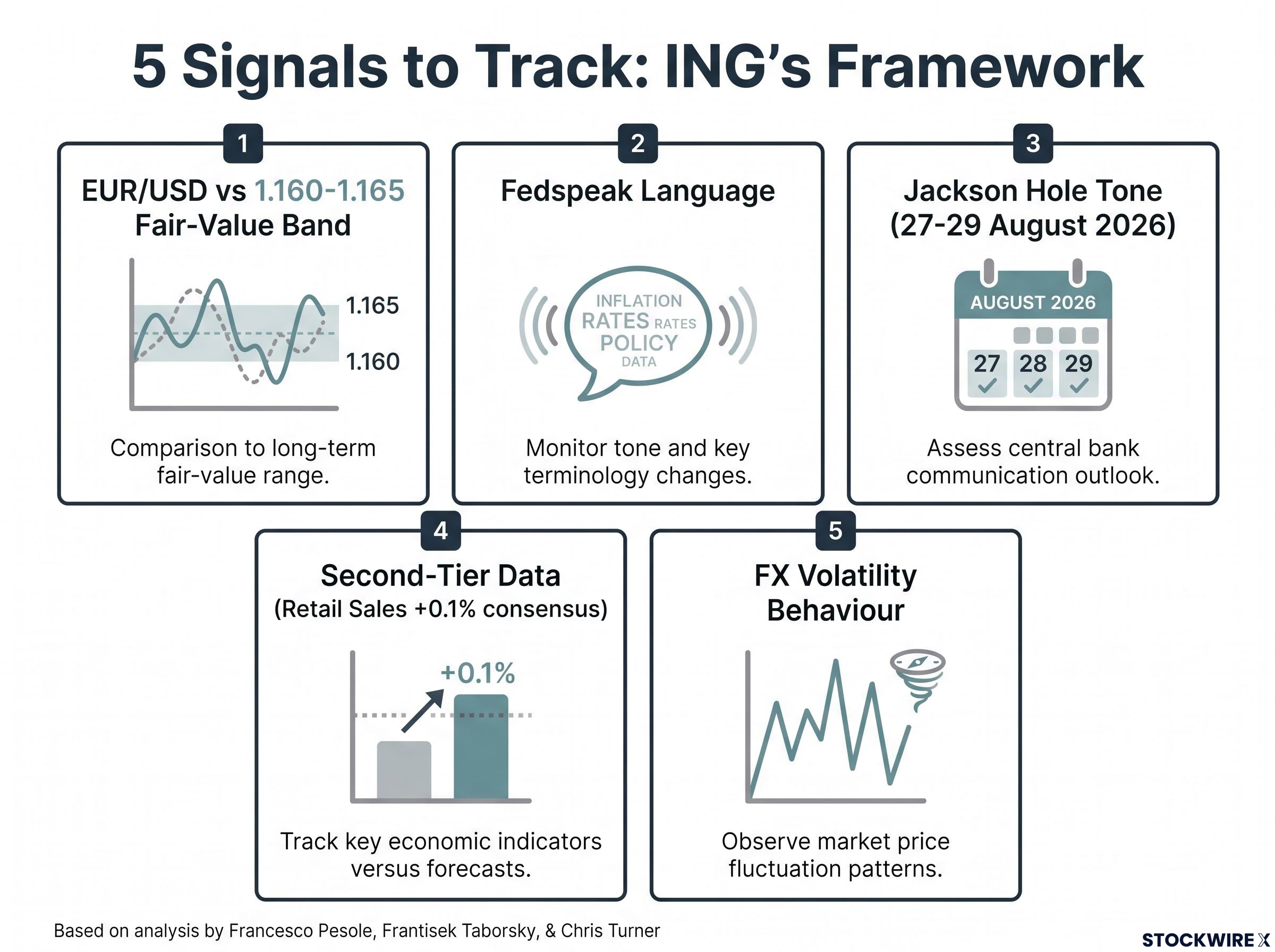
- EUR/USD relative to the 1.160-1.165 fair-value band: If the pair stays below this range while rate differentials hold steady, the undervaluation case strengthens.
- Fedspeak language on restrictiveness: Listen for descriptions of policy as “sufficiently restrictive” versus signals of remaining willingness to hike. The former begins unwinding the hawkish premium.
- Jackson Hole tone (27-29 August 2026): A balanced or cautious tone from the Fed chair is the primary confirming catalyst for ING’s bearish dollar view.
- Second-tier data surprises: July retail sales at +0.1% consensus and Michigan sentiment near July levels are background noise unless the deviation is very large.
- FX volatility behaviour: Persistent low volatility supports building defined-risk positions ahead of the Symposium; a volatility spike before Jackson Hole would signal the market is starting to reprice ahead of the event.
| Signal to Watch | Confirming for Dollar Weakness | Disconfirming |
|---|---|---|
| EUR/USD vs fair-value band | Stays below 1.160 while differentials hold (undervaluation deepens) | Breaks above 1.165 without a Fed catalyst (model noise) |
| Fedspeak language | “Sufficiently restrictive” framing; higher bar for further hikes | Explicit reaffirmation of willingness to hike |
| Jackson Hole tone | Balanced or cautious; hints at eventual easing | Strong pushback against near-term easing speculation |
| Retail sales / sentiment | Meaningful downside miss that weakens growth narrative | Strong beat that revives tightening expectations |
| FX volatility | Low vol persists (cheap options for event positioning) | Vol spike before Jackson Hole (early repricing underway) |
This framework converts ING’s institutional thesis into five specific monitoring decisions you can make in real time, turning a directional view into something actionable without requiring a high-conviction timing call.
What changes the picture, and what does not
ING’s thesis is testable, and knowing the specific conditions that would falsify it is as valuable as knowing the thesis itself. It tells you when to stay the course and when the underlying assumption has genuinely changed.
Conditions that reinforce the bearish dollar thesis:
- A dovish or balanced tone at Jackson Hole
- Fedspeak that raises the bar for further hikes or signals sufficient restrictiveness
- Second-tier data that misses to the downside, weakening the growth narrative
Conditions that delay or challenge the thesis:
- A hawkish Jackson Hole surprise with strong pushback against easing speculation
- Fedspeak that explicitly reaffirms willingness to hike
- A strong retail sales beat that revives growth optimism
ING is explicit that even their bearish scenario is moderate in scale. Their language, “broadly bearish baseline” and “pressure against $ building from all sides,” frames a directional call with defined boundaries, not a bet on a dollar crash. The 6-12 month EUR/USD target of 1.20-1.22 is the outer boundary of what they expect.
ING characterises this outlook as a “dollar dip, not a collapse,” a cyclical moderate decline rather than a structural crash. That framing limits the downside of being wrong on direction while keeping the thesis clear enough to act on.
A bearish dollar thesis with a clearly defined set of disconfirming signals is more useful to you than a directional view with no built-in exit conditions. ING’s framework gives you both the call and the conditions under which to revise it.
For investors wanting to stress-test ING’s bearish dollar view against the opposite institutional consensus, our full explainer on competing EUR/USD forecasts covers the BofA and J.P. Morgan bull cases in detail, including the structural and cyclical arguments behind a Q3 2026 floor well below ING’s 6-12 month target.
This article is for informational purposes only and should not be considered financial advice. Investors should conduct their own research and consult with financial professionals before making investment decisions. Past performance does not guarantee future results. Financial projections are subject to market conditions and various risk factors.