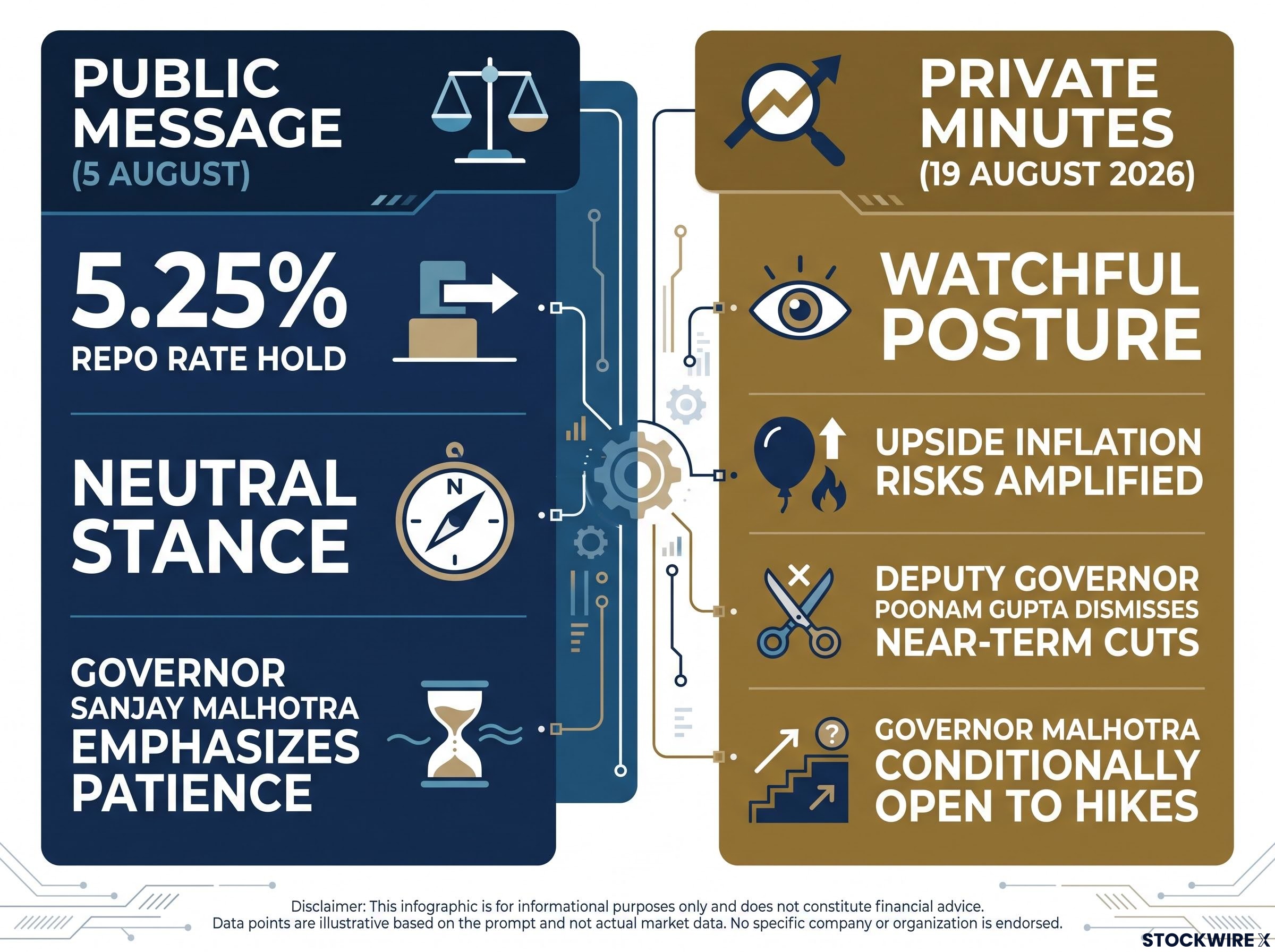
On 3–5 August, the Reserve Bank of India (RBI) held its repo rate steady at 5.25% for the fourth consecutive meeting, retained a neutral stance, and signalled patience. Two weeks later, the minutes from that same meeting told a different story. Released on 19 August 2026, those minutes revealed a committee that is more guarded, more hawkish in its internal language, and more actively stress-testing scenarios that could force it to tighten.
That gap between the public message and the private deliberation is not a minor stylistic difference. It is the most important signal in Indian monetary policy right now. The next Monetary Policy Committee (MPC) meeting is scheduled for 5-7 October 2026, which means investors have a defined window, roughly seven weeks, in which the data that will determine the RBI’s next move will arrive.
Here is what the minutes actually tell you about the India inflation outlook, which specific triggers could push the committee toward a hike, and how to translate the RBI’s internal logic into concrete positioning decisions before October.
The RBI said neutral. The minutes said something else
Start with what investors already know. The 5 August decision was unanimous: all six MPC members voted to hold at 5.25%, and the stance was described as neutral. Governor Sanjay Malhotra’s public remarks emphasised patience and data dependence. Markets read it as steady-as-she-goes.
What the minutes revealed
Then the minutes landed, and the picture widened considerably. According to analysis from Radhika Rao at DBS Group Research, four of six MPC members adopted positions ranging from neutral to cautious. The committee framed its hold within a “watchful” posture rather than one of comfort, and members explicitly acknowledged that upside inflation risks have “amplified.”
Two individual voices anchor the internal tone:
- Deputy Governor Poonam Gupta took the committee’s most explicitly hawkish position, making clear that any prospect of rate cuts in the near term is off the agenda
- Governor Malhotra himself signalled that a move toward broad-based policy tightening could be warranted if price pressures were to intensify further
The contrast between the two communications is worth holding clearly:
- Public statement: Neutral stance, patience, data dependence, continuity
- Minutes: Watchful posture, amplified upside risks, explicit dismissal of cuts, conditional openness to hikes
A central bank that sounds neutral in its press release but writes hawkish minutes is telling you something. The minutes, not the headline statement, are the more reliable signal of where the RBI’s true policy bias sits.
When big ASX news breaks, our subscribers know first
Where India’s inflation is headed, and why the RBI is not comfortable
The inflation trajectory the committee is navigating is not a single number. It is a sequence, and each point in that sequence constrains the RBI’s options differently.
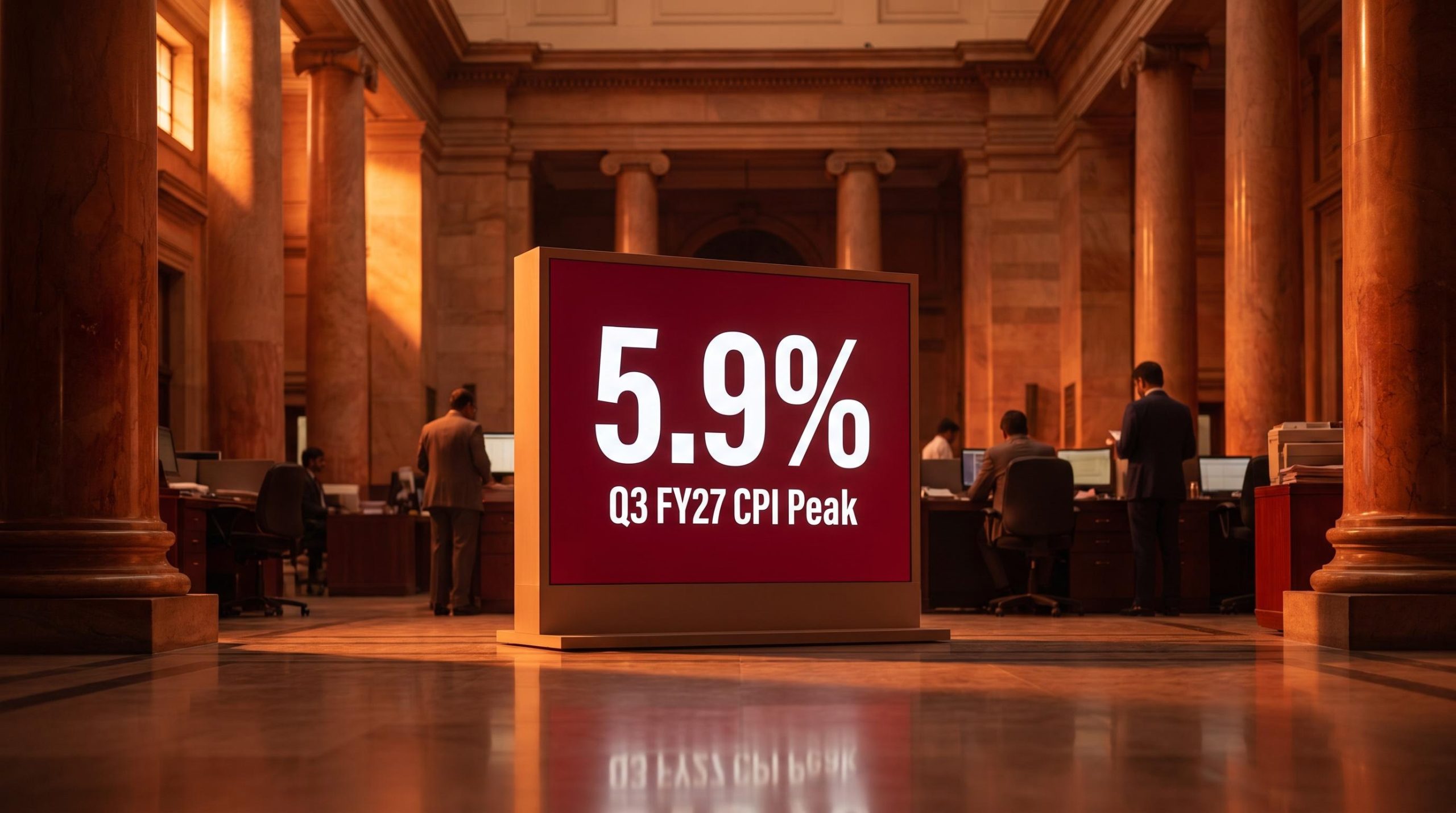
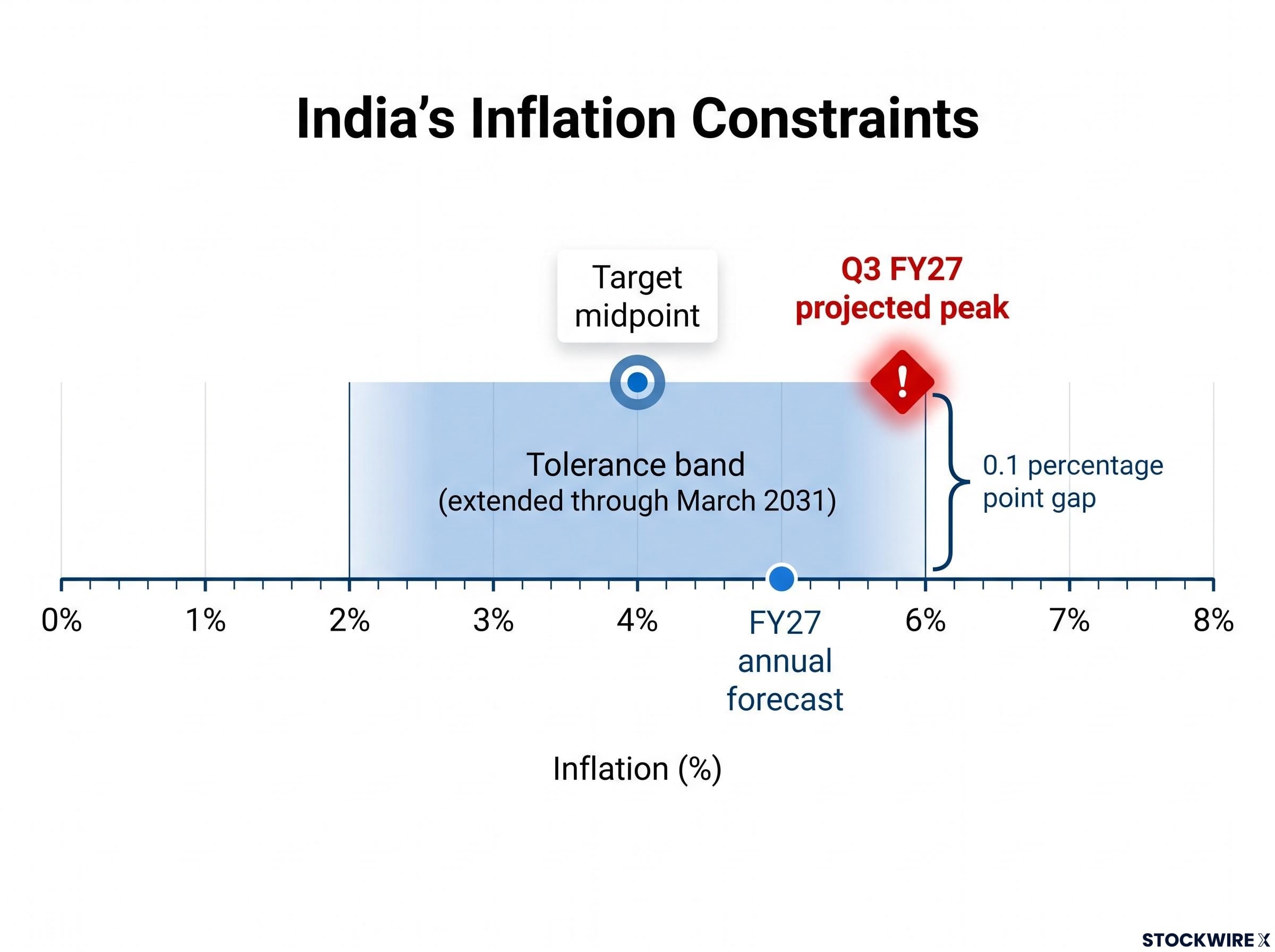
The committee’s own projections show headline Consumer Price Index (CPI) inflation, the broadest measure of price increases across the economy, peaking at approximately 5.9% in Q3 FY27. That peak sits uncomfortably close to the 6% upper boundary of the RBI’s tolerance band. It does not breach it, but it leaves almost no margin.
| Metric | Value | Significance |
|---|---|---|
| Repo rate (held) | 5.25% | Fourth consecutive hold; unchanged since early 2026 |
| Projected Q3 FY27 CPI peak | ~5.9% | Near the 6% upper tolerance band; minimal margin |
| FY27 annual CPI forecast | ~5.0% | Revised down from ~5.1%; still well above the 4% target |
| RBI inflation target | 4% midpoint; 2-6% band | Band extended through March 2031 |
The full-year FY27 forecast of approximately 5.0%, revised down marginally from 5.1%, might look reassuring at first glance. It is not. A full-year average a full percentage point above the 4% target midpoint signals an extended period of elevated inflation rather than a quick reversion.
The RBI’s inflation tolerance band runs from 2% to 6%, extended through March 2031. A projected peak of 5.9% sits just 0.1 percentage points below the upper boundary.
Committee members also flagged early indications of cost pressures spreading across multiple economic categories. Even if the current inflation impulse is largely supply-driven, food and fuel shocks spilling into broader prices through second-round effects would change the character of the problem entirely. An inflation path that stays close to the ceiling for an extended period, without technically breaching it, is precisely the kind of outcome that keeps a central bank in active vigilance mode rather than easing mode.
What could actually push the RBI to hike
The minutes do not treat risk factors as background context. MPC members are actively stress-testing three specific categories of risk, and understanding the mechanism behind each one tells you what to monitor between now and October.
- Food and monsoon dynamics. Food inflation remains the single largest swing factor in India’s CPI basket. The distribution of monsoon rainfall will determine whether recent food price pressures fade or persist. Committee members specifically flagged the potential emergence of El Niño weather conditions as an upside risk. An El Niño event would extend and potentially worsen food price pressures by disrupting agricultural output during the final quarter of the monsoon season.
Academic research on El Nino disruption to Asian agricultural output shows how abnormal weather conditions suppress crop cultivation across multiple growing seasons, a dynamic that would extend food price pressures well beyond the immediate monsoon quarter and deepen the RBI’s upside inflation risk.
- Oil and global energy prices. A renewed spike in crude prices would transmit directly into broader CPI through transport, manufacturing, and input costs. The rupee’s sensitivity to oil makes this a dual-channel risk: higher oil prices raise domestic costs while simultaneously weakening the currency, which amplifies imported inflation.
A renewed spike in crude prices would transmit directly into broader CPI through transport, manufacturing, and input costs, and the mechanism behind oil price transmission into CPI is well-documented: analyst pass-through estimates suggest 40-60% of an oil price increase feeds into core inflation over a 3-6 month lag, compressing the window the RBI has to assess whether a shock is transient.
- Geopolitical and global uncertainty. The minutes cite an “uncertain global environment” and geopolitical tensions as reasons for a watchful stance. This backdrop complicates the trade-off between currency defence and domestic price stability. The USD/INR pair has met sustained selling pressure at the 96.0 level, partly reflecting this sensitivity.
Committee members specifically cited El Niño conditions as an upside risk to food prices, a concrete and monitorable trigger that could shift the inflation outlook before the October meeting.
The critical distinction here is that MPC members are building these scenarios into their active deliberations rather than discounting them. If any one of these triggers materialises in the August-to-October window, the committee’s conditional hike posture shifts from a tail risk to a live policy question.
How the RBI’s reaction function actually works right now
A reaction function describes how a central bank responds to changes in economic data, specifically which data points trigger action and in which direction. Understanding the RBI’s current reaction function is the most practical output of reading these minutes, because it tells you not just what the committee will probably do, but which surprises will move it and which will not.
A reaction function describes how a central bank responds to changes in economic data, and the limits of central bank reaction functions as precise policy tools are well-established: long and variable lags between a rate decision and its real-economy effect mean committees are often calibrating to data that already reflects a prior policy setting rather than the current one.
The committee is neutral in the sense that it has not moved. But it is hawkish in a specific and important way: its tolerance for upside inflation surprises is lower than its tolerance for downside growth surprises. Growth has been described as resilient in the committee’s discussion, which removes the growth-slowdown rationale that would typically support cuts.
Three shifts the minutes create for the rate outlook
- Near-term rate cuts are effectively off the table; Deputy Governor Gupta’s explicit dismissal leaves no ambiguity
- Conditional hike risk is now on the distribution, with at least one member flagging hike potential if inflation persists
- The data-weighting is asymmetric: upside inflation surprises carry more policy weight than equivalent downside surprises
The next MPC meeting on 5-7 October 2026 will be informed by CPI prints for August and September, monsoon final-quarter data, and any significant move in global oil benchmarks. If you had built rate-cut scenarios into your positioning for mid-FY27, the minutes have effectively closed that path unless incoming data shifts materially in the right direction.
Bond market, rupee, and what this means for EM positioning
The RBI’s hawkish-neutral posture translates into specific, asset-class-level implications that are directly actionable.
| Asset class | RBI posture implication | Investor action |
|---|---|---|
| Indian bonds | Lower probability of a 2026-27 easing cycle; rising term premium around FY27 inflation peak | Reassess duration exposure; account for potential bear-steepening bias in the curve |
| Rupee (USD/INR) | RBI likely to maintain real rate buffer for currency defence; sensitivity to oil and global risk sentiment | Maintain prudent hedging; do not assume benign volatility compression |
| Broader EM context | RBI aligned with EM peers that have paused after tightening but remain watchful | Read Indian rate dynamics within the global EM rate cycle, not as idiosyncratic |
For bond investors, the setup favours a flatter or slightly bear-steepening curve as the market demands more term premium around the window when inflation is projected to peak. The probability mass has shifted away from an easing cycle and toward a fatter tail of conditional tightening.
After reaching its highest point in June 2026, rupee one-month implied volatility eased back over the course of August 2026, pointing to a degree of near-term stabilisation. Medium-term risks, however, remain elevated, and investors should not mistake the volatility compression for a resolved outlook.
For currency-exposed investors, the USD/INR 96.0 resistance level is a practical anchor. The RBI’s willingness to maintain a real rate buffer to support the rupee in a risk-off scenario argues against assuming a one-way appreciation path. Many emerging-market central banks share this watchful, paused-but-ready posture, which means Indian rate dynamics are part of a broader EM pattern, not an outlier.
Many emerging-market central banks share this watchful, paused-but-ready posture, a dynamic that began taking shape when Goldman Sachs projected the Reserve Bank of India among the peers expected to join an Asian rate tightening cycle in H2 2026, driven by dollar strength and Hormuz-linked energy cost pressures across the region.
The combination of elevated inflation, an asymmetrically cautious central bank, and sensitivity to global shocks creates a risk profile for Indian assets that the headline “neutral stance” framing simply does not capture. Your positioning should reflect the fuller picture.
Reading the October meeting before it happens
The 5-7 October MPC meeting is less than seven weeks away. Rather than waiting passively for the decision, the minutes give you a specific set of data inputs to track in real time, each of which will tell you which way the committee is leaning before it formally convenes.
- CPI prints for August and September. If either print comes in at or above 5.9%, the projected peak, the conditional hike posture shifts from background risk to active debate. A moderation below 5.5% would reinforce the hold-with-vigilance baseline.
- Monsoon final-quarter outcome. Any confirmation of El Niño conditions would extend food price pressures and tilt the committee toward the hawkish end of its range. A normal close to the monsoon season eases the most immediate supply-side concern.
- Global oil benchmarks. A sustained move higher in crude would activate the dual-channel inflation risk, both through direct input costs and through rupee depreciation, giving the committee less room to stay patient.
The two anchors of the committee’s current bias are Deputy Governor Gupta, the most explicitly hawkish voice, and Governor Malhotra, conditionally open to tightening. If the data between now and October validates their caution, the October meeting becomes a genuinely live event rather than a formality.
The central conclusion of these minutes is straightforward: the RBI’s true policy bias is more guarded than its public statement implies. Investors who read the minutes rather than the press release, and who monitor the right data inputs between now and October, will have an evidence-based view of the committee’s direction well before the decision lands.
This article is for informational purposes only and should not be considered financial advice. Investors should conduct their own research and consult with financial professionals before making investment decisions. Financial projections referenced in this article are subject to market conditions and various risk factors.