ASX short interest hit a record at DroneShield, where short sellers pushed their position to 15.17% of shares in the week to 28 September, just before a US$500 million US contract headline. Over the same week, shorts rose in Steadfast, a company with a signed $6.00 cash takeover, and fled Healius after its asset sale.
Three moves, three different directions. The data also runs behind the market, so what you see today reflects positions held days ago.
The figures cover 21-28 September 2026 and were reviewed on 5 October 2026. Here is how to tell which moves signal real bearish conviction and which are hedging, arbitrage or covering.
Why this week’s short-interest figures are already out of date
Most readers assume short-interest numbers are live. They are not.
The Australian Securities and Investments Commission (ASIC) publishes aggregated short positions on a T+4 basis, meaning four trading days after the reporting day. Brokers must report trades within three business days, and ASIC aggregates them without verifying each report.
Australia’s mandatory reporting rules require brokers to disclose every on-market short sale regardless of size, and ASIC aggregates those reports without verifying each one, which is why data quality matters for anyone reading the weekly tables.
The lag that matters: The data reflects positions on the reporting day, not live trading. DroneShield’s contract announcement on 30 September falls after the cut-off.
That timing is the key to reading the week. The weekly comparison runs 21-28 September, the monthly one 31 August-28 September, and the rising and covered lists capture moves of about 0.5% or more.
Short selling means borrowing shares to sell them, hoping to buy them back cheaper. Derivatives and synthetic shorts are not fully captured, and many shorts are hedges or arbitrage rather than bearish bets.
Four quick rules follow:
- Treat every figure as a snapshot of past positioning, not a reaction to the latest headline.
- Judge moves against the starting level: Steadfast’s jump to 4.04% from a low base says more than DroneShield’s +0.87% on top of 15.17%.
- Ask whether a short could be a hedge before calling it bearish.
- Wait for later reports before linking any number to news.
DroneShield shorts hit a record before the US$500 million contract landed
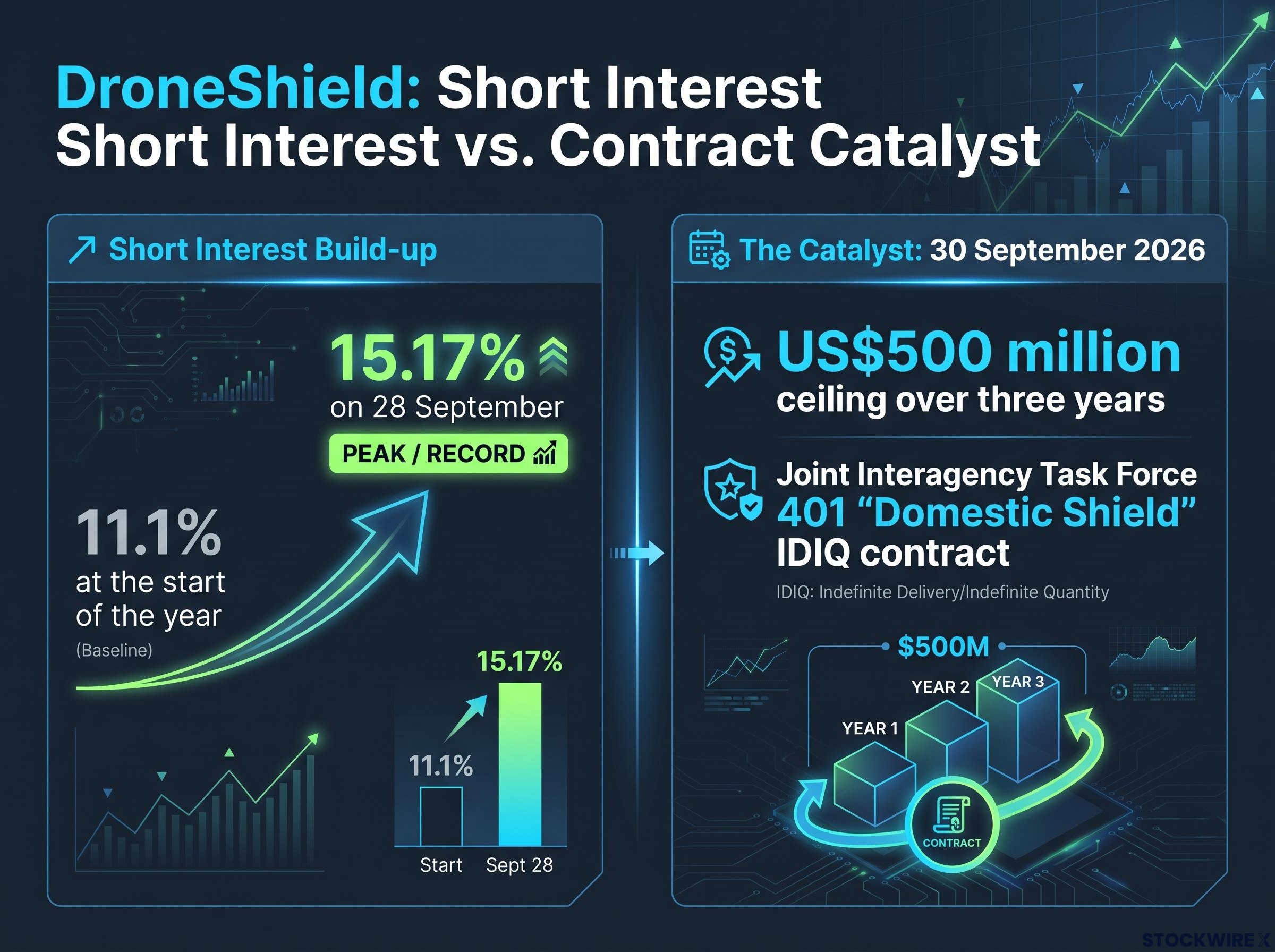
DroneShield is the most shorted stock on the ASX at 15.17% (+0.87% on the week, -0.19% on the month), up from 11.1% at the start of the year. Shares are down 47% year to date and sit near two-year lows, despite a 35% rally between 3 and 6 August.
| Stock | Short % | Week | Month |
|---|---|---|---|
| DroneShield | 15.17% | +0.87% | -0.19% |
| Lotus Resources | 13.26% | -1.54% | -1.77% |
| Boss Energy | 13.19% | +0.40% | +3.38% |
| IperionX | 12.80% | +0.41% | +2.53% |
| Zip Co | 12.68% | +1.72% | +1.60% |
| PLS Group | 12.29% | +0.55% | +1.20% |
| 4DMedical | 11.93% | -0.08% | -0.40% |
| Domino’s | 11.76% | +0.05% | -0.28% |
| Paladin Energy | 11.04% | +0.46% | +0.39% |
| Treasury Wine Estates | 10.86% | +0.14% | -0.90% |
On 30 September 2026, wholly owned subsidiary DroneShield LLC was awarded a Joint Interagency Task Force 401 “Domestic Shield” contract with a US$500 million ceiling over three years. Market Index reported shares up 5.2%, while Investing.com reported a surge of about 9% to a one-month high. The gap may reflect intraday versus closing prices, though that is unconfirmed.
The headline is large, but the caveats are larger. Record shorting is not contradicted by one day’s rally, because the shorts were built before the news.
The most shorted ASX stocks have a record of attracting institutional positioning well before large share price moves, which is why the starting level of a position often matters more than the latest weekly change.
What the IDIQ does and does not promise
An Indefinite Delivery, Indefinite Quantity (IDIQ) contract is a procurement vehicle: DroneShield can compete for future orders, but none is guaranteed. It sits within a multi-vendor framework worth several billion dollars, and the company itself said amounts cannot be quantified. It classed the announcement as non-price sensitive.
No named analyst commentary was found, so the following is general market-structure reasoning. Shorts may persist because a framework is not a firm order, task orders are competitively awarded, and rallies can attract tactical shorting.
You should read the US$500 million as a maximum vehicle value, not revenue. Wait for later T+4 reports to see whether shorts actually reacted.
Why shorts rose in Steadfast during a takeover and left Healius after a sale
Steadfast and Healius show the same deal-driven backdrop producing opposite moves, each for its own reason.
Short interest moves around corporate events can point in opposite directions, as when a takeover closing removes the deal-risk thesis and covering follows, while a disappointing study can prompt shorts to build further.
| Company | Short % | Week / Month | Catalyst | Key risk |
|---|---|---|---|---|
| Steadfast | 4.04% | +2.25% / +1.50% | $6.00 cash takeover | Multi-jurisdiction approvals |
| Healius | 2.92% | -2.09% / -5.50% | $160 million Agilex Biolabs sale | Low sale price; FIRB and ACCC approvals |
Steadfast: arbitrage, hedging or deal doubt?
Steadfast posted the week’s largest increase in short interest. It signed a Scheme Implementation Deed on 21 August 2026 with Amwins, Dragoneer and KKR at $6.00 cash per share, a 51.9% premium to the $3.95 undisturbed close and an implied enterprise value of about $7.7 billion.
Shares trade near $5.77, a spread of about 4%. Approvals are needed from FIRB, the ACCC, New Zealand’s Overseas Investment Office, the UK Financial Conduct Authority and Singapore’s Monetary Authority, with implementation targeted around December 2026.
A rising short here may be arbitrage or hedging rather than a bet against the company, though some holders may doubt the deal. The spread is consistent with modest completion risk.
Healius: balance-sheet repair or fire sale?
Healius recorded the week’s largest covering, agreeing on 25 September to sell Agilex Biolabs to a Novotech subsidiary for $160 million. That is well below the $301 million paid in 2021, at 19.8x FY2026 EBITDA, with net proceeds of about $155 million.
Net debt was $32.8 million, implying roughly $120 million net cash after completion, expected in H2 FY2027. Shares peaked 18% intraday at 42.5 cents and closed up 5.5% at 38 cents; management has not said whether proceeds will be returned.
Covering after deleveraging suggests the original short thesis weakened. If the low price reads as a fire sale, some shorts could stay.
Elsewhere, rising shorts clustered in themes:
- Gold and silver miners: Catalyst, Meeka, Silver Mines, Unico
- Lithium: Core Lithium, PLS
- Speculative tech: Artrya (+1.84% to 7.69%), EchoIQ
- Rate-sensitive consumer and property: Zip (+1.72% to 12.68%), Lovisa, Lottery Corp, Arena REIT
Lotus fell 1.54% to 13.26%.
What to watch in the next short-interest release
Three lessons carry forward: the data lags, the starting level matters, and hedged shorts are not directional ones.
Watch the next T+4 reports for DroneShield after 30 September, Steadfast ahead of regulatory approvals, and Healius after any capital-return update. Weigh short data alongside fundamentals, never on its own.
This article is for informational purposes only and should not be considered financial advice. Investors should conduct their own research and consult with financial professionals before making investment decisions.