
A Bank of Japan deputy governor has just said AI is now a leading subject at policy meetings, which means a technology story has become a variable in how interest rates get set. For anyone tracking AI BoJ policy, that is the signal worth catching.
The remarks came from Deputy Governor Shinichi Uchida on 5 October 2026, at the ECONDAT 2026 Fall Meeting. They land just weeks after the Bank of Japan (BoJ) lifted its policy rate to 1.25% on 18 September 2026, a 31-year high. FXStreet read the speech as modestly hawkish and mildly supportive for the yen.
A note on sourcing: the speech content here comes from FXStreet’s report. No BoJ transcript or coverage from other outlets was found, so treat the details as single-sourced.
Here is a working framework for how AI-driven demand and supply effects can move rate expectations and the yen, and why one speech should not be over-read.
What did Uchida actually say about AI, and why does it read as hawkish?
According to FXStreet, Uchida said AI affects three things a central bank watches closely. The main claims:
- Demand effect: AI is a significant positive demand shock, pushing the economy and prices upward.
- Supply effect: AI could lift productivity and speed up capital stock accumulation, though this is the slower force.
- Financial conditions: AI has raised stock prices, easing conditions, while heavy bond issuance by AI-related firms has pushed long-term rates up.
- Monitoring pledge: the BoJ will keep watching economic and financial indicators to grasp AI’s effects.
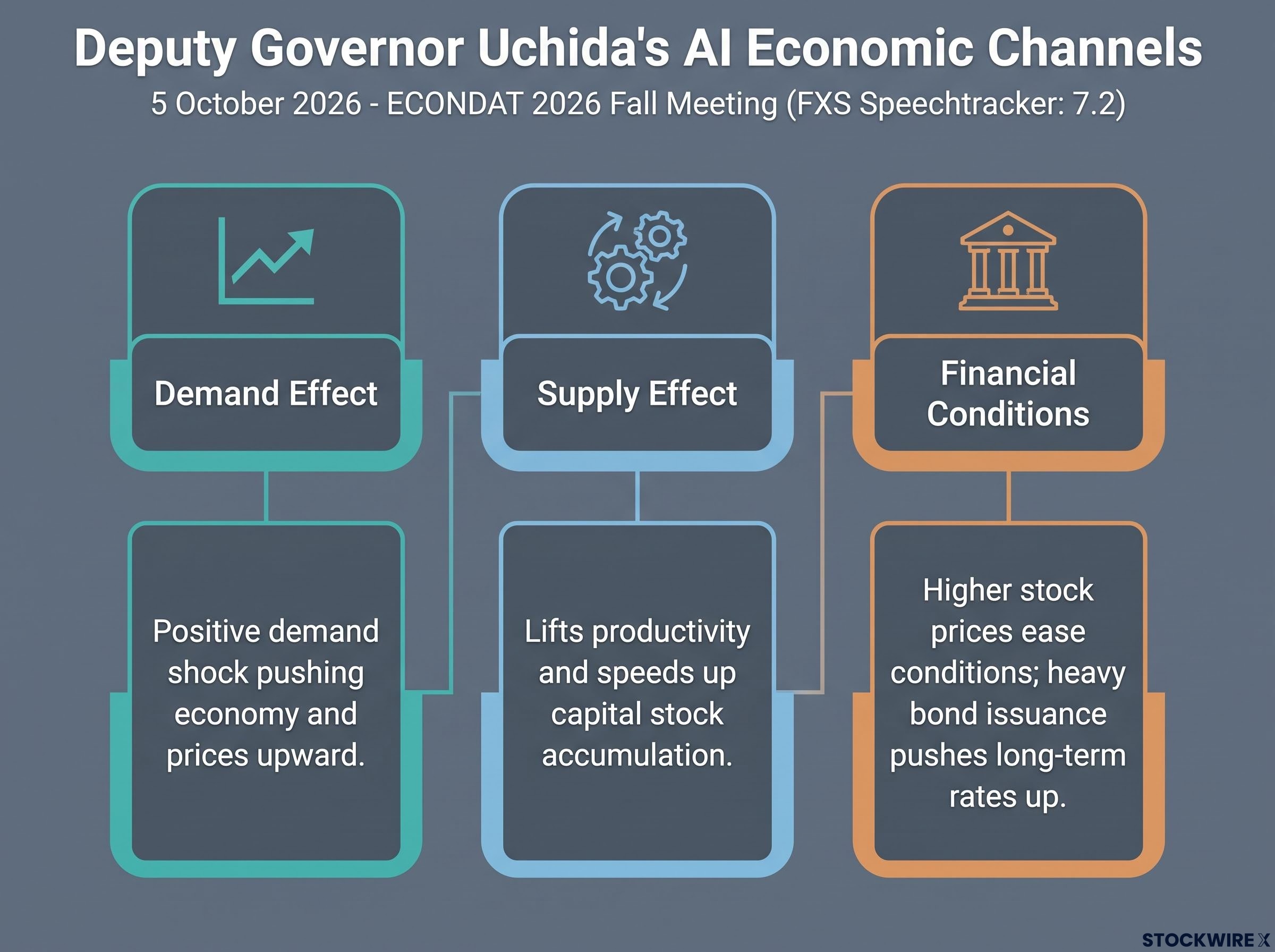
AI has become a leading subject for central banks, including the BoJ’s policy meetings. (Uchida’s remarks, as reported by FXStreet)
Uchida tentatively placed the demand effect first, making conditions more accommodative overall. He also flagged a correction risk if corporate profits fail to materialise.
How FXStreet scored it
FXStreet judged the speech modestly hawkish, treating AI as an upside risk to growth and prices, and mildly supportive for the yen. The logic: if AI can lift demand and equilibrium rates, a BoJ tolerating persistent upside surprises looks less likely.
It scored 7.2 on the FXS Speechtracker, equal to Uchida’s average. That tells you this was a continuation of his usual tone, not a pivot, so read it as a signal about direction rather than a trigger for repricing.
The case for caution
The BoJ remains gradualist and data dependent. The 7-2 September vote shows internal dissent, and Japan’s long history of low inflation may keep the bank from hiking aggressively.
When big ASX news breaks, our subscribers know first
How does AI move rates? The channels behind the speech
The educational foundation: output gap and neutral rate
The output gap is the difference between what an economy is producing and what it could sustainably produce. A positive gap means demand is running hot, which tends to push prices up, so central banks track it.
Financial conditions describe how easy or costly it is to borrow and invest, shaped by share prices, bond yields and credit availability. The neutral rate (also called the equilibrium or “star” rate) is the interest rate that neither stimulates nor restrains the economy. If AI raises it, today’s rate is looser than it looks.
The output gap and neutral rate only matter because of how central banks set rates: a policy rate that moves overnight lending costs and then transmits into mortgages, business loans and asset prices.
Why the channels pull in opposite directions
Uchida’s own observation shows the tension. AI optimism has lifted equities, which raises wealth, lowers firms’ cost of capital and eases conditions.
Meanwhile, data centres, semiconductors and energy grids are often funded by bond issuance. More long-dated supply can raise term premiums (the extra yield investors demand for holding longer bonds), pushing long-term rates up.
Productivity adds a third layer. The IMF and OECD have argued AI could raise potential growth, which would lift the real neutral rate, but that depends on how widely AI spreads. Inflation risk runs both ways: lower unit labour costs are disinflationary, while investment booms, specialist wage pressure and concentrated pricing power are inflationary.
| Channel | Mechanism | Effect on financial conditions | Effect on rate expectations | Main risk |
|---|---|---|---|---|
| Equity/wealth | AI optimism lifts share prices | Easier | Higher | Profit disappointment, correction |
| Bond supply/term premium | Heavy AI-related issuance | Tighter | Higher long rates | Structural rise in long yields |
| Productivity/supply | Higher potential output, lower unit labour costs | Neutral to easier | Higher neutral rate, lower inflation pressure | Slow diffusion |
| Demand shock | Investment and spending surge | More accommodative | More hikes | Inflation overshoot |
This tells you AI can ease and tighten conditions at once. Stop asking whether AI is “hawkish or dovish” and ask which channel is dominant at a given moment.
Where does 1.25% leave the BoJ? Policy path and the neutral-rate question
AI arrives just as the BoJ is asking how far is far enough. The path there was long:
- 2013: Quantitative and Qualitative Easing begins, with large asset purchases.
- 2016: Negative interest rates and yield curve control on 10-year government bonds are added.
- March 2024: The BoJ abandons its ultra-loose stance with its first hike.
- June 2026: The policy rate reaches 1%.
- September 2026: A 25 bp hike takes it to 1.25%.
The September move was widely expected and described as preemptive, as underlying inflation approaches the roughly 2% target. The complementary deposit facility is 1.25% and the basic loan rate 1.5%, effective 24 September 2026.
Crucially, 1.25% sits inside the BoJ’s estimated nominal neutral range of 1.1%-2.5%. AI also appears in leadership’s own risk list.
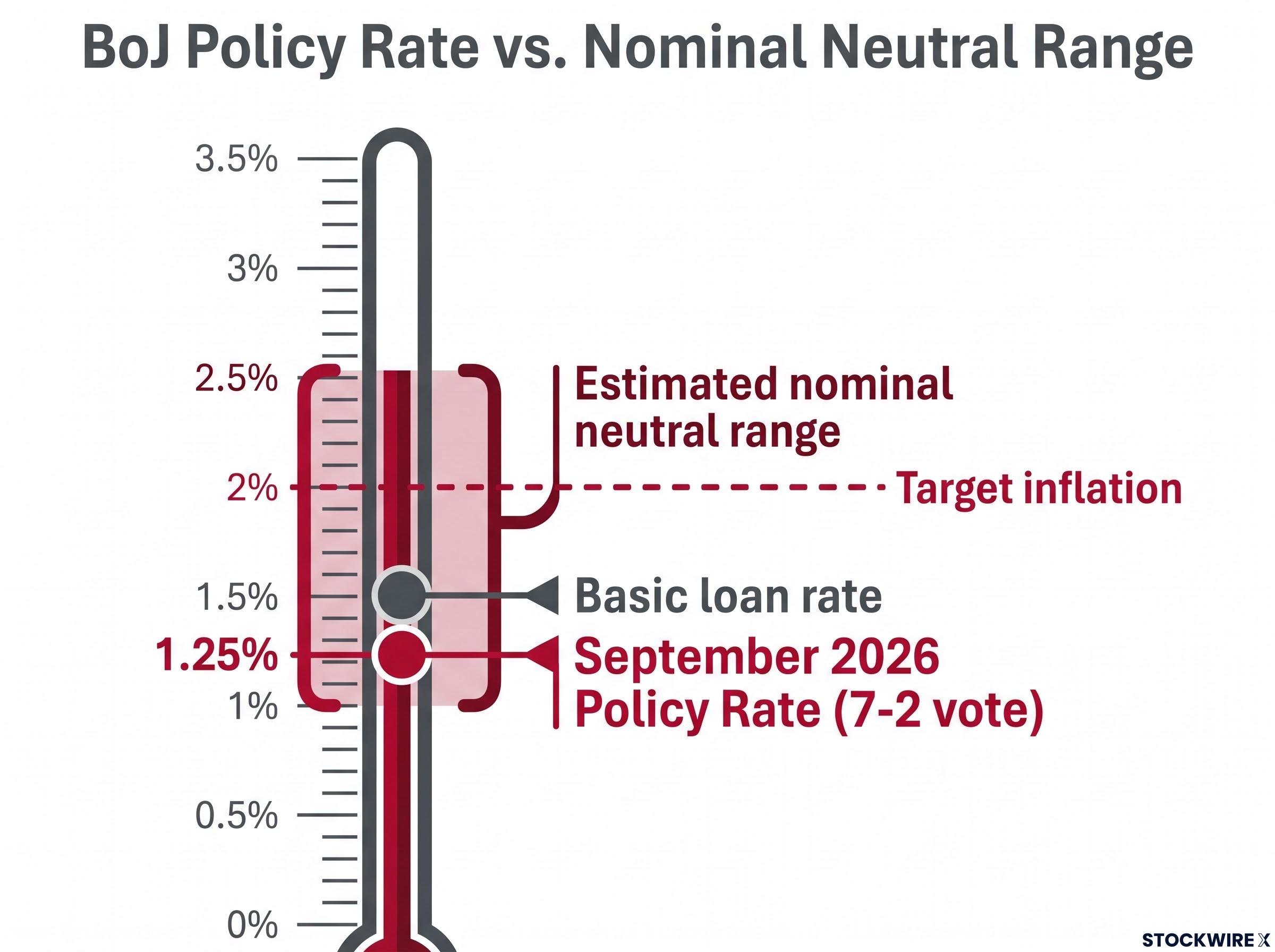
The decision took into account “various risks like the war in Iran, the expanding market demand for artificial intelligence and currency fluctuations.” (Governor Kazuo Ueda, via AP, 18 September 2026)
Inside the neutral range, each further hike is a judgement call rather than a normalisation step. Expect the AI-driven neutral-rate debate to matter more to future decisions.
Institutional research projects AI-driven neutral rate shifts of 25-60 basis points in frontier economies like the US, while the effect on Japan and the euro area is judged modest or indeterminate without faster adoption.
What could AI mean for the yen, and what history warns about
The bullish case is straightforward. A demand-led AI boom means more hikes, which supports the yen, and that is the thrust of FXStreet’s “mildly supportive” reading. It is a reading, not a forecast.
Then complicate it. Global AI equity gains can spill into risk appetite and weaken safe-haven demand for the yen. No market-implied probabilities or consensus forecasts for the next BoJ move were found, so none are offered here.
| Scenario | Demand/supply effect | BoJ rate implication | Yen implication |
|---|---|---|---|
| Demand-led AI boom | Demand outpaces supply | More hikes | Supportive, though risk appetite may offset |
| AI profit disappointment | Equity correction, tighter conditions | Lower neutral-rate estimates, fewer hikes | Less rate support |
| Productivity without demand | Supply gains, weak demand | Lower equilibrium inflation, fewer hikes | Less rate support |
The Federal Reserve, European Central Bank and Bank of England have all discussed AI through productivity, neutral-rate and inflation lenses, so the BoJ is joining a global conversation. History says hold the narrative loosely:
- Late-1990s US IT boom: productivity gains and strong equities, then a correction when profit expectations proved excessive.
- Mid-2000s housing boom: perceived structural change lifted neutral-rate estimates before a bust exposed misjudged risks.
- Japan’s late-1980s bubble: a structural story coexisted with mispriced risk.
A rate view built on AI needs a stated assumption about profits and demand. Without one, you are guessing which scenario you are in. These scenarios are speculative and subject to change based on market developments.
The correction risk Uchida flagged has a market-structure twin in AI model convergence, where crowded positioning and correlated automated de-risking can turn an earnings disappointment into a sharper equity unwind.
What AI changes for the BoJ, and what it leaves unsettled
AI has moved from a technology theme to an input in the BoJ’s assessment of the output gap, financial conditions and neutral rate. The speech itself is FXStreet-reported only and fits a gradualist path.
Three variables deserve your attention: AI-related corporate earnings against the correction risk, long-term yields as bond issuance continues, and BoJ communication on the neutral rate.
The framework of demand versus supply, and equity versus bond-supply, will outlast any single speech read.
This article is for informational purposes only and should not be considered financial advice. Investors should conduct their own research and consult with financial professionals before making investment decisions.