A drone attack shut down a pipeline capable of moving up to 7 million barrels per day, and the oil price spike it triggered barely outlived a single trading session. That gap, between the headline severity and the market’s verdict, is the entire story.
This is a case study in how geopolitics and oil prices actually interact in a modern, well-supplied market. The pipeline in question, Saudi Arabia’s East-West line (also called Petroline), exists specifically to route crude around the Strait of Hormuz. So shutting it down does not replace Hormuz anxiety; it stacks a second worry on top of it.
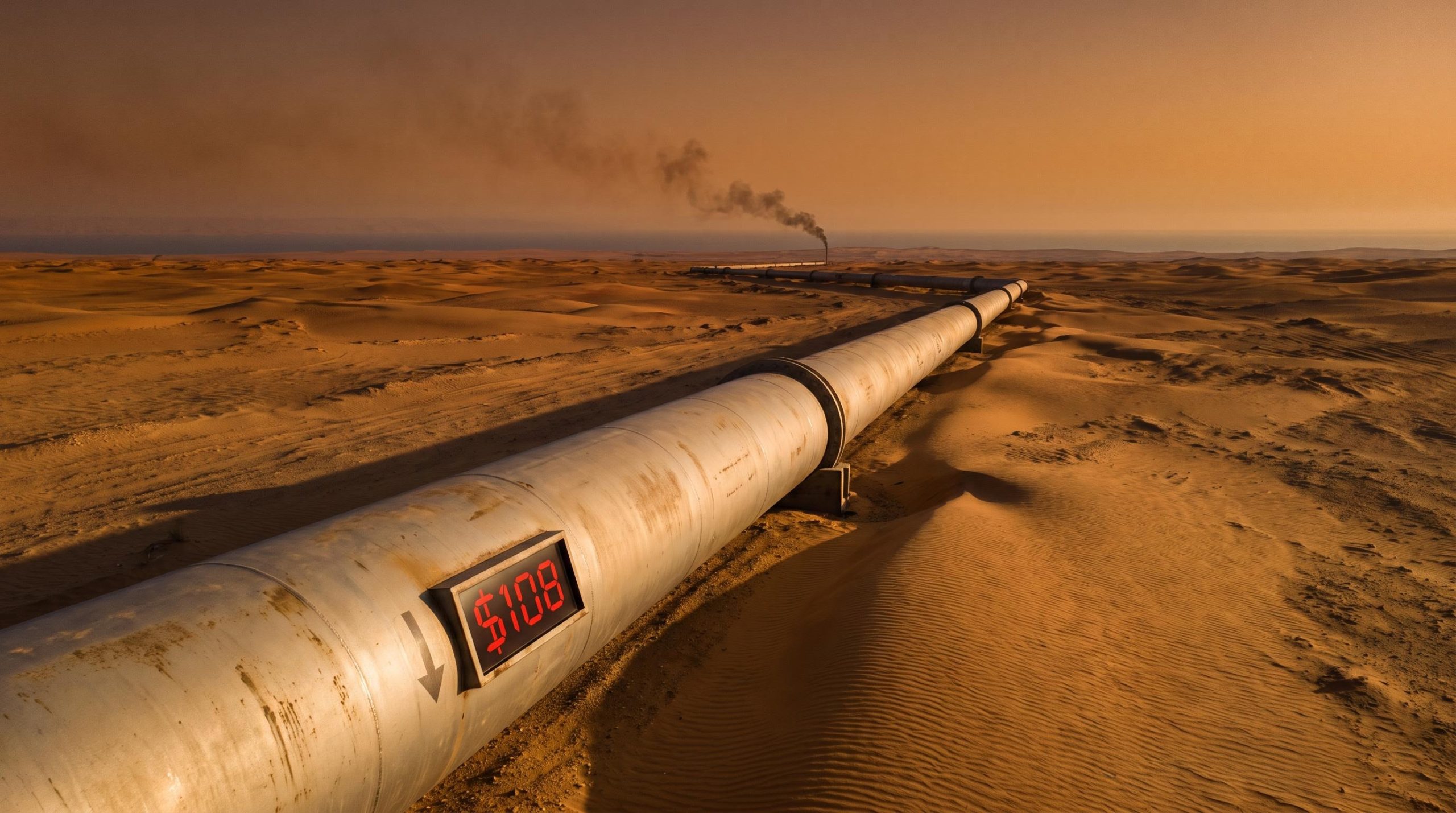
Brent crude touched roughly $108 a barrel intraday on 14 September 2026 before sliding back toward $107, and the reversal happened while the pipeline was still offline. The market looked at a genuine supply disruption and decided it did not matter much.
After reading this, you will have a working tool for the next Gulf headline: the three conditions that determine whether an oil spike reshapes the market or merely borrows from it before handing the gains straight back.
How the pipeline attack compounded an already-stressed supply picture
To understand why this attack landed harder than a routine outage, start with what the East-West pipeline is for. It carries Saudi crude westward across the Arabian Peninsula to Red Sea terminals, giving Riyadh a way to export oil without sending a single barrel through the Strait of Hormuz.
That bypass function is its strategic value. When the pipeline goes dark, two separate risk factors switch on at once:
- The Hormuz workaround disappears, leaving Saudi exports more dependent on the very chokepoint the pipeline was built to avoid.
- The Red Sea export route it feeds is disrupted, adding to concerns already circling the Bab-el-Mandeb strait.
That is why the closure is geometrically worse than losing an equivalent volume from a standalone field. The barrel count alone understates it.
On 11 September 2026, Saudi authorities reported that drones launched from Iraqi territory, attributed to Iran-aligned proxy militias based in Iraq, struck the pipeline in the Riyadh and Medina regions. The strikes caused fires, injuries and material damage, and the Ministry of Energy shut the line down as a precautionary measure while it assessed the situation.
The timing is the point. Saudi Arabia’s Hormuz alternative went offline at the precise moment Hormuz itself is under active diplomatic and military stress, which is what turned a repairable outage into a market event.
April 2026 versus September 2026: a pattern of infrastructure targeting
This was not a first strike. In April 2026, a drone attack on a key pumping station cut throughput by roughly 700,000 barrels per day, before Saudi Arabia’s Ministry of Energy confirmed full capacity of around 7 million barrels per day had been restored, reported by ICIS on 13 April 2026.
The contrast with September is the tell. April was resolved within days; as of 14 September 2026, reporting from CNBC, Al Jazeera, CNN and the New York Times described the pipeline as still shut, with no confirmation that flows had resumed.
Hitting the same asset twice in one year signals intent, not opportunism. For the market, that shifts the East-West pipeline from a one-off casualty into a recurring line item, which is exactly how traders began to treat it.
When big ASX news breaks, our subscribers know first
Why Brent briefly touched $108 and then gave it all back
The price action tells its own story if you read it as a sequence of competing signals rather than a single move. In the days before the attack, Brent was already elevated: it settled at $97.31 on 7 September after an intraday high of $98.06, then $97.92 on 8 September as Houthi attacks on Saudi energy facilities kept the pressure on.
When the pipeline shutdown hit, Brent surged toward $108 intraday on fears that Saudi supply could be curtailed within days, according to The Telegraph on 14 September 2026. That was the market reacting to the headline.
Then it started reading the fundamentals. Brent slid back toward $107 while the pipeline remained shut, meaning the reversal had nothing to do with the outage ending. Traders simply decided the disruption was survivable.
The baseline that made the spike look excessive almost immediately came from J.P. Morgan.
The risk premium was already thin A J.P. Morgan analysis in September 2026 assessed the global oil market as oversupplied, with traders pricing only around $2 per barrel of geopolitical risk premium despite heightened US-Iran tensions.
That $2 per barrel figure is the key to the whole episode. It tells you professional oil traders were already treating Gulf risk as a manageable, recurring background charge rather than an acute emergency, so a jump toward $108 was never going to sit still.
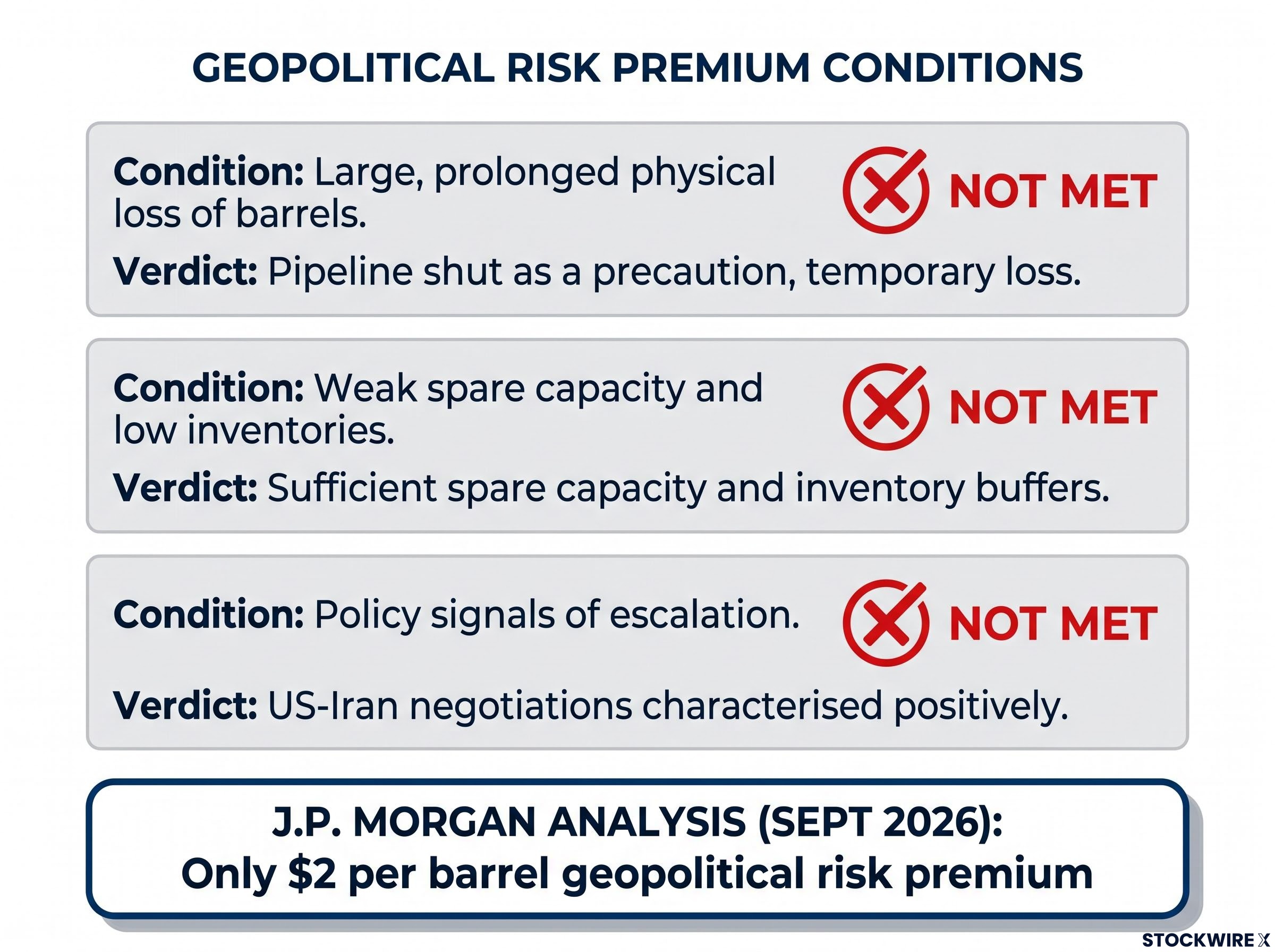
Institutional analysis points to three conditions that must coincide for a geopolitical shock to produce a lasting price move. In this episode, none of them was firmly met.
| Condition for a sustained move | What this episode showed | Verdict |
|---|---|---|
| Large, prolonged physical loss of barrels that cannot be quickly replaced | Pipeline shut as a precaution; damage assessment suggested manageable, likely temporary loss | Not met |
| Weak spare capacity and low inventories | Producer spare capacity and inventory buffers seen as sufficient to absorb the outage | Not met |
| Policy signals of escalation rather than de-escalation | Active US-Iran negotiations characterised positively; Saudi framing of the closure as precautionary | Not met |
Once Saudi officials framed the closure as precautionary rather than a long-term shutdown, the speculative premium had nothing to anchor to. The read for you is straightforward: chasing a commodity move driven by a headline the market has already partly priced, or is about to reassess within hours, is how you end up buying the top.
What the US-Iran diplomatic track tells you about the risk premium
The diplomatic backdrop is best understood as a series of partially closed doors, because that is exactly how the market is reading it. The picture is neither hopeful nor alarming; it is structurally ambiguous, and that ambiguity is what keeps the risk premium thin rather than expanding.
The sequence matters:
- In June 2026, Trump signed a preliminary framework promising the immediate and permanent termination of military operations, the reopening of Hormuz, and a 60-day window to negotiate a comprehensive deal, though major sticking points on sanctions relief and Iran’s enriched uranium remained unresolved.
- A planned meeting between Iran and other Gulf-region producers was cancelled, with Oman announcing the talks were abandoned due to an anticipated lack of agreement.
- On 5 August 2026, Reuters reported Trump describing an “all-day negotiation” with Iran in positive terms, while simultaneously warning the US would hit Iran “really hard” if no deal was reached.
That dual posture, active negotiation paired with an explicit escalation threat, is the signal that matters. It tells you Washington is managing the situation rather than letting it deteriorate, and a market that believes a crisis is being managed does not price acute risk.
This is also why the diplomatic track, not the pipeline damage report, drove the oil reversal. Trump’s signals of engagement gave traders permission to step back from the intraday high, because the policy direction pointed toward de-escalation rather than a widening conflict.
Diplomatic collapse risk has already produced measurable price dislocations in this cycle: when JD Vance cancelled scheduled Geneva peace talks in June 2026, Brent fell below $80 per barrel on approximately 10% weekly losses, demonstrating that the diplomatic track moves prices with at least as much force as infrastructure headlines.
The Strait of Hormuz fee standoff: why Gulf producers and Washington agree on rejection
The one genuine impasse sits over Hormuz transit fees. Iran has sought the right to collect mandatory fees plus broader concessions, including sanctions relief and an end to the US naval blockade. Reported Iranian proposals in the 5-7% of cargo value range have not been independently confirmed.
Oman has floated an alternative: a Gulf-backed plan for joint regional management funded by voluntary service fees rather than compulsory tolls. The US has firmly rejected any fee or toll regime, insisting Hormuz is an international waterway that must remain free of Iranian control.
The logic behind that rejection is what makes Gulf producers and Washington natural allies. A mandatory Iranian fee would effectively recognise Tehran’s veto power over a global chokepoint, a precedent Saudi Arabia, the UAE and Qatar have every reason to resist. Shipping industry representatives quoted by Reuters described Iran’s proposed structure as “not feasible” within existing contracts.
For anyone tracking oil, the takeaway is that the diplomatic temperature, not the infrastructure headlines, is what the market is actually pricing. Watch the negotiation signals first.
Gold, the dollar, bonds, and Bitcoin: what the war-trade showed and why it faded
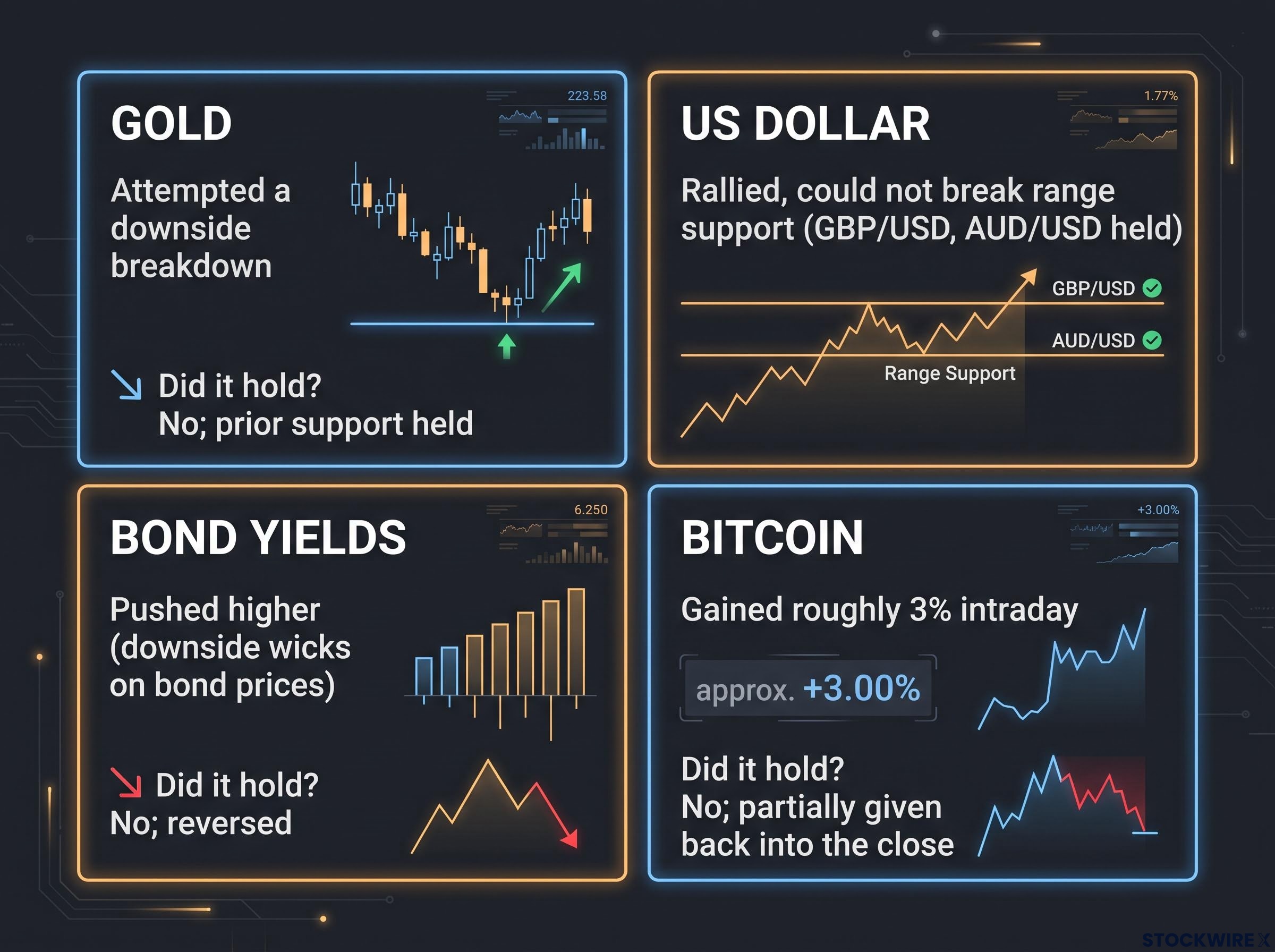
The move was not confined to oil. For a session, the familiar war-trade playbook activated across four asset classes, then failed at every level. That simultaneous activation and simultaneous collapse is the diagnostic signal, not background noise.
| Asset | Move during the spike | Did it hold? |
|---|---|---|
| Gold | Attempted a downside breakdown | No; prior support held |
| US dollar | Rallied, but could not break range support on major pairs (GBP/USD, AUD/USD held) | No |
| Bond yields | Pushed higher (downside wicks on bond prices) | No; reversed |
| Bitcoin | Gained roughly 3% intraday | No; partially given back into the close |
Read the table as a whole and the message is unambiguous. When gold, the dollar, bonds and Bitcoin all attempt the classic escalation trade and all fail to hold within the same session, professional markets have collectively decided this is a headline shock, not a regime change.
Where the attention went next Once oil retreated, market focus rotated back toward currency debasement and central bank policy themes, the concerns the brief war-trade had temporarily displaced.
For anyone with exposure spread across asset classes, that pattern is the calibration tool. A geopolitical correlation spike that holds across markets may signal genuine structural repricing worth positioning around. One that fails across every asset in a single session, as this one did, belongs firmly in the transient category.
What would need to change for the next spike to hold
Descriptive analysis only helps if it hands you something to watch for next time. The three conditions for a sustained move double as a forward-looking checklist:
- A prolonged physical loss of barrels. The trigger would be a confirmed multi-week pipeline outage with no rerouting capacity, not a precautionary shutdown resolved within days.
- Weak spare capacity and low inventories. Watch for an OPEC spare capacity drawdown into the low single-digit millions of barrels per day, the point at which buffers stop being reassuring.
- Policy signals of escalation. The signal here is a diplomatic framework collapsing outright rather than merely stalling.
History sets the bar high. In the September 2019 Abqaiq-Khurais attack, which knocked out more than 5% of global supply, Brent surged roughly 20% intraday to about $71.95 and WTI jumped around 15% to about $63.34, before both retreated as Saudi Arabia restored production.
That precedent is the reason the checklist matters. Even a historically large shock reverts quickly when repair capacity is credible and diplomatic signals are stable, so the variables worth watching are precisely the ones that would break those two anchors at the same time.
The dual-chokepoint scenario: when the Hormuz alternative disappears at the same time
Here is the scenario that could actually satisfy the first condition. The East-West pipeline’s entire value is as a Hormuz alternative. If the Houthis simultaneously disrupted Bab-el-Mandeb, the Red Sea routing option would vanish too, leaving no easy bypass.
The Houthis have been active disruptors of Red Sea shipping since late 2023, and their presence near Bab-el-Mandeb added to supply concern throughout this period. Simultaneous stress at Hormuz and Bab-el-Mandeb would remove both alternatives at once, the layered risk case that genuinely changes the arithmetic.
Tanker tracking data from late July 2026 confirmed that dual-chokepoint stress was already beginning to redirect supertankers toward Egypt’s Sumed Pipeline and Mediterranean loading terminals, a rerouting pattern that illustrates both the adaptive capacity of global supply chains and the limits of that capacity under sustained simultaneous pressure.
The counterweight, for now, comes from Lloyd’s List, which assessed that Houthi restrictions have not triggered widespread diversions and that Bab-el-Mandeb remains dangerous but navigable, with enforcement capacity limited by international naval presence. So the dual-chokepoint scenario is a real risk, not a present reality.
What the correction changes, and what it does not
The episode settled a few things and left others wide open. Separating the two is the whole exercise.
What it confirmed:
- The current Gulf risk premium is genuinely thin, validated by the J.P. Morgan $2 per barrel working assumption.
- Markets have internalised attack-and-repair as a repeating cycle rather than a shock, which is why a jump toward $108 could not hold.
- The diplomatic track is the controlling variable, not the infrastructure damage report.
What it did not resolve:
- The pipeline remained shut as of 14 September 2026, with no confirmed restoration.
- The US-Iran comprehensive deal is unsigned, with the June 2026 framework still incomplete despite the positive 5 August 2026 talks.
- The Houthi threat at Bab-el-Mandeb stays active and unaddressed.
The thin risk premium is not complacency. It is a calibrated bet that the current diplomatic track holds, which means a confirmed collapse of the Oman mediation channel would be the clearest sign that bet is being unwound. The conditions for a sustained move are not present today, but the infrastructure for one is quietly being assembled, and the diplomatic track is the leading indicator to watch. Verify current pipeline and diplomatic status independently before acting.
For investors wanting to translate the analytical framework in this article into specific portfolio decisions, our dedicated guide to geopolitical risk investing examines the behavioural biases that make headline-driven trading systematically costly, with research-backed alternatives for positioning through periods of sustained Gulf uncertainty.
Fragile de-escalation episodes have a consistent structural pattern: Brent fell 3.89% in a single session on 25-26 August 2026 purely on diplomatic sentiment, with no physical change in supply, and ING analysts flagged that tightening inventories could push prices back above $100 if flows failed to normalise, a dynamic that maps directly onto the September pipeline episode’s rapid reversal.
This article is for informational purposes only and should not be considered financial advice. Investors should conduct their own research and consult with financial professionals before making investment decisions. Past performance does not guarantee future results, and financial projections are subject to market conditions and various risk factors.