
France’s 10-year borrowing cost now sits near where it stood when the euro was still finding its feet, and the premium investors demand over Germany has just crossed a threshold not breached since the 2012 eurozone debt crisis. That is not a blip. It is a repricing, and the France fiscal crisis now unfolding in sovereign bond markets is being driven by a combination of structural debt, political fragility, and a budget whose passage is anything but assured.
If you have noticed the headlines about French bond yields but have not yet connected the threads, this is where the pieces fit together. The yield level says something specific about French government finances. The political situation makes near-term improvement unlikely. And that risk is now travelling into the euro itself.
The proximate catalyst is the 2027 budget bill, presented on 1 October 2026. But the story behind it runs deeper and reaches further back.
Here is what the data tells you about how far France has drifted from its fiscal anchors, what the budget’s prospects actually are, and why that combination is putting pressure on the shared currency right now.
Yields at a 24-year high: what the bond market is actually signalling
Start with the number itself. French 10-year OAT yields eased to 4.87% on 2 October 2026, according to TradingEconomics, after touching an intraday peak of 4.96% the previous day as reported by Il Sole 24 Ore. Both readings sit at the highest level since 2002.
Two decades matters as a frame because it strips the current episode of any sense that this is ordinary market noise. The last time France borrowed at these rates, the euro was three years old and still establishing itself as a credible single currency.
Sovereign bond yields encode more than a single risk premium; they reflect a composite of inflation expectations, central bank policy signals, and fiscal credibility assessments, which is why a sustained move of the kind France is experiencing carries more diagnostic weight than any single session’s price action.
The more revealing signal, though, is the spread. Politico reported that the premium investors demand to hold French 10-year debt over the German equivalent crossed 130 basis points, a level last seen during the 2012 eurozone debt crisis.
The premium investors demand to hold French 10-year bonds over their German counterparts has crossed 130 basis points, a level not seen since the 2012 eurozone debt crisis. (Politico, 1 October 2026)
A spread above 130 basis points tells you that professional sovereign investors are now demanding crisis-era compensation to hold French debt. When a core euro-area member starts trading on those terms, the market is no longer treating it as a routine safe asset.
| Metric | Value | Date | Source |
|---|---|---|---|
| French 10-yr OAT yield | 4.87% | 2 October 2026 | TradingEconomics |
| French 10-yr OAT yield (intraday peak) | 4.96% | 1 October 2026 | Il Sole 24 Ore |
| OAT-Bund spread | 130-150 bp | 1-2 October 2026 | Politico; Pollar.news |
From core to semi-core: what spread widening actually reclassifies
Sustained spread widening is not just an abstract signal. It feeds directly into higher debt-service costs that compound on an already large debt stock, and it narrows the market’s tolerance for any further fiscal slippage.
It also sends a message to other high-debt euro-area members: if France can be repriced, so can they.
The comparison increasingly drawn is with Italy, which has run debt above 130% of GDP with repeated bouts of spread volatility yet without outright default. France is not there, but the trajectory of market perception is pointing that way. The reclassification from pure core sovereign toward something closer to semi-core is the real story the yield curve is telling.
The core-periphery inversion that placed France above Italy on borrowing costs was itself the product of the same diverging deficit and debt trajectories the current budget bill is failing to credibly address, making the spread-widening the current article describes a continuation rather than a new shock.
When big ASX news breaks, our subscribers know first
The structural problem a budget bill cannot fix in one year
The yield level makes more sense once you look at the fiscal anchors underneath it. France’s general government debt stood at 117.6% of GDP at the end of Q1 2026, according to Eurostat, with INSEE’s near-identical figure of 117.5%. The Associated Press has published an alternative estimate of roughly 119%. For context, the end-2025 reading was 115.7%, so the direction of travel is up.
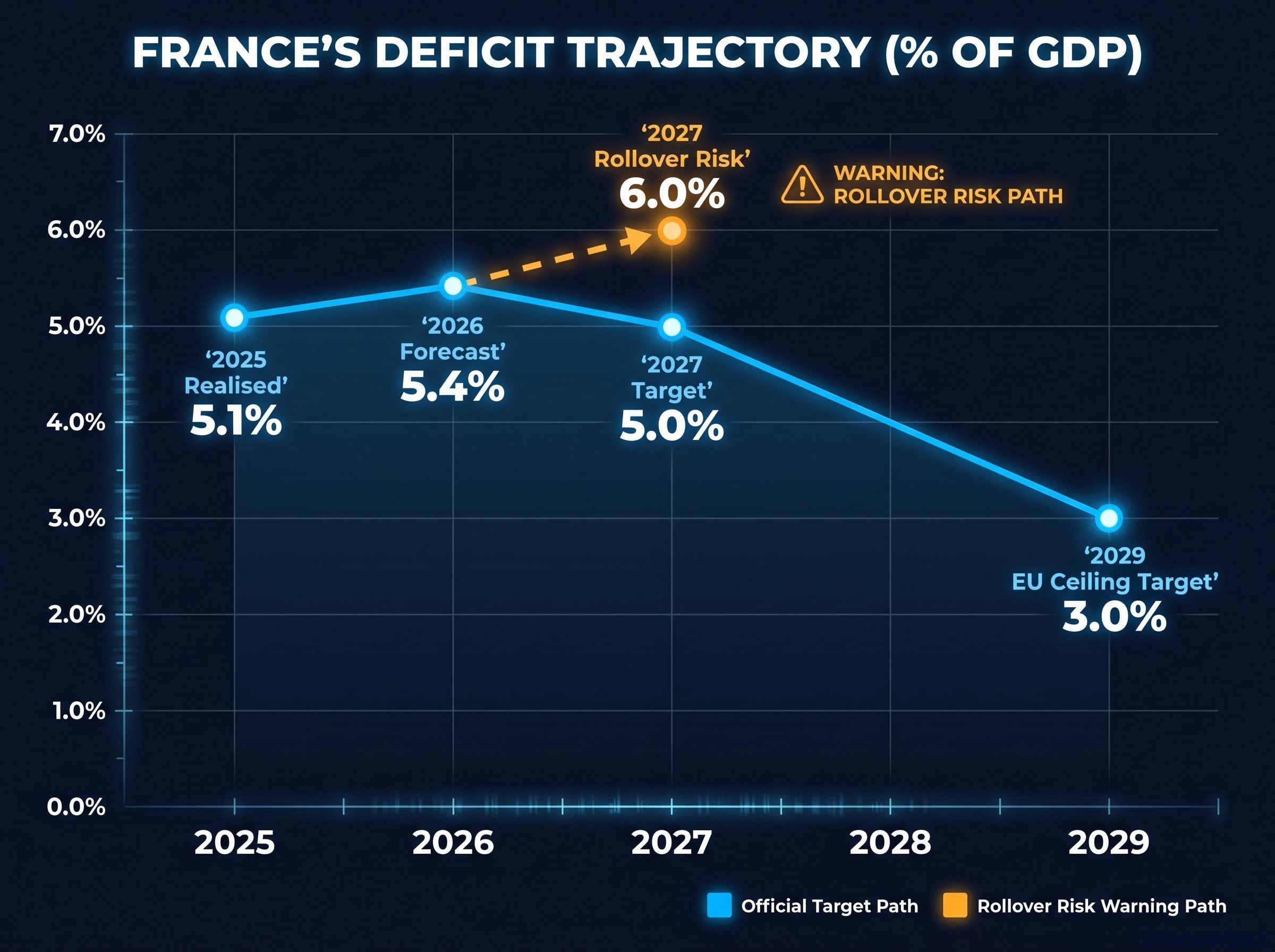
The deficit path is where the pressure becomes concrete. France realised a 5.1% deficit in 2025 per INSEE, forecasts 5.4% for 2026, targets 5.0% for 2027 under the proposed budget, and has committed to the EU’s 3.0% ceiling by 2029.
| Year | Deficit (% of GDP) | Status | Source |
|---|---|---|---|
| 2025 | 5.1% | Realised | INSEE |
| 2026 | 5.4% | Forecast | French government via Politico |
| 2027 | 5.0% | Target | French government via Politico/Reuters |
| 2029 | 3.0% | EU ceiling (committed) | EU rules |
Read that table as a compression problem. Moving from a 5.0% target in 2027 to the 3.0% ceiling by 2029 means cutting the deficit by two full percentage points in two years. That is a demanding adjustment anywhere, and it is especially demanding in a political environment that has historically resisted exactly this kind of consolidation.
Why are the numbers where they are? Three structural drivers do most of the work:
- Spending rigidity: A large public-spending structure built around pensions, healthcare, social transfers, and public wages that is politically difficult to cut meaningfully.
- A tax ceiling: An already high tax burden that leaves little room to raise revenue without harming growth or triggering backlash.
- Interest rate normalisation: The move away from post-financial-crisis ultra-low rates, which crystallises the true cost of carrying a debt stock above 117% of GDP.
That last driver is the one quietly doing the most damage, because it converts a legacy debt pile into a rising annual bill. France’s independent fiscal watchdog has already warned that the economic assumptions embedded in the budget are overly optimistic, which means even the modest 5.0% target for 2027 may prove hard to hit. What you are looking at is not a bad year. It is a trajectory.
Rate normalisation is the structural force quietly compounding France’s debt-service burden: a legacy debt stock above 117% of GDP that was manageable at post-crisis suppressed yields becomes materially more expensive when borrowing costs return to pre-QE norms, and the current OAT yield near 4.9% illustrates exactly that arithmetic.
The ECB warning on French debt, delivered by Christine Lagarde in September 2026, broke with the central bank’s longstanding convention of avoiding public criticism of individual sovereigns and accelerated the repricing now reflected in the 130 basis-point OAT-Bund spread.
Why the 2027 budget is unlikely to resolve investor anxiety
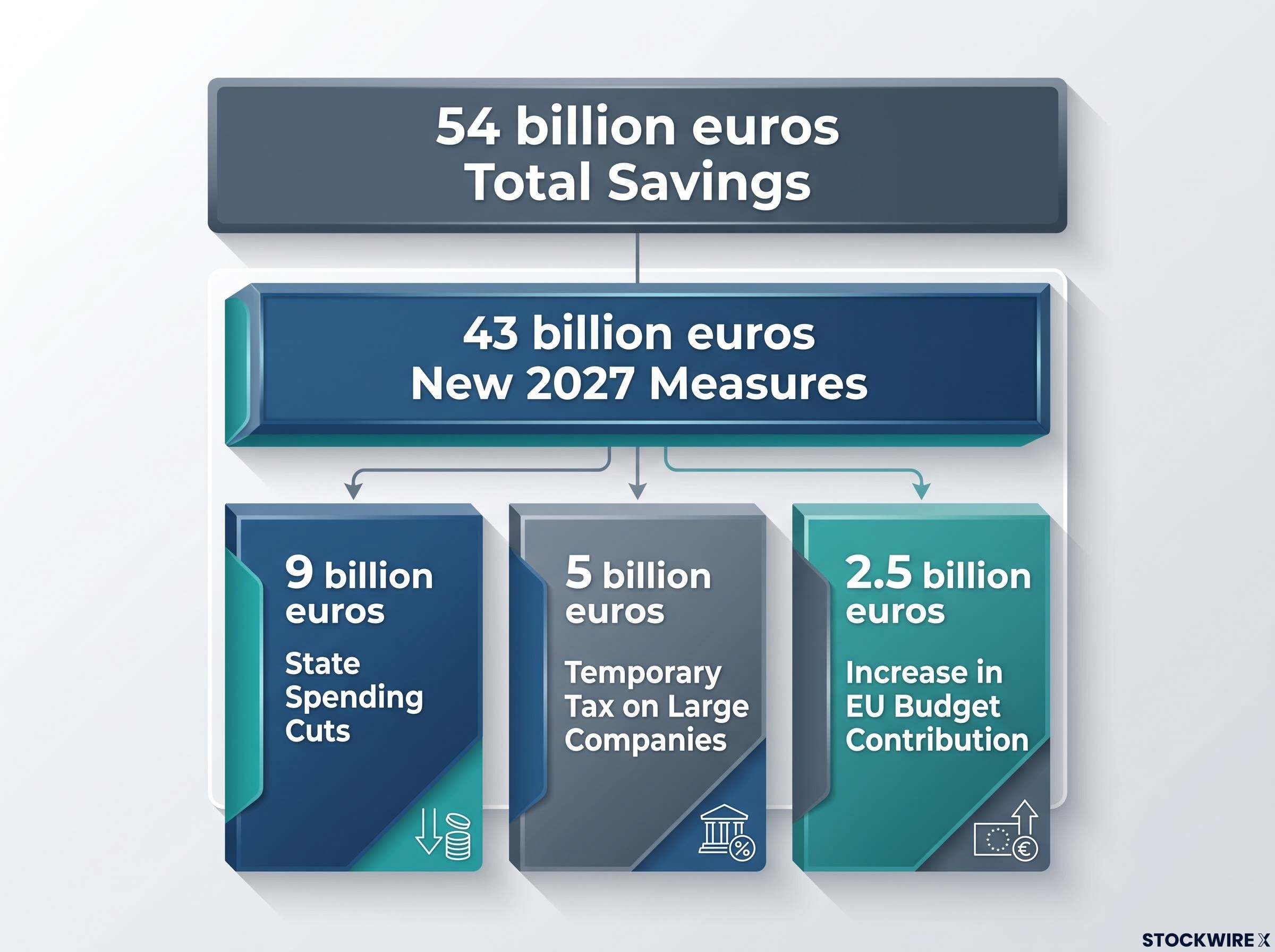
The budget itself is a serious consolidation attempt. Finance Minister Roland Lescure cited total savings of 54 billion euros, of which 43 billion are new 2027 measures. The headline package is substantial on paper.
The measures fall across spending restraint and targeted revenue:
- 9 billion euros in state spending cuts.
- A freeze on public-sector wages.
- A freeze on all but the lowest pensions.
- Curbs on local government budgets and healthcare costs.
- An extended temporary tax on large companies, expected to yield roughly 5 billion euros, alongside a 2.5 billion euro increase in France’s EU budget contribution.
Here is where the fiscal logic and the political prospects separate into two very different questions. The budget’s arithmetic is coherent. Its passage is not.
The constraint is precise. The government holds minority status in parliament, which means it needs backing from Marine Le Pen’s National Rally to pass legislation. BBH analyst Elias Haddad has assessed that a budget rollover, meaning failure to pass the 2027 bill at all, is the most probable outcome, reflecting deep scepticism that workable support will materialise.
BBH’s Elias Haddad estimates that a rollover of the 2026 budget could push France’s 2027 deficit from roughly 5.4% toward around 6.0% of GDP. (Analyst estimate; not independently confirmed.)
A rollover would not freeze the deficit in place. It would let it drift wider, undoing the consolidation the budget is designed to deliver and widening the very gap markets are already worried about.
The Le Pen factor and what minority government means for fiscal credibility
The political arithmetic creates leverage. Because the government needs National Rally support, Le Pen’s party can press for amendments that dilute the consolidation measures, and the presidential election on 18 April 2027 gives both sides incentive for brinkmanship.
A budget built to placate Le Pen’s party while reassuring bond markets is trying to serve two audiences whose preferences point in opposite directions. That tension is precisely what makes real consolidation harder than the 54 billion euro headline suggests.
France also has a documented history of diluting deficit-reduction plans under political pressure. A minority government, dependence on far-right backing, and an election one year out together replicate the conditions in which past slippage occurred. For you, the read is straightforward: a fiscal plan and a fiscal plan that passes intact are two different things, and bond markets are pricing the gap between them.
How French fiscal stress is moving through the euro
The stress is no longer confined to bonds. During the European session on 2 October 2026, the euro was the weakest major currency, and the pattern of its decline is where the signal sits.
| Currency Pair | Move (%) | Direction | Note |
|---|---|---|---|
| EUR/CHF | -0.41% | Euro weaker | Most affected pair |
| EUR/JPY | -0.35% | Euro weaker | Fell toward 177.00 |
| EUR/GBP | -0.19% | Euro weaker | Moderate decline |
| EUR/USD | -0.13% | Euro weaker | Smallest move |
Lead with the Swiss Franc. The EUR/CHF move was the largest of the session, and that is no accident. The Franc is the natural first destination for capital stepping away from French fiscal risk, given Switzerland’s proximity, its deep financial links with France, and the currency’s long-standing European safe-haven status, according to FXStreet analyst Sagar Dua.
The transmission mechanism runs from spread to currency. When risk premia climb on a large core euro-area sovereign, they raise doubts about the fiscal coherence of the entire currency area, and that weighs on the euro most heavily against safe-haven alternatives.
The Swiss Franc strengthened roughly 0.41% against the euro and 0.29% against the US dollar during the session, confirming safe-haven demand. (FXStreet, 2 October 2026)
Notice the asymmetry: the EUR/CHF move was nearly three times larger than the EUR/USD move. That tells you this is a specifically European stress event, not a broad dollar-strength story. For anyone watching European currency exposure, it means the budget headlines will register first and hardest in the safe-haven crosses.
What about the ECB? Tools including the Transmission Protection Instrument exist as a potential floor under French spreads. But their deployment depends on conditions that may not currently be met, and critically, their existence has not stopped the current repricing.
The ECB’s Transmission Protection Instrument was designed specifically to counter unwarranted spread widening in euro-area sovereign markets, but its activation criteria include conditions around fiscal compliance and the absence of severe macroeconomic imbalances, conditions that France’s current trajectory may complicate.
What the data on France’s fiscal trajectory actually means for investors right now
Pull the four threads together and a single picture emerges. France is undergoing a sustained reclassification in investor perception, from core toward semi-core sovereign. Political fragility, structural spending rigidity, and a deficit still more than two percentage points above the EU ceiling mean that reclassification is unlikely to reverse quickly, whatever version of the budget eventually clears parliament.
The debt level is the anchor beneath everything. At 117.6% of GDP, each percentage-point rise in average borrowing cost adds roughly 1.2 percentage points to the deficit through debt service alone (an illustrative calculation, not a sourced figure). That is why normalising interest rates matter so much on a stock this large.
Three variables that will define the next phase
- Budget passage, and in what form. Credible passage means the consolidation measures survive intact. Cosmetic passage means a package amended enough to dilute the headline savings. The difference is what bond markets will judge.
- The ECB response threshold. The Transmission Protection Instrument exists, but its deployment criteria include fiscal compliance conditions that France’s current trajectory may complicate, which is why the backstop has not yet acted as a ceiling on spreads.
- The 2027 election outcome. This is the structural reset point. It could produce a mandate for deeper reform or a further shift toward parties with limited appetite for consolidation, making it the most significant medium-term variable for French sovereign risk.
Here is the positioning insight to take away. If the budget passes in credible form, euro relief is likely to be limited and temporary. If it stalls or rolls over, with BBH flagging a possible 6.0% deficit in 2027, the downside for EUR/CHF and the broader euro crosses is more significant. The risk-reward on French fiscal optimism is currently skewed to the downside.
This article is for informational purposes only and should not be considered financial advice. Investors should conduct their own research and consult with financial professionals before making investment decisions. Past performance does not guarantee future results. Financial projections are subject to market conditions and various risk factors, and forward-looking scenarios cited here are speculative and subject to change based on market and political developments.