
Something once considered impossible is now a plain fact of the bond market: France borrows more expensively than Italy. Spain’s government now raises money at a lower cost than France when you measure the spread over the benchmark rate. The long-standing pecking order of European sovereign credit risk, a hierarchy that survived crisis after crisis and shaped two decades of fixed income strategy, has quietly turned upside down.
This is not a fleeting quirk sparked by one data release. It reflects a structural repricing of eurozone sovereign bond yields, built on fiscal paths that are pulling apart.
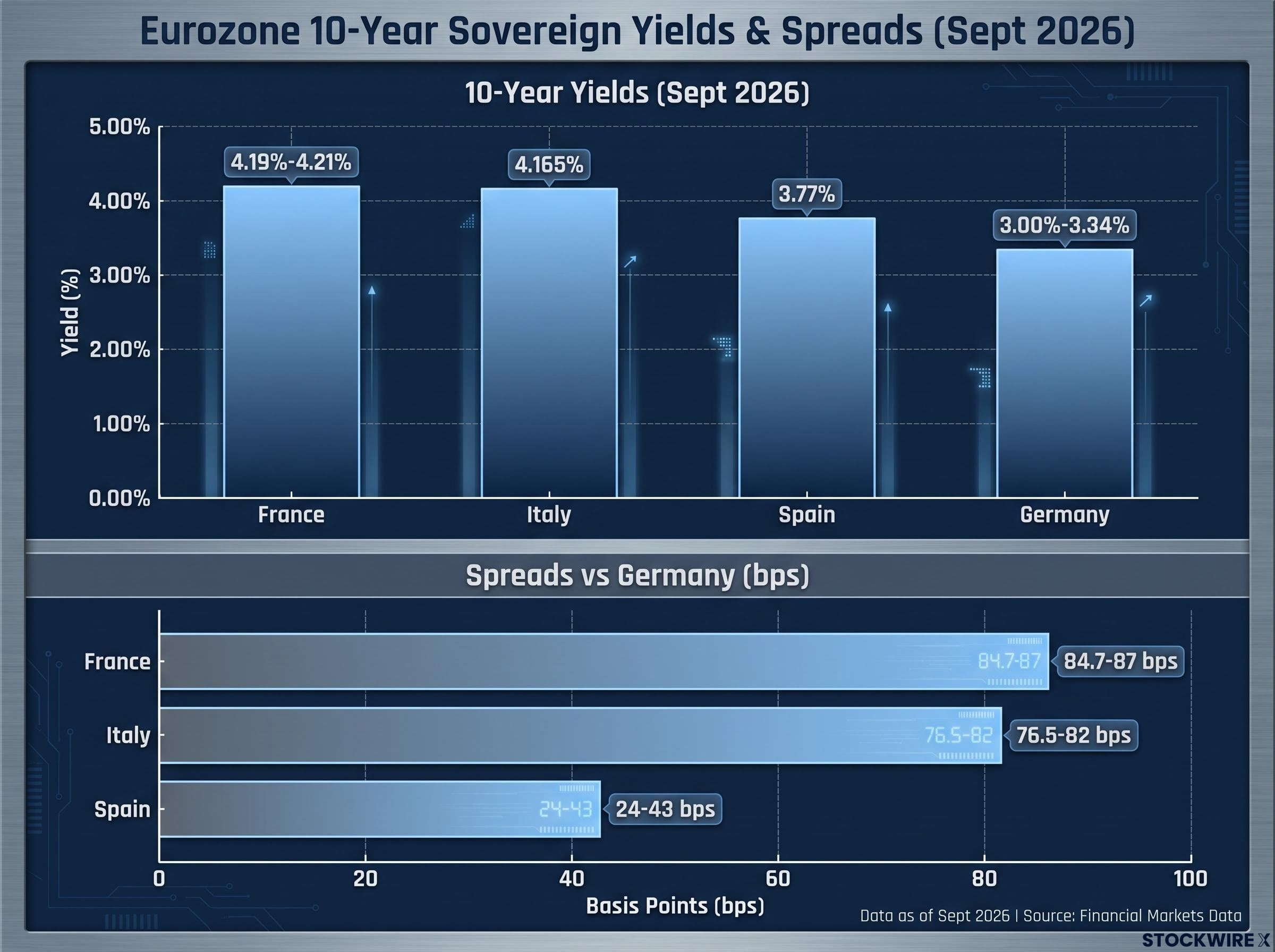
As of early September 2026, France’s 10-year yield sits near 4.20%, above Italy’s 4.17%. Germany’s Bund yield has climbed toward levels not seen since 2011, driven partly by a constitutional overhaul of its debt rules and a wave of fresh issuance. Spain, meanwhile, borrows at just 3.77%, and the gap between French and German 10-year bonds has reached its widest since at least 2012.
Here is what you need to understand about European sovereign debt before the next economic turn changes the calculus entirely: how this inversion happened, what the fiscal numbers behind it actually look like, and what the 2008-2011 crisis tells you about when yield divergence like this crosses from interesting to dangerous.
What the yield numbers are actually showing right now
Start with the raw figures, because they make the point better than any argument could.
France’s 10-year government bond yields roughly 4.19%-4.21%. Italy’s yields 4.165%. Read that twice. France, a founding pillar of the euro and long treated as core credit, now pays investors more to borrow than Italy, which spent most of the euro’s history in the market’s high-risk category.
Germany’s Bund yields somewhere in the 3.00%-3.34% range, with 3.27% reported as the highest level since May 2011. Spain comes in at 3.77%. For calibration, the U.S. 10-year Treasury sits above 4.8%, higher in absolute terms but still below its own 2023 peak.
| Country | 10-Year Yield (Sept 2026) | Spread vs. Germany (bps) | Notes |
|---|---|---|---|
| France (OAT) | 4.19%-4.21% | 84.7-87 | Widest vs. Germany since 2012* |
| Germany (Bund) | 3.00%-3.34% | Benchmark | 3.27% is highest since May 2011* |
| Italy (BTP) | 4.165% | 76.5-82 | Up from roughly 53 bps in early 2026* |
| Spain (Bonos) | 3.77% | 24-43 | Trading tighter than France in several tenors |
*Figures marked with an asterisk are reported but not independently confirmed.
A Financial Times analysis observed that the 10-year French OAT yield overtaking the Italian BTP was, until recently, considered “unimaginable.”
How spreads reveal the repricing more clearly than absolute yields
The absolute yield levels only tell you so much, because every eurozone country shares the same European Central Bank (ECB) policy rate. The spread over Germany, the extra yield investors demand relative to the Bund, strips out that shared rate environment and isolates what the market actually thinks about each country’s own fiscal and political risk.
ECB policy tools shape the floor beneath every eurozone spread calculation: because all member states share the same Deposit Facility Rate, divergences in sovereign yields express country-specific fiscal and political risk rather than differing monetary conditions, which is precisely why the France-Italy inversion carries real analytical weight.
Seen through that lens, the inversion is stark. The Italy/Germany spread has widened to around 76.5-82 basis points, up from roughly 53 basis points in early 2026, while the France/Germany spread has pushed to 84.7-87 basis points, its widest since 2012.
What that reordering tells you is that professional bond markets have stopped treating France as a core safe-haven credit and begun pricing it as an intermediate risk. If you hold French sovereign debt as low-risk portfolio ballast, that reclassification, not the headline yield, is the change that matters to you.
When big ASX news breaks, our subscribers know first
Why the fiscal fundamentals have flipped
To understand the inversion, look at where each government’s budget is heading, because the yields are tracking the deficits almost exactly.
The picture divides cleanly. On one side sit France and Germany, running deficits well above the EU’s 3% ceiling. On the other sit Spain and Italy, the countries the market once feared most, now the fiscally disciplined ones.
Here is the four-country deficit comparison for the year ahead:
- France: projected deficit of approximately 5.5%-5.6% of GDP
- Germany: projected deficit of approximately 5%-6% of GDP, driven by its debt-brake reform
- Italy: projected deficit of approximately 2%-3% of GDP, broadly within the EU ceiling
- Spain: projected deficit of approximately 2%-3% of GDP, also within the ceiling
France’s problem is not just the size of the gap. It is the trajectory, compounded by politics.
France’s debt-to-GDP ratio stood at 116.5% in 2025 and is projected to climb to 129.4% by 2030 if current policy holds. That is the number markets are pricing forward.
France revised its 2023 deficit up to 5.5% of GDP, which implies roughly €50 billion in additional savings needed before the 2027 elections. Domestic resistance to spending cuts and the proximity of that election create a credible commitment problem: markets doubt that fast consolidation is politically deliverable.
Southern Europe’s quiet fiscal rehabilitation
The other half of the story is that Spain and Italy have genuinely cleaned up their finances. Both are now projected to hold deficits of roughly 2%-3% of GDP, keeping them broadly within the EU’s 3% reference threshold.
This tightening looks structural rather than a one-off, which is precisely why their yields have moderated even as France’s have climbed. The spread inversion widened from both ends at once: France deteriorating, the south improving.
The gap between France’s path and Spain’s is no longer a difference of degree. It is a qualitative split between a country whose debt is rising and one whose debt is stabilising, and the bond market is pricing exactly that. Because the divergence is grounded in observable fiscal data rather than sentiment, it is unlikely to compress quickly unless French policy materially tightens.
The German supply shock and what it means for Bund pricing
Germany’s decision to loosen its constitutional debt rules is arguably the most consequential single policy shift in European bond markets in a decade. To grasp why, you have to understand what made the Bund special in the first place.
The German Bund was the risk-free benchmark for the whole eurozone partly because Germany issued so little of it. Scarcity supported the price. That constraint has now been dismantled through reform of the country’s “debt brake,” the constitutional limit on federal borrowing.
The scale of the new issuance programme, listed here from largest structural component down, is what makes the shift land:
- A €500 billion, 12-year off-budget infrastructure and climate neutrality fund
- A defence borrowing allowance of up to €380 billion between 2025 and 2029, with spending projected at €117.2 billion in 2026 rising to €161.8 billion by 2029
- A 2026 gross issuance target of approximately €512 billion
- Net borrowing projected at €143 billion, or 3.3% of GDP, in 2025
Analysts estimate the stimulus could add roughly €625 billion of new debt over five years. That flood of supply is a large part of why the Bund yield reached 3.27%, its highest since May 2011.
Here is the distinction that matters, because it is easy to misread. A rising Bund yield is not a warning about German creditworthiness.
The IMF notes that markets have read the German yield increase as a reassessment of future growth, inflation, and bond supply, rather than a deterioration in German sovereign credit quality.
For fixed income investors, that changes the hedging calculus. German bonds are becoming more expensive to hold not because Germany is riskier, but because Germany is issuing far more of them, and managing a supply-driven repricing is a different exercise to managing a credit scare.
The knock-on effect reaches every corner of the currency bloc. The Bund is the benchmark from which all eurozone spreads are calculated, so a structurally higher Bund floor lifts borrowing costs everywhere, even for the countries doing everything right.
What the eurozone yield hierarchy actually means, and how the old labels broke down
For most of the euro’s life, investors sorted its members into two mental buckets. Germany and France were the “core,” the safe-haven borrowers. Italy, Spain, Portugal, and Greece were the “periphery,” the higher-risk names you demanded extra yield to hold.
That framework felt intuitive for years. Then it stopped describing reality.
France is now priced as an intermediate issuer rather than a core safe haven, a shift confirmed across the institutional spectrum. French 5-year and 10-year yields have exceeded Italian equivalents for the first time since roughly 2005, and Spanish, Portuguese, and Greek yields have all traded below France in various tenors.
The institutional consensus on this is broad:
- The IMF has flagged the fiscal credibility gap between euro-area members
- The ECB has warned about the consequences of stalled consolidation
- The OMFIF and major asset managers have re-ranked euro-area credits on contemporary risk rather than geography
To see how far the pricing has swung, anchor it against history. During the early convergence years, average 10-year spreads against the Bund fell from around 18 basis points in 1999 to roughly 4 basis points by 2003. From that near-total compression, the market has now moved to an inversion of the old order entirely.
Why fiscal credibility, not geography, is now the operative variable
Here is the underlying truth the old labels were always a proxy for: fiscal credibility. That is the market’s judgement of whether a government’s debt is on a sustainable path, given its political capacity to actually deliver the consolidation required.
Geography was never the real variable. It just happened to correlate with credibility for a couple of decades.
Score countries on credibility today and the ranking rearranges itself. France scores lower because its debt is rising and its politics constrain quick fixes. Italy and Spain score higher because their deficits are falling and their improvement looks durable.
If your mental model still maps “core equals safe, periphery equals risky” onto a map of Europe, the current pricing is telling you that model is broken. Updating it to a country-by-country fiscal assessment is not optional for anyone allocating in European fixed income.
When does spread widening become genuinely dangerous? Lessons from 2008 to 2011
The current pattern rhymes uncomfortably with the run-up to the last eurozone sovereign debt crisis, and the timeline is the part worth studying.
Spread widening actually began as early as 2008. Yet a full systemic breakdown did not arrive until late 2011, and when it came, it coincided with an economic slowdown earlier that year. Fiscal stress incubated quietly for three years before it detonated.
A competing interpretation of the current environment frames it as yield normalisation rather than crisis incubation: after a decade of QE-suppressed rates, levels near 4-5% across European sovereigns may simply reflect the return of a pre-crisis pricing regime, with auction bid-to-cover ratios at or above ten-year averages supporting that reading.
That lag is the real lesson. During good growth, investors happily overlook fiscal weakness; during a contraction, they suddenly reassess the most exposed borrowers all at once.
The mechanics of that reassessment are punishing for high-debt countries. The ECB finds that every 100 basis point rise in yields can lift annual interest costs by 0.46% of GDP within three years, which equates to roughly €20 billion for Germany and €10 billion for Italy.
Cumulatively, France, Germany, Italy, and Spain are projected to pay around €170 billion more in interest in 2028 than they did in 2020.
What holds this together, according to analysts, is that a repeat of 2011-style fragmentation is now mitigated by two institutional backstops:
- The ECB Transmission Protection Instrument (TPI): allows the central bank to buy a country’s bonds to counter excessive, fundamentals-inconsistent spread widening, though moral-hazard conditionality applies.
- Reformed EU fiscal rules: require a minimum annual average debt reduction of 1 percentage point of GDP for countries with debt above 90% of GDP, 0.5 points for debt between 60% and 90%, plus a deficit resilience safeguard keeping margins below the 3% reference value.
What the institutional safeguards actually cover, and where they do not reach
The catch sits in one word: fundamentals-inconsistent. The ECB’s TPI is designed to fight spread widening that is driven by market panic detached from a country’s actual finances. It is not designed to prop up a government whose spread reflects genuine fiscal deterioration.
That distinction matters enormously for France. If markets widen French spreads because France’s debt path is genuinely worsening, the ECB may judge that widening to be fundamentals-consistent, and therefore outside the scope of TPI support.
The ECB’s own modelling of second-round spillover risk across European insurers, banks, and pension funds illustrates why institutional safeguards like the Transmission Protection Instrument address only one channel of potential stress, leaving indirect balance-sheet contagion from private credit exposures outside its scope.
The takeaway from 2008-2011 is not that crisis is inevitable. It is that the gap between fiscal deterioration and market stress is long enough to breed complacency, and the thing that punctures complacency is almost always a growth shock, not a budget announcement. Today’s spreads are stable but fragile: the danger is not priced into current yields, it is conditional on growth holding.
The case for watching French fiscal credibility as the bellwether
If you want a single variable to watch, it is not Italy, and it is not Spain. It is France.
France sits at the pressure point for three reasons at once. It is large enough to be systemically significant. It is fiscally stretched enough to be genuinely vulnerable, with debt-to-GDP heading toward 129.4% by 2030 if the trajectory holds. And it is politically constrained enough that rapid consolidation is not a credible near-term scenario, given the roughly €50 billion in savings needed before the 2027 elections.
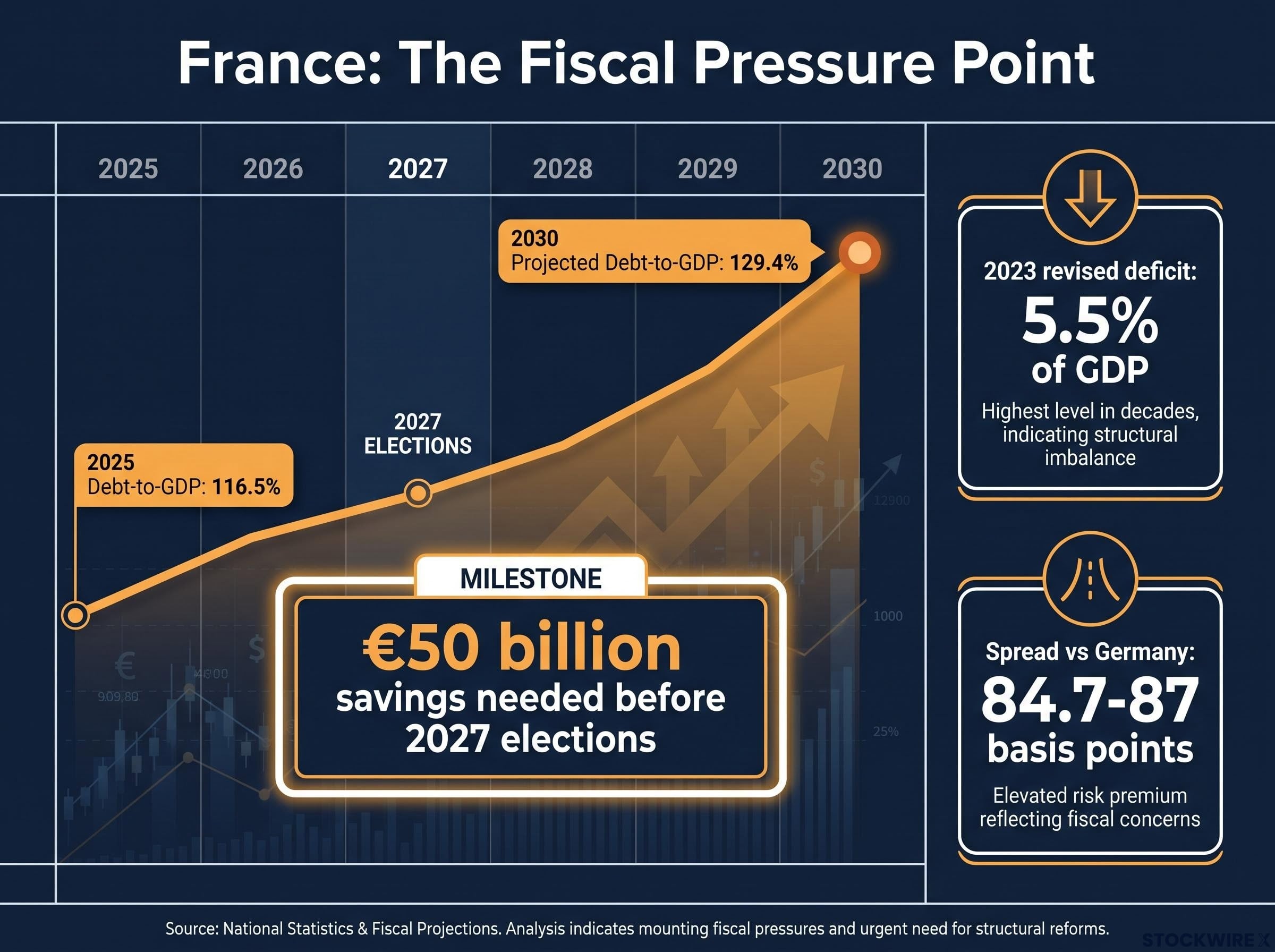
That election cycle is the structural horizon. Meaningful fiscal tightening will be hard to accelerate before then, which means the current spread environment, with France trading 84.7-87 basis points over Germany, is more likely to persist or widen than to compress in the near term.
Two scenarios frame what happens next:
- Compression: France produces a credible medium-term fiscal plan that markets accept as politically deliverable, allowing the spread to narrow.
- Escalation: an economic downturn arrives and triggers the 2011-parallel fragmentation dynamic, with political gridlock preventing a fiscal response.
KB Securities’ base case is that an immediate crisis is unlikely, but that an economic downturn remains the key risk variable. The inversion will not fix itself. It will hold as long as French fiscal credibility stays uncertain relative to its southern peers, and it will worsen if growth softens. For anyone with European fixed income exposure, France is now the country to watch, and that is a meaningful shift in where your credit-risk attention should sit.
For investors wanting to understand how the sovereign repricing flows through to equity markets, our full explainer on European equity positioning covers Germany’s fiscal stimulus, institutional underweight signals, and why mid-cap domestic names may be most directly leveraged to the reform cycle.
This article is for informational purposes only and should not be considered financial advice. Investors should conduct their own research and consult with financial professionals before making investment decisions.
Past performance does not guarantee future results. Financial projections are subject to market conditions and various risk factors. Forward-looking scenarios described here are speculative and subject to change based on economic and political developments.