
For years, French government bonds sat in the same mental category as German Bunds: core Eurozone paper, boring, safe, the closest thing continental Europe offers to a risk-free asset. That assumption is now under strain.
French 10-year yields have climbed to an 18-year high, and the European Central Bank has done something it almost never does: publicly named a core member state as a fiscal problem.
The trigger is simple to state and harder to solve. France’s debt is closing in on 120% of GDP with no credible plan to bring it down, and in late September 2026 that reality collided with the bond market. Risk premiums on French debt widened sharply, and ECB President Christine Lagarde stepped into the open to say so.
This is where the France debt-to-GDP ECB warning stops being an abstract macroeconomic story and starts affecting how European assets are priced.
The sections below give you a framework for understanding how a shift in sovereign credibility moves bond markets, how that risk transmits to the rest of Europe, and what these channels mean for your allocations right now.
When the central bank points fingers at a core economy
The market told the story before Lagarde said a word.
Through September 2026, French 10-year OAT (Obligations Assimilables du Trésor, France’s benchmark government bonds) yields pushed up to between 4.74% and 4.81%, according to data from Deutsche Bank and TradingEconomics. Those are levels not seen since the early 2010s, the depths of the last Eurozone crisis.
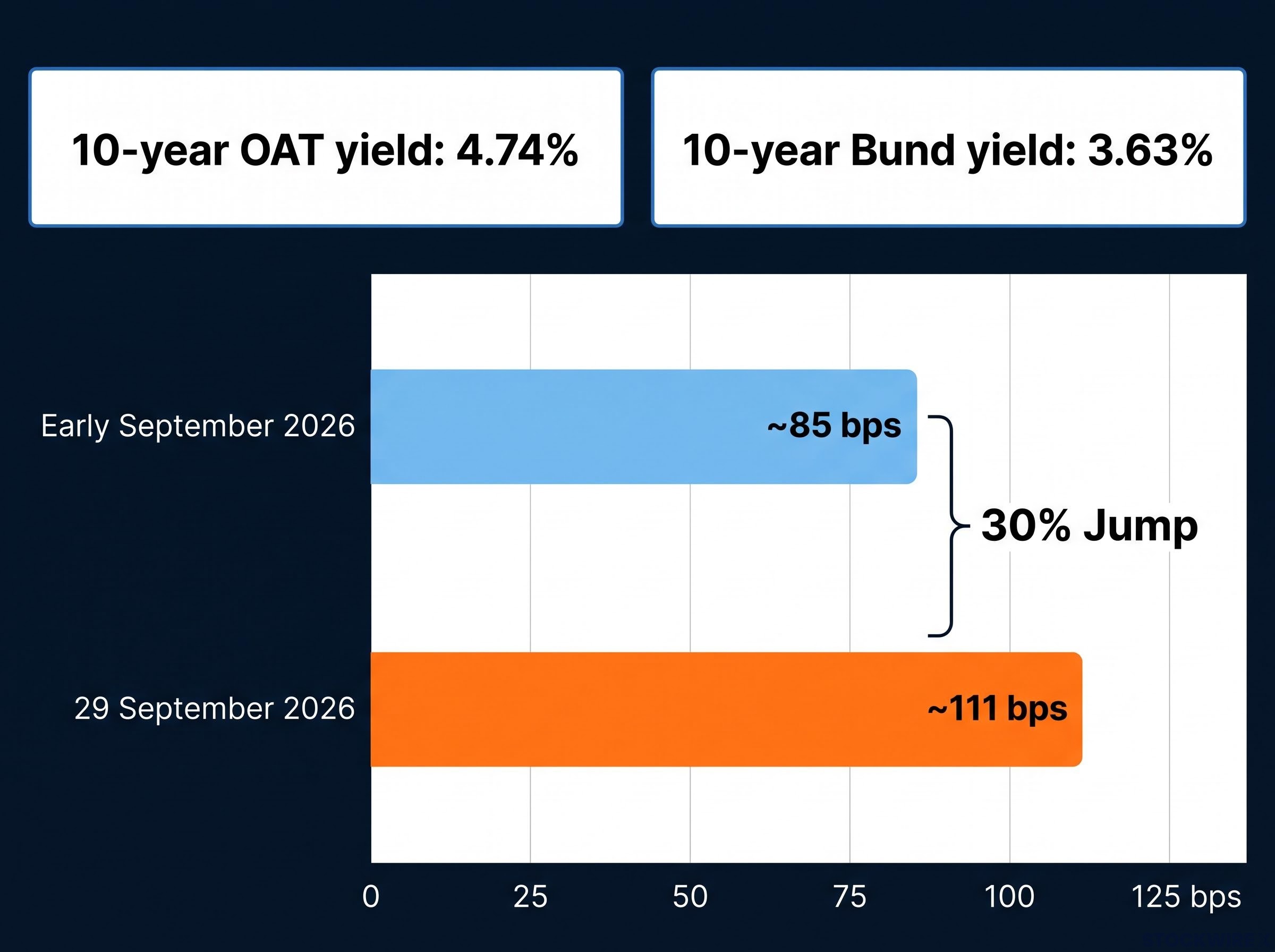
The more revealing number is the spread. The gap between French OAT yields and German Bund yields, the market’s cleanest measure of how much extra risk investors attach to France, widened from roughly 85 basis points at the start of September to more than 110 basis points by month-end, per Deutsche Bank. That is a jump of around 30% in a single month.
| Metric | Value | Date |
|---|---|---|
| 10-year OAT yield | 4.74% | 29 September 2026 |
| 10-year Bund yield | 3.63% | 29 September 2026 |
| OAT-Bund spread (start of month) | ~85 bps | Early September 2026 |
| OAT-Bund spread (month-end) | ~111 bps | 29 September 2026 |
You need to read this as more than day-to-day market noise. A spread widening of this speed is a structural repricing of risk, and it feeds directly into the baseline valuation of anything sitting in your fixed income allocation that references European sovereign rates.
Into that repricing walked Lagarde. In an interview with French newspaper La Croix published on 30 September 2026, she chose not to speak in the usual area-wide generalities.
“The debt situation in France is serious at 120% of GDP and without a path to lowering it,” Lagarde said, calling for a credible budget trajectory and structural reforms to restore confidence.
That framing matters. The ECB has historically been careful to avoid singling out individual sovereigns in public, preferring the quiet, technocratic channel. As commentary from Newsquawk put it, an ECB president naming a member state’s fiscal position in public is unusual territory, and the act itself is the signal rather than the 120% reference. When the central bank breaks its own convention, the market listens harder than the words alone would justify.
Lagarde’s La Croix interview, published directly on the ECB’s official site, is notable not only for the 120% debt reference but for its simultaneous acknowledgement that the Eurozone financial system is considerably more resilient than in 2008 and 2011, a pairing that sets the tone for how the ECB wants markets to interpret the warning.
When big ASX news breaks, our subscribers know first
Decoding fiscal credibility and sovereign risk premiums
Here is the part most headline coverage skips: France is not running out of money.
With a total public debt stock of roughly €3.6 trillion as of end-June 2026, according to national statistics agency Insee, France is not facing a hard solvency crisis, where a government literally cannot meet its obligations. What it faces is a crisis of fiscal credibility, which is a different and more slippery thing.
The distinction matters for how you assess the risk. A solvency crisis is about arithmetic. A credibility crisis is about trust: whether markets believe a government will actually follow through on a plan to stabilise its debt. When that trust evaporates, spreads can widen fast even though nothing about the underlying balance sheet changed overnight.
A sovereign risk premium, the extra yield investors demand to hold one country’s debt over the safest benchmark, is built from three things:
- Absolute debt level: how much the government owes relative to the size of its economy.
- Policy predictability: whether the government has a believable, consistent plan to manage that debt.
- Central bank backing: the degree to which investors expect institutional support if things deteriorate.
France’s problem is concentrated in the middle component. The debt is high but not extreme by developed-world standards; the missing piece is a credible consolidation path, which is exactly what Lagarde called for.
The clearest evidence of how far perceptions have shifted is the reshuffling of the Eurozone risk hierarchy. According to Morningstar, French spreads have moved above those of Italy (around 90 basis points) and Greece (roughly 76 basis points), reversing the long-standing order in which those southern economies were seen as the risky ones and France as core.
The sovereign bond yield inversion that placed France above Italy in the eurozone risk hierarchy did not appear overnight; it reflects a multi-year drift in relative fiscal trajectories, with Spain and Italy both projecting deficits within the EU’s 3% reference threshold while France’s deficit runs at 5.5%-5.6% of GDP.
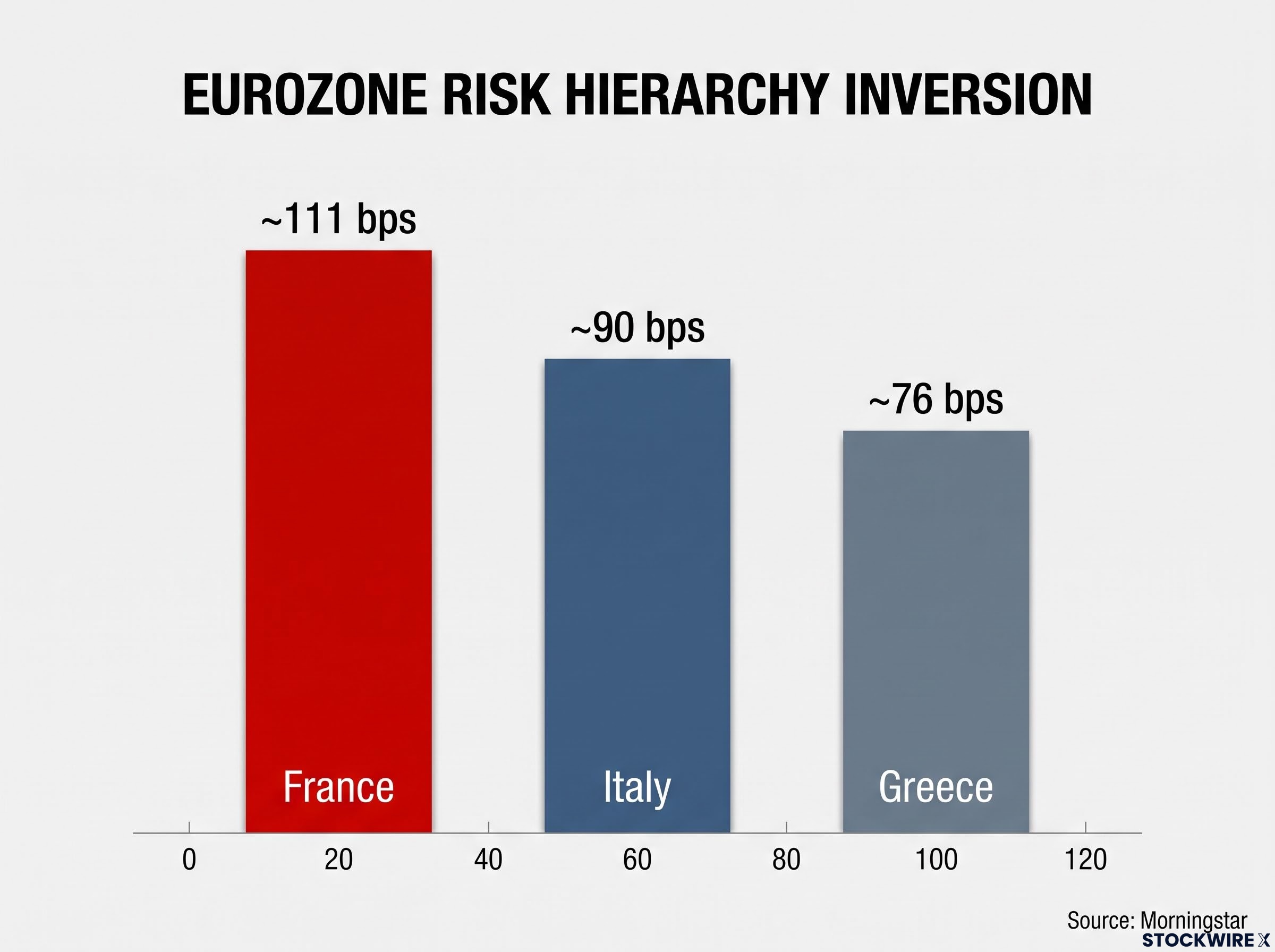
Understand what that inversion tells you. Your exposure to French debt is priced on market perception and policy trust, not on the raw arithmetic of the balance sheet. A country can carry a heavy debt load for years without incident, right up until investors stop believing in the plan to manage it.
Tracking transmission channels to broader European assets
The reason this matters beyond Paris is that France is too big to isolate.
Term premium, the compensation investors demand for holding long-duration bonds rather than rolling short-term paper, has been rebuilding globally as sovereign debt supply surges and central banks withdraw as price-insensitive buyers, a dynamic that amplifies any country-specific credibility shock like the one France is now experiencing.
A €3.6 trillion debt market does not move in a vacuum. When the pricing of French sovereign paper shifts, it drags on the wider Eurozone through several connected channels:
- Benchmark spread channel: OATs are a reference point for European sovereign paper. As their spreads widen, portfolio rebalancing and relative-value trades pull other Eurozone yields along with them. Deutsche Bank cautions that French spreads now act as a risk barometer for the bloc rather than reflecting purely French concerns.
- Policy credibility channel: Lagarde naming France leads investors to reassess the ECB’s tolerance for high debt everywhere. If the central bank is signalling a tougher stance on fiscal drift, that reprices expectations for other high-debt members too.
- Fiscal space channel: persistent deficits erode the room a government has to borrow in the next downturn. The concern, flagged by the IMF, is what happens if Europe meets a fresh economic shock with France already stretched.
The scale of the numbers keeps analysts alert. Morningstar has warned that the sheer size of French debt has put global bond investors on crisis watch, precisely because volatility in OATs can ripple into global bond portfolios and risk appetite.
The IMF’s July 2026 Article IV assessment adds hard figures to the worry. It projects French debt remaining above 120% of GDP through 2030 without intervention, and recommends a front-loaded structural fiscal effort of around 1.1% of GDP in 2026, followed by roughly 0.9% per year over the medium term.
Look past French borders here. A shift in benchmark pricing can weigh on your wider European equity and debt holdings through higher discount rates and softer risk sentiment, even for companies with no direct link to Paris. Contagion in bond markets rarely respects the boundaries of a single issuer.
Why 2026 looks different from previous sovereign crises
Before you treat this as 2011 all over again, the counterweights deserve equal attention.
Lagarde herself supplied one of them. In the same La Croix interview, she stressed that the European financial system is considerably more solid than during the 2008 and 2011 crises, pointing to stronger regulatory frameworks, better bank capitalisation, and a deeper toolkit for managing crises.
That is not spin. The decade since the last Eurozone panic produced genuine institutional reinforcement: tighter bank supervision, higher capital buffers, and ECB backstop mechanisms that did not exist when Greece and Italy were in the firing line. The architecture built to absorb this kind of stress is materially stronger than it was fifteen years ago.
ECB backstop mechanisms, including the Transmission Protection Instrument introduced after the 2022 fragmentation episode, are specifically designed to cap spread widening that the ECB judges to be inconsistent with underlying fundamentals, though their activation requires the sovereign in question to be in compliance with EU fiscal rules.
You should let that temper the immediate concern. A widening spread in a system with real shock absorbers is a different proposition from the same move in the fragile framework of 2011.
The priced-in argument
There is also a case that the market has already done most of its repricing.
Deutsche Bank argues that a substantial share of France’s fiscal and political risk already appears reflected in current OAT-Bund spreads. If that read is correct, today’s yield levels incorporate the known concerns rather than sitting on top of an unpriced tail risk waiting to detonate.
The practical implication for you is that the scope for further sharp repricing may be limited, absent a genuinely new shock. Political noise and budget wrangling are already in the price; it would take a fresh, unexpected deterioration to drive spreads meaningfully wider from here.
That does not make the situation benign. It means the risk is elevated and acknowledged rather than hidden, which is a distinction worth holding onto before making any panicked allocation decision.
Navigating Eurozone allocations amid structural fiscal shifts
The tension at the heart of this story is worth holding in both hands. France’s debt is genuinely elevated and its credibility is genuinely under question, yet the European financial system is far better equipped to absorb the strain than it was in the last crisis.
For positioning, that argues for attention rather than alarm. The variables that will decide which way this resolves are already on the calendar: upcoming French national budget votes will test whether a credible consolidation path actually materialises, and further ECB signalling will show how far the central bank is willing to press.
Watch those two threads closely. They will tell you whether September’s repricing was a peak or a first step.
For investors reassessing their European positioning in light of this repricing, our deep-dive into European equity allocation examines how country-level selectivity across Spain and Sweden has materially outperformed continental breadth, with direct implications for how OAT-driven risk sentiment should be translated into equity exposure decisions.
This article is for informational purposes only and should not be considered financial advice. Investors should conduct their own research and consult with financial professionals before making investment decisions. Past performance does not guarantee future results, and financial projections are subject to market conditions and various risk factors.