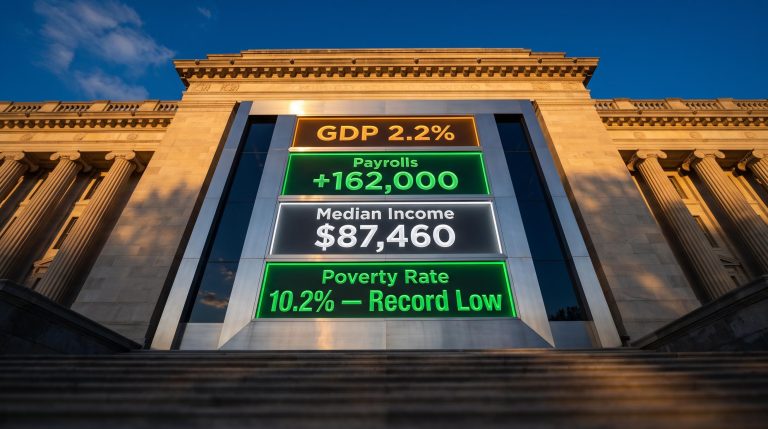
Core inflation across the euro area is running at 2.5%, with headline sitting at 3.8%, almost double the ECB’s 2% target. On the face of it, that looks like a central bank with a problem to solve and a meeting coming up to solve it.
Yet the ECB’s October meeting is widely treated by analysts as a near-certain non-event. The gap between what the inflation numbers seem to demand and what policymakers are actually expected to do is the real story here, and it comes down to a question of timing rather than direction.
Standard Chartered Global Research sits firmly in the camp that sees October passing without action, pointing to two forces pulling in the same cautious direction: core inflation that is drifting rather than accelerating, and a bond market that is already tightening financial conditions on the ECB’s behalf. The December meeting, by contrast, carries the institutional machinery for a genuine decision. What follows maps the two-meeting logic and the specific data triggers that will determine which scenario plays out.
Why October is the meeting that almost certainly will not move
Standard Chartered Global Research assesses an October rate adjustment as unlikely, and the reasoning is structural rather than a hunch about where inflation is headed. Two things stand against October: the absence of fresh staff projections, and core inflation that has barely moved.
Start with the inflation picture, because it is what makes October look puzzling at first glance. Headline HICP came in at 3.8% year-on-year in September 2026, per the Eurostat flash estimate published on 2 October 2026. That number is high, but it is energy-inflated and not where the ECB actually looks for signal.
The Eurostat HICP flash estimate for September 2026, published on 2 October, confirms headline inflation at 3.8% year-on-year and core at 2.5%, with a full component breakdown that shows energy driving the gap between the two readings rather than any broad-based acceleration in underlying prices.
Core inflation, which strips out energy, food, alcohol and tobacco, read 2.5% year-on-year in September, up from 2.4% in August and 2.2% back in January. That is a drift of just 0.3 percentage points over nine months.
Reading eurozone HICP data correctly requires separating energy-driven headline moves from the underlying core and services components, because a headline spike produced by one volatile category does not carry the same policy signal as a broad-based acceleration across the basket.
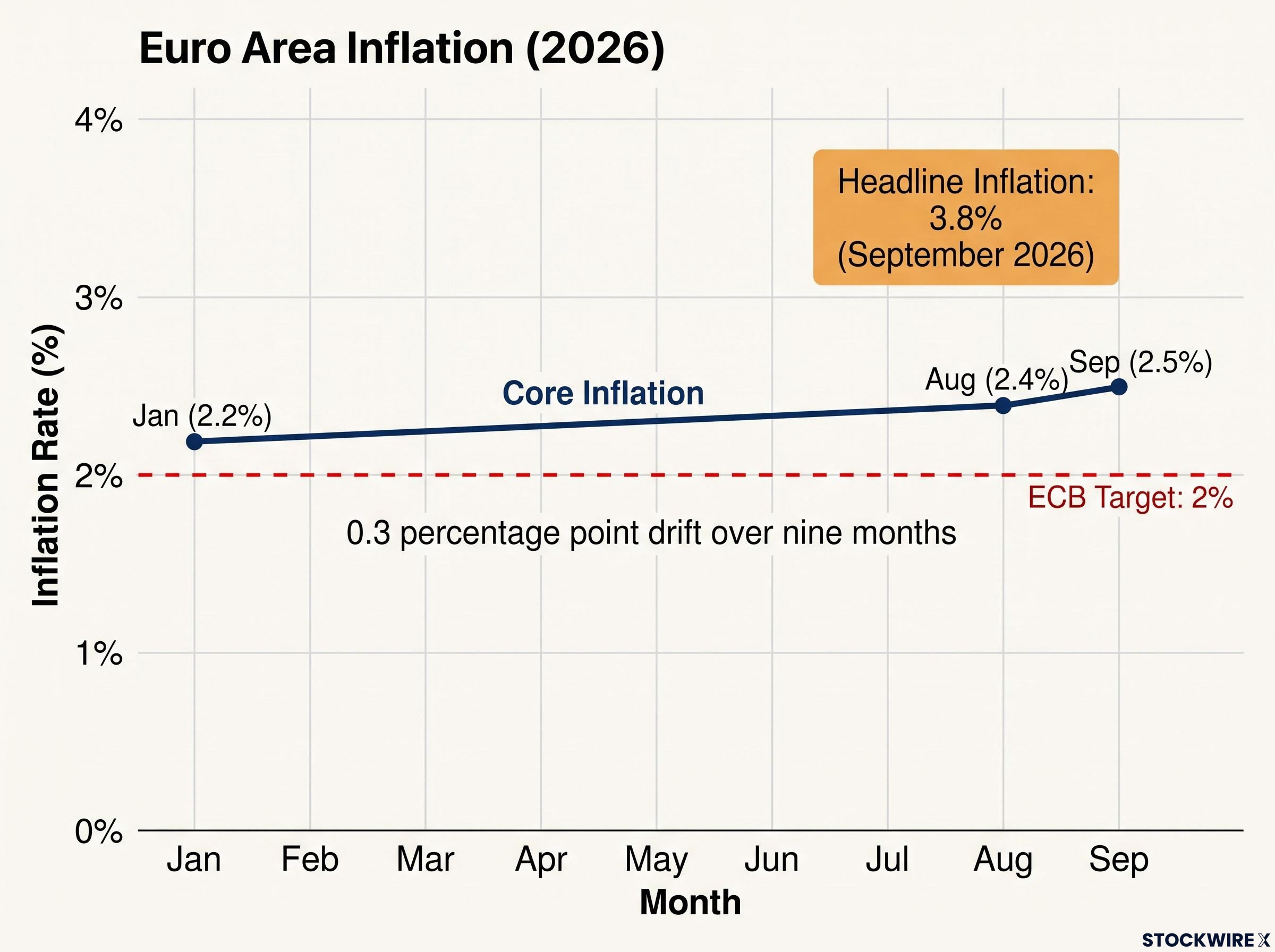
For readers tracking the ECB, that marginal move is the whole point. It tells you underlying price pressure is real but not accelerating, which is precisely the kind of ambiguous signal that argues for waiting and watching rather than acting now.
The institutional calendar works against action
The second obstacle is timing of a different sort. The ECB publishes full staff macroeconomic projections on a quarterly cycle: March, June, September and December. Significant policy moves are typically aligned with those projection meetings, and October simply is not one of them.
That leaves the case for October resting on three structural disadvantages:
- No fresh macroeconomic projections are released at the October meeting
- Core inflation has shown only limited upward movement, giving no new urgency
- Rising bond yields are already tightening financial conditions on their own
Standard Chartered Global Research assesses an October rate adjustment as unlikely, citing subdued core inflation movement and yield-related headwinds, and identifies December 2026 as the anticipated timing for any potential rate change.
The takeaway for positioning is straightforward. An analyst-consensus non-event carries a very different risk profile from a genuinely live meeting, which means the volatility worth preparing for sits around December, not October.
When big ASX news breaks, our subscribers know first
How rising bond yields are doing the ECB’s tightening work
Here is the load-bearing pillar of the October-inaction case, and it has nothing to do with the deposit rate. It is the bond market.
The ECB’s own framing runs as a chain of causes, not a list of observations. Lagarde has laid out the mechanism repeatedly, and it works in three steps:
- Higher long-term yields raise borrowing costs for governments, corporations and households, tightening financial conditions independently of any ECB move
- Those higher costs slow economic growth, as investment and consumption get dampened
- Weaker growth and tighter credit reduce the pass-through of energy price shocks into broader inflation, because firms have less pricing power
In Bloomberg-reported remarks on 28 September 2026, Lagarde said long-term interest rates have risen notably since the last ECB meeting, and that this rise will curb economic expansion and limit the transfer of elevated energy costs to inflation “by more than projected” in the ECB’s September exercise.
That phrase, “by more than projected,” is the one that matters. It signals the ECB thinks the bond market is doing more tightening work than its own models had assumed, which lowers the need for the central bank to add its own.
Lagarde reinforced the point in European Parliament testimony on 2 October 2026, stating that higher public debt yields must limit economic growth and inflation, while noting that second-round effects on wages remain limited. At the 10 September 2026 press conference, she had already linked worsening global financial market sentiment and bond-market spillovers to tighter credit conditions and dampened demand.
The complication is that not all yield moves mean the same thing. There are two ways to read the rise, and they point toward different policy responses.
| Reading | Yields as policy substitute | Yields as risk premium |
|---|---|---|
| What drives it | Tighter financial conditions doing the work of rate hikes | Geopolitical uncertainty and fiscal concerns lifting risk premia |
| What it implies for ECB action | Less need for further rate increases; room to stay cautious | Careful calibration needed; the signal is noisier and less reliable |
| What data would confirm it | Slowing growth and credit flows alongside the yield rise | Yield moves tracking geopolitical events rather than fundamentals |
The practical read for you is this: the ECB is no longer watching only its own rate lever. It is watching the entire term structure of borrowing costs, which means 10-year Bund yields and peripheral spreads are now leading indicators of policy, not just market noise.
What makes December different, and what conditions need to hold
If October is structurally disadvantaged, December is structurally equipped. The difference is not that policymakers suddenly become more willing to move; it is that December hands them the tools to move credibly.
The December structural case
December carries three advantages October cannot match:
- Fresh staff macroeconomic projections covering 2026 through 2028, giving a full updated view of inflation, growth and labour markets
- The ability to formally incorporate the recent rise in long-term yields, and its observed drag on growth and inflation, into the baseline
- More complete autumn data on inflation prints, wage negotiations and credit conditions, reducing the risk of acting on partial information
The current baseline comes from the ECB’s Economic Bulletin Issue 6/2026, published on 24 September 2026. It projects core inflation (excluding energy and food) at 2.5% in 2026, 2.6% in 2027 and 2.3% in 2028, with headline inflation expected to return to the 2% target around the end of 2027.
The ECB September projections revised headline inflation upward to 2.5% in 2027 and 2.1% in 2028, both above June estimates, a revision driven by the Middle East energy shock and one that the December round will either confirm or begin to walk back.
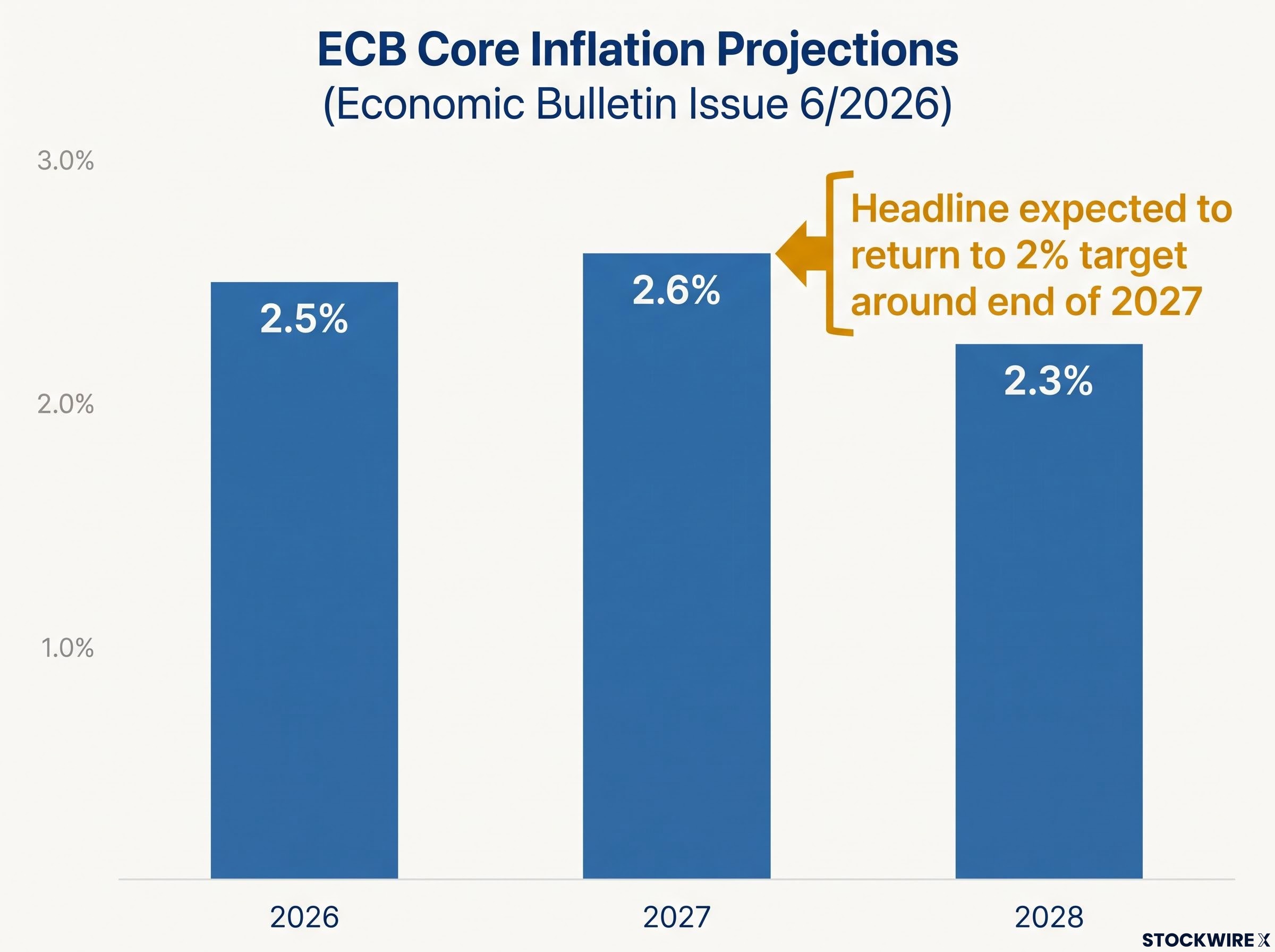
The ECB projects headline inflation returning to its 2% target around the end of 2027, supported by the effects of past interest-rate increases working through the economy.
That end-2027 anchor is the institutional foundation for the entire December thesis. It establishes a disinflation path that the December projections will either confirm or revise, and that confirmation is what would justify a move.
What needs to remain true
December is conditional, not confirmed. For the scenario to hold, two things need to stay in place between now and the meeting.
First, the October and November inflation prints must not accelerate sharply beyond September’s readings. Second, wage second-round effects need to remain contained, which is how Lagarde described them in her 2 October 2026 parliamentary testimony, justifying a measured rather than aggressive response.
For you, that reframes the data calendar. Each October and November inflation release stops being background noise and becomes a direct policy input, because a surprise acceleration in core or wages would move the probability of December action in real time.
The conditions that could push December into 2027
The hawkish scenario is worth naming. If October and November prints hold at or above September levels, meaning 3.8% headline and 2.5% core, that would not mechanically block December action, but it would shift the internal Governing Council debate materially toward delay.
Lagarde has also flagged genuine upside risks that sit outside the data. At the 10 September 2026 press conference she named the Middle East conflict and Russia’s war against Ukraine as factors that could intensify the energy shock and push it into wages faster than the September projections assume. If either escalates, the December window could slip into 2027.
The data signals to track between now and the December decision
This is where the analysis becomes a monitoring framework. Rather than wait for the decision itself, you can treat the stretch between now and December as a sequence of probability-shifters, each one updating the odds of action.
Three data triggers carry the most weight.
| Data trigger | What to watch for | Policy implication |
|---|---|---|
| Eurostat HICP October and November prints | Whether core holds near 2.5% or accelerates; whether headline stays around 3.8% or climbs | A surprise acceleration strengthens the case for delay; a cooling print supports a December move |
| Credit condition and bond-spread indicators | Signs that bond-market spillovers are tightening credit and dampening demand, which Lagarde linked directly | Marked tightening raises the odds the ECB acts to prevent a deeper downturn |
| Growth and demand data | Whether the economy’s described resilience holds or begins to fade under higher yields | Fading demand supports a dovish tilt; sustained resilience reduces urgency |
The risk balance here is genuinely two-sided, and it is worth resisting the urge to resolve it prematurely.
Institutional forecasts for the rate peak span a meaningful range, with Rabobank projecting a 2.75% ceiling and cuts in the second half of 2027 while Citigroup and Nordea see rates approaching 3.00% by March 2027, a spread that illustrates precisely how much the December data flow will matter.
On the upside, Lagarde has flagged energy and geopolitical shocks, specifically the Middle East conflict and Russia’s war against Ukraine, as risks that could lift inflation. On the downside, she has warned that worsening global financial sentiment and bond-market spillovers could tighten credit and dampen demand. Both risks are real, and both are named by the ECB itself.
For you, that balance means December is neither a foregone conclusion nor an impossibility. The useful posture is to treat each release as evidence that updates the probability, rather than anchoring on one outcome and being forced to unwind the position later.
December as the probable decision point, not the guaranteed one
Pull the threads together and the two-meeting logic resolves cleanly, even if the outcome does not. The structure explains why attention belongs on December rather than October.
- October passes without action: no fresh projections, limited core inflation movement, and yield-driven tightening already doing part of the ECB’s work
- December carries the institutional conditions for a move: fresh staff projections, more complete autumn data, and a formal chance to fold yield dynamics into the baseline
- Even so, December remains conditional on the inflation and wage data that arrives between now and then
The honest conclusion is that the ECB faces a finely balanced risk environment, with upside inflation risks and downside growth risks both identified by policymakers themselves. That is exactly why Standard Chartered frames December as “anticipated timing” rather than a certain move, and why Lagarde’s messaging across September and October stayed data-dependent and cautious.
The divergence between market pricing of ECB rate hikes and institutional forecasts is itself a live variable in the policy calculus, because a significant gap between what forward curves assume and what policymakers signal creates the conditions for sharp repricing around any meeting that delivers a surprise.
The practical takeaway is not that December is confirmed. It is that December is where the evidential conditions could align, and that actively tracking the autumn data is more useful than committing to either outcome in advance.
This article is for informational purposes only and should not be considered financial advice. Investors should conduct their own research and consult with financial professionals before making investment decisions. Financial projections are subject to market conditions and various risk factors, and these forward-looking assessments are speculative and subject to change based on economic developments.