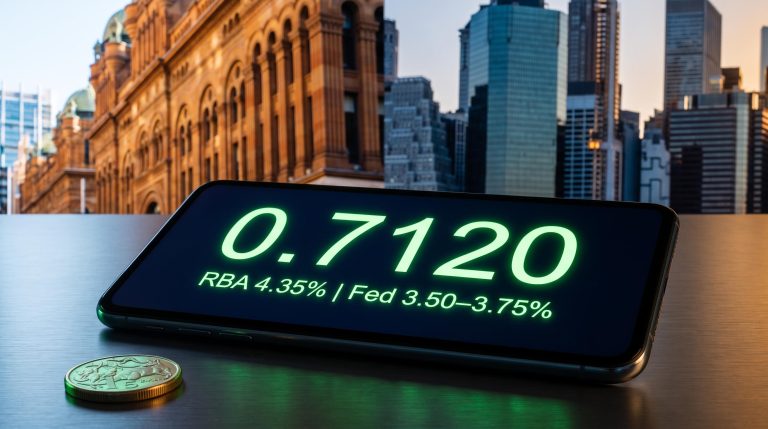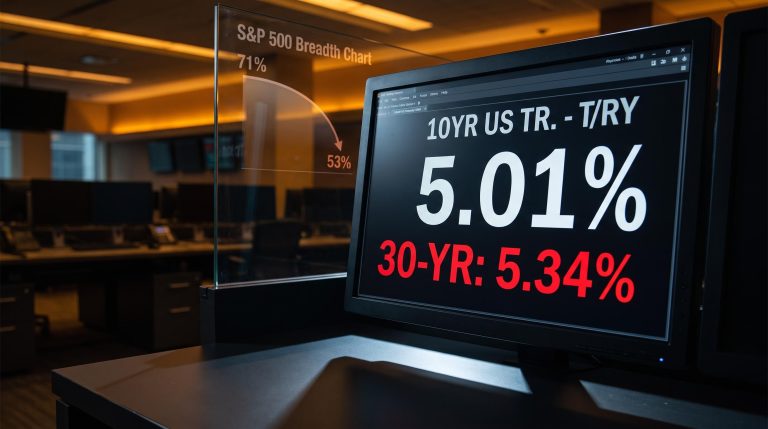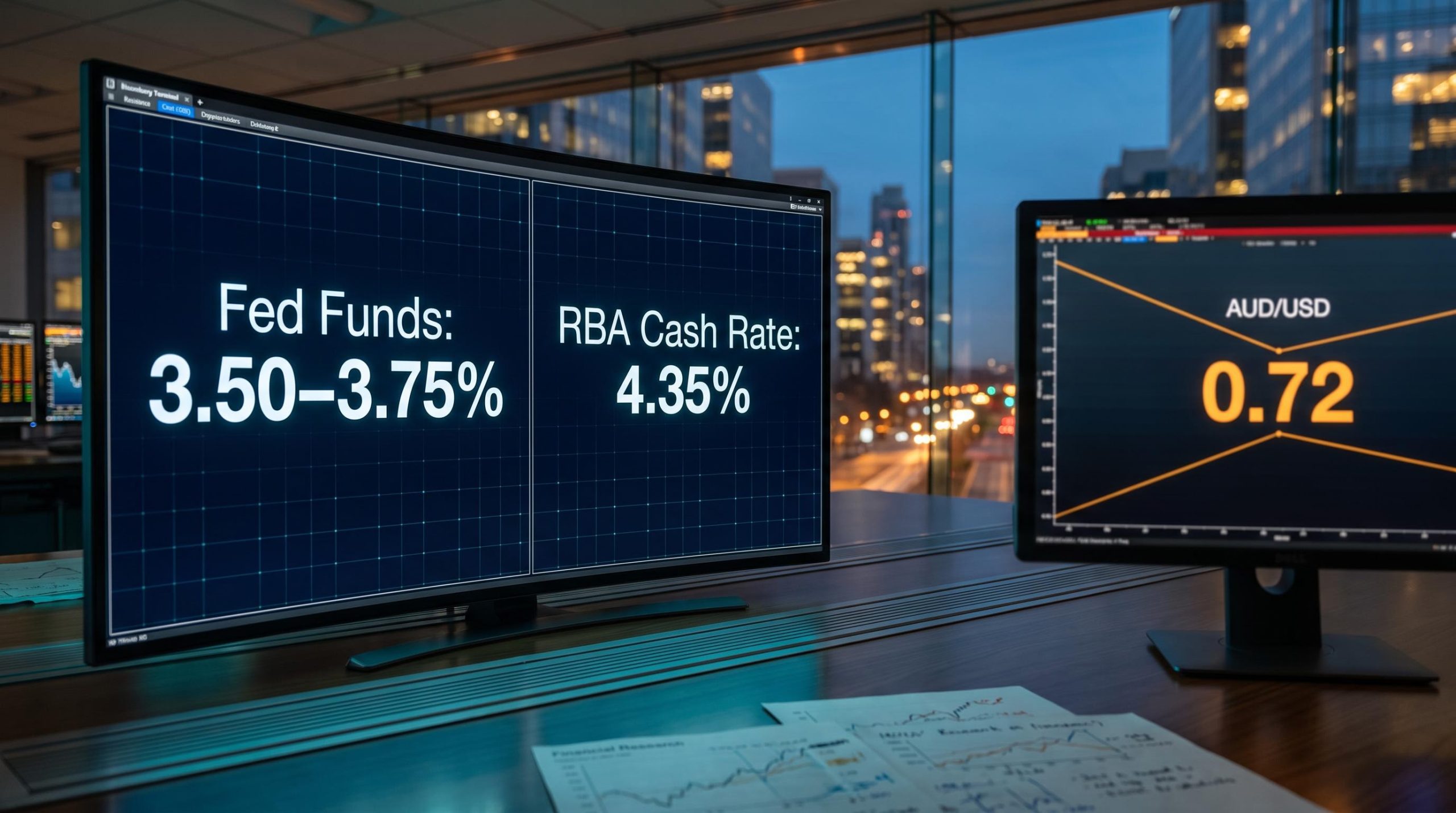
Both the US Federal Reserve and the Reserve Bank of Australia are widely expected to raise interest rates within two weeks of each other, and yet AUD/USD is sitting almost exactly where it started the month, pinned near 0.72 and squarely inside its consensus band. Two hikes, no clear direction. That dissonance is the whole story.
The September calendar has produced something markets rarely see: a genuine convergence. The Fed is poised to deliver its first hike since July 2023 after holding at 3.50-3.75% all year, while the RBA may add a fourth hike of 2026 to a cash rate already at 4.35%. When both central banks move in the same direction at the same time, the gap between their rates, which is what actually drives money into or out of the Australian dollar, can stay almost unchanged even as headline rates climb on both sides.
That is why a dual-hike environment produces ambiguity rather than a signal. Read on, and you will know which variables actually move AUD/USD when both central banks are active at once, and exactly what to watch in the next fortnight beyond the rate decisions themselves.
Two central banks, one window: what the September timing means for AUD/USD
Rarely do the Fed and the RBA reprice inside the same two-week window. This September, they do.
The Federal Open Market Committee (FOMC) meets on 15-16 September 2026, with the Fed funds rate currently held at 3.50-3.75%, a level unchanged since its March meeting after a December 2025 cut. The RBA Board follows on 29 September 2026, with its cash rate at 4.35% after three hikes earlier in the year and a hold at the August meeting.
Here is the mechanical point that trips up the simple narrative. If both banks hike by the standard 25 basis points, the rate spread between Australia and the US barely moves.
| Central bank | Current rate | Expected post-meeting rate | Market-implied hike probability | Next meeting |
|---|---|---|---|---|
| US Federal Reserve | 3.50-3.75% | 3.75-4.00% | ~90-92% (CME FedWatch, 14 Sep) | 15-16 September 2026 |
| Reserve Bank of Australia | 4.35% | 4.60% | 63-80% (~78% RBA Rate Tracker) | 29 September 2026 |
Run the arithmetic. Australia’s advantage sits at roughly 60-85bp now. If both hikes land, the post-decision spread is about 4.60% minus 3.75-4.00%, or close to 60bp in Australia’s favour. Essentially unchanged.
The pricing asymmetry that leaves room for surprise
The two decisions are not equally settled, and that matters. The Fed hike is priced at roughly 90-92%, per CME’s FedWatch tool as of 14 September, which means delivery is close to a foregone conclusion.
The RBA is a different picture, with hike probabilities ranging from 63% to 80% across trackers and around 78% on the RBA Rate Tracker. That gap is where the surprise potential lives.
The ASX RBA Rate Tracker derives hike probabilities from 30-day interbank cash rate futures, making it the most direct market-based read on RBA expectations and the source underpinning the approximately 78% probability figure cited across this analysis.
The near-identical spread before and after both hikes tells you the rate decisions themselves are unlikely to be the decisive catalyst for the pair. If the numbers are already in the price, the market’s real attention shifts to what each bank signals about what comes next.
When big ASX news breaks, our subscribers know first
How central bank divergence actually transmits into AUD/USD moves
To see how rate differences move the currency, it helps to watch the mechanism working in real time. Early 2026 provides exactly that test case.
The rate gap reaches the currency through two main channels:
- Carry trade dynamics: Investors rotate capital toward higher-yielding assets, so a wider yield advantage draws money into the currency offering it.
- Safe-haven flows: During risk-off episodes, demand for the US dollar as a reserve currency can override rate signals entirely, pulling capital toward US cash and Treasuries regardless of the spread.
Now the episode. Across early-to-mid 2026, the RBA delivered three 25bp hikes, lifting the cash rate from below 3.85% to 4.35% by May 2026, while the Fed held steady at 3.50-3.75% through its March, June and July meetings.
The divergence did its work. AUD/USD climbed from around 0.7049 on 7 August 2026 toward the 0.7196-0.7226 band by 9 September, and IBTimes reported on 10 April 2026 that the currency had touched three-year highs inside a 0.69-0.73 range.
Here is the principle that episode illustrates. It is the direction of divergence, not just its size, that decides whether the rate gap helps or hurts the Australian dollar. A relatively hawkish RBA against a static Fed lifted the currency; reverse that configuration and the effect flips.
That reversal is not hypothetical. It is already shaping the forward view.
NAB’s July 2026 FX Strategy carries a bearish 2027 AUD/USD call built on an internal forecast of 75bp of RBA cuts starting in Q2 2027, a scenario that would widen the gap in the US dollar’s favour and drag on the currency well before any cut actually arrives.
What the 2026 run tells you is that the RBA-Fed gap has already done meaningful lifting this year. The pressing question now is whether the gap can widen further, or whether it has already carried the pair close to fair value. That single distinction determines whether September’s decisions add fuel or simply confirm a level.
What the Fed chair’s tone and the RBA’s language will actually move
If the rate moves are already in the price, then the only variable left with genuine surprise potential is language. This is where the next fortnight will be decided.
Carol Kong, currency strategist at Commonwealth Bank of Australia in Sydney, frames the Fed side cleanly: with the 25bp hike roughly 90% priced in, delivering it will provide only modest US dollar support. The net effect on AUD/USD hinges instead on Chair Kevin Warsh’s tone. A dovish message would be a near-term drag on the dollar; hawkish commentary would lift it against the Australian dollar.
Dollar carry appeal shifted materially in the week before the FOMC meeting, when Fed Governor Christopher Waller’s 3 September speech moved market-implied hike probability from 64% to 54% in a single session and dragged the DXY to 99.00 alongside yen carry-trade unwinds.
The same logic applies at the RBA. A hawkish hold, or a hike wrapped in tightening language, supports the currency. A hike framed as possibly the last in the cycle, a so-called dovish hike, caps the upside.
There is also a real forecaster split. As of 9 September, Westpac stood as the lone major bank expecting no further RBA hikes in 2026, even as market pricing sat between 63% and 80% for a September move (approximately 78% on the RBA Rate Tracker, 76% on centralbank.watch, 63.6% on OurTop10 and around 80% via OrbitRemit).
The spread of those probabilities, combined with Westpac’s dissent, tells you the RBA decision carries real surprise potential in either direction. That is precisely where the short-term move will be made.
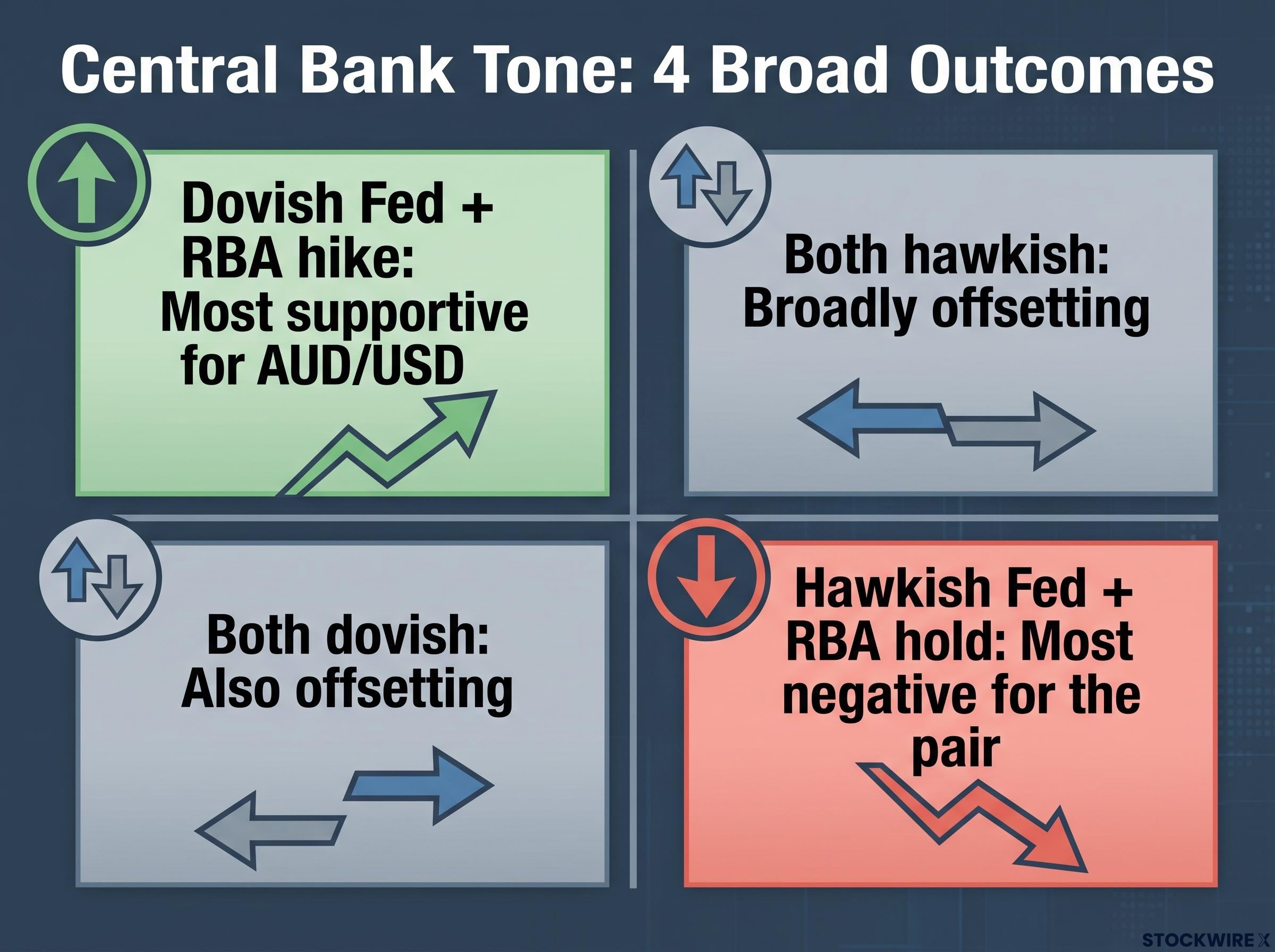
The four broad outcomes and their likely directional pull on AUD/USD:
- Dovish Fed plus RBA hike: Most supportive for AUD/USD, as US dollar softness meets a wider yield case.
- Hawkish Fed plus RBA hold: Most negative for the pair, favouring the US dollar on both fronts.
- Both hawkish: Broadly offsetting, with the spread little changed and the move driven by which tone surprises more.
- Both dovish: Also offsetting, but with weaker overall support and external variables likely to dominate.
What to listen for in Chair Warsh’s press conference
The signals separating a hawkish Fed from a dovish one are specific: whether Warsh preserves optionality for further hikes, how he frames the terminal rate, and how firmly he characterises inflation persistence. Warsh vowed to fight inflation at the July meeting and signalled a possible slight year-end rise back in June, so the market will weigh any shift against that hawkish baseline.
Any softening on the pace of future hikes would be the key US-dollar-negative signal, even if the 25bp hike itself lands exactly as expected.
For investors wanting to model the specific risk that a Warsh press conference introduces, our full explainer on Warsh’s no-guidance framework examines why the 10-year yield moved only 0.14 percentage points after the July meeting despite media alarm, and what that tells you about positioning into September.
What a “dovish hike” from the RBA would look like
A hike accompanied by peak-rate language, or hints of conditional pausing, would suggest the Board sees itself near the end of its cycle and would limit the currency’s upside relative to a hike paired with open-ended tightening language.
The August meeting, where the RBA held at 4.35%, is the communication template against which September’s statement will be read. The tighter the September language relative to that hold, the stronger the AUD response.
The variables rate differentials cannot explain
Rate spreads are necessary but not sufficient. Even a supportive RBA-Fed dynamic can be overridden, and two external forces are the usual culprits.
Beyond the yield gap, three variable categories shape where the pair trades:
- Central bank communication tone: The dovish-versus-hawkish signal that determines whether a priced-in decision helps or hurts.
- Global risk sentiment: As a risk-sensitive currency, AUD weakens when safe-haven US dollar demand takes over during risk-off episodes.
- China-linked commodity demand: Australia’s terms of trade, and therefore the fundamental case for a stronger AUD, rest heavily on Chinese industrial appetite for commodities.
The research flags both external headwinds as live right now. Elevated Middle East geopolitical tensions have supported safe-haven US dollar demand, while oil-driven inflation has pushed US Treasury yields toward multi-year highs, reinforcing the pull toward the dollar regardless of the rate spread.
Safe-haven USD demand was the dominant force on AUD/USD as recently as June 2026, when Hormuz escalation compressed Brent toward $110 and pushed the pair to the 0.7000 psychological level despite a rate differential still running in Australia’s favour.
The China dependency is explicit in the forecasts themselves. TheIndustrySpread’s 0.73 base case for end-2026, published 29 May 2026, rests on the “RBA-Fed gap plus terms of trade” and comes with a blunt caveat: the call breaks if China’s industrial demand rolls over.
| Scenario | AUD/USD level | Rate conditions | Risk sentiment | Commodity demand |
|---|---|---|---|---|
| Base case | ~0.73 (CBA ~0.72, NAB 0.71, Westpac 0.71) | RBA holds near cycle top, Fed on hold | Stable | Favourable terms of trade |
| Bull case | 0.75-0.76 | Supportive spread | Improving, USD weakness | Robust China demand |
| Bear case | 0.68 | RBA cuts | Risk-off, safe-haven USD bid | China demand rolls over |
Read that table as a probability distribution, not a set of predictions. The consensus band of 0.69-0.73 across Westpac, NAB, CBA and AMP is the middle of the range, with the tails reached only when external conditions line up.
The detail that should stay with you is this: the bull case to 0.75-0.76 requires more than a favourable rate spread. It needs improved risk sentiment and continued Chinese industrial demand at the same time. That tells you monitoring those two external conditions matters just as much as tracking the two central bank meetings.
Reading September’s central bank signals with both eyes open
Pull it together, and the picture is clear enough to act on. AUD/USD direction through late September will be decided less by whether each bank hikes and more by three things at once: the post-meeting tone, the RBA’s genuine surprise potential given forecaster disagreement, and whether external risk conditions cooperate.
With the pair near 0.72, sitting mid-band inside the 0.69-0.73 consensus, and the spread holding around 60-85bp now (roughly 60bp if both September hikes deliver), the rate differential is supportive but not enough on its own to guarantee strength.
Three signposts are worth watching through the FOMC decision on 15-16 September and the RBA decision on 29 September:
- Chair Warsh’s language on future rate optionality: Any softening on the pace of further hikes is the key US-dollar-negative signal.
- The RBA’s September statement framing: How its tone compares to the August hold will shape the AUD reaction more than the hike itself.
- Chinese industrial demand data: The commodity-demand proxy that can override even a supportive rate gap.
The most useful thing you can do over the next fortnight is watch the language, not the rate decisions. The decisions are already in the price.
For readers wanting to understand why Warsh’s statement length matters as much as its content, our dedicated guide to Fed forward guidance mechanics traces how FOMC communication grew from 130 words in 2002 to 895 at its peak and explains why the two clearest guidance failures both originated from the gap between prior guidance and subsequent action.
This article is for informational purposes only and should not be considered financial advice. Investors should conduct their own research and consult with financial professionals before making investment decisions. Past performance does not guarantee future results. Financial projections are subject to market conditions and various risk factors, and forward-looking statements are speculative and subject to change based on market developments.