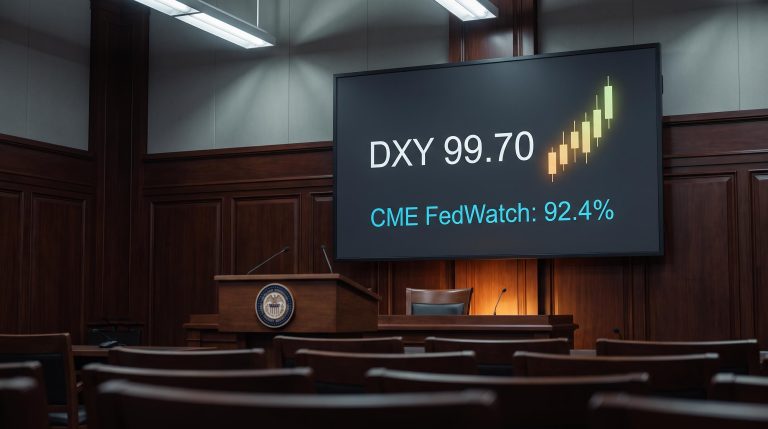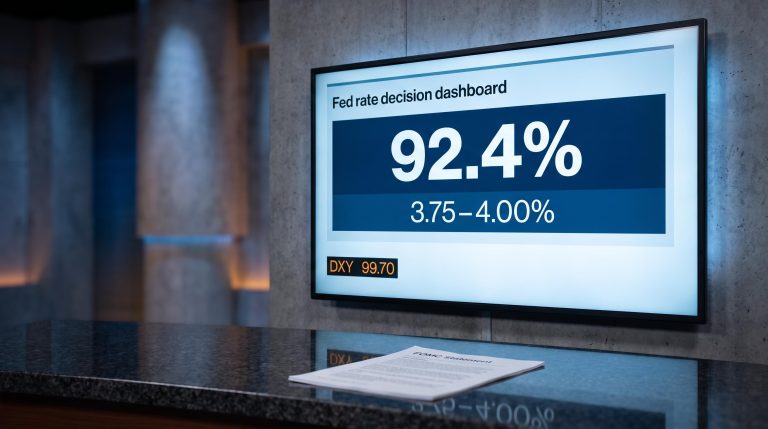
Here is a puzzle worth sitting with: the US Federal Reserve is almost certain to raise interest rates today, and yet the Australian dollar may not fall against the greenback at all.
That runs against the intuition most people bring to currency markets, where higher rates are supposed to lift a currency and a weaker rival is supposed to sink. The 16 September 2026 Federal Open Market Committee (FOMC) meeting carries a 25 basis point hike priced in at roughly 90% probability. Australia’s own central bank, the Reserve Bank of Australia (RBA), has already lifted its cash rate to 4.35% and meets on 29 September with a further hike considered likely. Two central banks are tightening at once, but only one of them issues the world’s reserve currency, and that asymmetry breaks the simple story.
Here is a clear framework for reading central bank decisions as AUD/USD inputs: what the rate differential actually means, why the Fed’s tone matters more than its move, and which outside forces can override both.
Why interest rate differentials move currency pairs
Start with the money itself. If you were holding a large pile of cash and one country paid you meaningfully more to park it there than another, where would you put it?
That instinct is the engine of currency flows. Capital tends to move toward the currency offering the higher yield on cash holdings, and that movement creates demand for the currency, which pushes its price up against the one being sold.
Professional investors formalise this into a trade. They borrow in a currency with low interest rates, convert the money, and hold assets in a currency with higher rates, pocketing the gap between the two. The gap is called the interest rate differential, and it is the profit engine of what markets know as the carry trade.
Right now, that gap favours the Australian dollar. The RBA’s Official Cash Rate sits at 4.35%, effective 12 August 2026, while the Fed held its target range at 3.50%-3.75% at its 29 July 2026 meeting. That leaves a positive spread of roughly 60-85 basis points in Australia’s favour, a midpoint of about 72.5 basis points, which in principle supports demand for the AUD.
| Central Bank | Current Rate | Next Meeting | Market-Implied Probability of Hike |
|---|---|---|---|
| US Federal Reserve | 3.50%-3.75% | 16 September 2026 | Approximately 90% (range 60.6%-91.4% across sources) |
| Reserve Bank of Australia | 4.35% | 29 September 2026 | 71%-76% across sources |
Three conditions make a rate spread genuinely attractive to a carry trader:
- The differential is positive, meaning the currency you hold pays more than the one you borrowed.
- The higher-rate currency is stable or appreciating, so exchange-rate moves do not wipe out the interest gain.
- Financing costs in the low-rate currency stay manageable, keeping the borrowing side cheap.
Here is where the puzzle from the opening comes into focus. If the Fed hikes today to 3.75%-4.00%, the spread narrows to roughly 35-60 basis points. The US dollar’s carry disadvantage shrinks, but it does not disappear, and the AUD still pays more. That is why a Fed hike, on its own, is not automatically bullish for the greenback against the Australian dollar.
When big ASX news breaks, our subscribers know first
The “priced-in” problem: why the hike itself may not move the AUD
The most common retail assumption goes like this: the Fed hikes, the US dollar rises, the AUD falls. It sounds airtight, and it is usually wrong.
The reason sits in how markets discover price. When a rate decision is priced in at around 90% probability, traders have already bought and sold as though the hike has happened. By the time the announcement actually lands, the currency has largely finished adjusting, and the move on the day is often muted or even backwards.
The numbers show just how completely the market has absorbed this one. Centralbank.watch put the implied probability of a 25 basis point September hike at 91.4%, with a broader range of 60.6%-92.4% across data providers. As recently as mid-June 2026, that same implied probability sat at just 0.6%. The market repriced from near-zero to near-certainty in three months.
Carol Kong, currency strategist at Commonwealth Bank of Australia The hike is around 90% priced in, which means the potential boost to the US dollar on delivery is likely to be modest.
What this tells you is that the greenback has already banked most of the bullish impact of this hike. The genuine market-moving event is not the number itself. It is the post-decision press conference and the forward guidance that comes with it.
What to watch in the post-decision press conference
Fed Chair Kevin Warsh will speak after the decision, and his language, not the rate change, is what can actually shift AUD/USD. Listen for these signals:
Warsh’s communication regime has removed the forward-guidance buffer that once dampened market reactions to FOMC meetings, meaning each CPI print and jobs report now carries greater pricing weight than under prior Fed chairs, and the post-decision press conference carries even more interpretive responsibility than it did before 2026.
- Warsh signals further tightening ahead. References to “further firming” or the need for more restrictive policy read as hawkish. This tends to support the US dollar, because the market reprices for additional hikes and the carry gap looks likely to keep narrowing.
- Warsh signals a pause or a shift to data-dependency. Language such as “appropriate to pause,” heavy emphasis on “data dependence,” or talk of the “neutral rate” being close reads as dovish. This can undercut the US dollar even as the hike is delivered, because the market reprices the path beyond September toward an end of the cycle.
The distinction matters because it decides which direction the reprice runs. A hawkish tone extends the tightening story and props up the greenback. A dovish tone tells traders the peak is near, and the modest carry advantage the US dollar still holds starts to look temporary.
For you, the practical lesson is uncomfortable but useful: waiting for the rate announcement to trade the news usually means reacting to an event the market settled weeks ago. Your intuition that good news lifts price frequently fails here because the news was already in the price.
What rate differentials cannot explain: China, commodities, and risk sentiment
The rate differential is a necessary part of the AUD/USD story. It is not the whole story, and treating it as such is where a lot of otherwise sensible analysis goes wrong.
The Australian dollar is a commodity currency, tied at a structural level to Chinese demand for iron ore. When Beijing’s construction pipeline slows or steel consumption softens, the AUD can weaken regardless of what either central bank does with rates. Major institutions name the structural decline in Chinese steel demand, combined with rising global iron ore supply, as the single largest long-term risk to Australian dollar strength.
Then there is the current geopolitical backdrop. Elevated Middle East tension in September 2026 is doing two things at once, and both weigh on AUD/USD independently of the rate spread. Higher oil prices are lifting US Treasury yields, which supports the greenback, while the uncertainty itself is triggering safe-haven flows into the US dollar.
The geopolitical pressure on the pair is not a new phenomenon: earlier in 2026, Strait of Hormuz escalation drove Brent crude from roughly $70 toward $110 per barrel in under three months, a supply shock that simultaneously lifted US Treasury yields and triggered safe-haven USD demand, compressing AUD/USD even as the rate differential remained positive.
That second force is worth naming on its own: risk sentiment. In periods of elevated global uncertainty, investors sell higher-yielding, commodity-linked currencies like the AUD even when the carry case for holding them is perfectly intact. The fundamentals stay the same; the appetite for risk collapses around them.
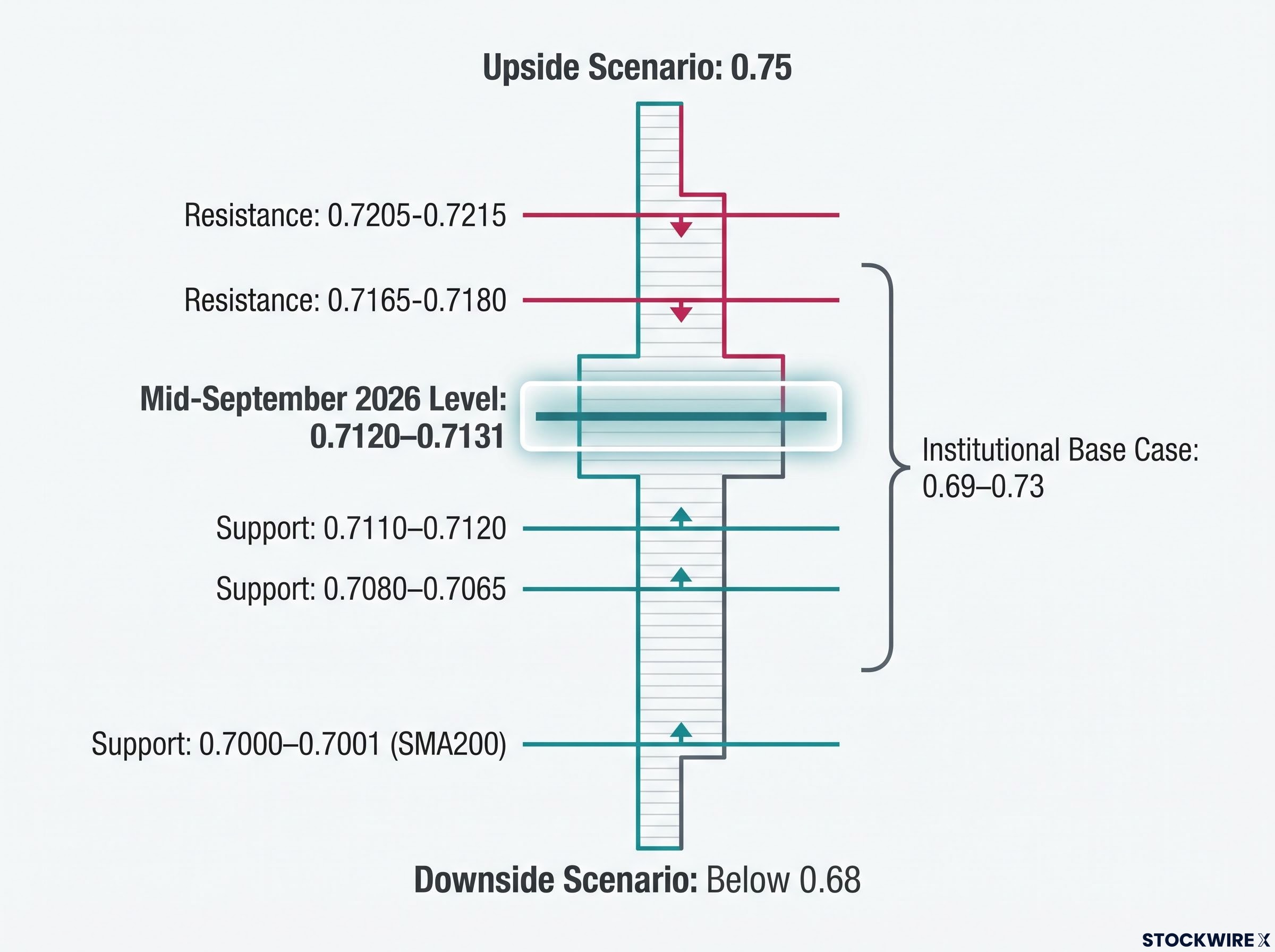
You can see the composite pressure in the price. AUD/USD has been trading near 0.7120-0.7131 in mid-September 2026, held down by US dollar strength, geopolitical tension, and oil-driven yield pressure all at once.
| Driver Category | Current Direction of Pressure on AUD/USD | Key Metric to Watch |
|---|---|---|
| Rate differential | Mildly supportive (positive spread favours AUD) | Australia-US cash rate gap |
| China and commodities | Negative (soft demand, rising supply) | Iron ore prices and Chinese steel data |
| Risk sentiment and geopolitics | Negative (safe-haven flows into USD) | Oil prices and Middle East tension |
For technical reference, the current levels cluster as follows:
- Support zones: near-term at 0.7110-0.7120, secondary at 0.7080-0.7065, and a longer-term anchor at 0.7000-0.7001 (the 200-period simple moving average, or SMA200).
- Resistance zones: near-term at 0.7165-0.7180, with a key band above at 0.7205-0.7215.
For an Australian reader, this section carries a direct message. If you hold US-denominated assets, earn in AUD, or plan an overseas purchase, your purchasing power is being shaped by Beijing’s construction schedule and Middle East stability as much as by anything Warsh or the RBA decides.
The RBA side of the equation: what the 29 September meeting adds
The Fed is only half of the spread. The Australian dollar has its own catalyst on 29 September, when the RBA Board meets and, on current pricing, may lift the cash rate again.
A hike from 4.35% to around 4.60% would widen the Australia-US spread back out, undoing the narrowing that a Fed hike creates. Market-implied probability of an RBA move sits at 71%-78% across sources, with centralbank.watch showing 76% and an implied post-meeting rate of about 4.54%, and RateProbability.com showing 71%. The RBA delivered three consecutive hikes earlier in 2026 before holding at its June and August meetings, so a return to tightening would fit the recent pattern.
The RBA’s tightening bias heading into the September meeting was shaped by the August statement, where June trimmed mean CPI came in at 3.6% against an RBA forecast of 3.8%, a modest undershoot that gave markets comfort without providing the sustained evidence the board said it needed before reconsidering policy.
This is where policy divergence becomes the key idea. If the Fed is edging toward a pause while the RBA keeps hiking, the spread widens in Australia’s favour, and that provides structural support for the AUD over the medium term.
Institutional base case (Westpac, NAB, CBA and AMP) Under benign conditions, AUD/USD is seen trading in a 0.69-0.73 range, with upside toward 0.75 in favourable scenarios.
There is a scenario that undercuts that support, and it is worth flagging now. Some institutions project that RBA easing could be brought forward. NAB, for example, has called for 75 basis points of RBA cuts starting in Q2 2027 [this projection is unverified and should be treated as one institution’s forward view, not consensus]. If that easing arrives, the spread compresses and removes a central pillar of AUD strength.
Three divergence scenarios frame what the two meetings can do to the spread you now understand:
- RBA hikes, Fed pauses. The spread widens in Australia’s favour, which is AUD positive.
- Both central banks hike in tandem. The spread stays roughly stable, with limited directional impact from rates alone.
- Fed pauses and the RBA eventually cuts. The spread compresses, which is AUD negative.
If you are timing decisions around international travel, an overseas property purchase, or a foreign currency conversion, the next six to twelve months hold two competing forces at once: near-term RBA support for the AUD against a longer-term expectation of eventual easing. Acting as though only one of them exists will give you a flawed read.
The scenarios that would override the rate framework entirely
Rate differentials become secondary under three conditions:
- A sharp deterioration in Chinese economic data, which would hit iron ore revenues and Australian risk appetite directly.
- A major geopolitical escalation that triggers sustained risk-off flows into the US dollar.
- A commodities price shock that alters Australia’s terms of trade, given the country’s position as a net energy exporter.
In any of these, the rate spread you have learned to read moves to the background, and the composite drivers take over.
Reading the next two weeks as a two-event sequence
The cleanest way to hold all of this is to stop treating the two central bank meetings as separate news items. The 16 September Fed decision and the 29 September RBA decision are two inputs into the same spread calculation, and the first sets the context for the second.
Watch the arithmetic across both. The current spread is 60-85 basis points. A Fed hike narrows it to roughly 35-60 basis points. An RBA hike two weeks later widens it back to roughly 60-85 basis points.
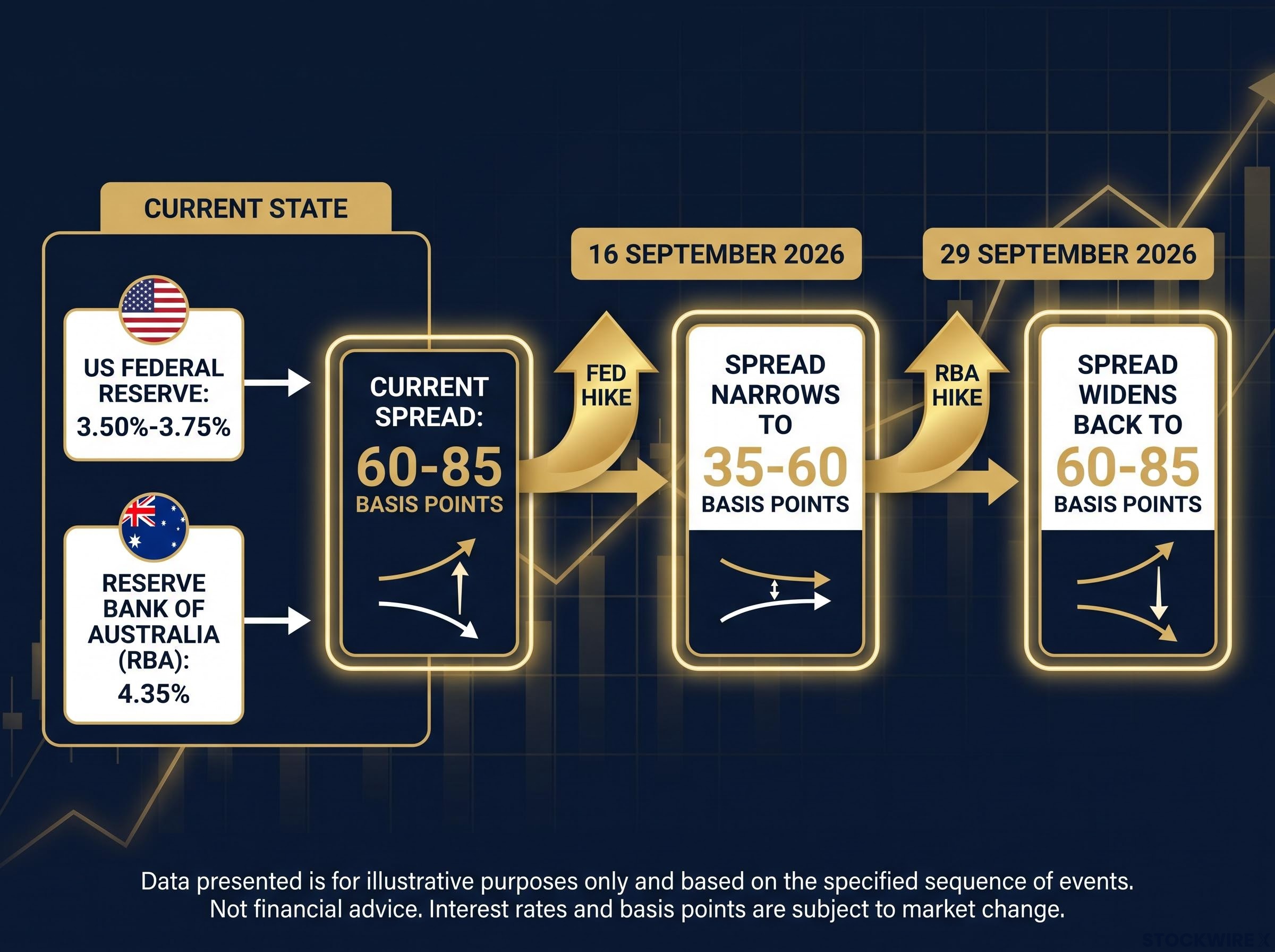
The takeaway to remember If both central banks deliver a 25 basis point hike, the net move in the rate differential is close to neutral, which means tone, forward guidance, China, and geopolitics will do most of the directional work over the next month.
That leaves you with a repeatable habit rather than a one-off call. Here is the four-step sequence to apply to any future Fed or RBA decision:
- Check the spread. Where does the rate gap sit before the meeting, and which currency does it favour?
- Check what is priced in. If the move is near-certain, the announcement itself is unlikely to shift the pair much.
- Check the guidance tone. Hawkish or dovish language, and any shift in the dot plot, is where the real repricing happens.
- Check the external drivers. China demand, iron ore, oil and risk sentiment can override the rate story entirely.
Use the technical structure as a navigational reference through the sequence: support at 0.7110-0.7120, then 0.7080-0.7065, then 0.7000-0.7001; resistance at 0.7165-0.7180, then the key band at 0.7205-0.7215.
For households and businesses managing real AUD/USD exposure, whether through travel, imports or remittances, this framework helps you contextualise movements as they happen. It does not replace hedging or professional financial advice.
What the September decisions actually change for the AUD/USD outlook
The honest answer is that the two meetings sharpen the picture without settling it. What they do is define which conditional path you are watching unfold, and here the framework earns its keep.
Three outcomes are worth holding in mind:
- Fed hikes and sounds hawkish while the RBA holds. The spread narrows and the US dollar’s tightening story extends. This is AUD negative.
- Both central banks hike and guidance is neutral. The spread stays roughly stable and the pair is left range-bound, with external drivers deciding direction. This is broadly neutral for the rate story.
- Fed sounds dovish and the RBA hikes at its September meeting. The spread widens in Australia’s favour and the carry case strengthens. This is AUD supportive.
The base case from major Australian institutions places AUD/USD in a 0.69-0.73 range, with upside toward 0.75 under favourable conditions. The downside scenario is sharper: a serious risk-off escalation could push the pair below 0.68.
The AUD/USD breakout conditions identified in late August 2026 by DBS Group Research required three things to converge at once: a weekly close above the 0.7275-0.7309 resistance zone, synchronised Asian FX strength across CNY, KRW, and JPY, and structural USD weakness driven by Fed credibility doubts rather than a single data surprise.
Your job is not to predict which of these unfolds. It is to recognise which one is unfolding as it happens, and this framework has given you the variables to watch to do exactly that.
This article is for informational purposes only and should not be considered financial advice. Investors should conduct their own research and consult with financial professionals before making investment decisions.
Past performance does not guarantee future results, and these scenarios are speculative and subject to change based on market developments and central bank decisions.
A note for Australians with direct AUD/USD exposure
If you are converting AUD to USD for travel, importing US-denominated goods, holding US property or investments, or sending and receiving remittances, the rate differential framework helps you make sense of the news as it breaks. It is context, not a timing tool. Because China, commodities and geopolitics can override the rate story at any point, professional advice and hedging instruments remain relevant for any material exposure you carry.