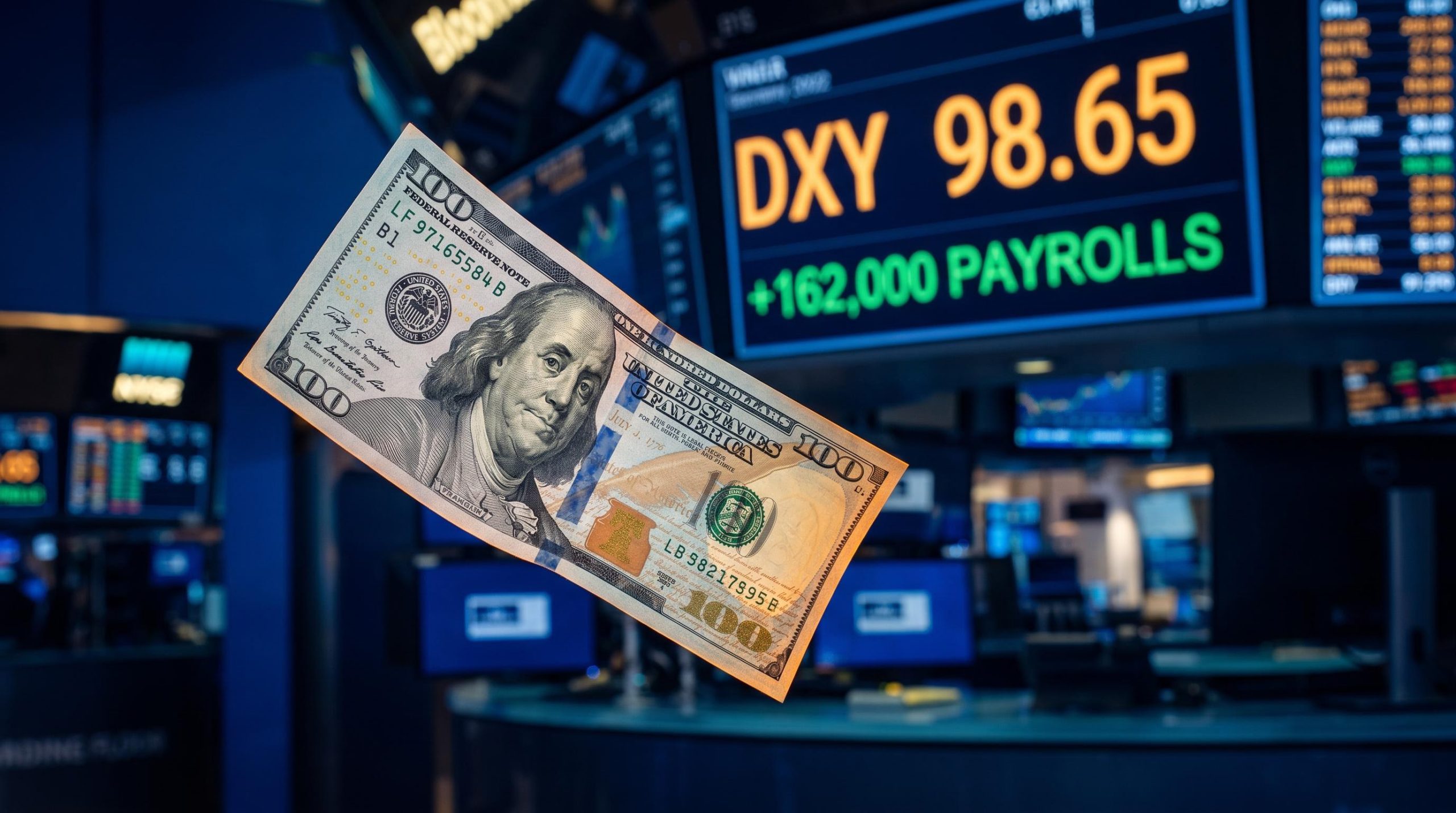
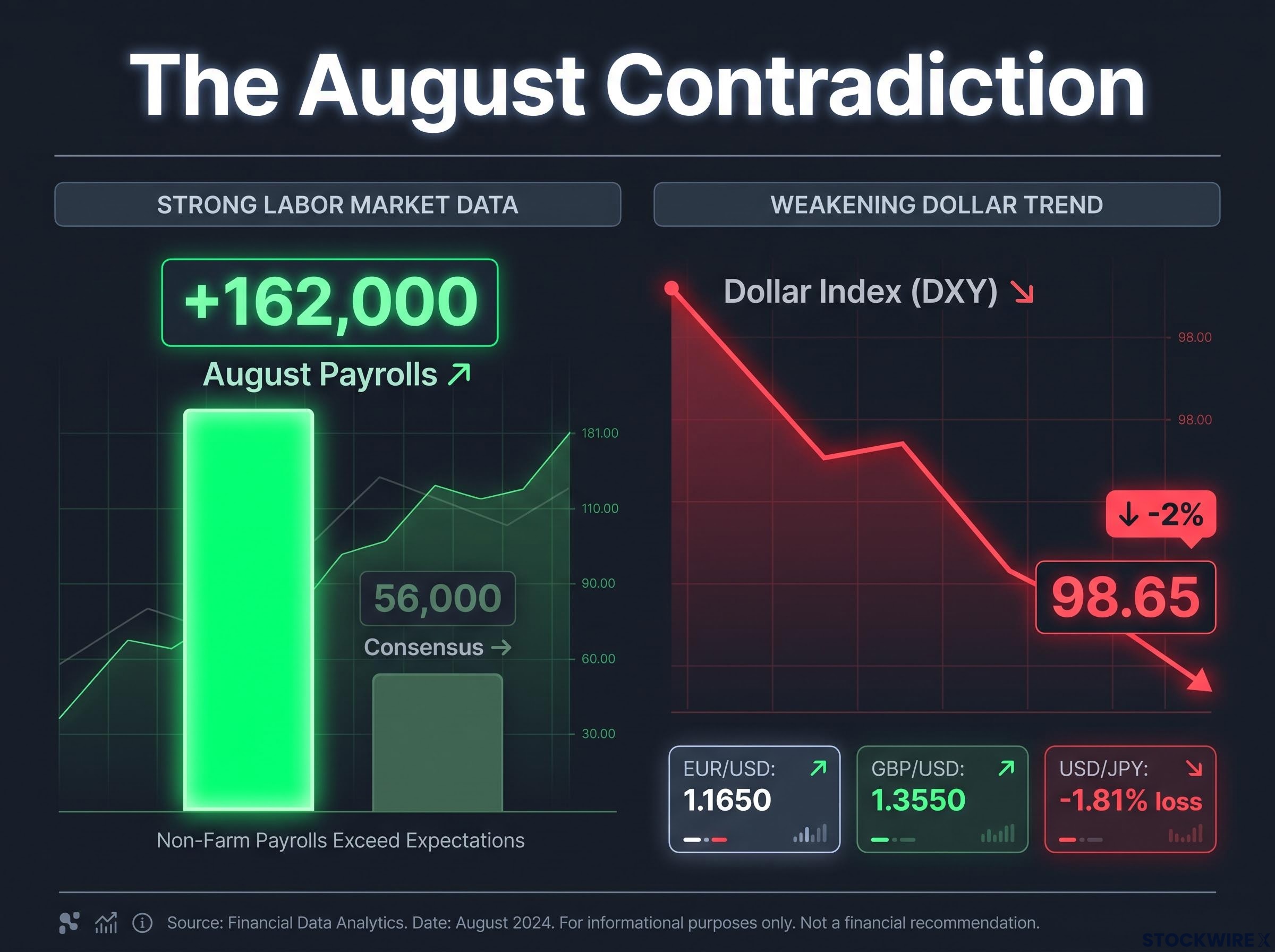
The August jobs report should have been a gift to the dollar. Payrolls came in at +162,000, nearly triple the consensus of 56,000, the biggest beat in five months. The dollar fell anyway.
That is the puzzle. Strong labour data is supposed to lift a currency, not sink it, and yet the greenback slid to multi-week lows while its trading partners rallied. Something is off in how the market is reading American strength right now.
The context makes it stranger. The U.S. Dollar Index (DXY) is trading near 98.65, a multi-week low, with EUR/USD around 1.16 and GBP/USD near 1.35. A word has entered the conversation that carries real weight: debasement. Treasury Secretary Scott Bessent doubled long-duration bond buybacks in August, and strategists from Rabobank to Goldman Sachs have started asking whether the dollar is behaving oddly for structural reasons rather than cyclical ones.
Here is what the debasement debate actually means for how you hold assets, and how to read the inflation data landing this week. After this, you will know the difference between a dollar that is weakening normally and one that is being debased, why that distinction changes your portfolio decisions, and what the September CPI print could resolve.
A jobs number that should have lifted the dollar, and did not
Start with the jobs data on its own terms, because on its own terms it was strong. The Bureau of Labor Statistics (BLS) reported +162,000 nonfarm payroll additions for August, reported by Reuters on 4 September 2026. That was the largest monthly gain in five months, July was revised upward to a 21,000 increase, and the number eased fears of a sharper slowdown in hiring.
The contradiction in one line August payrolls: +162,000. Consensus forecast: 56,000. The dollar fell anyway.
Under normal conditions, a beat like this pushes the dollar higher. The logic is straightforward: a resilient labour market gives the Federal Reserve room to hold interest rates higher for longer, and higher rates make dollar-denominated assets more attractive to global capital. Money flows in, the dollar firms.
This time the mechanism did not fire. During the session on 9 September 2026, the DXY fell to 98.65, its weakest point in more than two weeks, according to MarketWatch. Instead of a dollar rally, its trading partners climbed.
Here is how the moves looked across the majors:
- DXY at 98.65, down roughly 2% from its late-July highs
- EUR/USD climbing toward 1.1650 during the European session
- GBP/USD above 1.3550 after an indecisive prior day
- USD/JPY posting the dollar’s largest weekly loss at roughly -1.81%
The gap between what the data said and what the dollar did is the whole point. When a currency ignores a signal it usually respects, the driver has shifted somewhere else. Rate expectations are no longer in the driver’s seat, and that means any assumption you hold about dollar strength based on economic data needs a second look before you act on it.
When big ASX news breaks, our subscribers know first
What Bessent’s bond buyback actually did to the dollar
To see where the pressure moved, follow the sequence that started in the bond market. On 19 August 2026, Treasury Secretary Scott Bessent announced that the Treasury would double its buyback sizes for 10- to 30-year Treasuries, lifting them from $2 billion to at least $4 billion per operation, running from 9 September through 4 November and funded by heavier issuance of short-term bills, as reported by Reuters.
The Treasury’s official buyback announcement confirmed that maximum operation sizes would rise from $2 billion to at least $4 billion for longer-dated nominal coupon securities, with the programme running from 9 September through 4 November and funded by heavier short-term bill issuance.
In plain terms, this is an “Operation Twist”-style move: the government buys long-dated bonds to hold their prices up and their yields down, while issuing short-term bills to pay for it. The effect is a flatter yield curve, with long-term borrowing costs capped.
The Treasury buyback mechanics that drove the August announcement are frequently misread as a form of quantitative easing, but the programme swaps long-duration supply for short-duration bills without creating reserves or reducing total federal debt, making the signal far more consequential than the raw dollar volume.
Here is how that intervention travels from the bond market to the currency:
- The Treasury buys long-dated bonds, supporting their prices
- It funds those purchases by issuing more short-term bills
- Long-term yields are held down, capping the “upward march” that had unnerved investors
- With yields suppressed, the dollar absorbs the cost of that support through depreciation
That fourth step is the one that matters for you. When policymakers step in to protect the bond market, the pressure does not vanish; it moves. Analysts describe the dollar becoming the “adjustment valve,” the release point for a cost that would otherwise show up in higher rates.
Goldman Sachs’ read The “durable expression” of the policy is a lower dollar rather than lower rates. Bond support comes at the expense of currency strength.
Rabobank framed the same dynamic from the confidence side. The debasement debate that Bessent’s announcement triggered undermined trust in the dollar, which explains why it could not capitalise on otherwise supportive rate expectations. The intervention drew public criticism from investor Stanley Druckenmiller, and Bessent defended it on CNBC on 31 August 2026.
The takeaway is that the dollar is not falling because the U.S. economy is weak. It is falling because policymakers made a deliberate choice to defend the bond market and let the currency absorb the strain. Knowing that trade-off is what separates investors who are prepared for the next bond or currency move from those who are caught out by it.
Why the bond market reaction was short-lived
Unilateral Treasury interventions have a history of limited staying power. The buyback announcement sparked only a brief rally in bond prices before yields rebounded, a reminder that a single government hand on the market rarely holds the line for long.
The lasting damage was not to yields but to confidence. A yield level can be pushed back into place; trust in a currency, once dented, is far harder to restore, and that is where the effect of this intervention actually lingers.
Dollar debasement versus ordinary currency weakness: what the distinction actually means
This is the word you came to understand, so here is a precise definition. Dollar debasement is a persistent, policy-driven erosion of the dollar’s real purchasing power. It typically involves sustained money and credit expansion, higher inflation, and negative real yields, the situation where the return on an asset after inflation is below zero, with policymakers effectively using the currency to absorb fiscal and debt pressures.
Ordinary currency weakness is a different animal. Here the dollar falls because interest rate expectations shift, but the institutional framework underneath it stays intact: Federal Reserve independence, Treasury credibility, and global demand for dollars as a reserve currency all hold firm. The price moves; the trust does not.
The contrast is easier to see side by side:
| Attribute | Dollar debasement | Ordinary currency weakness |
|---|---|---|
| Cause | Sustained money and credit expansion; policy tolerance of inflation | Shifting interest rate expectations; valuation and flow adjustments |
| Duration | Persistent and structural | Cyclical and reversible |
| Key signal | Negative real yields with no policy response; foreign selling of Treasuries | Rate differentials and choppy trading ranges |
| Expert view on now | Not the current episode, per Goldman and Rabobank | Best fit for what is happening today |
The expert consensus lands firmly on the right-hand column:
Dollar reserve status underpins the argument that cyclical weakness is not the same as structural decline: the dollar still sits on one side of 89.2% of all global FX trades and holds roughly 57% of official reserves, figures that define the institutional floor beneath the currency even when policy interventions dent confidence.
- Goldman Sachs estimates the dollar is roughly 15% overvalued but says reserve-currency status is not at risk, citing “limited evidence of displacement” and expecting only a “shallower dollar descent.”
- Rabobank’s Jane Foley notes that FX is “typically led by movements in short-term interest rates,” and that fiscal anxieties are adding volatility and choppy ranges rather than a straight-line collapse.
- A Yahoo Finance strategist argued that “US dollar debasement isn’t really happening,” pointing out that genuine debasement would show up as foreign investors offloading Treasuries in size, which the data does not show.
For historical context, Goldman warned back in 2020 that “expanded balance sheets and vast money creation spurs debasement fears,” language that defines the structural version of the phenomenon. The clearest real-world benchmark is the 1970s Great Inflation, which research from the Cleveland and Dallas Feds attributes to a policy framework that tolerated high inflation and heavy monetary expansion. That is the bar for genuine debasement, and it is a high one.
This distinction is the practical heart of the matter. If this were debasement, you would be repositioning defensively for a structural currency decline. Because it is cyclical weakness, your job is to manage through a volatile phase, which means you should not panic-sell dollar assets on a policy headline, but you should know exactly which conditions would justify a more defensive stance.
What history says about jobs data, policy interventions, and dollar trajectories
History is useful here as a measuring stick, not an alarm. The 1970s remains the clearest case of genuine dollar debasement. Heavy fiscal deficits from Vietnam War spending, rapid monetary expansion, and the 1971 closure of the gold window produced sustained depreciation, because policymakers tolerated high inflation and prioritised low unemployment over price stability. IMF and UN analyses of the Bretton Woods collapse tie that gold-window decision directly to devaluation and widespread confidence concerns.
What ended it is the part worth remembering. The dollar’s credibility was restored not by a single intervention but by the Volcker-era tightening, a prolonged willingness to raise rates and absorb short-term economic pain. Structural debasement requires a sustained failure to restore discipline, not a few weak weeks in the currency market.
History also shows this is not the first time strong jobs data has failed to lift the dollar. A 2016 Investing.com analysis described a “strong NFP fails to impress” episode where dovish Fed communication outweighed the data, and more recent 2025-2026 commentary noted times when soft inflation or downward revisions knocked the stuffing out of an apparent dollar rally.
The current episode rhymes with those policy-driven weak patches, but three structural differences separate it from the 1970s:
- The dollar retains its reserve-currency status and its dominance in trade invoicing
- The Treasury market offers deep liquidity that few alternatives can match
- Foreign demand for Treasuries remains at record levels, per Rabobank
Rabobank’s anchor Record foreign demand for Treasuries and the dollar’s deep liquidity still underpin its safe-haven role, even as fiscal worries heighten volatility.
The read for you is that this situation warrants attention but not a structural portfolio response. The dollar is under policy-driven pressure, not in a debasement spiral, and the nearest test of which way it resolves arrives in days.
What the September CPI print could change
The BLS is scheduled to release the August Consumer Price Index (CPI) on 12 September 2026, and markets are watching it as a key signal for Fed policy. The July print set the baseline: +0.1% month-on-month and +3.4% year-on-year, released by the BLS on 12 August 2026.
Two scenarios split from there. An upside surprise reopens rate-hike expectations and could hand the dollar a genuine catalyst, the kind of fundamental support the jobs data failed to provide. A soft print does the opposite: it reinforces the view that the Fed is constrained, keeps the dollar under pressure, and gives the debasement narrative more oxygen.
That is why the inflation number matters more than any single jobs report right now. It speaks directly to the anchor that debasement fears revolve around.
Reading the dollar right now, and knowing what would actually change the thesis
Pull the threads together and the current state is clear. The dollar is falling because a policy intervention shifted the adjustment cost onto the currency, confidence has been dented, and markets are waiting on inflation data to recalibrate. It is not falling because the United States has entered a genuine debasement spiral.
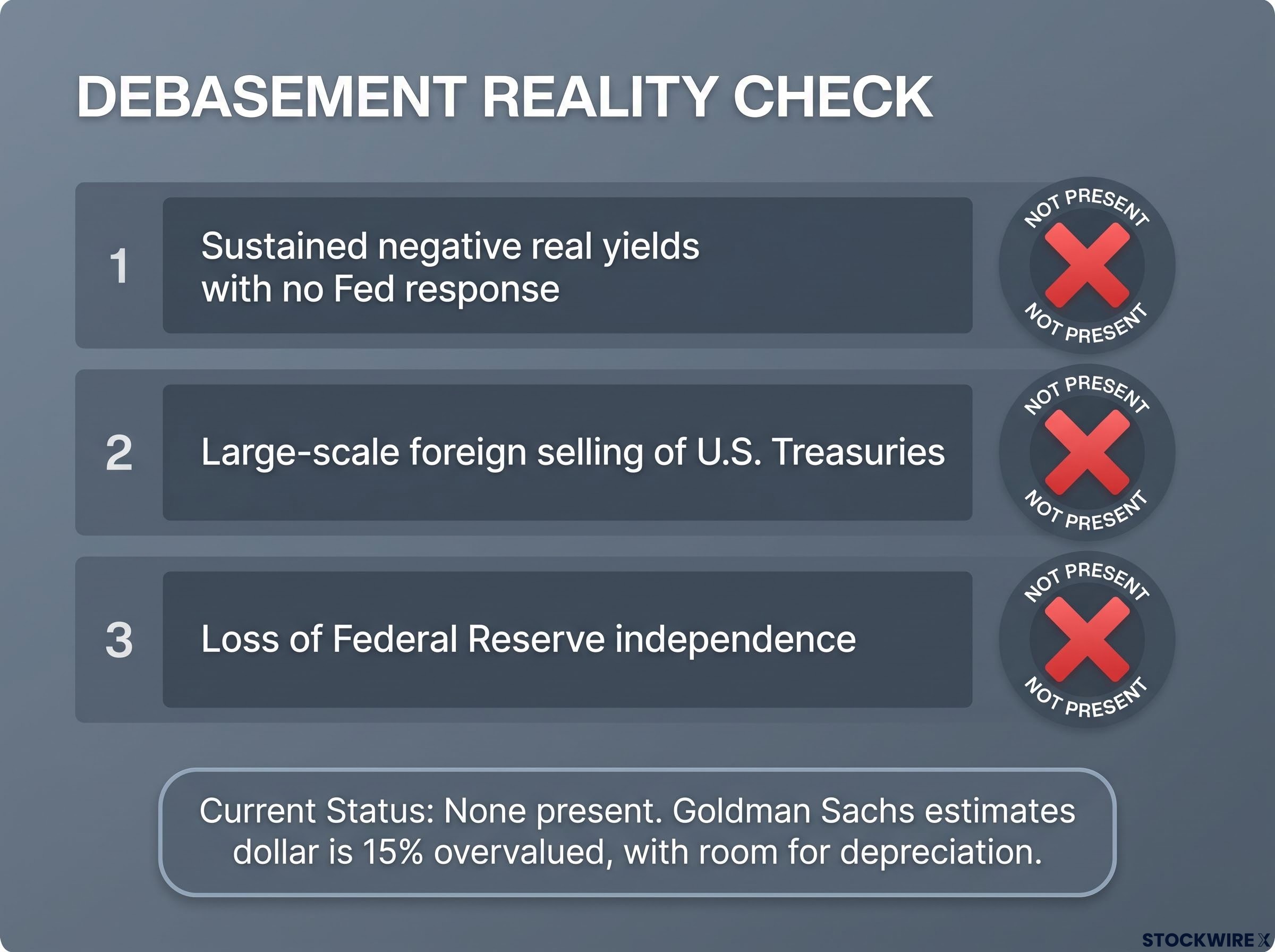
That gives you a monitoring framework rather than a reason to react. Three conditions would signal that debasement is actually underway, and you can return to this checklist whenever a fresh headline lands:
Federal Reserve independence is the third item on the debasement checklist, and the Supreme Court’s 5-4 ruling in Trump v. Cook on 29 June 2026 established explicit procedural requirements that make the rapid removal of sitting governors substantially harder to execute than it was before.
- Sustained negative real yields with no policy response from the Fed
- Large-scale foreign selling of U.S. Treasuries
- A loss of Federal Reserve independence
None of the three is present in the current data. The DXY, down about 2% from late July and trading near 98.65, remains well within its historical ranges. Goldman’s estimate that the dollar is roughly 15% overvalued implies there is room for further depreciation without any of it constituting debasement, and Rabobank expects choppy ranges as newsflow shifts, not a collapse.
For positioning, the practical signals to watch are narrow and specific:
- Real yield trends, the return on Treasuries after inflation
- CPI prints as the most direct read on the inflation anchor
- Foreign demand data for Treasuries, the clearest test of whether trust is holding
Real yield direction, rather than the nominal level, is the operative variable for assets that benefit from debasement fears: gold’s most durable bull markets have coincided with real yields collapsing toward zero or deeply negative territory, conditions that are absent while the Fed retains room to respond.
There is a portfolio dimension too. Dollar weakness is already flowing into higher-beta currencies, with AUD/USD up roughly 0.3% on 9 September and the dollar up about 0.31% on the week against the New Zealand dollar. If you already hold a diversified mix with some gold, commodity, or international equity exposure, you have partial hedges in place. If your fixed income is concentrated in dollar-denominated assets, real yields and CPI are the signals that deserve your attention, not the headlines.
This article is for informational purposes only and should not be considered financial advice. Investors should conduct their own research and consult with financial professionals before making investment decisions. Past performance does not guarantee future results, and financial projections are subject to market conditions and various risk factors.
The dollar’s credibility test is still being scored
The core distinction holds. The dollar is under pressure, but pressure is not collapse, and policy noise is not the same as institutional failure. Confidence has been dented by a deliberate trade-off, not eroded by a breakdown in the framework that backs the currency.
The debasement debate is still worth taking seriously, precisely because it forces the right questions. Is fiscal credibility intact? Are real yields turning genuinely negative? Does the Fed still have room to manoeuvre? Those are the questions that separate a passing weak patch from a structural shift.
The mainstream base case Goldman Sachs expects a “shallower dollar descent,” not a collapse. Rabobank frames the tactical reality as choppy ranges rather than a straight line down.
The nearest inflection point is the CPI release on 12 September 2026, and the broader test runs through Bessent’s buyback programme, which continues to 4 November. Watch how Fed policy responds across that window, because that is where you will see whether discipline is being restored or eroded. For now, your job is to monitor with a framework, not to act on a narrative the evidence has not yet confirmed.