How Hormuz Closure at $104 Oil Is Reshaping Every Asset Class
7 hrs ago


The S&P 500’s average dividend yield sits at just 1.1% in April 2026. For investors who need their portfolios to generate income, not just appreciate on paper, that number is a problem. Yet three widely available securities are paying between 2.77% and 11% right now, each through a structurally distinct mechanism that carries its own risk-reward profile. Realty Income, ExxonMobil, and the JPMorgan Nasdaq Equity Premium Income ETF (JEPQ) represent three different answers to the same question: how to extract meaningful cash flow from a market that offers very little at the index level. What follows is a comparison of their yield mechanics, sustainability metrics, and investor fit, designed to help income-focused US investors determine which option, if any, belongs in their portfolio.
An investor holding $500,000 in an S&P 500 index fund at a 1.1% yield collects roughly $5,500 per year in dividends. That figure does not cover a single quarter of living expenses for most retirees, and it barely registers as a return component for accumulation-phase investors. The frustration is not impatience; it is arithmetic.
The shift toward dividend-paying securities in 2026 reflects that arithmetic playing out across portfolios at scale. REITs have gained approximately 10% year-to-date, while the Magnificent Seven have delivered uneven performance weighed by AI-related uncertainties. Capital is rotating toward income generators, not fleeing growth in panic, but because the yield gap between the index and purpose-built income securities has widened to a point where ignoring it carries real opportunity cost.
Bloomberg reporting on investor rotation from technology into dividend-paying sectors confirmed that the S&P 500’s overall payout ratio had declined toward a 50-year low, with institutional capital actively reallocating toward cash-returning defensive holdings as the yield gap between the broad index and purpose-built income securities widened.
The S&P 500 yields 1.1%. Realty Income pays 5.13%. ExxonMobil pays 2.77%. JEPQ pays approximately 10.48-11.14%. Each achieves its yield through a different structural mechanism.
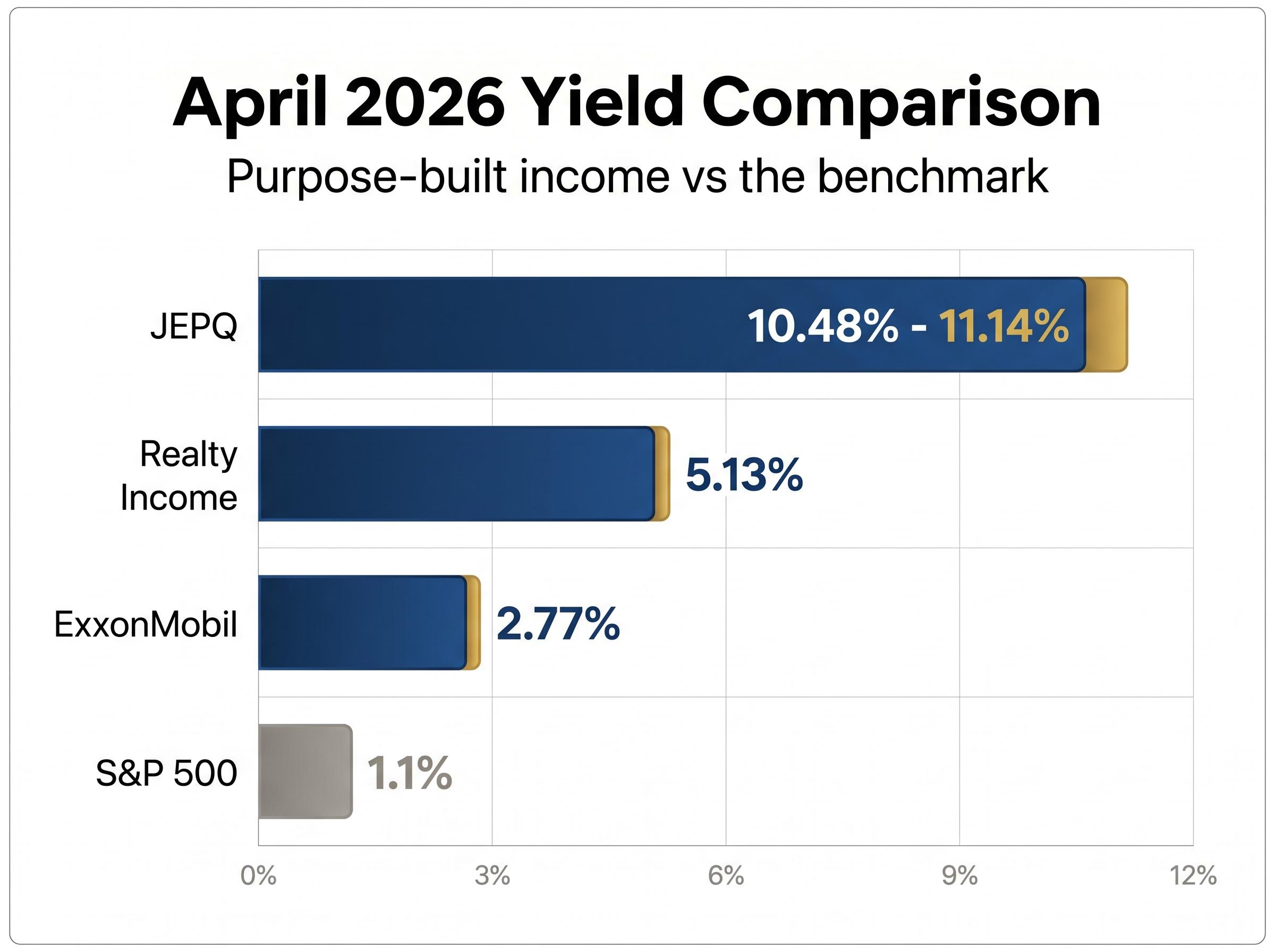
The three securities featured in this analysis represent three distinct approaches to generating yield above the benchmark:
Realty Income’s yield is not a management preference. It is a legal obligation. As a Real Estate Investment Trust (a structure that allows companies to avoid corporate-level taxation in exchange for distributing at least 90% of taxable income to shareholders), Realty Income is engineered from the ground up to pay out income. The result, at an April 27, 2026 share price of $63.33, is a forward dividend yield of 5.13%, paying $0.2705 per share monthly ($3.246 annualised).
The SEC investor bulletin on Real Estate Investment Trust distribution requirements codifies the 90% taxable income payout threshold that defines the REIT structure, making this legal obligation the foundation of Realty Income’s yield rather than a discretionary management choice.
The structural mandate tells investors why Realty Income pays. The operational record tells them how reliably it has done so. On 14 April 2026, the company declared its 670th consecutive monthly dividend, payable 15 May 2026, with an ex-date of 30 April 2026. Its 134th consecutive dividend increase was declared on 11 March 2026. Those are not marketing statistics. They represent an unbroken payout record spanning decades of rate cycles, recessions, and real estate downturns.
Key sustainability metrics reinforce the picture:
REITs depreciate large property portfolios under GAAP accounting, which inflates the apparent payout ratio when measured against net income. Adjusted Funds From Operations (AFFO) strips out depreciation and other non-cash charges to produce a figure that more accurately reflects the cash available for dividends. Realty Income’s forward AFFO payout ratio of approximately 75% sits comfortably below the 80% threshold that analysts typically use as a sustainability ceiling, meaning the company retains a meaningful buffer after distributions.
The yield figure stops most readers mid-scroll. A fund paying approximately 10.48-11.14% in April 2026, holding Nvidia, Apple, Alphabet, Microsoft, Amazon, and Meta, sounds like it should carry a catch. It does, but the catch is a deliberate trade-off rather than a hidden flaw.
The mechanics operate in three steps:
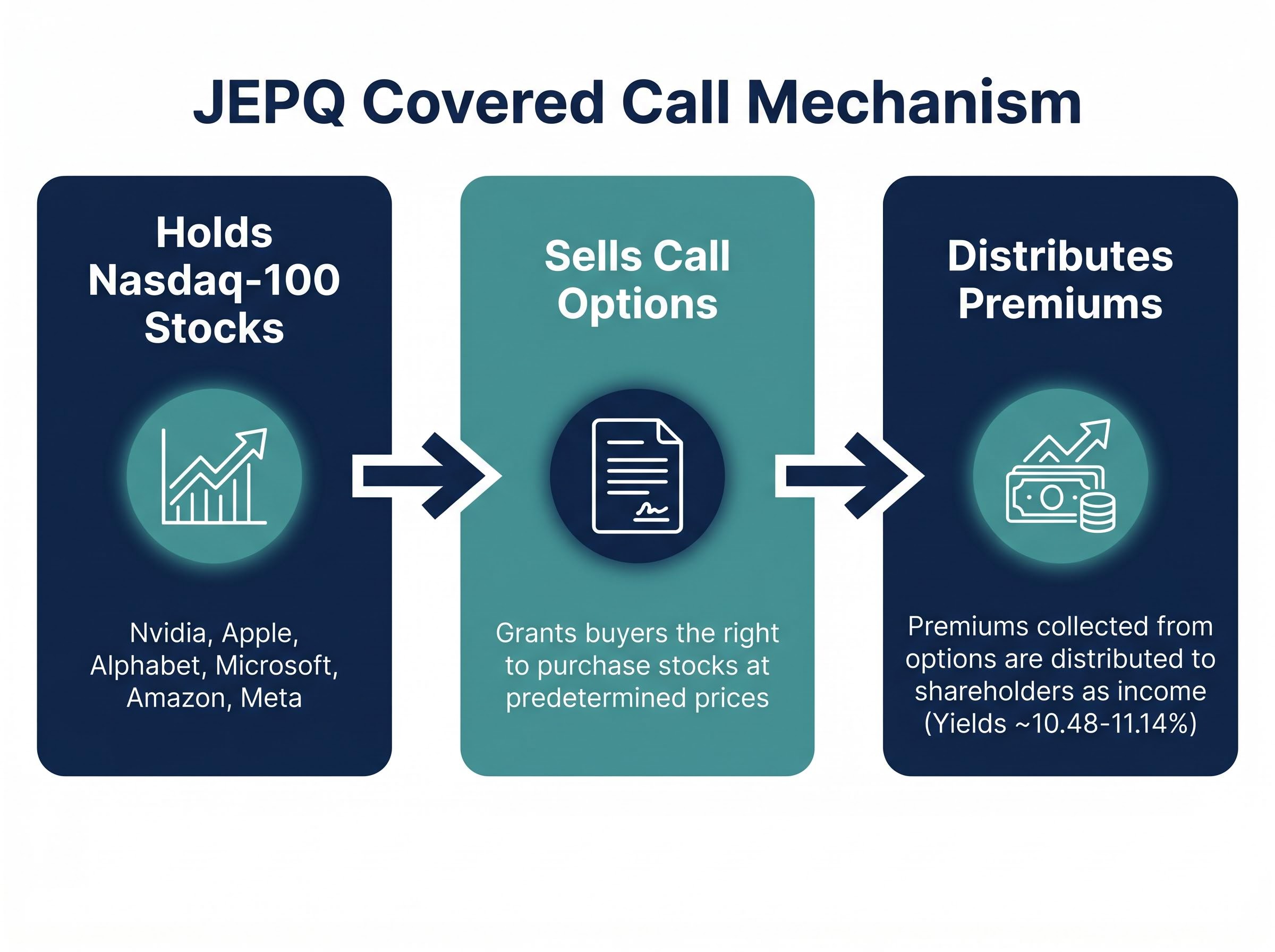
The total return inclusive of dividends over the prior twelve months reached 32%, according to available performance data. For current fund-level performance figures, JPMorgan Asset Management’s fund page and SEC filings serve as the primary sources.
JEPQ performs best in sideways or mildly declining markets. In those conditions, the underlying stocks move little, the call options expire unexercised, and the fund keeps both the stocks and the premium income. The distributions provide a return buffer that the underlying equities alone cannot match.
In strongly bullish markets, the calculus reverses. When Nasdaq-100 stocks surge, the call options are exercised and the fund must sell holdings at the predetermined strike price, missing the full upside. Total return lags the index in those periods. This is not a structural flaw; it is the cost of the income. Investors whose market outlook favours choppy or range-bound conditions may find the trade-off acceptable. Those expecting a sustained rally may find the capped upside frustrating.
Income-generating strategies during 2026 market volatility have attracted renewed attention as the Federal Reserve held rates steady and projected only one cut for the year, conditions that simultaneously suppress bond yields and increase the relative attractiveness of dividend-paying equities and covered-call structures that convert volatility into distributable income.
Distributions are variable by design, tied to the level of options premiums, which fluctuate with market volatility. Unlike Realty Income’s predictable monthly payout, JEPQ’s income stream rises and falls with the options market.
ExxonMobil has raised its dividend every year for 43 consecutive years. That streak earns the company Dividend Aristocrat status and places it in a small cohort of S&P 500 constituents that have maintained annual increases through recessions, oil price collapses, and industry-wide capital discipline cycles. At a share price of $148.91 and an annual dividend of $4.12 per share, the forward yield stands at 2.77%, more than double the S&P 500’s 1.1% benchmark, without requiring any exotic structure.
ExxonMobil generated $52 billion in operating cash flow in 2025, alongside $28.8 billion in net earnings, providing substantial coverage for its $4.12 annual dividend.
The financial backing is considerable. Q1 2026 earnings per share are estimated at approximately $2.50, with oil prices holding near $80 per barrel. The dividend consumes a manageable fraction of the company’s cash generation, leaving room for reinvestment and buybacks.
| Security | Yield | Dividend Growth Streak | Key Risk Factor |
|---|---|---|---|
| ExxonMobil (XOM) | 2.77% | 43 years consecutive increases | Oil price volatility and energy transition |
| S&P 500 (benchmark) | 1.1% | N/A | Broad market risk |
The complication is commodity dependence. Every future year in that 43-year streak is contingent on oil prices remaining supportive enough to sustain both the dividend and the capital expenditures required to maintain production. The energy transition adds a longer-horizon question about demand trajectories. ExxonMobil is not a bond-like income play; it is a dividend growth story with a macro variable that management cannot fully control.
The three securities solve the yield problem differently, and those differences determine which portfolio each one belongs in. Evaluating them in isolation misses the point. The comparison is where the decision lives.
| Security | Current Yield | Yield Type | Primary Risk | Best Suited For |
|---|---|---|---|---|
| Realty Income (O) | 5.13% | Fixed, monthly, growing | Interest rate sensitivity | Capital preservation, predictable income |
| ExxonMobil (XOM) | 2.77% | Annual, growing | Oil price volatility | Long-horizon inflation hedging |
| JEPQ | ~10.48-11.14% | Variable, options-based | Capped upside in rallies | Income maximisation in range-bound markets |
All three outperform the S&P 500’s 1.1% yield by margins ranging from 2.5x to roughly 10x. The differences lie in consistency, growth trajectory, and the specific market conditions under which each performs best.
Three investor-type profiles emerge:
These are not mutually exclusive choices. A portfolio combining Realty Income as a stability anchor, JEPQ for high current income, and ExxonMobil for dividend growth and inflation protection deploys three structurally uncorrelated income streams.
High yield dividend stocks with sustainable payout ratios in other sectors, including consumer staples names such as General Mills and Best Buy, offer a parallel screen for income investors who want equity-based cash flow without concentrating in REITs or energy; those alternatives carry their own sector-specific risks but provide a broader menu of 6%-plus yielding positions with analyst-endorsed payout sustainability credentials.
Before committing capital to any high-yield security, investors benefit from understanding the mechanics that separate sustainable income from yield traps.
A yield figure is a function of both dividend size and share price movement. A stock yielding 8% may be paying a generous dividend, or it may be a company whose share price has fallen 40% while the dividend has not yet been cut. Distinguishing between the two is the first analytical step.
Payout sustainability is the primary filter, but the right metric varies by security type:
Tax treatment also differs materially for US investors. REIT dividends are typically classified as ordinary income and taxed at the investor’s marginal rate. Qualified dividends, such as those paid by ExxonMobil, are taxed at the lower long-term capital gains rate. JEPQ distributions may include components classified as return of capital or short-term capital gains, each carrying different tax treatment. Investors should consult a tax professional for guidance specific to their situation.
The IRS guidance on dividend and distribution tax classifications formally distinguishes ordinary dividends, qualified dividends, and return of capital distributions, with each category carrying a different effective rate that can materially alter the after-tax income from the three securities compared in this analysis.
Income investing without understanding these sustainability metrics and tax implications is yield-chasing, not strategy.
Realty Income, ExxonMobil, and JEPQ each deliver yields that materially exceed the S&P 500’s 1.1% benchmark, but they achieve this through structurally different mechanisms carrying different risk profiles. Realty Income offers predictable monthly cash flow backed by a legally mandated payout structure and one of the longest dividend streaks in US equities. ExxonMobil provides inflation-linked dividend growth over a longer horizon, contingent on commodity market conditions. JEPQ maximises current income by converting Nasdaq-100 volatility into distributable premiums, accepting capped upside as the cost.
As 2026 volatility persists and growth-stock performance remains uneven, income-generating alternatives to low-yield index exposure are earning renewed strategic attention. The framework above provides a starting point; the decision requires matching these profiles against individual income requirements, risk tolerance, and tax circumstances before acting.
This article is for informational purposes only and should not be considered financial advice. Investors should conduct their own research and consult with financial professionals before making investment decisions. Past performance does not guarantee future results.
Dividend income investing is a strategy focused on holding securities that regularly distribute cash to shareholders, such as REITs, dividend growth stocks, and covered-call ETFs, rather than relying solely on share price appreciation for returns.
The S&P 500's overall payout ratio has declined toward a 50-year low, with the index yielding just 1.1% in April 2026, prompting income-focused investors to rotate toward purpose-built income securities that offer materially higher yields.
JEPQ generates its approximately 10.48-11.14% yield by holding Nasdaq-100 stocks and selling call options on those holdings, distributing the premiums collected from option buyers to shareholders as monthly income.
Realty Income's forward AFFO payout ratio sits at approximately 75%, below the commonly cited 80% sustainability threshold, and the company has made 670 consecutive monthly dividend payments including 134 consecutive increases, supporting the case for sustainability.
REIT dividends such as those from Realty Income are typically classified as ordinary income and taxed at the investor's marginal rate, while qualified dividends such as those paid by ExxonMobil are taxed at the lower long-term capital gains rate.