

A 15.1% quarterly gain demands more than a headline. It demands an explanation.
The MSCI All Country World Index (MSCI ACWI) recorded its best quarterly result in years during the April-to-June 2026 period, surpassing performance not seen since markets bounced back from the pandemic, according to FactSet data. That alone would be worth examining. But it arrived after a losing Q1, making the swing from retreat to advance the real story. Three forces powered it: an AI investment cycle grounded in actual earnings, the mechanics of U.S. midterm election years, and a sentiment mix that looks more like a maturing bull market than one about to break.
Here is what the evidence says about where this rally stands, what is driving it, and what it changes for investors thinking about the second half of 2026.
A quarter that erased the damage and then some
According to FactSet data as of 1 July 2026, the MSCI ACWI delivered a 15.1% return across Q2 2026, covering the period from 31 March through 30 June 2026. On a year-to-date basis, starting from 31 December 2025, the index had accumulated a 11.5% gain by the close of June.
| Metric | Return | Period | Source |
|---|---|---|---|
| MSCI ACWI Q2 2026 gain | 15.1% | 31 March – 30 June 2026 | FactSet (1 July 2026) |
| MSCI ACWI year-to-date | 11.5% | 31 December 2025 – 30 June 2026 | FactSet (1 July 2026) |
Marking its best quarterly showing since the COVID-era rebound, the MSCI ACWI’s Q2 performance wiped out the first-quarter decline and lifted first-half returns to a level that sits somewhat ahead of the typical outcome for positive U.S. midterm election years.
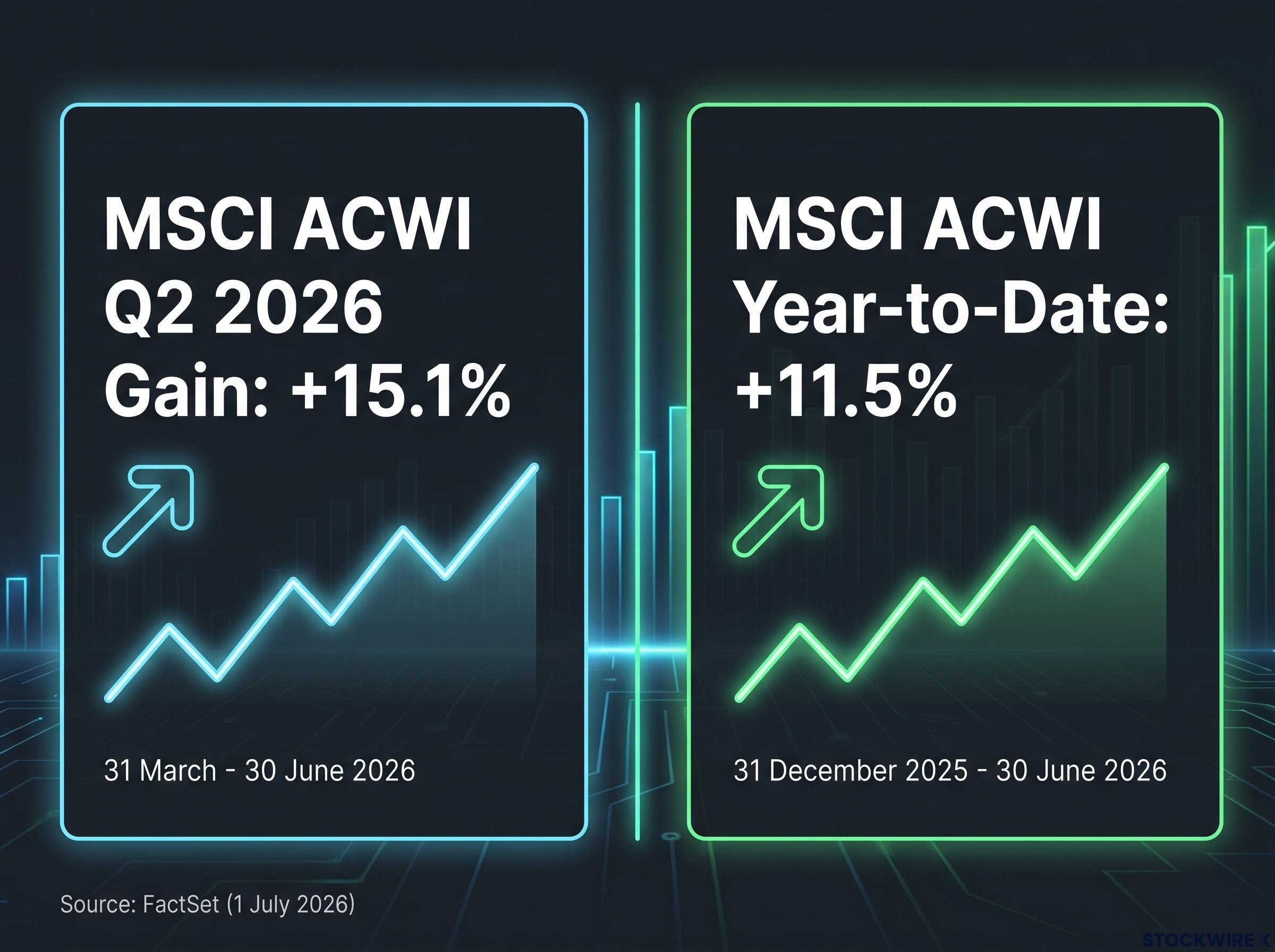
That year-to-date figure matters. An 11.5% gain after a losing first quarter tells you the underlying advance absorbed a real setback and came back stronger. That is structurally different from a bull market that has never been tested. Broad participation across U.S. large-, mid-, and small-cap indexes, along with international developed and emerging markets, reinforced the advance. Leadership remained concentrated in technology, but market breadth improved during the quarter, a combination that historically signals a more durable foundation than a narrow mega-cap rally alone.
When big ASX news breaks, our subscribers know first
Why AI is driving markets, and why that also creates risk
AI is not powering this rally on sentiment alone. Capital expenditure cycles in semiconductors, cloud computing, and data centre infrastructure are generating real revenue for the companies at the centre of the trade. Three structural forces underpin the move:
- Semiconductor demand: Companies supplying AI compute chips are reporting accelerating order books tied to enterprise and hyperscale deployments.
- Cloud infrastructure spending: Major cloud providers are expanding capacity to serve AI workloads, feeding revenue growth across the supply chain.
- Data centre capital expenditure: Physical infrastructure buildouts are translating AI demand into tangible spending commitments with multi-year visibility.
This is what separates the current moment from earlier technology-led rallies where speculation outran fundamentals. The earnings are arriving. The capex is hitting income statements. Investors are pricing AI as a structural productivity story, which supports higher long-term earnings expectations for the sector.
The case that the current advance rests on earnings cycle fundamentals rather than speculative expansion is supported by forward P/E compression in several market segments even as nominal prices climbed, the mathematical opposite of what bubble dynamics produce.
When the theme is real but the trade is crowded
The counterargument is already circulating. Some research houses are explicitly using “AI-fuelled stock market bubble” language, flagging stretched valuations that could prove vulnerable to higher interest rates and persistent inflation. Separately, Fisher Investments has pointed to heightened excitement around AI and technology as a sign of early-stage euphoria, with the firm indicating this places the bull market in a more advanced phase.
Both observations can be true simultaneously. The AI trade is real in its fundamentals and crowded in its positioning. That combination is characteristic of late-stage, not finished, bull markets, where the theme continues to deliver but the easy returns may have already been captured. What this tells you is that distinguishing between AI-exposed companies with durable revenue growth and those riding sentiment alone is now the work the market is asking you to do. Treating AI as a monolithic theme risks being right about the trend and wrong about specific positions.
What the midterm election calendar means for global equity returns
The U.S. midterm elections are scheduled for 3 November 2026. For equity markets, this date carries weight beyond politics because of a historical pattern that has repeated with notable consistency since the mid-20th century.
The sequence unfolds in three stages:
- Pre-vote volatility: Midterm years feature higher average volatility and lower average returns than non-midterm years, particularly from spring into autumn. Policy uncertainty forces investors to demand a higher equity risk premium, producing weaker and choppier performance.
- Election resolution: Once the vote produces a result, policy uncertainty compresses. Markets begin repricing the reduced probability of large-scale legislative change.
- Post-vote re-rating: The 6-12 months following midterm elections have historically delivered above-average equity returns, as risk premia normalise and capital re-enters markets.
Historical studies covering the mid-20th century to the present show average post-midterm one-year gains for the S&P 500 in the low- to mid-teens.
The post-midterm return record stretches back to 1950 without a single losing 12-month window across all 19 cycles, a consistency that spans recessions, financial crises, and geopolitical shocks, and that gives the historical pattern more statistical weight than most cycle analogies carry.
Markets tend to favour gridlock, meaning divided government, because it limits the probability of disruptive changes to taxes, regulation, or spending. Fisher Investments characterises prospective gridlock as a market catalyst that has not yet materialised, a potential tailwind still ahead.
The practical read for you is that the 3 November vote is not simply a political event. It is a potential volatility trigger followed by a historically favourable setup. Historical data show that midterm years can feature deeper intra-year drawdowns even in years where the subsequent period was strong. Drawdowns between now and the election are more likely to represent an entry point than a trend break.
Understanding what a “maturing bull market” actually means
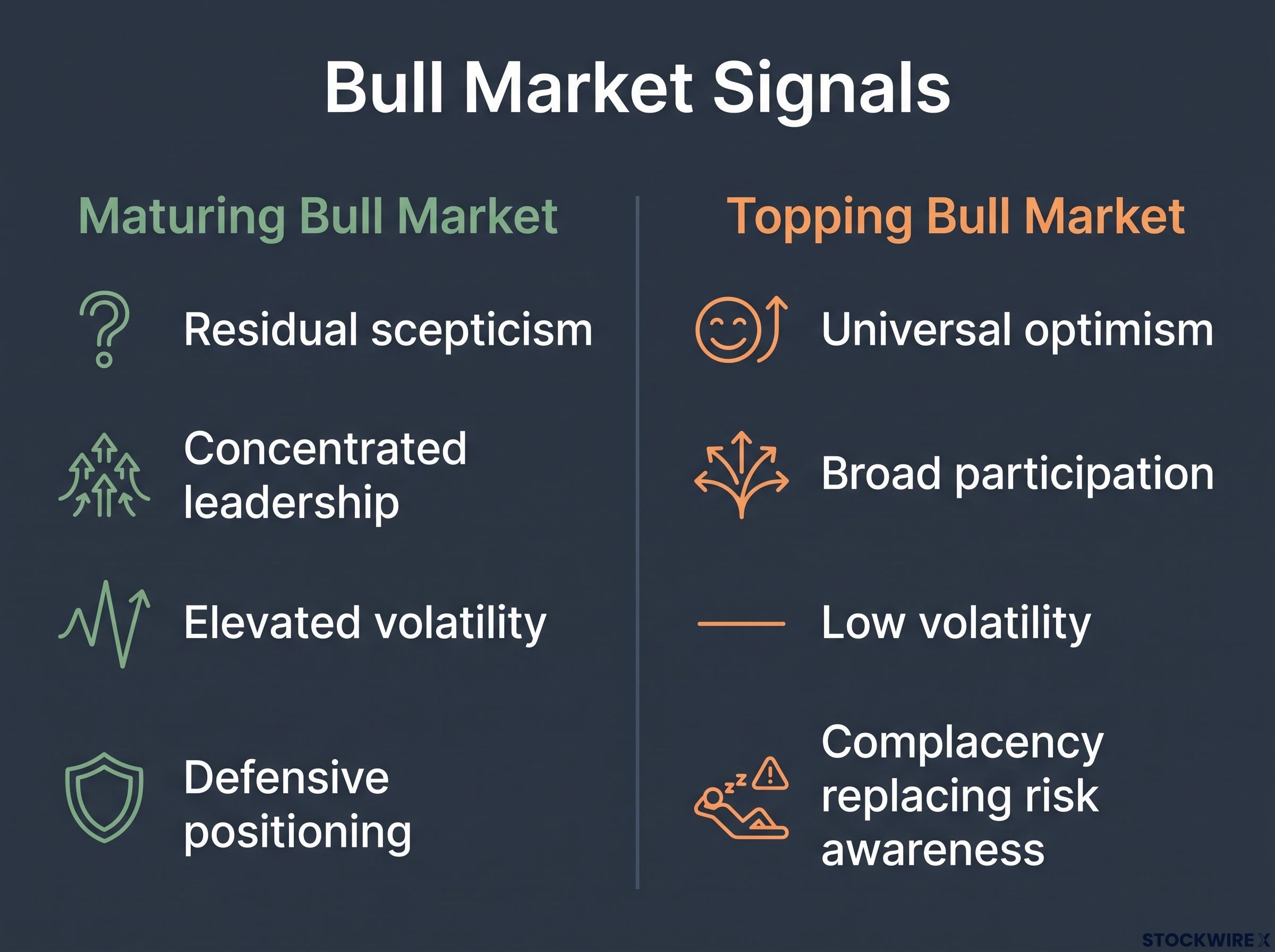
Bull markets do not die of old age. They die of sentiment. The distinction between a maturing bull market and a topping bull market is not about how long the rally has lasted or how high prices have climbed. It is about the texture of investor sentiment.
- Maturing bull market signals: Residual scepticism in broad swathes of the market, concentrated leadership in a dominant theme, elevated volatility, and defensive positioning outside the leading sectors.
- Topping bull market signals: Universal optimism, broad participation driven by conviction rather than caution, low volatility, and complacency replacing risk awareness.
The distinction matters because the instinct to treat age alone as a warning signal leads investors to exit prematurely. Bull markets most often end when scepticism is exhausted and optimism becomes universal.
The Templeton sentiment model offers a four-stage framework for mapping where a bull market sits relative to its eventual peak, and Ken Fisher’s May 2026 placement of the current cycle in early-stage euphoria suggests that the phase the article describes as ‘maturing’ still carries a potential two-year or longer runway before the terminal phase exhausts itself.
How the current environment reads against these signals
Three current signals align with the maturing pattern rather than the topping one. AI enthusiasm is real but concentrated, not universal across sectors. According to Fisher Investments, pockets of persistent doubt in areas of the market outside technology serve to partially offset the more exuberant signals. Defensive positioning outside technology, combined with midterm-driven anxiety, reinforces the “wall of worry” texture that characterises mid-to-late-cycle environments, not peaks.
What this tells you is that the absence of universal optimism is itself a positive structural signal. Pervasive worry feels like a reason to reduce exposure. In a mid-cycle environment, it is more likely evidence that the advance has room to continue.
Three positioning principles for the second half of 2026
The analysis above points to three actionable conclusions, each derived from a specific element of the current environment.
- Treat this as a maturing, not dying, bull market. According to Fisher Investments, enthusiasm for AI and technology is visible but has not reached the kind of broad, entrenched euphoria that marks a terminal phase, leaving the bull market with considerable scope to extend further. The known positive catalyst, post-midterm gridlock repricing, has not yet played out. The 12-18 month window spanning late 2026 into 2027 remains statistically favourable based on historical midterm return patterns.
- Manage concentration risk deliberately. AI-exposed sectors have been the primary drivers, but thematically dominated bull markets are historically more vulnerable to narrative shifts. A diversified global allocation reduces vulnerability to a sharp reversal in a single theme, particularly as bubble language circulates more widely across research desks.
- Prioritise earnings fundamentals over narrative momentum. Monitoring whether revenue, cash flows, and balance-sheet strength continue to support current valuations in AI-linked names is more effective than attempting to time sentiment swings. The fundamentals are the signal; the narrative is the noise around it.
Backed by the historical pattern of strong post-midterm equity performance, the stretch from late 2026 through 2027 offers investors who are broadly diversified a well-supported basis for expecting continued progress in their portfolios.
The most likely error right now is not staying invested. It is being invested in the wrong way: overexposed to one theme and underexposed to the diversified global portfolio that history says performs well through the post-midterm window.
The opportunity cost of defensive positioning is not abstract: early-stage investors who shift to cash equivalents during volatile periods pay a 7-9 percentage point annual return gap that compounds and cannot be recovered by contributing more later, a dynamic that makes the current article’s warning against premature de-risking numerically concrete.
What would actually change this picture
The bull case is conditional, not guaranteed. Three specific risk factors could materially alter the current outlook:
- AI earnings disappointment: If the capital expenditure cycle fails to translate into revenue growth that justifies current valuations, the most crowded trade in global markets would face a sharp repricing. The vulnerability of AI-linked equities to higher rates and inflation compounds this risk.
- Policy disruption from midterms: The base case assumes the November vote produces gridlock. An outcome that instead creates significant policy uncertainty, particularly on taxes, regulation, or trade, would undermine the historical pattern rather than confirm it.
- Macro shock: Fisher Investments identifies macro and geopolitical uncertainty as periodic disruptors of risk appetite even in ongoing bull markets. A rate or inflation surprise, or a geopolitical escalation, could convert current defensive positioning into actual outflows.
None of these risk factors is dominant today. Naming them is not pessimism; it is precision. An investor who knows what to watch for is better positioned than one who is simply hoping the trend continues.
The period from now through mid-2027 is historically well-supported. The drivers are identifiable. The risks are named. That is a better foundation for positioning decisions than either optimism or fear alone.
This article is for informational purposes only and should not be considered financial advice. Investors should conduct their own research and consult with financial professionals before making investment decisions. Past performance does not guarantee future results. Financial projections are subject to market conditions and various risk factors.


