Holding cash on the sidelines is either the most disciplined move in your portfolio or the quietest wealth-destroying habit you have. The difference has nothing to do with the strategy itself. It has everything to do with where you sit in your investing journey.
That distinction is the reason standard financial guidance feels contradictory. One source tells you “time in the market beats timing the market.” The next tells you to “keep dry powder for opportunities.” Both are correct. They are just talking to different people, and neither tells you how to figure out which one applies to you.
Here is a stage-by-stage framework for making that call honestly, including how to identify which camp you currently fall into, what the appropriate default looks like for your situation, and the specific behavioural trap that catches investors on both sides.
The same strategy, two completely different outcomes
Picture two investors, both holding 30% of their savings in cash. The first is 25, a decade from their next major financial milestone, building wealth through regular contributions. The second is 55, with a portfolio generating enough income to cover most living expenses, a few years from retirement.
The 25-year-old is paying a compounding penalty every year that cash sits idle. The 55-year-old is preserving flexibility and controlling downside risk at exactly the stage where that trade-off makes sense. Same cash allocation. Opposite financial outcomes.
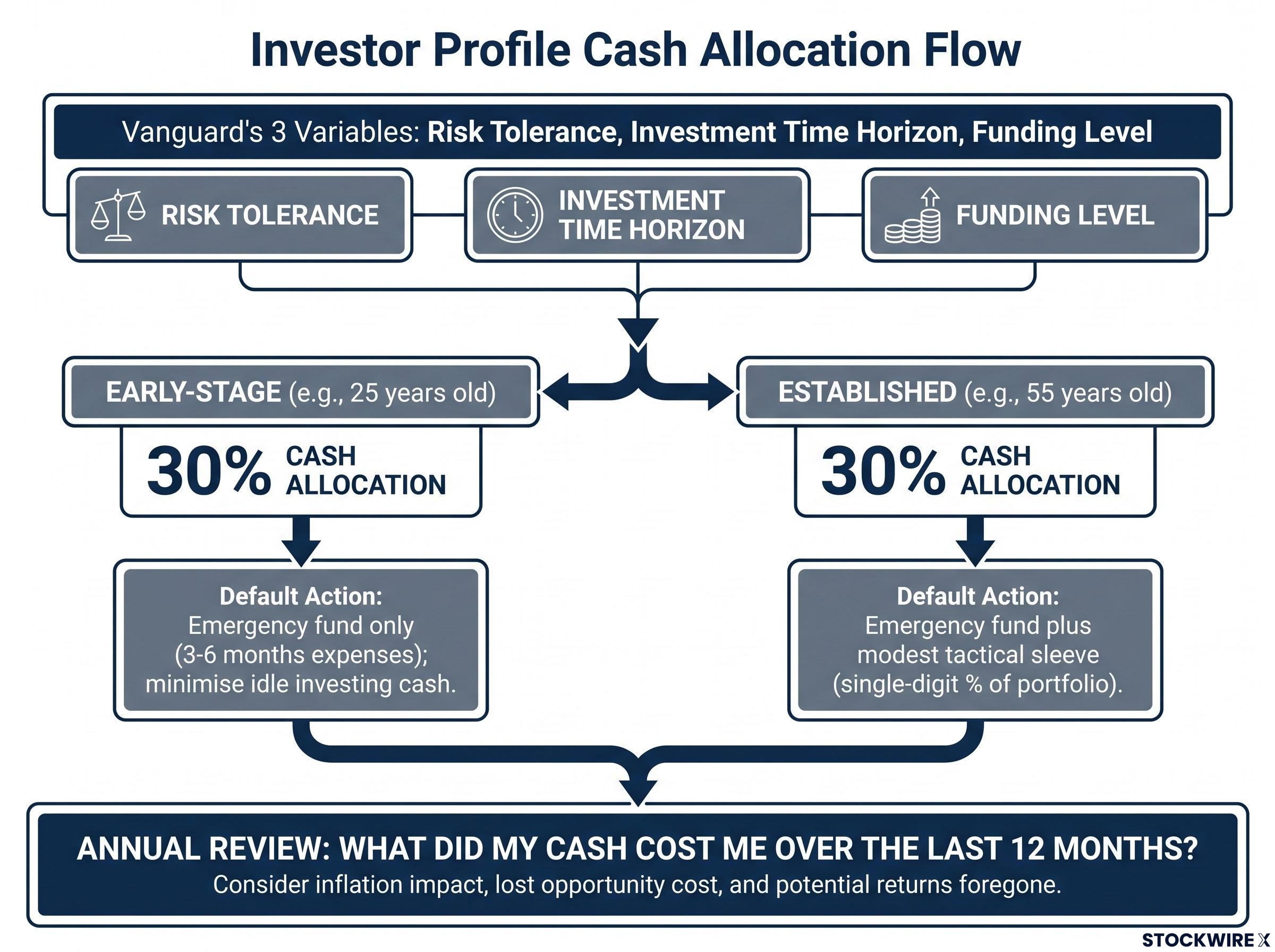
This is why no single “how much cash should I hold” rule works for everyone. The answer depends on three variables, formalised by Vanguard as a professional framework for determining appropriate cash allocations:
- Risk tolerance: How much short-term volatility you can absorb without making reactive decisions that damage long-term returns.
- Investment time horizon: How many years stand between you and the financial goal the money is earmarked for.
- Funding level: How close your portfolio already is to fully funding your major financial goals.
Before you ask “how much cash should I hold,” you need to answer a prior question: what phase of the journey are you actually in? Get the prior question wrong, and the cash figure is meaningless regardless of whose rule you follow.
When big ASX news breaks, our subscribers know first
Why cash is the wrong default for investors who are still building
If you are in the accumulation phase, your wealth grows through two engines: new contributions and compounding on invested assets. Cash contributes to neither. Every year your capital sits in a savings account instead of a diversified portfolio, the compounding clock does not pause; it runs against you.
The numbers make the cost concrete.
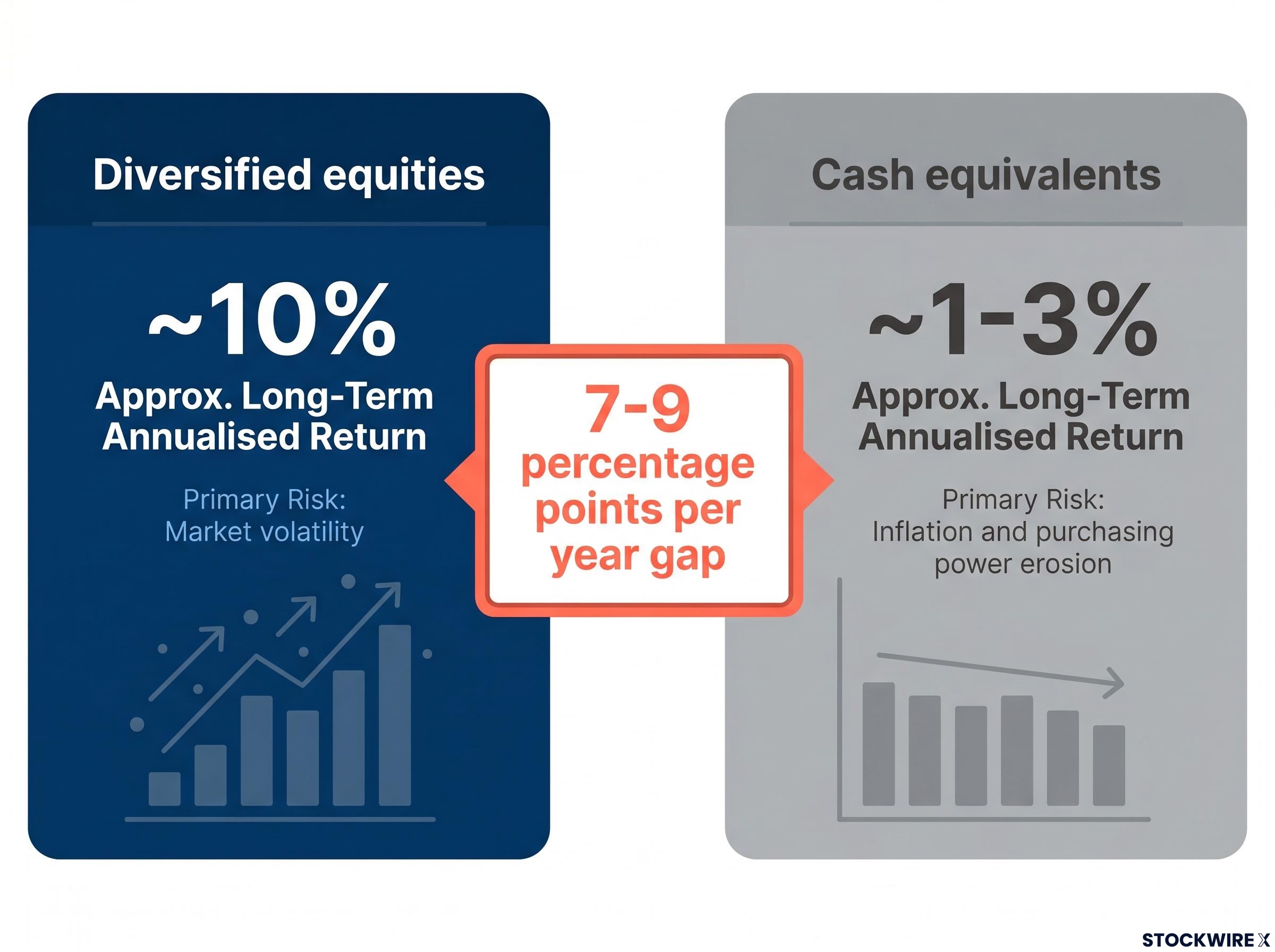
Stocks have delivered long-term annualised nominal returns of approximately 10%. Cash equivalents, such as Treasury bills and similar instruments, have typically returned approximately 1-3% annualised.
That gap, roughly 7-9 percentage points per year over long horizons, is not an abstraction. It is the quantifiable price of waiting for the “right moment” to invest. This pattern is well documented: investors who spend years accumulating savings without putting that capital to work forgo the compounding gains that cannot be recovered later. For early-stage investors, patience waiting on the sidelines carries a cost that compounds against you every year you wait.
The compounding cost of delayed contributions is more concrete than most investors expect: a five-year delay on $100 monthly at 7% annual returns costs approximately $20,400 in final portfolio value, a gap that cannot be closed by contributing more later because the compounding years themselves are irretrievable.
| Asset Type | Approx. Long-Term Annualised Return | Primary Risk | Best Suited To |
|---|---|---|---|
| Diversified equities | ~10% | Market volatility | Long-horizon investors |
| Cash equivalents | ~1-3% | Inflation and purchasing power erosion | Short-term reserves and emergencies |
This does not mean you should keep zero cash. It means the cash you hold should have a specific job. Standard guidance points to an emergency fund of 3-6 months of your essential expenses, held in a high-yield savings account or equivalent, kept separate from your investment portfolio. That is safety-net cash. It is not the same as “investing cash” sitting idle because you are waiting for a pullback.
For early-stage investors, “playing it safe” by holding excess cash is not conservative. It is a structural disadvantage wearing the clothes of caution.
What dollar-cost averaging actually does (and why most guides get it wrong)
If lump-sum investing beats dollar-cost averaging (DCA) more often than not in mathematical backtests, why do professionals still recommend it? Because DCA’s value was never about producing better returns on average. Its value is behavioural.
Dollar-cost averaging means investing a fixed amount on a regular schedule, regardless of what the market is doing that week. The maths of this approach is straightforward: you buy more units when prices are low and fewer when prices are high, smoothing your average entry price over time. But the real mechanism protecting you is not the price averaging. It is the removal of the decision point that would otherwise give anxiety a chance to talk you into cash.
Here is what DCA actually does in practice:
- Eliminates the timing decision. You do not need to decide whether today is a good day to invest. The schedule decides for you.
- Smooths entry points across market cycles. Your average cost reflects months or years of prices, not a single entry that might haunt you.
- Builds consistent investment habits and emotional resilience. Investors who stay in the market through volatile periods develop the experiential confidence that protects them from costly panic-selling later.
Asset-allocation specialists consistently caution against moving in and out of the market or parking large sums in cash “waiting for volatility to pass.” DCA keeps you from second-guessing yourself and freezing when headlines get noisy. That is how professionals actually use it.
Starting with small, regular contributions builds more than a balance. It builds the discipline and market literacy that compound alongside your capital. If you are using DCA and feel the urge to pause contributions and “wait,” that is the exact moment the tool is doing its most important work.
For investors wanting to examine the evidence in depth before committing to a schedule, our full explainer on lump sum versus DCA covers the Vanguard 68% finding, how the result shifts for regret-prone investors, and the hybrid deployment approach that resolves the tension for most situations.
When a cash reserve becomes a legitimate tool, not a drag
Everything above applies to investors whose portfolios are still in the growth phase. The calculus genuinely changes once your portfolio crosses a threshold: when it is generating meaningful income on its own and is close to fully funding your major financial goals.
At that point, your priority shifts. You are no longer maximising growth at all costs. You are preserving flexibility, controlling risk, and maintaining the ability to act when opportunity appears without selling long-term holdings at a bad moment.
A modest portfolio cash sleeve, generally discussed in single-digit percentage terms among professional planners, serves this purpose. The conditions that make it appropriate are specific:
- Your portfolio is generating meaningful income independently of new contributions.
- Your major financial goals are substantially funded.
- Your cash is tied to a specific, pre-defined deployment condition, not a vague feeling that markets look expensive.
“Tactical” means something precise here. It means cash earmarked for observable conditions: defined drawdown levels, known valuation thresholds, or upcoming spending needs. Periods of negative market sentiment and short-term corrections are a recurring feature of equity markets, and positioning a cash reserve to respond to them requires knowing in advance what conditions would trigger deployment.
Cash is “a tool to limit permanent losses while waiting for better opportunities” but “a terrible long-term investment” if overused, according to Novel Investor’s framework.
For you as an established investor, a small cash sleeve functions as optionality insurance. It lets you avoid forced selling and act when conditions align. But only if the deployment trigger is defined in advance, not constructed after the fact to justify inaction.
For established investors wanting to translate the tactical cash sleeve concept into a fully structured withdrawal framework, our dedicated guide to the retirement bucket strategy explains how to size each bucket against your income gap, which instruments belong in Bucket 1 versus Bucket 2, and when to begin the transition before the first withdrawal.
Optionality versus avoidance: the behavioural trap that looks identical from the outside
Here is the most consequential distinction in this entire framework: tactical cash and emotional cash look identical on your brokerage statement. The balance is the same. The asset class is the same. The difference is entirely internal, and the test for which one you are holding is not the amount but the presence or absence of a defined trigger.
Many investors allow anxiety about markets to masquerade as a disciplined cash strategy. They sit on large cash balances without a clearly defined deployment plan, telling themselves they are “waiting for the right opportunity.” Professional literature identifies this pattern, emotional cash holding, as one of the most common failure modes across both stage groups. It is not just an early-stage problem.
Behavioural return drag, the performance gap created by reactive decisions such as pausing contributions during volatile periods or reallocating to cash after a drawdown, costs investors an estimated 1.5 percentage points per year on average, a figure that compounds into a material wealth shortfall across a multi-decade horizon.
| Attribute | Strategic Cash | Emotional Cash |
|---|---|---|
| Motivation | Defined opportunity or known spending need | Fear of volatility or general uncertainty |
| Deployment Trigger | Observable, pre-defined condition | Vague sense that “things feel safer” |
| Review Cadence | Annual opportunity-cost audit | Rarely reviewed; rationalisations updated instead |
| Risk | Modest drag if no opportunity appears | Sustained compounding penalty, often unquantified |
The diagnostic that keeps any cash thesis honest is the opportunity-cost audit: a single question you review annually.
“What did my cash cost me over the last 12 months?”
This question is rarely made this concrete in popular finance writing, yet advisors repeatedly stress it is the central risk of excess cash positions. Convert the abstract risk of sidelining cash into a concrete, reviewable number, and the distinction between optionality and avoidance becomes much harder to ignore.
If you cannot state in a single sentence what specific, observable market condition would cause you to deploy your cash reserve, you are probably not holding strategic cash. You are holding emotional cash with a strategic label on it.
Making the call: a stage-based default for each investor type
The framework above gives you the logic. Here is how it converts into a practical starting position for each stage.
If you are an early-stage, growth-focused investor:
- Maintain an emergency fund of 3-6 months of essential expenses in a high-yield savings account or equivalent. This is separate from your investment portfolio.
- Outside that safety bucket, minimise long-term idle cash. Deploy new contributions on a set schedule aligned with your risk tolerance and time horizon.
- Treat market volatility as training. Stay invested through cycles to build the behavioural resilience that protects you from costly exits later.
If you are an established, income-generating investor:
- Maintain the same emergency fund principle as above.
- Add a modest portfolio cash sleeve, a single-digit percentage of portfolio value, tied to specific, observable conditions such as valuation levels, defined drawdowns, or known spending needs.
- Review the opportunity cost of that cash annually versus your target return. If the cash has not been deployed and the cost is material, reassess whether the thesis is still valid or whether it has become a habit.
| Investor Stage | Cash Default | Annual Review Question |
|---|---|---|
| Early-Stage (Growth Phase) | Emergency fund only (3-6 months expenses); minimise idle investing cash; deploy on a set schedule | “What did my idle cash cost me versus my target return over the last 12 months?” |
| Established (Income-Generating Phase) | Emergency fund plus modest tactical sleeve (single-digit % of portfolio); tied to pre-defined conditions | “What did my cash cost me versus my target return over the last 12 months, and did any deployment triggers activate?” |
The universal principle across both stages: cash is best suited for short-term goals, emergencies, upcoming known expenses, and targeted optionality. It is not a primary long-term wealth-building asset.
What changes as your portfolio matures, and what stays the same
The answer to whether you should hold cash or invest is not a single verdict. It is a moving target that should be recalibrated as your portfolio’s funding level, income generation, and time horizon shift. What stays constant is the discipline: the annual opportunity-cost review and the one-sentence deployment trigger test are the two tools that keep the decision honest regardless of stage.
The most useful thing you can do now is identify honestly which stage you are in, apply the appropriate default, and commit to reviewing the cost of your cash position at least once a year. If you can state in one sentence the observable condition that would cause you to deploy your cash, you have a strategy. If you cannot, you have a habit. The distinction matters more than the number.
This article is for informational purposes only and should not be considered financial advice. Investors should conduct their own research and consult with financial professionals before making investment decisions.