A record emergency stock release and tankers moving again through the Strait of Hormuz should, in theory, drag oil back under $100. They have not. The Brent crude price settled near $105.92 a barrel on 15 October 2026, the same day the International Energy Agency (IEA) announced the final 100 million barrels of its emergency release.
The pattern has repeated for days. Brent slips early in a session, buyers step in, and by the close most of the loss is gone.
That stubbornness is the puzzle. Some lost supply is returning, yet the market keeps paying a large premium for what could still go wrong. If you hold energy stocks, airlines or anything sensitive to fuel costs, you need to separate barrels actually missing from fear of barrels that might go missing.
Here is a framework for reading oil signals across geopolitics, policy and weather, so the next headline does not catch you leaning the wrong way.
Why is Brent still above $100 when Hormuz flows are recovering?
Look at the screen and the paradox is obvious. Dips keep getting bought. On 16 October, Brent traded roughly between $104.9 and $105.9, below earlier 2026 peaks near $109-110 but still well clear of $100.
Sources disagree on exact levels; one market report put the close nearer $103. The verified settlement data from 15-16 October, around $105-106, is the better-supported reading.
Now look at the supply side. Some tracking shows Hormuz flows back to roughly 80-90% of pre-conflict levels, though still short of a baseline of about 17.15 million barrels per day (b/d).
| Source | Estimate (million b/d) | Basis | Date |
|---|---|---|---|
| Reuters-based reporting | 11.62 | Weekly average flow | Week to 13 October 2026 |
| Kpler and other trackers | 9.7-10.1 | Observed vessel transits | Mid-October 2026 |
| Pre-conflict baseline | About 17.15 | Estimated normal flow | Before the conflict |
These figures are not contradicting each other. They measure different things: crude cargoes, total oil, or ships physically counted passing through, all against unstable tanker movements. When you see a flow number quoted, check whose method sits behind it.
Vessel transit counts tell a different story from barrel estimates, because war-risk insurance and maritime classification can keep ships away even when the strait is declared open, which is one reason tracker figures diverge.
So why has the price barely moved? ING analysts Warren Patterson and Ewa Manthey put it plainly.
ING on the oil market Middle East uncertainty and doubts over Hormuz reliability are being priced as a “significant risk premium.”
The market is not pricing today’s shortfall. It is pricing the chance of a bigger one. Kpler reflects that two-way uncertainty with a Q4 Brent range of about $95-$115/bbl.
For you, the takeaway is direct: better flow data alone does not mean prices must fall. Treating it that way is how mistimed bearish bets get made.
When big ASX news breaks, our subscribers know first
What is a geopolitical risk premium, and what could erode it?
A geopolitical risk premium is the extra amount buyers pay above what current supply and demand would justify, because of the chance that a conflict causes a larger disruption. You are not paying for barrels already lost. You are paying for the probability and possible duration of losing many more.
That distinction changes how you read every headline.
The risk premium you see in Brent is rarely a one-day phenomenon. Insurance withdrawal and slow supply chain recovery mean it tends to decompress gradually, even after a ceasefire is announced.
How big is the premium?
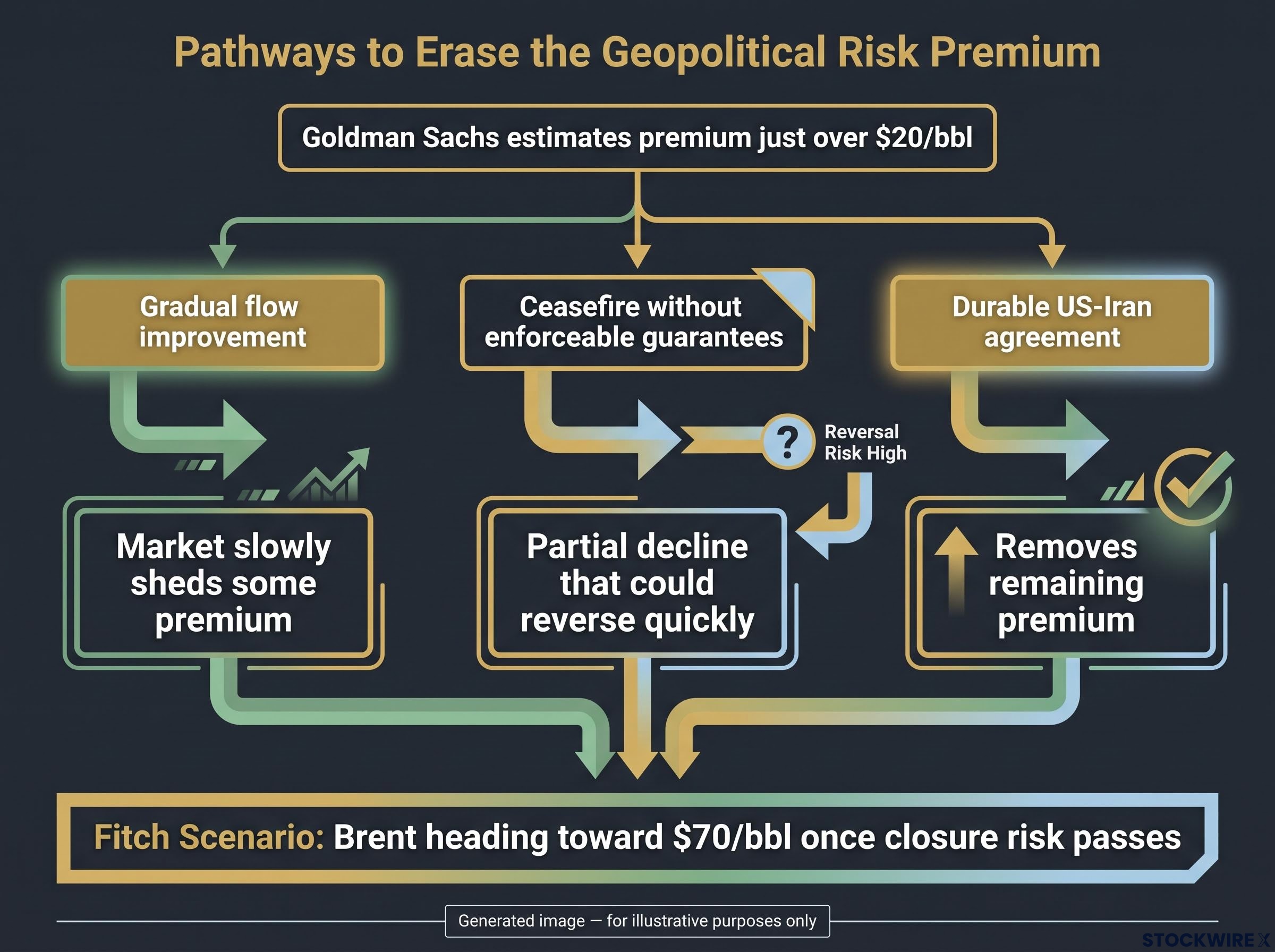
Estimates vary widely, and the spread is the point. Goldman Sachs puts the premium just over $20/bbl on a time-spread basis, meaning it is measured from the gap between near-dated and later-dated futures prices. Goldman has raised its December Brent forecast to $90 and sees $120 as plausible if attacks on infrastructure and tankers stall Gulf exports.
Goldman’s earlier scenario work ran from about $18/bbl in a severe Hormuz disruption down toward $4/bbl if half of Hormuz flows were interrupted for one month. The number shifts with what you assume about severity and duration.
A short, contained disruption is cheap to insure against. A long, uncertain one is expensive.
What would remove it?
ING draws a useful line between shedding part of the premium and removing it entirely. Three pathways stand out:
- Gradual flow improvement: if flows stay stronger for longer, the market may slowly shed some of the premium.
- Ceasefire without enforceable guarantees: likely a partial decline that could reverse quickly on any fresh incident.
- Durable US-Iran agreement: regarded as the main event able to remove the remaining premium, because it raises confidence that stronger flows will last.
As of 16 October 2026, no US-Iran breakthrough has been confirmed. A Fitch scenario sees Brent heading toward $70/bbl once supply returns and closure risk passes, which shows how much air the premium holds.
That means a diplomatic signal can matter more to price than a weekly flow print. Weight credible news on talks and enforceable guarantees more heavily than one good week of tanker data.
Why does the diesel part of the IEA release matter more than the headline barrels?
The headline sounds large. On 15 October, IEA members agreed to release the last 100 million barrels of emergency stocks, completing the 400 million barrel commitment from March. About 330 million barrels had already been distributed.
The more telling number is smaller. Roughly 20 million barrels of that final tranche is diesel.
Diesel is where the real squeeze sits. IEA data show global diesel and gasoil availability down about 1.5 million b/d year-on-year in Q2 and 1.7 million b/d in Q3. The bottleneck is refined products, not just crude.
Refined-product shortages explain much of the disconnect, since Gulf product flows run at only a fraction of pre-conflict levels even where crude shipments have largely recovered.
That links straight back to Brent. When diesel margins (the profit refiners earn turning crude into diesel, often called cracks) run high, refiners bid aggressively for crude to process. That keeps prompt crude prices firm even as Gulf exports recover.
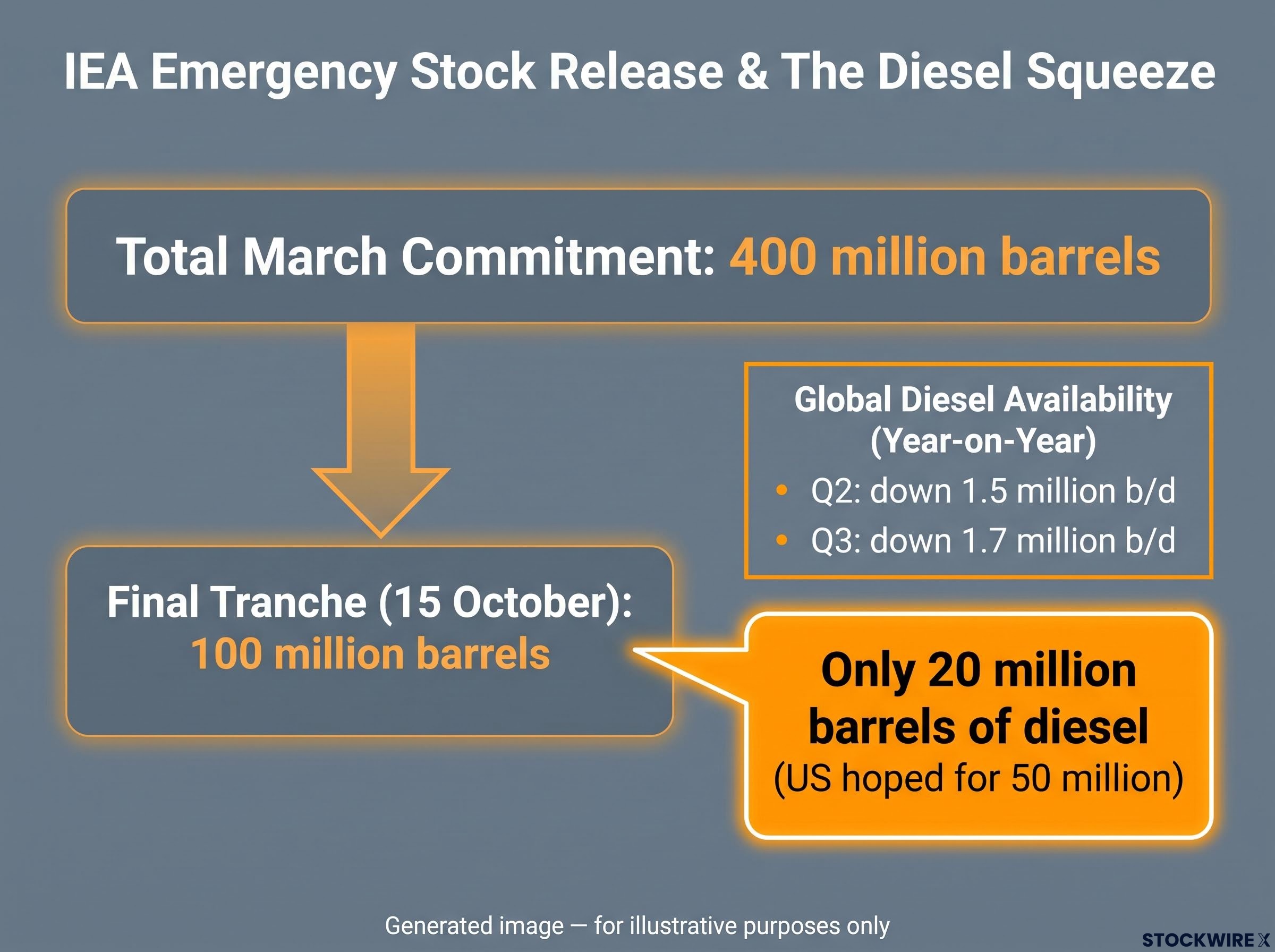
The US reportedly hoped for about 50 million barrels of diesel, so 20 million looks light. The IEA itself says the accumulated middle-distillate deficit will not be fully offset and that diesel tightness could last into 2027. No country-by-country allocation or firm completion date has been published.
| View | Core argument | Supporting evidence | What would confirm it |
|---|---|---|---|
| Bullish reading | Release gives temporary relief and postpones the shortage | IEA says the diesel deficit will not be fully offset; tightness could run into 2027 | Diesel margins stay elevated once release barrels are absorbed |
| Bearish reading | Announcement calms markets while Gulf supply, refining and shipping normalise | April 2022: Brent fell nearly $10/bbl after release announcements | Hormuz flows keep rising and diesel margins ease |
The 2022 precedent cuts both ways. Brent fell, yet diesel and kerosene stayed tight. Releases move timing; they do not repair infrastructure or secure a shipping lane.
So judge any policy announcement by the product it targets and the time it buys you, not the headline volume.
How do weather shocks, history and demand destruction shape the next move?
Geopolitics is not the only force at work. A storm in the Gulf of Mexico just showed how quickly a separate shock can tighten the balance.
A separate shock: the US inventory draw
The US Energy Information Administration (EIA) reported that commercial crude stocks fell about 8.6 million barrels to 415.6 million in the week ended 9 October, the largest weekly decline since February. One poll had expected a draw of just 288,000 barrels.
Hurricane-related offshore shut-ins disrupted production and oil movements, with US output estimated at 13.7 million b/d, down about 300,000 b/d on the week. Exact shut-in volumes were not available in the data reviewed.
None of this had anything to do with Hormuz, yet it added support to prices in the same week.
The Brent-WTI spread offers a useful cross-check during hurricane season: a widening gap points to a Gulf-specific shock, while a narrow one suggests broader repricing across crude benchmarks.
What history says about fading premiums
Past crises show a consistent shape. In 1990-91, prices jumped as traders priced the possible loss of Gulf supply, then eased as the outcome became clearer. In September 2019, attacks on Abqaiq removed about 5.7 million b/d of Saudi output and Brent jumped as much as 19.5% to $71.95, before retreating on restoration plans.
Premiums tend to fade when three conditions converge:
- Supply is visibly restored. 2026 status: Gulf flows have improved but remain below baseline.
- The chance of renewed disruption falls. 2026 status: no US-Iran breakthrough, so Hormuz security is still uncertain.
- A credible replacement source exists. 2026 status: stocks are flowing, but confidence in quick spare barrels is limited.
Only part of that checklist is ticked, which helps explain why Brent sits above $100. The risks still run both ways:
- Upside: attacks that stall Gulf exports, further hurricane disruption, persistent diesel tightness.
- Downside: the IEA projects a 2.6 million b/d fall in 2026 demand, with diesel about one-quarter of it; Kpler says high prices are already destroying demand; Fitch cites about 3.6 million b/d of pre-conflict OPEC+ spare capacity, though that figure is not independently confirmed and its speed to market is questioned.
Treat weather, demand and spare capacity as separate signals. Any one of them can tighten or loosen the market without a single Hormuz headline.
Past performance does not guarantee future results. Forecasts and scenarios cited are subject to market conditions and may change with developments.
Reading the signals: what would change the call on Brent
The premium reflects probability, which is why Brent can hold above $100 while flows recover, and why it could fall quickly if all three fade conditions line up together. Four signals carry the most information:
- Hormuz flow trend, and which tracker produced the number.
- US-Iran negotiating status, especially any enforceable guarantees.
- Diesel inventories and margins, the clearest read on product tightness.
- Weekly EIA data while hurricane season runs.
If you weight one most heavily, make it diplomacy, since it is the only signal analysts link to full removal of the premium. Kpler’s $95-$115 Q4 range is a reminder that risk runs in both directions.
This article is for informational purposes only and should not be considered financial advice. Investors should conduct their own research and consult with financial professionals before making investment decisions.