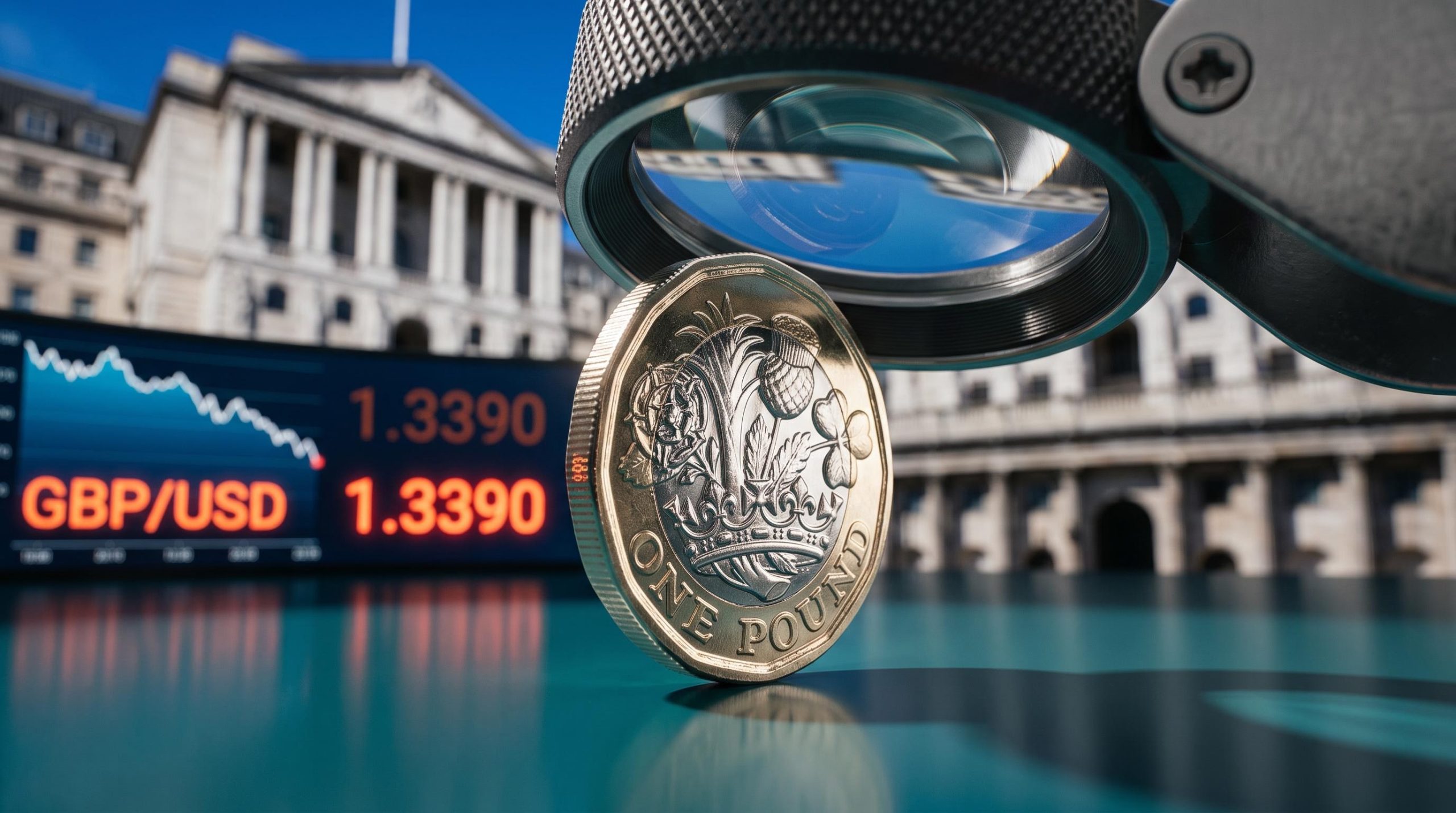
The Bank of England raised Bank Rate to 4% on 5 November by an 8-1 vote. One day later, the pound fell about 0.45% to near 1.3390 against the US dollar. A hawkish vote, a weaker currency: on the surface, the two do not fit together.
The explanation sits in what came after the decision. On 6 November, Huw Pill, the Bank’s Chief Economist, said “nothing is baked in” for rates next year. That cut directly against market pricing for roughly three more increases in 2027.
The stakes are real. The November rise was the first since August 2023, and inflation stood at 3.5% in September, well above the 2% target.
Here is what Pill’s remarks tell you about the Bank of England rate outlook, why the pound moved the way it did, and which signals from spring 2027 will settle the argument.
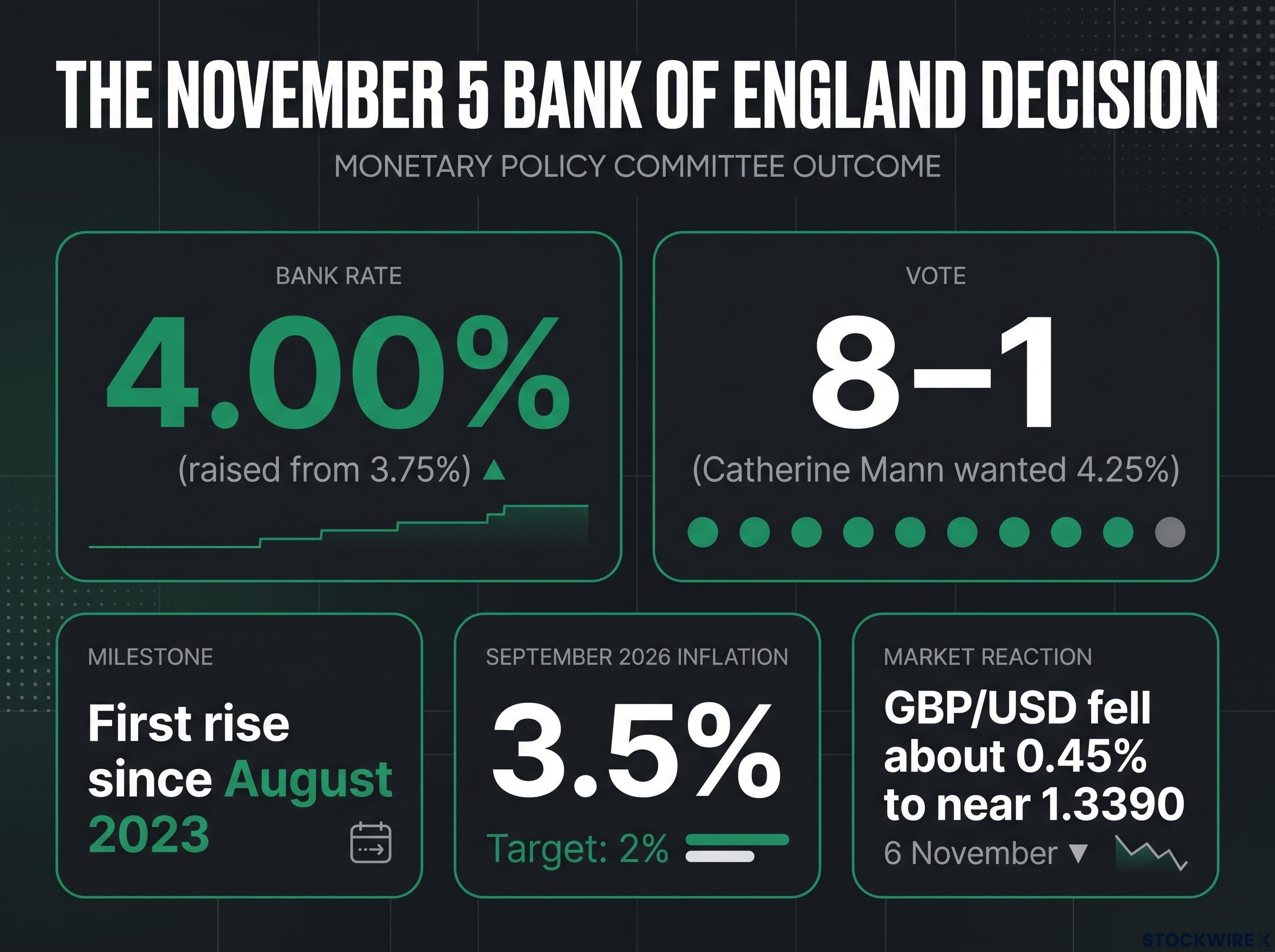
The Bank of England raised Bank Rate to 4.00% in an 8-1 vote, while September 2026 inflation stood at 3.5% and GBP/USD fell about 0.45% to near 1.3390.
What did Huw Pill actually say about 2027, and why did markets hear a shift?
Start with the words themselves, as reported by Reuters and relayed by FXStreet and AJ Bell on 6 November 2026.
Huw Pill, Chief Economist, Bank of England “Nothing is baked in.” “There is no preset upward path for interest rates from spring and beyond.”
Pill added that Bank Rate could stay on hold, or even fall, “if we saw stalling of growth next year.” He named the deciding factor as the “margin squeeze on companies and how companies react.” Spring 2027 matters because that is when the Monetary Policy Committee (MPC), the nine-member group that sets Bank Rate, should have clearer evidence on second-round effects. Second-round effects are what happens when higher costs pass from households and firms into wages and prices.
The backdrop makes the remarks more striking. The MPC lifted Bank Rate from 3.75% to 4.00%, with eight members backing the move. The lone dissenter, Catherine Mann, wanted 4.25%. The dissent was for a bigger hike, not for no hike.
MPC dissent carries its own signal: a hawkish drift in the vote split, such as the move from 8-1 in April to 6-3 in September, shows the committee’s balance of risk tilting before the headline rate does.
So the same words can be read two ways:
- Hawkish reading: Pill did not rule out further hikes, and he acknowledged tightening could be needed if energy costs feed into wages and prices.
- Dovish reading: By rejecting a preset upward path and raising the possibility of holds or cuts, he pushed back on the market’s near-mechanical sequence of three further 25 basis point hikes (Reuters had earlier reported pricing for three to four).
Markets took the dovish reading, and the logic holds. Agreement on November’s move did not mean agreement on the 2027 sequence.
What this tells you is that the Bank is no longer endorsing the hike path traders had built in. Treat priced-in hikes as a market assumption, not a Bank commitment.
When big ASX news breaks, our subscribers know first
Why does the corporate margin squeeze decide the rate path?
Pill singled out margins for a reason. An energy shock does not automatically become persistent inflation. The outcome depends on what firms do next.
The pressure is building. Inflation was 3.5% in September 2026, and the November Monetary Policy Report (MPR), the Bank’s quarterly economic forecast, projects it rising to about 5% in mid-2027 before easing. The MPR also flagged rising non-labour costs for airlines, hospitality and leisure firms.
The Bank’s November 2026 Monetary Policy Report sets out the central projection alongside the adverse escalation scenario, which shows how far inflation could run if energy costs embed, and gives investors the benchmark against which Pill’s conditional guidance should be read.
Firms can respond through four channels:
- Pricing: Raising prices to protect margins turns the shock into broader inflation, and repeated rises make it stick.
- Hiring and wages: Squeezed firms may freeze recruitment, delay pay rises or cut jobs, which weakens the wage-price loop. Firms protecting output may instead accept higher labour costs, which feeds inflation.
- Investment: Thinner margins cut internal cash flow, and a higher Bank Rate raises borrowing costs. Spending falls, easing near-term inflation but weakening future supply.
- Pricing power and demand: Firms can pass on costs only if customers keep buying. Squeezed real incomes force firms to absorb costs instead.
| Channel | Firm response | Inflation effect | Growth effect |
|---|---|---|---|
| Pricing | Raise prices to protect margins | Higher, more persistent | Hit to real incomes |
| Hiring and wages | Freeze hiring or accept higher pay | Lower if restrained; higher if pay rises | Weaker labour demand if restrained |
| Investment | Delay or cancel projects | Lower near term | Weaker future supply |
| Pricing power | Absorb costs as demand softens | Lower | Slower activity |
The Bank’s November minutes described both outcomes. Firms could absorb costs at first through lower margins or cost cuts, but those buffers might be temporary. The July MPR survey had already shown roughly two-thirds of firms expected higher energy prices to reduce margins, while only about 4% expected margins to rise.
Growth adds a wrinkle. Reuters reported forecasts of 1.6% for 2026 and 1.3% for 2027, though other coverage of the MPR cites 1.0% for 2027.
For you, margin data works as an early indicator. Firms passing costs on point toward more hikes; firms absorbing them or cutting hiring point toward a hold or cuts.
How do Bank Rate, QE and QT move the pound, and why did GBP/USD fall?
The reaction on screen was clear. GBP/USD, the pound’s exchange rate against the US dollar, slipped about 0.45% to near 1.3390 on 6 November and stayed under selling pressure.
That reversed a strong run. Sterling hit a roughly 16-month high against the euro on 13 October, then rose about 0.4% to $1.3429 on 30 October as hike expectations firmed.
Bank Rate is the Bank’s main tool: the interest rate it pays on reserves, which flows through to borrowing costs across the economy. Higher expected rates raise the return on sterling assets and tend to support the pound. The key word is expected; currencies trade on the anticipated path, not just today’s decision.
Two balance-sheet tools sit alongside it. Quantitative easing (QE) is when the Bank creates money to buy bonds, usually government debt, which pushes down longer-term rates and typically weakens the pound. Quantitative tightening (QT) reverses that by letting bonds mature without reinvesting or by selling them, which is usually positive for the pound.
| Tool | What the BoE does | Typical effect on rates | Typical effect on pound |
|---|---|---|---|
| Bank Rate | Sets its main policy rate | Moves short-term rates | Supportive when expected path rises |
| QE | Creates money to buy bonds | Lowers longer-term rates | Typically weakens |
| QT | Shrinks bond holdings | Can lift longer-term rates | Usually supportive |
The Bank describes QT mainly as balance-sheet normalisation rather than a rate tool. Catherine Mann has drawn the line plainly: QT acts on longer parts of the yield curve, while Bank Rate drives the short end. The expected short-term path dominates the currency.
Quantitative tightening does not simply mirror QE in reverse; in a high-debt environment, gilt sales can raise servicing costs and unsettle overseas holders, which can flip yield support into currency weakness.
Why a hawkish vote still lowered GBP/USD
Going into the meeting, money markets had almost fully priced the November hike plus several more. ING warned that the immediate move was largely priced in, leaving a high hurdle for any further sterling-positive surprise.
Pill then lowered confidence in the follow-up hikes. The decision delivered what was expected; the guidance took away what was hoped for.
If you hold sterling exposure, the lesson is that the pound reacts to revisions in the expected path. A hawkish decision can still lower GBP/USD when guidance disappoints.
Hold, one more hike or cuts: where do forecasters see Bank Rate heading?
Lay the views side by side and the divergence is plain.
| Source | View on 2027 | Reasoning |
|---|---|---|
| Market pricing | About three more hikes, toward 4.75%-5.00% | Energy shock seen requiring sustained tightening |
| BoE Market Participants Survey | Median 4.25% in February 2027, then about 3.5% | Brief extension of tightening, then easing as inflation fades |
| Capital Economics | Perhaps one more hike to 4.25% | Inflation back at 2% by end-2027; rates near 3.5% in 2028 |
| ING | February hike as base case | Market pricing excessive |
| Reuters economist poll | Expected November hike, not full market sequence | Near-term response needed; multi-hike path too aggressive |
Many economists regard the market path as aggressive. The middle ground, one more move then a pause, has broad support outside trading desks.
The case each way comes down to a handful of triggers:
- Hawkish triggers: Energy costs embedding in wages, services prices and inflation expectations.
- Dovish triggers: Falling real incomes, softer demand and squeezed margins pulling inflation lower without further hikes.
Stagflation, meaning high inflation alongside weak growth, sharpens the dilemma. The central scenario already pairs inflation near 5% with slowing activity, and the Bank’s adverse escalation scenario sees inflation above 6% in 2027. Tightening further protects against persistence but deepens the hit to incomes, investment and jobs.
For you, the read is conditional. If the Bank delivers one hike and pauses, sterling could soften as rate gaps with other economies narrow; sticky wages or services inflation would point the other way.
This article is for informational purposes only and should not be considered financial advice. Investors should conduct their own research and consult with financial professionals before making investment decisions. Past performance does not guarantee future results. Financial projections are subject to market conditions and various risk factors.
What the spring 2027 evidence will settle for rates and sterling
Pill’s message is conditionality. The November hike is done; everything after it depends on how firms handle the margin squeeze and whether second-round effects take hold.
The signals to watch are specific: wage growth, services inflation, corporate margin and hiring data, and the February 2027 decision. Each will either validate the market’s steeper path or pull it back toward the economists’ one-and-pause view.
If you track the pound or UK borrowing costs, measure each release against that gap. The distance between market pricing and the Bank’s open-ended guidance is where the next move in sterling is likely to come from.
For readers wanting a repeatable method, our dedicated guide to reading a Bank of England rate decision explains how to use OIS curves and the vote split to anticipate market reactions.