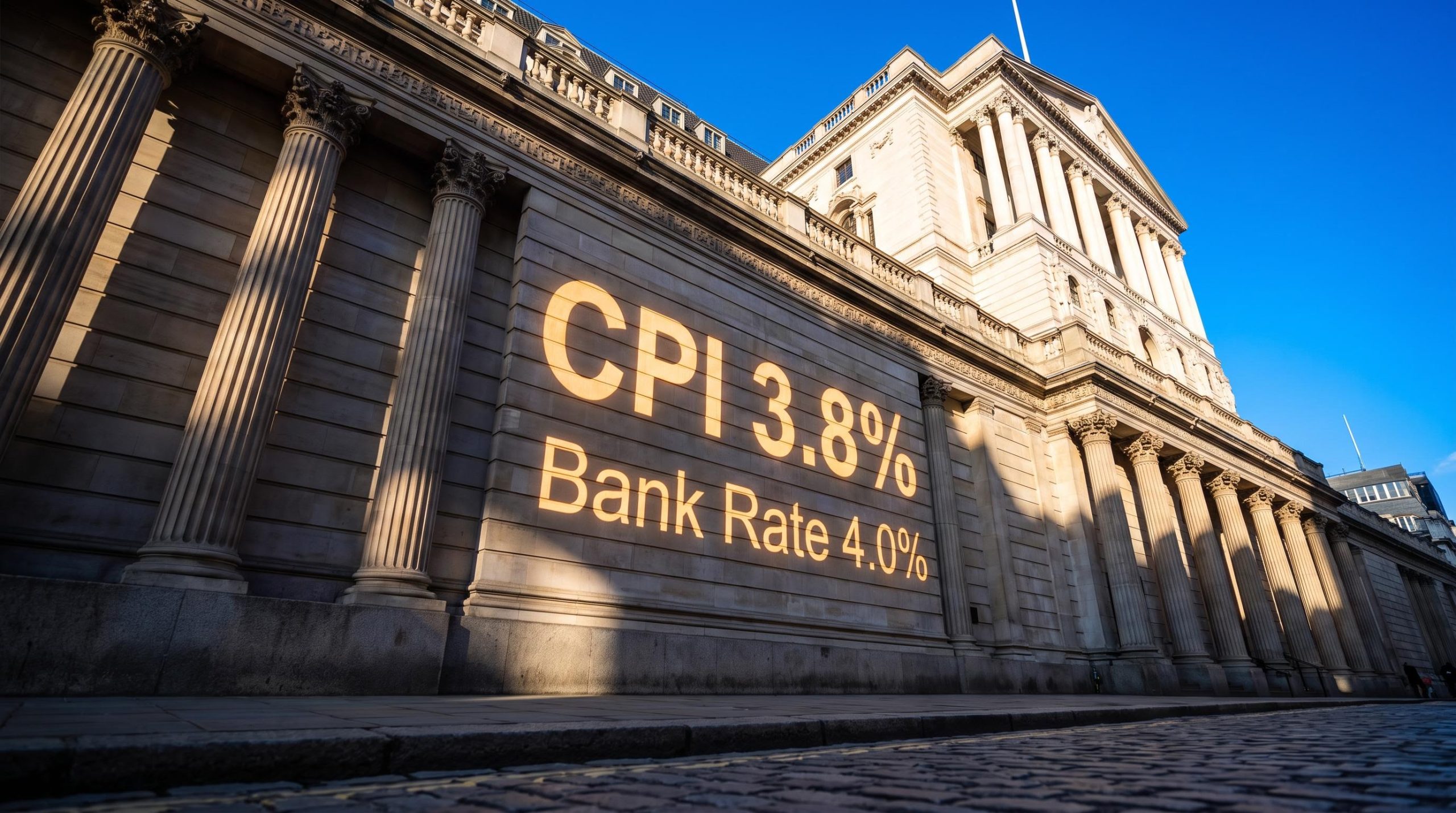
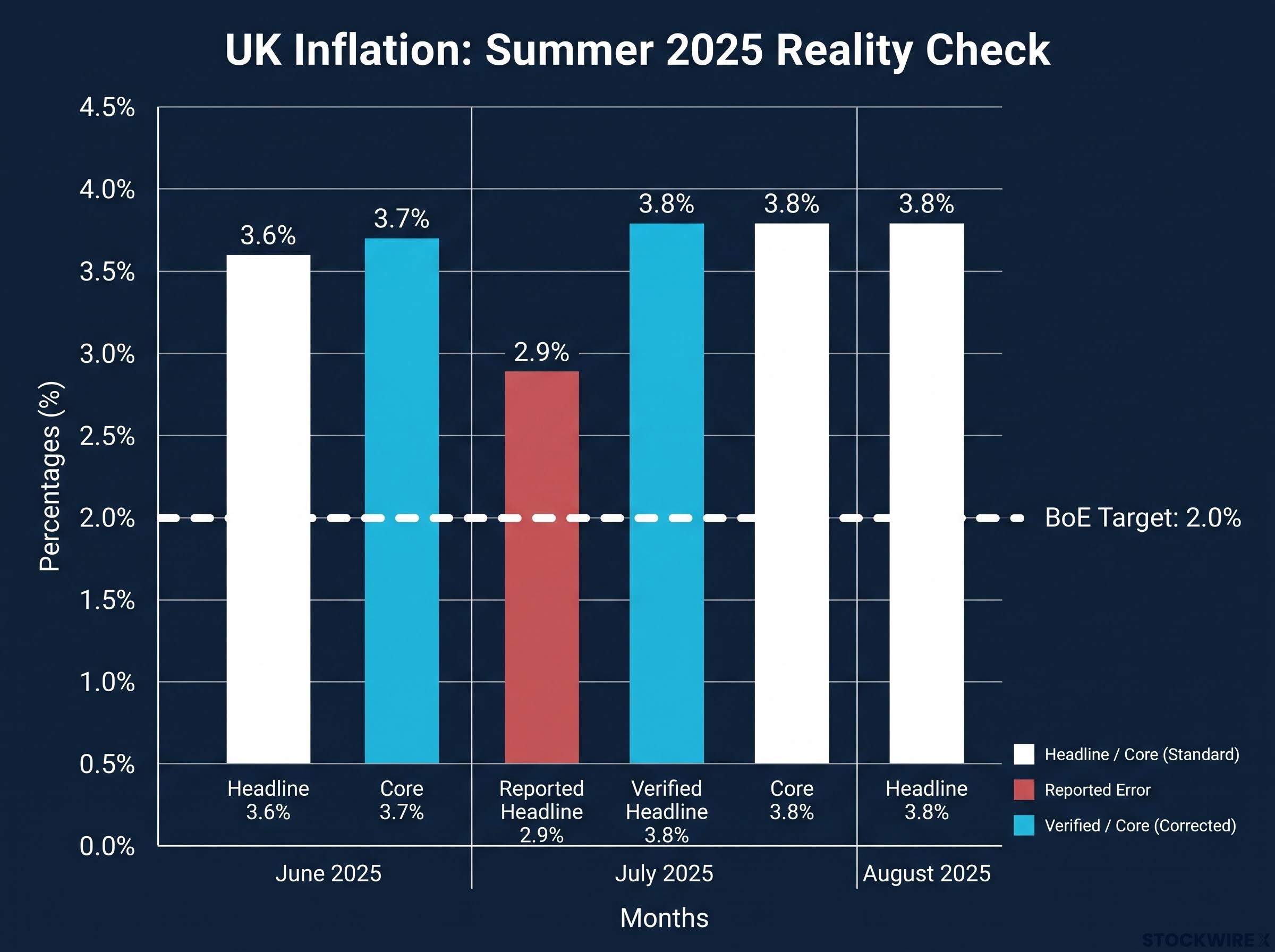
If you tracked UK inflation headlines earlier this year, there is a good chance you saw July 2025 CPI reported at 2.9%. That figure circulated widely. It was also wrong. The Office for National Statistics (ONS) confirmed headline CPI at 3.8% year-on-year for July, nearly a full percentage point higher, and the gap between those two numbers changes everything about how you read the Bank of England’s September decision.
The 17 September 2025 MPC meeting did not happen in a vacuum. It landed inside an active rate-cutting cycle, not a tightening one, with the Bank Rate already at 4.0% following an August cut. The Committee voted 7-2 to hold, with the two dissenters pushing for a cut, not a hike. That vote, set against headline CPI sitting 1.8 percentage points above the BoE’s 2% target, tells you a committee caught between sticky inflation and weakening growth.
Here is what this piece gives you: a clear framework for reading central bank probability distributions, a method for extracting forward signal from vote splits, and a specific list of data releases that will shape the next MPC move. The mechanics apply well beyond September 2025.
What UK inflation actually looked like heading into September
The corrected numbers reframe the entire policy picture. ONS data confirmed headline CPI at 3.6% year-on-year in June 2025, rising to 3.8% in July. Core CPI (which strips out food, energy, alcohol, and tobacco) followed the same trajectory: 3.7% in June, 3.8% in July. Both measures were edging higher, not softening.
The ONS CPI bulletin for July 2025 places headline CPI at 3.8% in the 12 months to July, up from 3.6% in June, the verified figures that replace the widely circulated 2.9% figure and reframe the entire policy context for the September MPC decision.
That matters because the BoE’s inflation target is 2%. At 3.8%, headline CPI sat almost double the target. This was not a mild overshoot. It was a clear, persistent breach that had been widening through the summer.
August 2025 CPI then held at 3.8%, confirming July was not a one-month anomaly. The MPC itself judged that inflation had likely reached or was near its peak, but the data had not yet turned lower. For you, this is the essential context: inflation sitting 1.8 percentage points above target and refusing to fall told the MPC it could not accelerate its cutting cycle, no matter how much the growth data argued for faster easing.
The evolving UK inflation picture into mid-2026 shows a split dynamic: headline CPI rising on energy price cap resets while core and services measures fall, a configuration the MPC explicitly distinguished from demand-driven overheating when justifying its 6-3 hold at 3.75% in late July 2026.
| Indicator | June 2025 | July 2025 | August 2025 |
|---|---|---|---|
| Headline CPI (y/y) | 3.6% | 3.8% | 3.8% |
| Core CPI (y/y) | 3.7% | 3.8% | — |
| Bank Rate | — | — | 4.0% (post-August cut) |
The gap between the earlier-reported 2.9% and the verified 3.8% is not a rounding difference. It changes the entire policy calculus: your read on gilt duration, currency exposure, and rate-sensitive equity positioning all shift when you know the MPC was staring at inflation nearly twice its target, not comfortably close to it.
When big ASX news breaks, our subscribers know first
Why the MPC was cutting rates while inflation stayed elevated
Your instinct here is probably right: a central bank should not be cutting rates when inflation is running at 3.8%. So why was the BoE doing exactly that?
By September, the Bank Rate stood at 4.0%, having already been reduced in August. The live debate at the 17 September meeting was between holding at 4.0% and cutting further to 3.75%. A hike was not on the table. The direction of travel had already been set.
The MPC was managing two pressures simultaneously. Sticky inflation above 3.5% argued against accelerating the pace of cuts. But weakening growth and the lagged effects of prior tightening (higher rates take months to fully flow through to mortgages, business lending, and consumer spending) argued against reversing course. The result was what analysts characterised as a “cautious easing” bias.
The UK growth outlook feeding into the MPC’s calculus was already qualified: Q1 2026 GDP grew 0.6% quarter-on-quarter but two-thirds of that expansion was concentrated in a single month, and the IMF’s full-year forecast of just 0.8% implied subsequent quarters would need to decelerate sharply, reinforcing the MPC’s reluctance to accelerate cuts on growth grounds alone.
Analysts described the September hold as “pragmatic,” consistent with prevailing OIS and SONIA curve pricing, reflecting a committee that wanted to ease but could not yet justify moving faster.
The MPC explicitly conditioned its future moves on three incoming data variables:
- CPI, particularly whether headline and core measures began falling from the 3.8% level
- Wage growth, which feeds directly into services inflation and the BoE’s assessment of domestic price pressure
- Services inflation, the stickiest component of the UK price basket and the one the MPC watches most closely for signs of embedded pricing behaviour
The fact that the MPC was cutting into elevated inflation tells you this is a committee managing growth risk as much as price stability. That framing should shape how you interpret any hawkish-sounding language from individual MPC members in subsequent speeches; the context is easing, even when the rhetoric sounds cautious.
How to read a central bank probability distribution
When you see a headline saying “markets price an 80% chance of a hold,” those numbers come from somewhere specific. Understanding where they come from gives you a framework you can apply to any future MPC meeting.
The instruments that generate these probabilities are OIS (Overnight Index Swap) contracts and SONIA (Sterling Overnight Index Average) futures. SONIA is the interest rate benchmark that tracks the rate banks pay to borrow sterling overnight. OIS contracts are derivatives that reference SONIA, allowing traders to lock in expected future interest rates. The spread between today’s policy rate and where these contracts price the rate after the next meeting is what produces the implied probability.
Here is the three-step logic:
- What the OIS/SONIA spread measures. The difference between the current Bank Rate and the rate implied by SONIA futures for the period after the next MPC meeting. If Bank Rate is 4.0% and SONIA futures price 4.0% for the post-meeting period, the market is telling you a hold is fully discounted.
- How the probability is inferred. If futures price something between 4.0% and 3.75%, the gap tells you the market assigns some probability to a 25-basis-point cut. The closer the pricing sits to 3.75%, the higher the implied probability of a cut.
- Why the base-case concentration creates asymmetric price reactions. When 95% of positioning assumes one outcome, the small probability alternative carries outsized market impact if it materialises, because almost no one is positioned for it.
Ahead of the September meeting, GBP OIS and SONIA curves had fully discounted a hold at 4.0%. The risk tail was concentrated on a 25-basis-point cut, not a hike. Earlier reporting had framed the risk as 80% hold versus 20% hike (per Prime Terminal data), but the corrected research establishes that by September the direction of risk pointed the other way entirely.
When the base case is fully priced, surprises hit harder
With a hold fully discounted, the marginal market-moving scenario in September was a surprise cut, not a surprise hike. If 95% of positioning assumes the hold, even a low-probability cut that arrives reprices gilts and sterling across the entire curve, because the repricing is not gradual; it is a rapid unwinding of concentrated positioning. When the hold is fully priced, the market-moving event shifts to the next data release, which means you need to watch the CPI calendar as closely as the meeting calendar itself.
The Bank of England rate forecast consensus hardened sharply through 2026, with roughly 90% of economists in a Reuters poll expecting Bank Rate to hold at 3.75% through year-end, a degree of pre-meeting consensus that illustrates precisely how fully-priced base cases reduce the meeting itself to a formality and shift all price-moving weight to incoming data.
What the 7-2 vote split actually signals
The headline outcome on 17 September was straightforward: hold at 4.0%. But the vote margin contained more information than the result.
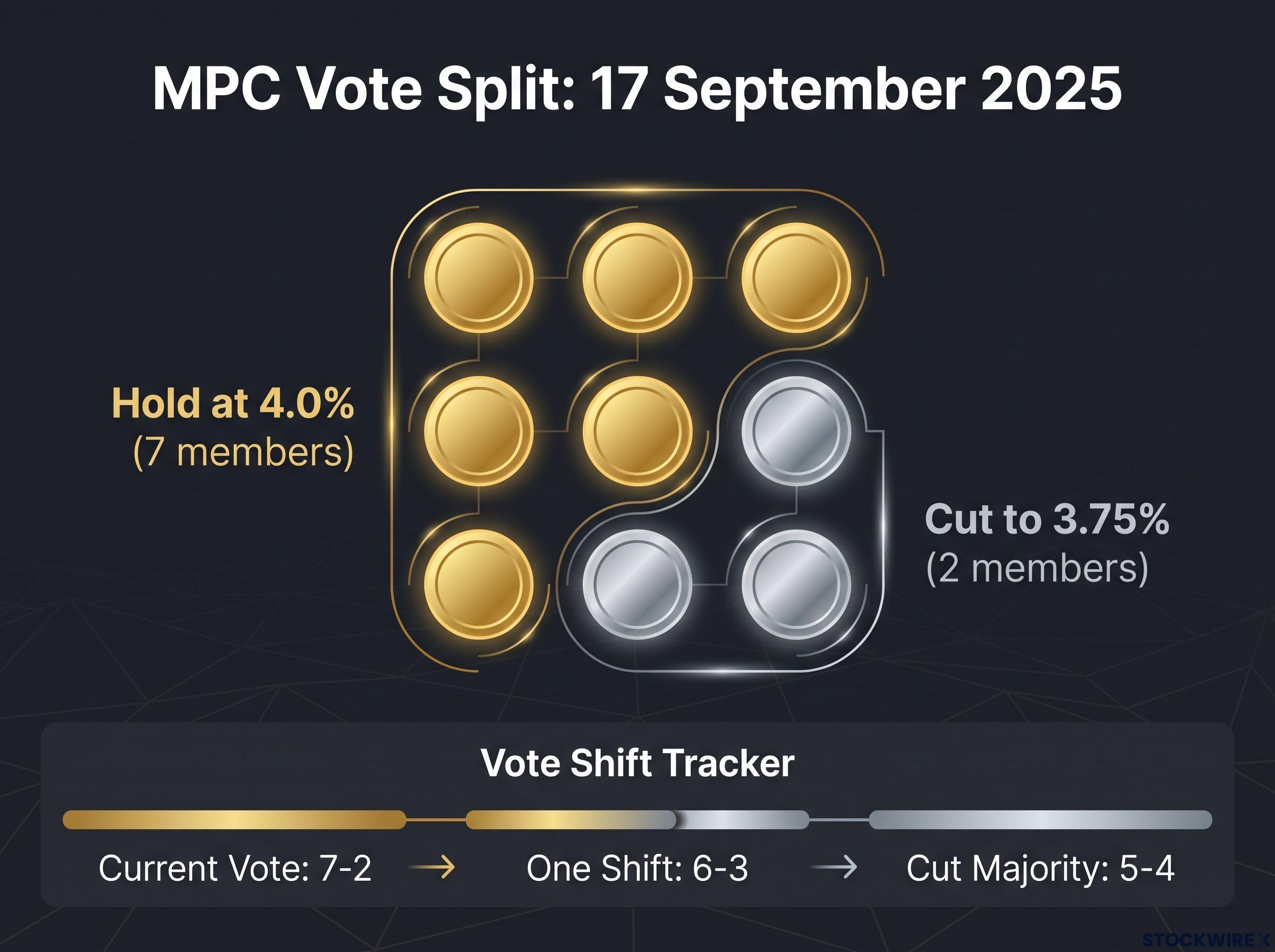
The Committee split 7-2, with the two dissenters preferring a cut to 3.75%. Not a hike. This is where the forward signal lives. A unanimous 9-0 hold would have told you the Committee was comfortably anchored at the current rate. A 7-2 split tells you something different: two members already believed the data justified moving lower, and one more member shifting their assessment would narrow the majority to 6-3. Two more shifts, and you have a cut.
The BoE September 2025 MPC minutes confirm the 7-2 vote to hold Bank Rate at 4.0%, with the official record explicitly conditioning future moves on incoming CPI, wage growth, and services inflation data.
Analysts characterised the September hold as “pragmatic,” consistent with prevailing OIS curve pricing, but the 7-2 margin made it clear the Committee was not settled.
The interpretive rule for vote splits is simple: the narrower the majority, the less data movement is required to flip the outcome at the next meeting. A 7-2 split means the bar for a cut is lower than a 9-0 hold would imply. That is why some analysts explicitly identified the next inflation release as the primary determinant of whether another cut would arrive by year-end.
The three data variables that would determine whether the minority became the majority:
- CPI, specifically whether headline and core measures cooled from 3.8%
- Wage growth, relative to the BoE’s projections for domestic cost pressure
- Services inflation, the component most likely to signal whether the inflation peak was genuine or premature
Two dissenters voting for a cut tells you the Committee is not comfortably anchored at 4.0%. Every subsequent CPI and wage release carried real policy weight, because the gap between the current vote and a changed outcome was only one or two members wide.
How gilt investors, sterling holders, and rate-sensitive equity investors should read this
The September decision translated differently across three asset classes, and each one carries a distinct monitoring question going forward.
- Gilt investors: A hold at 4.0% with a clear but conditional path toward further easing supported moderate duration risk. If disinflation materialised and allowed the MPC to follow through on cuts, longer-duration gilts stood to capture capital gains as yields fell. Your primary question: is the next CPI print low enough to bring forward the timeline for another cut?
- Sterling holders: With the September hold fully priced, the pound’s next move was no longer a function of the MPC decision itself. It became a function of the evolving inflation narrative and, critically, relative policy divergence against the Fed and European Central Bank (ECB). Beth Hammack, Lorie Logan, and Neel Kashkari all broke from the FOMC majority, casting dissenting votes in favour of a rate increase, and Fed Chair Kevin Warsh’s sparse public commentary meant the release of the Fed’s meeting minutes took on heightened significance for traders. Your primary question: is the BoE’s cutting pace diverging from the Fed and ECB, and in which direction?
FOMC dissent mechanics at the July 2026 meeting produced a 9-3 hawkish split, with Hammack, Kashkari, and Logan all formally demanding a 25-basis-point hike; the parallel to the MPC’s 7-2 dovish split is instructive, because in both cases the dissenting minority needed only a small shift in incoming data to move from minority to majority.
- Rate-sensitive UK equities (REITs, utilities, defensives): The September hold removed the risk of renewed tightening pressure. The primary valuation driver shifted to the speed and extent of future easing rather than any immediate rate threat. Your primary question: how many cuts does the market price by mid-2026, and is that number rising or falling with each data release?
For each of these asset classes, the key question after September was no longer “will they hike?” It became “how fast will they cut, and will that pace diverge from the Fed and ECB?” That reframing should change where you focus your monitoring.
The data releases that will determine the next move
With the September hold fully discounted and the 7-2 split on record, the probability distribution for November became more sensitive to incoming data than it was before September. Here is exactly what to watch and why each release matters.
- The next UK CPI release, particularly core and services components. This is the binary. If services inflation or core CPI cool meaningfully from the 3.8% level, the probability of a November cut shifts significantly, and that shift will show up in SONIA pricing before any formal MPC announcement. The MPC judged that inflation had likely reached or was near its peak; the next print either confirms or falsifies that view.
- Wage growth data relative to BoE projections. Wage growth feeds directly into services inflation. If pay settlements soften, it removes one of the MPC’s primary arguments for patience. If they hold firm, it reinforces the case for maintaining rates and waiting for more evidence.
- MPC member speeches and testimonies. With a 7-2 split, individual members’ public communications carry weight. Any signal that a member who voted for the hold is reconsidering, or that a dissenter is hardening their position, shifts the read on the November vote before it happens.
The vote arithmetic is straightforward: one member changing their position from hold to cut moves the split to 6-3. That is still a majority for hold, but it signals accelerating momentum toward a cut and would likely move SONIA pricing on the announcement. Two members shifting gives you 5-4, which is a cut. Every data release between September and November feeds directly into that arithmetic.
This article is for informational purposes only and should not be considered financial advice. Investors should conduct their own research and consult with financial professionals before making investment decisions.
These statements regarding future policy moves are speculative and subject to change based on market developments, incoming economic data, and MPC deliberations.
What September 2025 tells you about how to read future BoE decisions
The September meeting was one event, but the mechanics behind it give you a durable framework. Three principles, drawn from the specifics above, apply to any future Bank of England rate decision:
- Verify the direction of policy risk before reading any probability number. The difference between “80% hold, 20% hike” and “hold fully priced, tail risk on a cut” changes every conclusion downstream. Checking ONS official data against any single-source reporting is the first step, not an optional one.
- Read the vote split as a forward signal, not just a record of the current decision. The margin tells you how much data movement is required to shift the outcome. A 7-2 split is a lower bar for change than 9-0.
- When the base case is fully priced, the market-moving event is the next data release, not the decision itself. Track the CPI calendar, wage data releases, and MPC member speeches with the same attention you give the meeting dates.
The “cautious easing” posture the MPC adopted in September is likely to persist as the operative bias. The Committee will move again, but the pace remains data-conditional. If you track the conditioning variables (CPI, wages, services inflation), you will see the next cut reflected in SONIA pricing before it is formally announced.
The difference between 2.9% and 3.8% changed every conclusion in this article. That is the strongest possible argument for verifying the numbers before positioning around them. Apply the same discipline to the next MPC meeting, and you will not need this article again.