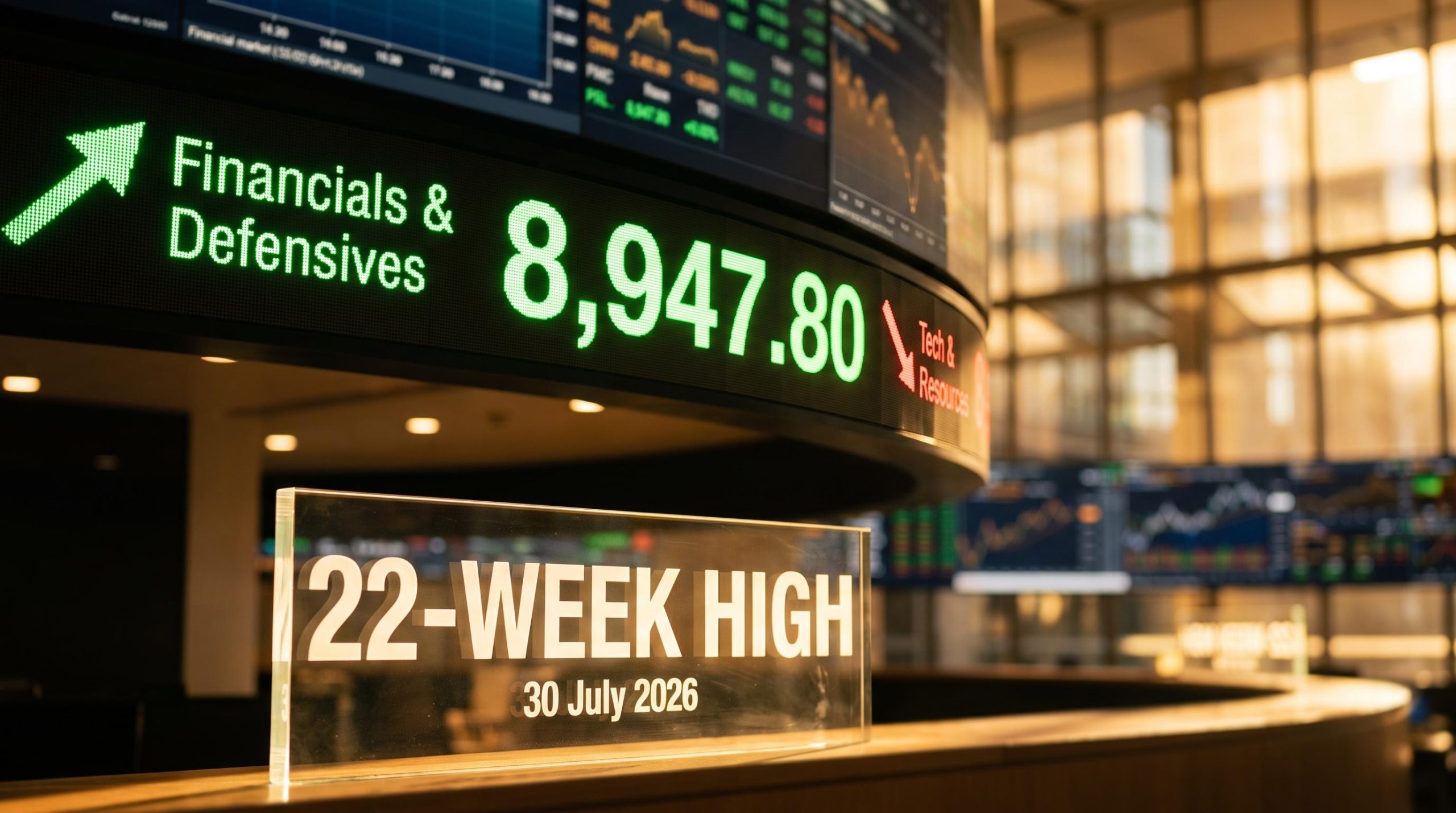
The ASX 200 hit a 22-week high on 30 July 2026, and the rally has nothing to do with the world getting safer. Geopolitical tensions in the Middle East remain unresolved. Oil prices are elevated. The risks that kept investors cautious a month ago are still live.
What changed is where the money is going. Australian equities are seeing a shift in allocation, with funds flowing away from AI and semiconductor stocks and toward banks, defensives, and blue chips offering strong dividend income. The index is climbing not because everything is working, but because a specific set of sectors is doing the heavy lifting while others lag.
Here is what that rotation tells you about the current market, whether your portfolio is positioned to benefit from it or exposed to its blind spots, and which conditions would cause the shift to reverse.
How the ASX 200 climbed to a 22-week high amid unresolved risks
The headline number looks clean: a 22-week high as of 30 July 2026. But the composition underneath tells a more complicated story.
On 28 July, the ASX 200 closed at 8,947.80, up 0.6%, its highest close in six weeks at that date. Ten of eleven sectors finished higher on the session, yet technology and resources lagged, meaning the advance was carried by a narrow group of outperformers rather than lifted by broad participation.
The prior defensive rotation in June 2026 followed a nearly identical pattern: a deceptively quiet headline number masking a decisive reallocation toward communication services, consumer staples, and healthcare as NAB economists called the end of the RBA rate-hike cycle, confirming that the July 2026 advance is a continuation of a trend rather than an isolated event.
ASX 200 (XJO): 8,947.80 on 28 July 2026, the highest close in six weeks, with ten of eleven sectors higher but tech and resources trailing the field.
The key surface facts:
- The ASX 200 reached a 22-week high as of 30 July 2026
- The 28 July close of 8,947.80 (up 0.6%) marked an intermediate data point within the week’s advancing trajectory
- Ten of eleven sectors closed higher, but technology and resources lagged behind financials and defensives
That gap between the headline index number and the actual distribution of gains matters directly. Your portfolio’s experience of this rally depends entirely on which sectors you hold, not simply whether you own Australian equities.
When big ASX news breaks, our subscribers know first
Why investors are walking away from AI and semiconductors right now
The retreat from growth stocks is not a verdict on whether AI will reshape industries. It is a reassessment of whether the risk-adjusted returns on those names still stack up relative to alternatives at this point in the cycle. Three drivers explain why:
- Rate sensitivity. Higher discount rates compress the present value of earnings projected far into the future. AI and semiconductor stocks, whose valuations rest on growth years away, are mechanically more vulnerable when rates stay elevated. This is not opinion; it is how discounted cash flow maths works.
- Narrative fatigue. After an extended run as the dominant performance theme, incremental AI news has to be exceptionally strong to justify pushing multiples any higher. Anything short of a genuine upside surprise encourages profit-taking.
- Macro risk as catalyst. Geopolitical tensions and oil-price-driven inflation concerns make investors more reluctant to hold stocks whose case rests on future growth rather than current cash flows. That sharpens the trade-off between growth and yield.
Asian technology stocks weakened on 28 July as financials drove gains, a pattern consistent with continued tech weakness observable through July 2026.
If you hold AI or semiconductor-linked positions, the pressure on those names is structural to the current rate and macro environment, not noise. Understanding that mechanism is what lets you decide whether to hold through, trim, or add on weakness, rather than simply reacting to the price moves themselves.
Australian banks: why they have become the rally’s engine
Start with the most immediate reason capital is flowing into CBA, NAB, Westpac, and ANZ: fully franked dividends.
Franking credits allow Australian investors to claim a tax offset for company tax already paid on profits. For self-managed super funds (SMSFs) in particular, a fully franked dividend at a 4% yield delivers substantially more after-tax income than an unfranked alternative or a term deposit at a comparable rate. That makes big four dividends especially valuable in the current environment.
Franking credit mechanics produce materially different after-tax outcomes depending on an investor’s structure, with pension-phase SMSF members receiving excess credits as a direct ATO cash refund rather than a tax offset, a gap that no international dividend alternative can replicate.
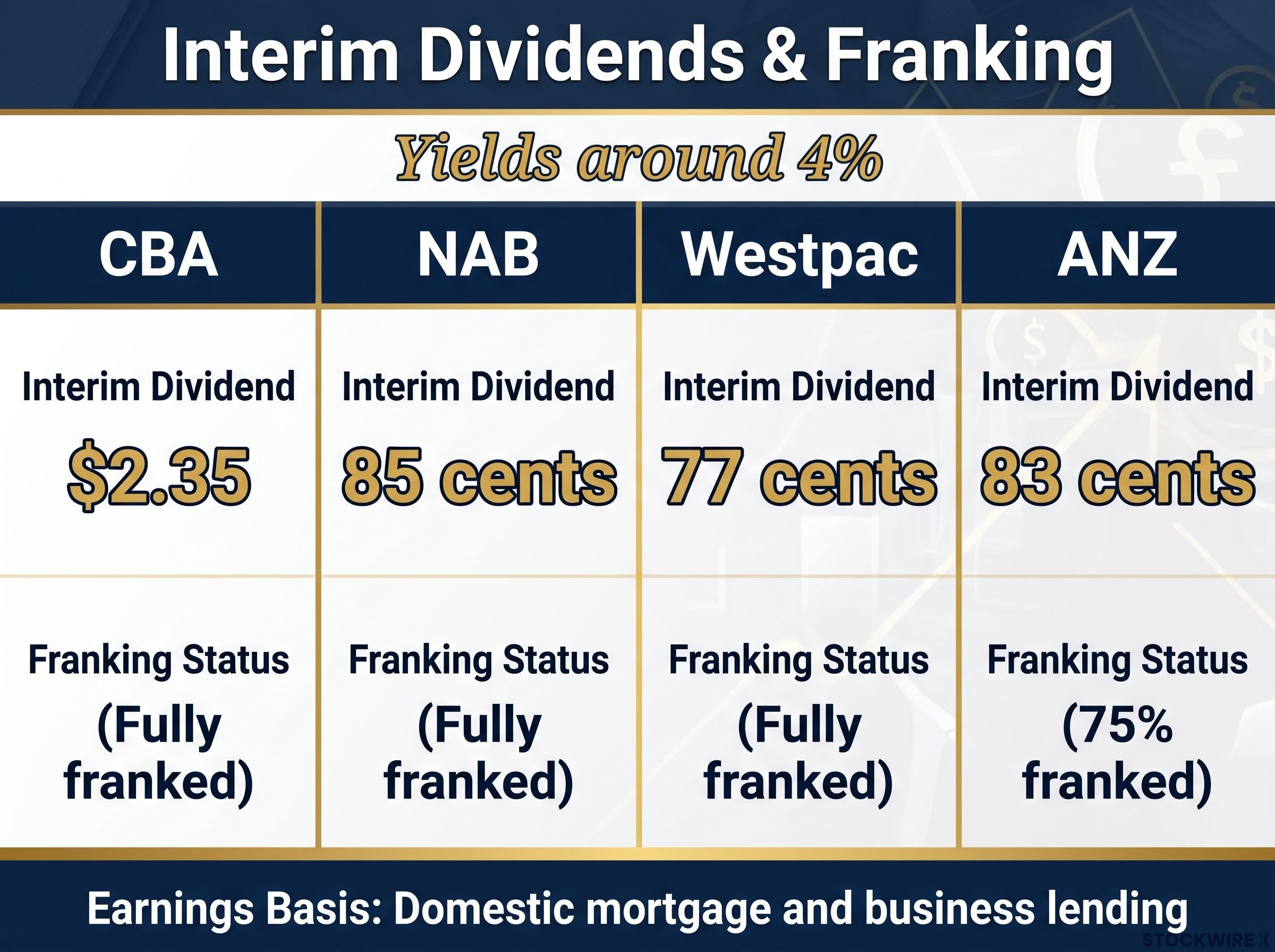
| Bank | Interim Dividend | Franking | Earnings Basis |
|---|---|---|---|
| CBA | $2.35 | Fully franked | Domestic mortgage and business lending |
| NAB | 85 cents | Fully franked | Domestic mortgage and business lending |
| Westpac | 77 cents | Fully franked | Domestic mortgage and business lending |
| ANZ | 83 cents | 75% franked | Domestic mortgage and business lending |
Beyond yield, the big four derive the bulk of their earnings from Australian mortgages, business lending, and fee-based services. That domestic focus is being priced as a virtue when global risks, from Middle East tensions to AI valuation corrections, feel more threatening than local conditions. Net interest margins (the spread between what banks charge on loans and pay on deposits) remain stable or supportive in a rate-plateau environment, reinforcing the earnings quality argument.
Analysts have highlighted that investors are willing to buy major banks at dividend yields around 4% because they view earnings as relatively stable and expect rates to have peaked or to move lower, supporting both valuations and loan demand.
Once capital starts moving into banks, the gains attract additional buyers. Retail investors and institutional traders join early movers, reinforcing the trend. That feedback loop is typical of sector rotations, and it is still operative.
The case for banks is not simply about chasing what has already moved. It is about a genuine alignment of yield, earnings quality, and macro positioning that remains intact.
What are defensives, and why do they appeal when uncertainty rises
Defensive stocks are companies whose investment cases are built on cash flows today, not speculative upside years into the future. They earn money from goods and services that people use regardless of economic conditions, which makes their revenue more predictable and less sensitive to market swings.
Four categories capture most of the defensive universe:
- Consumer staples (e.g. Woolworths, Coles): demand for food and household essentials does not disappear in downturns, providing structural revenue resilience
- Utilities and infrastructure: earnings are often regulated or contracted, producing bond-like income with high visibility
- Healthcare: demand is linked to ageing demographics and the provision of care that cannot be deferred, making it less cyclical than most sectors
- Telecommunications: subscription-based revenue means earnings visibility is high, because customers pay monthly regardless of market sentiment
What unites these stocks is that their value proposition does not require you to bet on a future that may not arrive. In an environment of geopolitical risk, oil price volatility, and rate uncertainty, the trade-off between today’s income and tomorrow’s growth potential tips toward defensives.
Past bank-led index advances in Australia have consistently seen consumer staples, healthcare, and defensives participate alongside financials. The pattern is holding in July 2026.
Scan your own portfolio with this lens: do your holdings skew toward cash-flow certainty or toward future-earnings speculation? That distinction determines which side of this rotation you are on.
The rally’s blind spot: what a narrow advance means for your portfolio
A rising index does not guarantee a rising portfolio.
The ASX 200 can print a 22-week high while a portfolio weighted toward growth, tech, or AI names sits flat or declines, because the index is being carried by financials and defensives, not growth sectors.
The 28 July session illustrated this precisely: ten of eleven sectors closed higher, but technology and resources lagged. A diversified portfolio with meaningful exposure to those sectors would have underperformed the index on a day the index moved higher.
The defensive versus energy divergence playing out in July 2026 has a direct precedent in Week 26 of the same year, when utilities, healthcare, and consumer staples pressed fresh 52-week highs while energy stocks fell to 52-week lows even as the headline index posted a near-flat weekly gain.
When sector dispersion is this wide, sector allocation becomes the dominant driver of returns. It is not enough to be in the market. Where you are invested matters more than whether you are invested.
The rotation is also conditional. Three developments could reverse it:
- A meaningful easing of geopolitical risk in the Middle East, reducing the safe-haven premium on defensives
- Oil price normalisation, which would ease inflation concerns and reduce the penalty on rate-sensitive growth names
- Rate expectations moving decisively lower, which would compress discount rates and make long-duration growth stocks relatively more attractive again
Check whether your own portfolio is overweight the sectors lagging this rally. Then weigh that against your time horizon and your capacity to hold through a period of divergence from the index. That assessment is more useful right now than watching the headline number.
What the rotation is and is not telling you about Australian equities
Through this rotation, investors are collectively expressing three preferences:
- Yield over speculation: near-term income from franked dividends is being valued more highly than potential capital gains from future earnings growth
- Domestic earnings over global exposure: the big four’s reliance on Australian mortgages and business lending is a feature, not a limitation, when global risks dominate
- Cash-flow certainty over growth optionality: stocks that earn today are being rewarded at the expense of those whose value depends on what happens next year
This is defensive repositioning within equities, not capital flight from equities. Money is not leaving the market. It is moving from one set of bets to another, consistent with prior bank-led rallies. The ASX 200 hitting a 22-week high during a period of global uncertainty confirms that investors still want to own Australian shares; they are just choosing different ones.
That preference is operative in July 2026’s specific environment and is subject to change as macro conditions evolve. The rotation tells you what the market is rewarding right now. It does not tell you what it will reward six months from now.
Sector rotation strategy is most valuable as a forward-looking tool rather than a description of what has already moved; institutional capital repositions ahead of confirmed economic shifts, meaning the pattern visible in July 2026 ASX data may already be signalling the next phase rather than simply reflecting the current one.
The practical question is whether your current allocation reflects a deliberate view on this environment or a legacy position that has not been reviewed. Knowing the difference is the starting point for your next portfolio decision, whether that conversation happens with yourself or with a financial adviser.
This article is for informational purposes only and should not be considered financial advice. Investors should conduct their own research and consult with financial professionals before making investment decisions.