The bond market did not wait for economists to weigh in after Kevin Warsh’s July 29 press conference. Long-term Treasury yields jumped while short-term rates fell, a yield curve movement that encodes one clear investor verdict: the Fed’s near-term moves are uncertain, and its long-run inflation resolve is even more so.
That reaction matters beyond the rate decision itself. Warsh entered office arguing the Fed had a credibility deficit and needed regime change. His second FOMC meeting has, for now, widened that deficit rather than closed it. Analysts at Wolfe Research, Capital Economics, and Barclays all flagged the same fault line: a hawkish written policy statement that does not square with a cautious, non-committal press conference. That misalignment is now the defining feature of Fed policy uncertainty heading into September and December.
Here is what the credibility gap actually looks like in yield curve mechanics, what it means for rate expectations through year-end, and the three specific signals that will tell you whether Warsh resolves it or compounds it.
The July meeting in brief: what Warsh said, what he signalled, and where they diverged
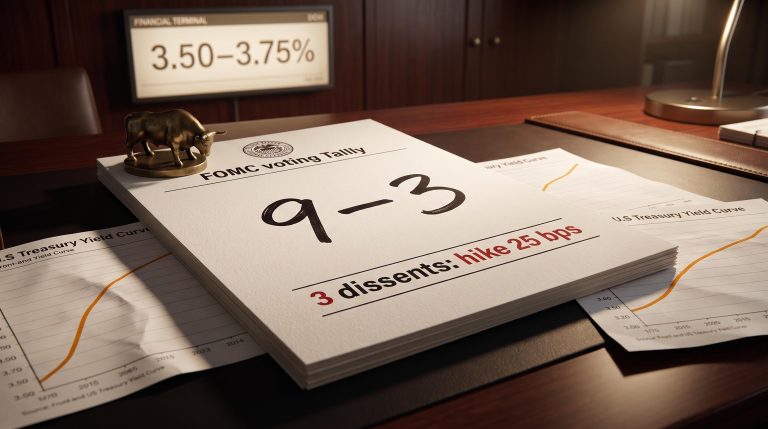
The decision itself was straightforward: hold rates steady. The communication around it was not. In his second FOMC meeting as Chair, Warsh faced an inflation rate still substantially above the Fed’s 2% target and a committee that was not unified. Three members dissented in favour of an immediate hike.
Warsh told reporters there was “broad agreement on difficult questions” among committee members. Three hawkish dissents make that claim hard to take at face value. This was not a committee holding calmly; it was a fractured one holding reluctantly, and that internal friction directly shapes how reliably the Chair can speak for the institution.
The written policy statement carried a hawkish tone. The press conference did not match it. Warsh has deliberately shortened and de-emphasised the policy statement as part of a structural retreat from explicit forward guidance, a shift that made the gap between the two channels harder for markets to interpret. Analysts identified three specific communication failures:
Warsh’s deliberate retreat from explicit forward guidance is not simply a stylistic choice; the forward guidance regime his predecessors built over two decades actively suppressed the uncertainty premium investors are now paying in the form of elevated long-end yields and wider outcome distributions across every rate-sensitive asset class.
- A hawkish written statement paired with a dovish, non-committal press conference tone
- Refusal to define a clear reaction function, meaning no stated thresholds for what would trigger a hike
- Questioning of PCE (the Personal Consumption Expenditures index, the Fed’s primary inflation gauge) as the right measure, without offering a replacement framework
Jon Hilsenrath, one of the most closely followed Fed watchers, captured the market’s reaction in blunt terms:
“He didn’t convey the message clearly or explicitly, and the bond market puked on him.”
That is not a stylistic critique. It is a description of what happened to long-term yields in the hours after the press conference.
When big ASX news breaks, our subscribers know first
Why central bank credibility is measurable, not just rhetorical
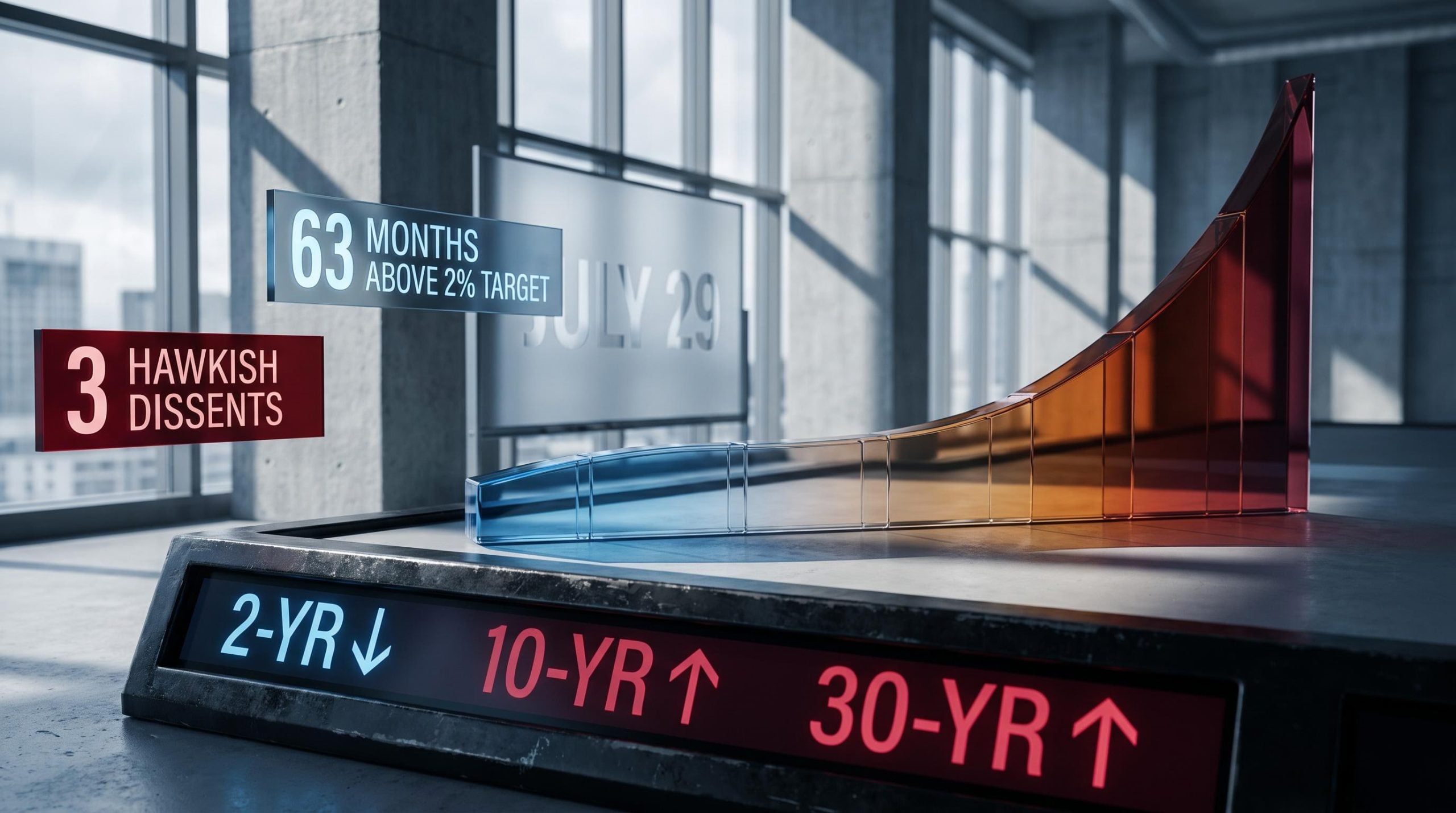
Credibility sounds abstract until you see it in the yield curve. After the July decision, the 2-year Treasury yield fell, while the 10-year and 30-year yields rose. That pattern tells you two things simultaneously: investors priced in near-term caution (lower short-end rates) while openly doubting the Fed’s long-run inflation resolve (higher long-end rates).
The mechanism behind the long-end move is the term premium: the extra yield investors demand on longer-dated bonds when they are uncertain whether the central bank will keep inflation in check over time. When a Fed chair’s words cannot be reliably mapped to future actions, the term premium rises, because every subsequent CPI print, PCE reading, and energy price move becomes a potential catalyst for sharp repricing rather than a data point absorbed within a known framework.
| Treasury Maturity | Direction After July Decision | What It Signals |
|---|---|---|
| 2-year | Fell | Markets pricing a cautious, near-term hold |
| 10-year | Rose | Growing doubt about medium-term inflation management |
| 30-year | Rose | Long-run inflation resolve openly questioned |
For any investor holding long-duration assets, that steepening is not a neutral market observation. It represents a direct cost already materialising from the communication gap, regardless of what the policy rate does next.
Joe Lavorgna, quoted by Reuters before the meeting, framed the stakes precisely:
“Credibility is more an issue if you don’t hike than if you hike. Talk is cheap.”
Why Warsh’s test is harder than the standard new-chair credibility trial
What the historical pattern looks like
New Fed chairs are tested early by markets. The test under Ben Bernanke, Janet Yellen, and Jerome Powell centred not on the specific rate level chosen but on predictability and commitment to the mandate. Could markets map the new chair’s words to future actions? Did the chair’s reaction function become legible within the first few meetings? That was the baseline question each time.
What makes Warsh’s version harder
Warsh faces four amplifiers that compound the standard test into something more acute:
- Pre-existing independence concerns: Doubts about susceptibility to political pressure for lower rates have followed Warsh since his nomination
- Self-imposed rhetoric bar: His own language, framing the Fed as having “lost credibility” and requiring “regime change,” sets an unusually high standard against which his own actions are now measured
- PCE measurement controversy: Any move to redefine the inflation target or shift away from PCE while inflation is above target would be read as changing the rules to avoid hiking, according to Haver Analytics
- Broad pre-tenure critic consensus: Better Markets described Warsh as entering with “virtually everyone questioning his credibility” before his first rate decision
Because Warsh staked his chairmanship on a credibility restoration argument, markets are applying a harsher standard to his early actions than they would to a chair who entered quietly. The cost of each ambiguous signal is higher than it would otherwise be. The July meeting did not provide the early confirmation markets needed to extend confidence; it provided the opposite.
The inflation context that makes patience costly
Warsh himself has acknowledged that inflation has been above the Fed’s 2% target for approximately 63 months as of July 2026. That duration removes any credible “transitory” defence. Every hold decision now requires an affirmative case for patience, and Warsh has not yet made that case with sufficient specificity.
The conditions Warsh inherited at confirmation, including headline CPI at 3.8%, Brent crude above $107, and three regional Fed presidents already calling publicly for rate hikes, set the baseline against which every subsequent hold decision is now measured.
The inflation backdrop carries three specific pressures:
- Duration above target: Roughly 63 months of continuous overshoot, with geopolitically rooted energy price rises linked to the Iran conflict as a primary contributor
- June 2026 CPI: Printed softer than expected, offering partial relief but not resolving the structural overshoot
- Frozen labour market: Low hiring and low layoffs simultaneously, a condition that limits how much demand-side cooling rate hikes can deliver
The policy constraint is uncomfortable from both directions. Raising rates theoretically suppresses inflation but risks further weakening a labour market already characterised by stasis. Doing nothing risks the credibility signal the July meeting has already transmitted. The Fed’s standard tool has limited leverage on an energy-driven, geopolitically rooted price shock, but inaction still carries a credibility cost the market is already measuring.
Michael Feroli of JPMorgan put the problem directly:
Warsh’s unwillingness to spell out what triggers hikes, combined with his questioning of PCE as the primary inflation gauge, raises doubts about his ability to deliver lower inflation.
That is the bind. Sixty-three months of above-target inflation means every hold decision is scrutinised not just for its policy logic but for what it reveals about whether the chair will act when conditions demand it.
Three scenarios for rates through December, and what each requires of Warsh
The range of plausible outcomes between now and year-end has widened, not narrowed, after July. Three paths are actively in play, and Warsh’s own choices are the branching variable in each.
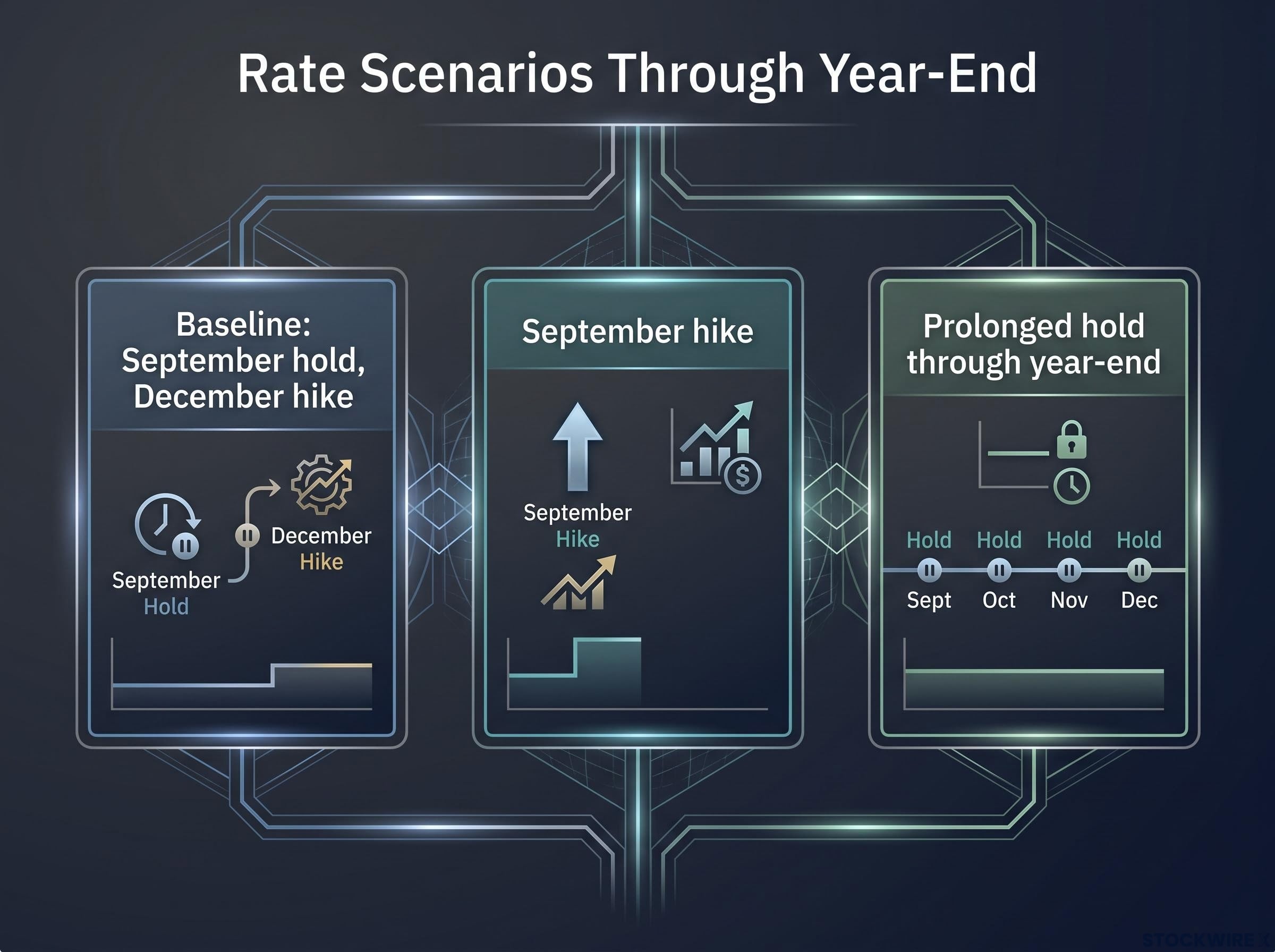
- Baseline: September hold, December hike. Markets grant Warsh time on an implicit condition: he acts if the data deteriorate. This path requires incoming inflation prints to hold steady or soften slightly, and it requires Warsh to signal clearly at or before the September meeting that a December hike is live if conditions warrant. It is the path of least credibility damage.
- September hike. Triggered by inflation re-accelerating over the summer. The three hawkish dissents at the July meeting confirm the faction exists and is active. A September hike would be understood as Warsh matching hawkish language with concrete action, a credibility repair move. Yahoo Finance framed the trigger clearly: if September arrives with renewed inflation pressure and no hike, “the credibility question comes into play” as the dominant market narrative.
Pre-meeting pricing and dissent signals going into July told the same story in different registers: BofA placed a hold at roughly 73%-76% probability while simultaneously projecting three additional hikes by year-end, a positioning that reflects not a comfortable pause but a committee whose internal balance is far closer to action than headline market pricing implies.
- Prolonged hold through year-end. This is the path most commentators warn would damage credibility most severely. Haver Analytics and Better Markets stress that changing targets, softening definitions, or repeatedly delaying action when inflation is above target would push long-term yields materially higher and embed a larger inflation risk premium.
| Scenario | Trigger Conditions | Warsh Action Required | Market Impact |
|---|---|---|---|
| Baseline hold / December hike | Inflation steady or softening; no re-acceleration | Signal December hike is live; narrow statement-to-press-conference gap | Moderate term premium; yield curve stabilises |
| September hike | Inflation re-accelerates; energy prices surge | Match hawkish rhetoric with concrete action | Short-term volatility; credibility partially restored |
| Prolonged hold | Elevated inflation persists; no policy response | None (inaction) | Long-term yields rise materially; credibility severely damaged |
The three scenarios converge on one variable you can actually watch: whether Warsh’s written statements and press conference tone narrow their gap or widen it at the next meeting. That gap is the leading indicator of which path the Fed is on before the rate decision itself arrives.
Four signals that will tell you whether Warsh’s credibility gap is closing
Between now and the September FOMC meeting, four indicators will determine whether the credibility problem is resolving or deepening. They are listed in order of diagnostic clarity.
- Incoming inflation data (CPI and PCE). If inflation softens convincingly, Warsh can justify patience without credibility cost. If it re-accelerates and he still holds, the credibility question becomes the dominant market narrative. Energy prices tied to the Iran conflict remain the primary wildcard.
- Consistency between written statements and press conference tone. A narrower gap, hawkish words matched by hawkish tone or clear conditions for action, would help rebuild market trust. Repeated mixed messaging will reinforce the perception that the Fed under Warsh is less predictable and less committed.
- Any shift on inflation targets or measurement. Any hint of moving away from PCE, redefining the 2% target, or announcing framework changes while inflation is above target would be read as changing the rules to avoid tightening, and would likely push long-term yields materially higher.
The Federal Reserve’s official 2% inflation target framework explains precisely why PCE was chosen over CPI as the primary gauge, making any mid-cycle move to redefine or replace that measure appear to markets as a structural retreat from the mandate rather than a technical refinement.
- Internal committee dissent count and composition at September. Persistent or growing hawkish dissents signal internal doubts about Warsh’s approach. Markets will fold the dissent count directly into rate-path probabilities.
The resolution mechanism
The four indicators collectively function as a credibility dashboard that updates in real time. For investors managing duration or volatility exposure, monitoring this dashboard is now a more reliable guide to the next rate move than the policy statement itself.
The evidence consistently points to one resolution mechanism: either Warsh clarifies his reaction function, specifying what data and thresholds would trigger hikes, or he backs his hawkish language with concrete action. Absent one of those two developments, elevated policy uncertainty persists through year-end.
What the credibility gap means for investors now, before September arrives
What has changed
The Fed’s reaction function is less transparent than it was before July 29. That reduced transparency has a measurable cost already visible in long-term yields and implied volatility. The yield curve steepening after the July meeting is the quantitative signal of the current credibility discount.
The range of plausible rate outcomes between September and December has widened, which affects not only the policy rate directly but long-term bond valuations, equity discount rates, and credit spreads. As CNBC and multiple analysts have noted, Warsh is now “in a difficult place, with his credibility potentially eroded in the face of the markets and within the Fed itself just months into the job.”
What to do with this
Warsh’s credibility problem is not terminal, but it is unresolved. The resolution will come from actions and communication consistency at the September and December FOMC meetings, not from further statements about the importance of credibility. The current environment rewards investors who understand the asymmetry: if Warsh acts credibly, rate and duration risk normalises; if the gap widens, long-end yields and volatility stay elevated.
Until the July question is answered by actions, investors are paying a credibility tax in the form of elevated long-end yields and a wider distribution of outcomes to position around.
For readers wanting to understand the legal framework constraining presidential influence over FOMC composition, our dedicated guide to the Fed independence ruling covers the Supreme Court’s 5-4 decision in Trump v. Cook, including the three procedural requirements Roberts established that now make reshaping the committee through rapid governor removals significantly harder to execute.
This article is for informational purposes only and should not be considered financial advice. Investors should conduct their own research and consult with financial professionals before making investment decisions. Forward-looking statements about rate paths and policy scenarios are speculative and subject to change based on incoming economic data and FOMC decisions.