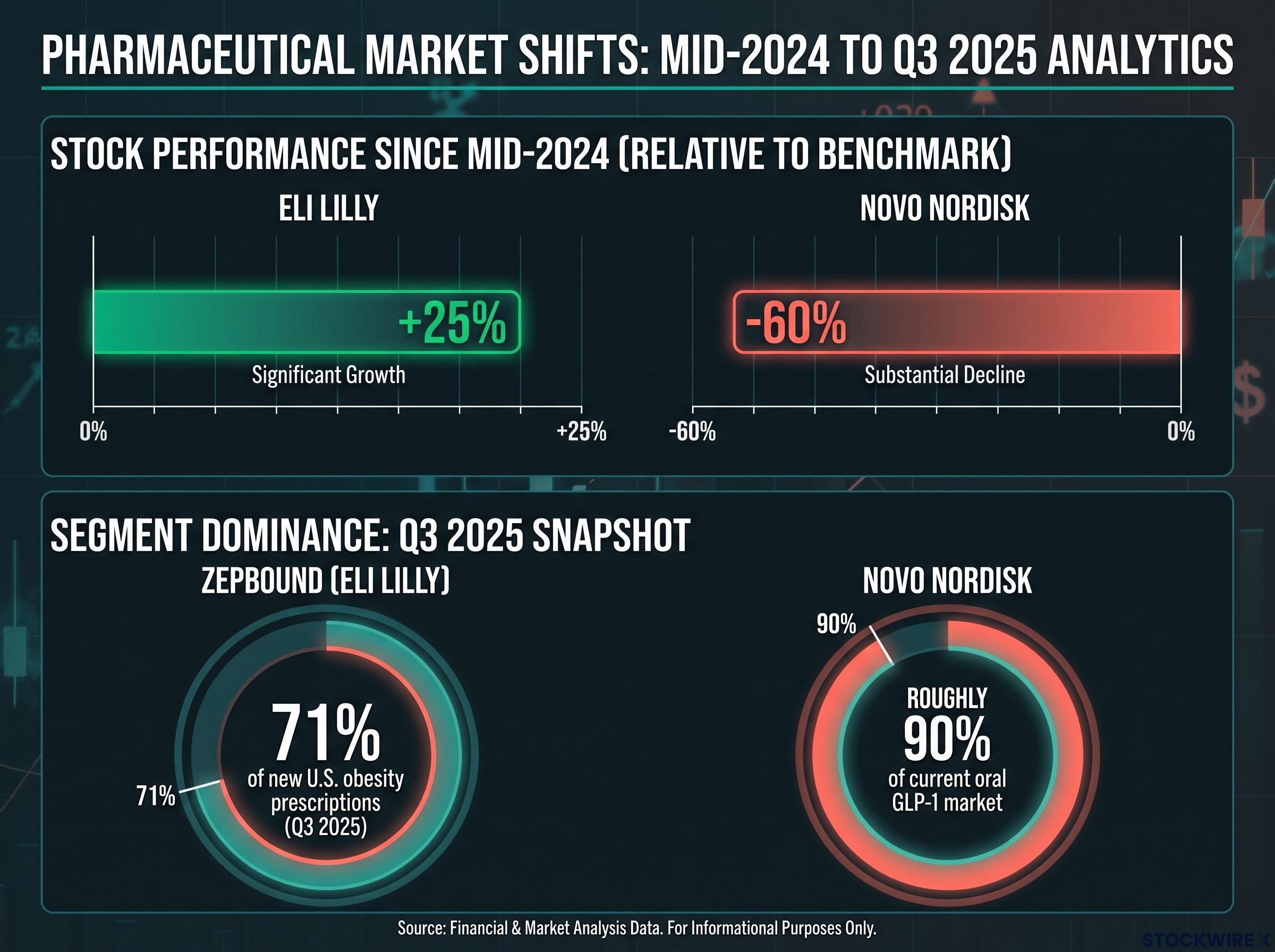
Novo Nordisk has shed roughly 60% of its stock value since mid-2024. Over the same stretch, Eli Lilly climbed approximately 25%. That divergence has an obvious cause, and it may also have a shelf life.
The injectable GLP-1 market handed Lilly an increasingly commanding lead, with Zepbound taking 71% of new U.S. obesity prescriptions by Q3 2025. But the ground underneath that outcome is moving. Two oral GLP-1 pills now sit on the U.S. market, built on different chemistries, carrying different clinical profiles, and pointing to different long-term competitive moats. The company that appeared to be losing the injectable war holds roughly 90% of today’s oral pill market.
Whether that matters depends on how durable oral leadership proves to be, and whether the valuation gap reflects a genuine structural disadvantage or a sentiment overshoot. This piece gives you a structured way to read the oral GLP-1 transition as a competitive signal: what the clinical data shows, where the moat differences sit between the two formulations, and what a finance-minded reader should weigh before drawing a conclusion on either Eli Lilly or Novo Nordisk.
How Lilly took control of the injectable market, and why the mechanism matters
Zepbound did not creep up on Wegovy. It ran it down.
In the week ending 19 July 2024, IQVIA data cited by Reuters put Zepbound at around 40% of the U.S. weight-loss market, still chasing the incumbent. By full-year 2025, that figure had flipped the market on its head.
The trajectory is worth seeing in sequence:
- Mid-2024: approximately 40% of the U.S. weight-loss market (IQVIA, via Reuters/Medwatch)
- Full-year 2025: approximately 60% of the overall U.S. obesity market (IQVIA, via Economic Times Pharma and Longbridge)
- Q3 2025: 71% of new U.S. obesity prescriptions, against 29% for semaglutide (IQVIA, via Towards Healthcare)
Zepbound captured 71% of new U.S. obesity prescriptions by Q3 2025, according to IQVIA data.
That new-prescription figure is the one to sit with. Overall market share includes patients already established on a therapy, but new prescriptions show what physicians are choosing for people starting treatment today. When 71% of fresh starts go one way, it compounds: those patients become tomorrow’s refills, tomorrow’s brand loyalty, and tomorrow’s baseline market share. It tells you the momentum is not a legacy effect. It is active preference.
Behind that preference is chemistry, not marketing. Tirzepatide, the molecule inside Zepbound, targets two receptor pathways: the GIP receptor and the GLP-1 receptor. Semaglutide, the molecule inside Wegovy, works through the GLP-1 pathway alone. That dual-mechanism design has produced greater average weight loss in the injectable segment, and greater efficacy is what prescribers respond to.
Here is the part that reframes everything that follows. Lilly’s moat in injectables is mechanical. It comes from a second receptor that its rival’s injectable does not engage. That advantage does not travel to the oral segment, because both companies’ pills target the GLP-1 receptor and only the GLP-1 receptor. The engine that produced the injectable rout simply is not running in the pill race.
When big ASX news breaks, our subscribers know first
What the clinical data actually says about the oral pill race
The most direct evidence available comes from a single head-to-head trial, and it does not settle the argument as cleanly as the headline numbers suggest.
The ACHIEVE-3 trial pitted Lilly’s orforglipron against Novo’s oral semaglutide. Published in full in The Lancet in February 2026, it showed orforglipron outperforming oral semaglutide across the primary and all key secondary endpoints at the doses studied.
The weight-loss numbers are decisive on their face. At the top dose, orforglipron 36 mg delivered around 19.7 lbs (9.2%) average weight loss, against roughly 11.0 lbs (5.3%) for the comparable oral semaglutide dose. At the lower dose, orforglipron 12 mg produced about 14.6 lbs (6.7%) versus 7.9 lbs (3.7%). Across all participants, the intention-to-treat analysis reported by CNBC put orforglipron at 8.2% average weight loss against 5.3% for oral semaglutide.
The ACHIEVE-3 trial results in The Lancet reported orforglipron outperforming oral semaglutide across the primary and key secondary endpoints, with the full published methodology detailing how discontinuation rates and tolerability outcomes were measured alongside the headline weight-loss figures.
| Drug | Type | Fasting required | FDA approval (obesity) | ACHIEVE-3 weight loss (high dose) |
|---|---|---|---|---|
| Orforglipron (Foundayo, Lilly) | Non-peptide small molecule | No | 1 April 2026 | ~19.7 lbs (9.2%) |
| Oral semaglutide (Novo) | Peptide | Yes | December 2025 | ~11.0 lbs (5.3%) |
There is also a convenience gap that the efficacy figures do not capture. Orforglipron, approved as Foundayo on 1 April 2026, carries no food or water restriction. Oral semaglutide, approved for weight loss in December 2025 and launched commercially in January 2026, is a peptide that needs an absorption enhancer and strict fasting before each dose. For a daily pill, that difference in daily friction is not trivial.
Efficacy versus adherence: where the commercial outcome is actually decided
The trial numbers are not the whole story, and the experts quoted at the time were careful to say so.
Commentary carried by Reuters and CNBC stressed that efficacy has to be read alongside tolerability. Yahoo’s summary of the same data flagged higher discontinuation rates for orforglipron, meaning more patients came off it during the study. A drug that produces more weight loss on paper does not win commercially if fewer patients stay on it.
For a patient choosing between the two pills, the no-fasting convenience of orforglipron may end up mattering more than the average weight-loss differential. That is why the signal to watch is not ACHIEVE-3 itself but real-world prescription and adherence data as both products accumulate use through 2026 and into 2027. The head-to-head tells you the oral race is genuinely competitive. It does not tell you who wins.
Why the chemistry of each pill has different long-term consequences for investors
“A pill is a pill” is the assumption to abandon here, because the two oral GLP-1s are not the same kind of drug at all, and the difference reaches straight into each company’s long-term margins.
Start with the two drug classes. A peptide is a chain of amino acids, essentially a small protein, and it is fragile and complex to manufacture, closer to a biologic than to a conventional tablet. Oral semaglutide is a peptide, which is why it needs an absorption enhancer to survive the gut and reach the bloodstream. A small molecule, by contrast, is a simpler chemical compound of the sort that makes up most traditional pills. Orforglipron is a non-peptide small molecule, and it needs no absorption enhancer at all.
That distinction is not a pharmacology footnote. It shapes how each drug can be defended once patent protection lapses.
- Manufacturing complexity: high for oral semaglutide (peptide, biologic-like); lower for orforglipron (small molecule, conventional pill-like)
- Fasting requirement: required for oral semaglutide; not required for orforglipron
- Generic competition exposure: orforglipron is more amenable to traditional generic manufacturing post-patent; oral semaglutide’s complexity may deter generic entrants for longer
- Biologic-style moat strength: stronger and more durable for the peptide; weaker and shorter for the small molecule
Here is the twist that runs against the clinical headlines. Orforglipron won ACHIEVE-3, but its small-molecule chemistry may make it easier to copy once exclusivity expires. If that holds, Lilly’s clinical lead in the oral segment could have a shorter defensible runway than its injectable advantage. For anyone weighing a long-term position, that is a material consideration, not a technicality.
And the stakes are rising because the market is expanding underneath both companies.
GLP-1 market penetration across the global obese population currently sits at roughly 2%, meaning the category’s conversion of its addressable base has barely begun despite the dramatic commercial ramp both Lilly and Novo have executed since 2023.
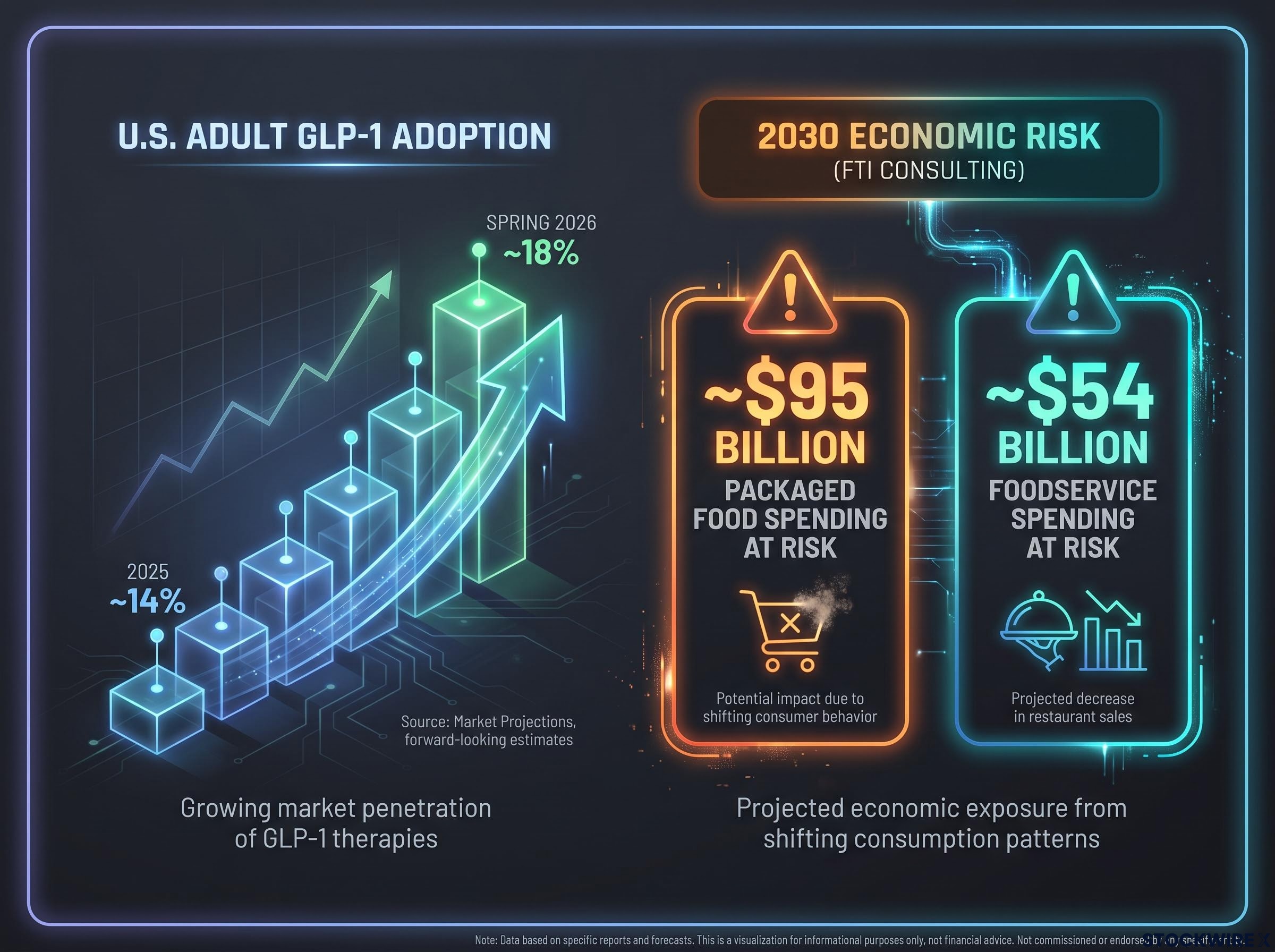
Approximately 18% of U.S. adults were using GLP-1 medications by spring 2026, up from around 14% in 2025, with further growth expected as oral formats lower barriers to entry.
FTI Consulting, which produced those figures, expects adoption to keep climbing as oral formulations arrive and prices fall. The analyst read is that the oral transition may accelerate commoditisation, compressing the biologic-style premium pricing both companies have enjoyed. A bigger market that is also a cheaper market is a genuinely double-edged outcome.
Reading Novo Nordisk’s valuation against the oral opportunity
Set the numbers side by side and the tension is hard to ignore. Novo Nordisk holds roughly 90% of the oral GLP-1 market by share. Its stock is down around 60% from mid-2024 and has been broadly flat since mid-2025. Lilly’s stock, by contrast, is up about 25% since mid-2024.
Novo got to market first. Its oral semaglutide was the first oral GLP-1 approved for weight loss to reach the U.S., cleared in December 2025 and launched in January 2026. Its pill launch in Germany marks the first EU market entry for an oral GLP-1, which some see as a potential international inflection point for the company.
So the bull case writes itself: near-total share of a segment that FTI expects to keep expanding, a stock already beaten down 60%, and an international rollout just beginning. A 60% decline set against 90% oral market share is a signal worth examining. It either reflects a rational market expectation that oral semaglutide will bleed share to orforglipron quickly, or it is a valuation overshoot driven by injectable-market sentiment that has not yet priced the oral opportunity.
The oral Wegovy revenue miss in Q2 2026, when Novo’s oral semaglutide sales came in at DKK 3.22 billion against higher consensus expectations, offered the first real-world signal that first-mover advantage in oral GLP-1s does not automatically translate into a beat-and-raise trajectory.
The uncertainties are what stop this from being a clean call.
Orforglipron beat oral semaglutide on average weight loss in ACHIEVE-3. Its no-fasting profile is a real, daily advantage for patients. Novo’s oral peptide moat may prove more durable over the long run precisely because it is harder to genericise, but that durability does not help if near-term prescription share compresses fast. First-mover advantage and clinical inferiority are pulling in opposite directions.
Three variables will decide whether Novo’s oral leadership holds:
- Payer and formulary positioning: which pill insurers favour, and at what patient cost, through the 2027 cycle
- Real-world adherence data through 2026-2027: whether orforglipron’s discontinuation signal materialises outside the trial setting
- Foundayo pricing strategy: how aggressively Lilly prices its pill relative to oral semaglutide
No named analyst P/E or price-to-book commentary was available in the research to sharpen the valuation picture, so this rests on share-price trajectory and market-share positioning rather than a precise multiple. For a finance-minded reader, the Novo setup is neither obvious opportunity nor obvious trap. It is a structured question about whether the injectable market’s verdict has been applied too bluntly to a segment where the competitive dynamics genuinely differ.
This article is for informational purposes only and should not be considered financial advice. Investors should conduct their own research and consult with financial professionals before making investment decisions. Past performance does not guarantee future results, and financial projections are subject to market conditions and various risk factors.
What the oral transition changes for both companies, and what it does not
Strip the noise away and the oral transition changes one specific thing: it narrows the playing field in the pill segment. Because both oral drugs act through the GLP-1 receptor alone, Lilly loses the dual-mechanism edge that let tirzepatide dominate injectables. In pills, the two companies compete on convenience, tolerability, pricing, and access, not on a superior receptor design.
What it does not change is Lilly’s injectable position. That 71% share of new prescriptions sits in a different segment, built on a different mechanism, and no oral drug currently threatens it. The oral race and the injectable race are two separate contests, and winning or losing one does not settle the other.
The scale of what both are competing to capture is large and still growing.
FTI Consulting projects approximately $95 billion of packaged food spending and $54 billion of foodservice spending at risk by 2030 as oral GLP-1 adoption expands.
The practical takeaway is a cleaner question than “who is winning.” It is “which segment’s dynamics will matter more to each company’s earnings over the next three to five years,” and that question now has a firmer evidence base. Three forward-looking signals will resolve it:
- Real-world oral prescription share: the running scoreboard between Foundayo and oral semaglutide through 2026-2027
- Payer formulary decisions for 2027: which pill secures preferred coverage, the single biggest lever on volume
- Early generic competition timelines for small-molecule GLP-1s: the first read on how short orforglipron’s exclusivity runway really is
The oral transition does not resolve the contest between these two companies. It opens a second front where the outcome is genuinely open, and a reader positioned in either stock should track oral prescription share through 2027 before the picture clarifies. These projections are speculative and subject to change based on market developments and company performance.