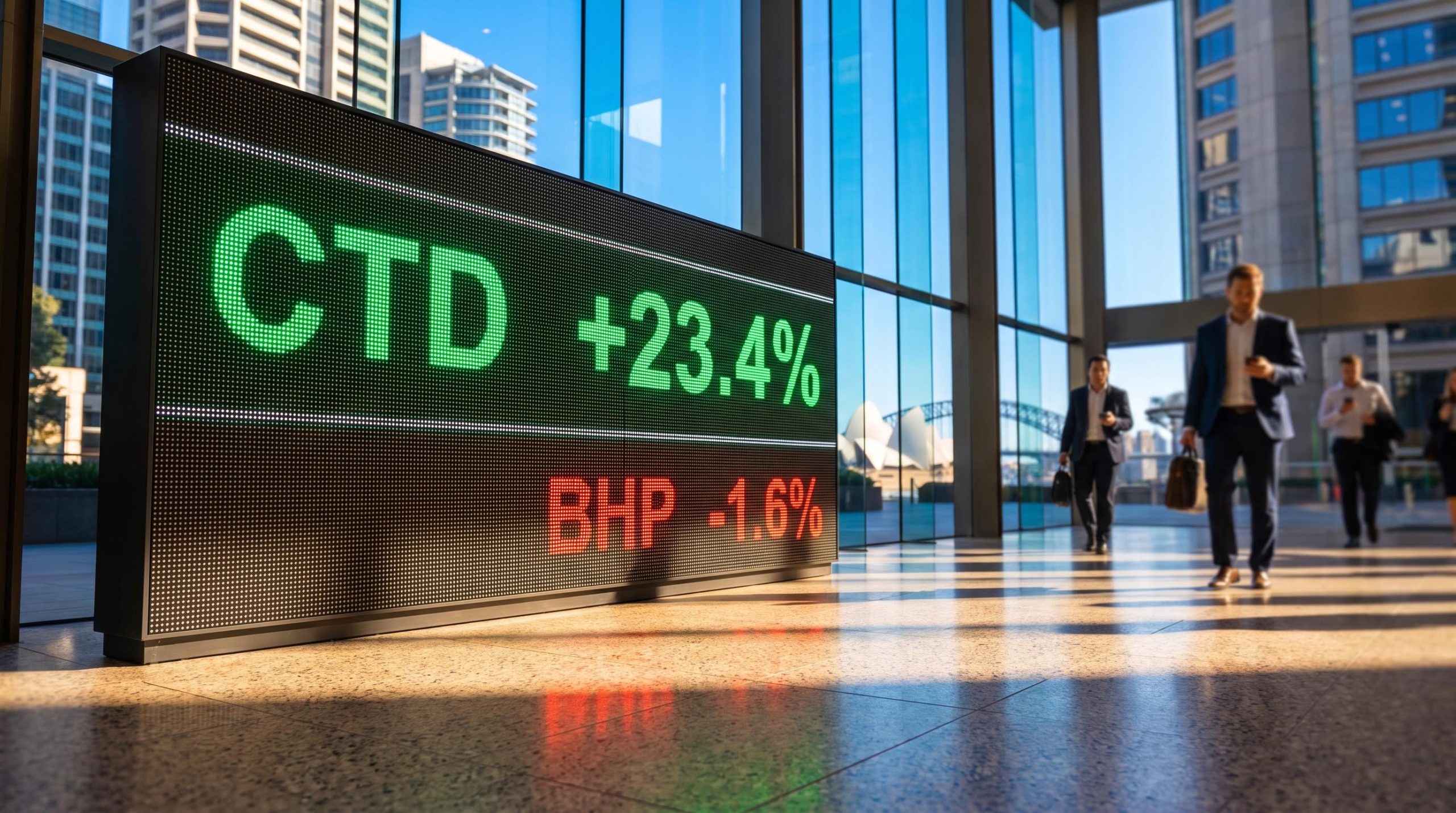
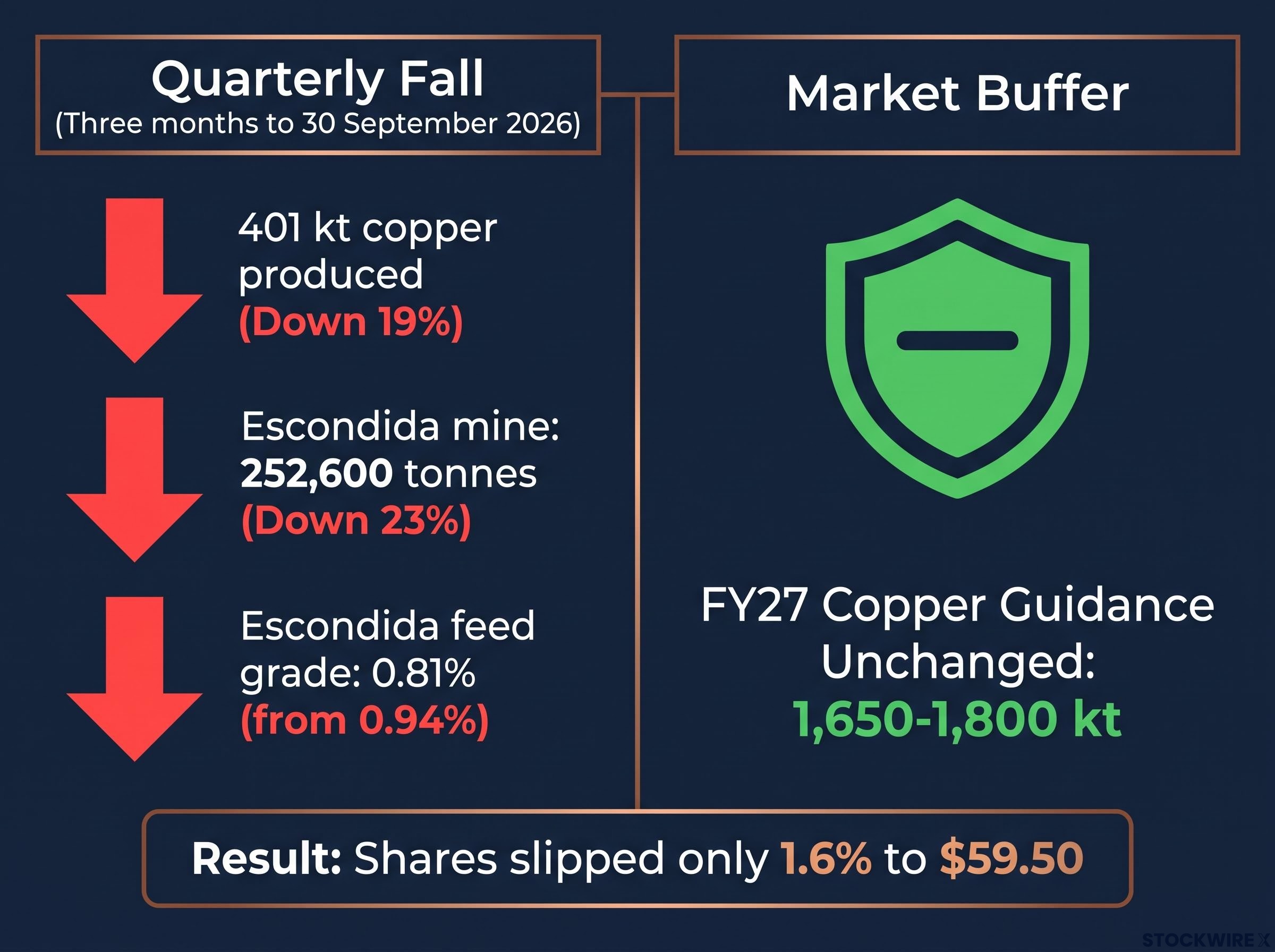
BHP reported a 19% fall in copper production for the September quarter, and its shares slipped only about 1.6% to $59.50. On the same day, Corporate Travel Management jumped more than 20% on a release about a security guarantee. If the biggest headline produced one of the smallest reactions, you have to ask why the size of the news and the size of the move so rarely match.
The answer sits in how the market reads each announcement. Among the ASX stock movers on 20 October, you could find almost every type of price-moving news in a single session: a takeover approach, a guidance upgrade, a restructuring, a quarterly production report and a run of broker rating changes.
That makes the session a useful case study. It is a recent trading day, not a forecast, and every move in it can be traced back to a specific change, or a lack of one.
Here is a repeatable way to read any announcement, whether it is a takeover headline, a production miss or a broker note, so you can separate noise from information before you act.
Why did BHP’s 19% copper fall move the shares so little?
On paper, the numbers looked bad. BHP produced 401 kt of copper in the three months to 30 September 2026, down 19% year on year, and Escondida, its largest mine, fell 23% to 252,600 tonnes.
Yet the market shrugged, because BHP left its FY27 copper guidance unchanged at 1,650-1,800 kt. Guidance is the production range a company tells investors to expect for the full year. Keeping it steady after a weak quarter suggests management expects a stronger second half.
The same logic explains why a 19% fall can barely register: what matters is the gap between the result and the market’s prior expectations, and you can see that gap at work in both good and bad announcements.
The rest of the portfolio also cushioned the blow. Pilbara iron ore rose 4%, steelmaking coal rose 1% and NSW energy coal rose 26%.
Temporary versus structural causes
The real question is whether each cause can reverse. BHP’s explanations fall into two groups:
- Temporary: scheduled maintenance, severe weather in Chile in July and August, safety-related stoppages (including a suspension after a fatal incident at Escondida), and a conveyor-belt failure at Carrapateena in South Australia.
- Possibly structural: declining ore grades at Escondida and Pampa Norte. Ore grade is the percentage of metal contained in the rock being processed. Escondida’s feed grade fell to 0.81% from 0.94%.
Maintenance finishes and weather passes. Falling grades do not fix themselves, and generally need sustained investment, changes to mine sequencing or better processing to offset. BHP framed the decline as largely planned, but RBC Capital Markets, as reported by Forbes contributor Tim Treadgold, said analysts had underestimated how quickly grades were deteriorating.
That disagreement shows up in the broker targets. Primary notes were not accessible, so these positions come from secondary market commentary.
| Broker | Rating | Target | Note on assumption |
|---|---|---|---|
| Bernstein | Hold | $46 | Lowest target in the group |
| UBS | Neutral | ~$61 | Close to the current price |
| Citi | Hold | $64.40 | Modest upside assumed |
| Morgan Stanley | Buy | $69 | More positive outlook |
| JPMorgan | Buy | $71 | Highest target in the group |
A $25 spread between Bernstein and JPMorgan reflects different assumptions about grades, execution, commodity prices and valuation. For your own resources holdings, the lesson is simple: a headline percentage fall tells you little until you know whether its cause can reverse. Grade decline is the item to watch in later quarters.
When big ASX news breaks, our subscribers know first
How do you read a takeover headline? The Ingenia case
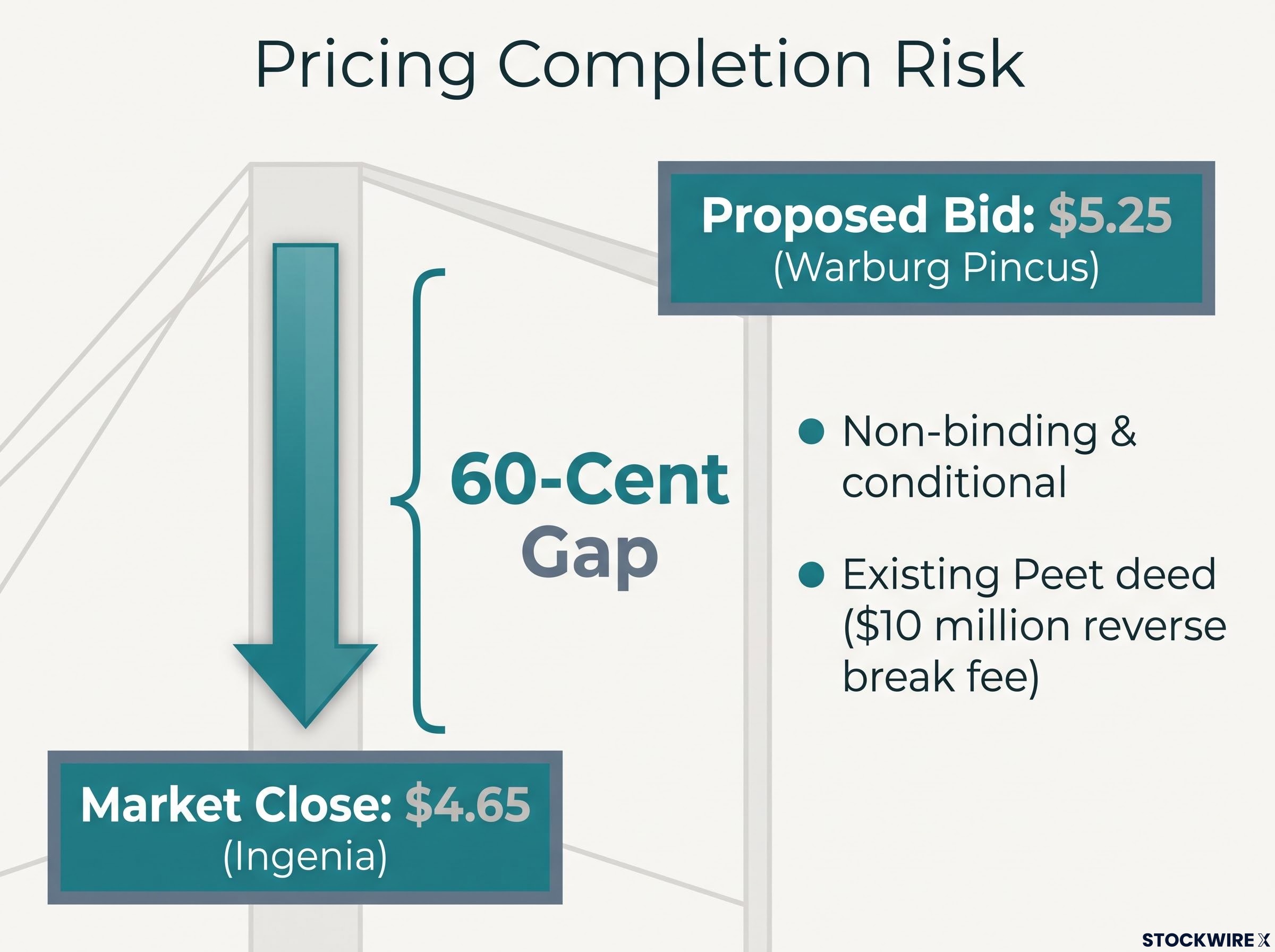
If a production miss is about cause, a takeover headline is about certainty. Warburg Pincus proposed to buy Ingenia for $5.25 cash per stapled security. Ingenia rose 9.7% on 20 October, but closed at $4.65.
That 60-cent gap is the market telling you something. The proposal was non-binding, meaning no one was legally committed to it, and was conditional on satisfactory due diligence, the investigation a bidder carries out on the target’s books before committing.
The terms also carried a qualifier that deserves a second look.
The condition that matters Warburg Pincus described its updated proposal as best and final only “in the absence of a superior proposal”.
Ingenia also already has a scheme implementation deed to acquire Peet, a binding agreement that sets out how that deal proceeds. Sources differ on Ingenia’s Peet position, but Ingenia had not terminated the Peet deal or recommended the Warburg proposal. Related reporting identified a $10 million reverse break fee if Ingenia walked away from Peet for a superior offer.
The original deadline of 19 October was extended, with the parties targeting a process deed by Friday, 23 October 2026. That is procedural progress, not agreement.
Use these six steps on any takeover headline:
- A non-binding proposal is not an offer that can complete.
- A board can extend a deadline without accepting the bid.
- “Best and final” is usually conditional on no better offer emerging.
- Competing deals must be compared under the existing agreement.
- Targets trade below the bid because of completion risk.
- Existing agreements carry switching costs.
Why the target trades below the bid
Completion risk covers everything that can stop a deal: conditions not met, regulators or shareholders objecting, a bidder walking away or a long delay. Each one shaves value off the headline price.
Switching costs add another layer. If Ingenia pursued Warburg, it would owe the break fee and lose the Peet deal it had already agreed to. Read a bid price as a ceiling that has not yet been earned, not as value already in your account.
For readers wanting to compare other live situations, our dedicated guide to reading ASX takeover bids contrasts binding schemes with non-binding approaches, using the FleetPartners and Challenger proposals.
What a company announcement is really telling you
Most ASX stock movers arrive on your screen as a single number: a green or red percentage. To read them properly, sort each move by what actually changed. Was it cash flow, the outlook, the risk, or nothing at all?
Move sizes below are session-end figures from Market Index. Other sources reported slightly different numbers depending on the time of day they were captured.
| Company | Move | What changed | What to check |
|---|---|---|---|
| Corporate Travel Management (CTD) | +23.4% to $3.06 | IATA released a $65M security guarantee and restored settlement cycles | The expected ~$30M working capital lift |
| PWR Holdings (PWH) | +6.1% | Aerospace and defence growth outlook raised to about 50% from 30% | Order book above $82M for FY27 |
| HUB24 | +3.9% | Net inflows of $4B beat $3.8B consensus | Funds under administration up 15% to $168.6B |
| NAB | -2.7% | Up to 2,500 roles cut | About $300M pre-tax FY27 charge |
| Starpharma | -33.3% | Petalion stake lifted to 66% | Up to $5M committed |
CTD’s move came from cash relief: money previously tied up was released. PWR delivered FY26 revenue of $170.7M (up 31.2%) and net profit after tax (NPAT) of $17.9M (up 83.2%), then lifted its outlook. HUB24 simply beat expectations on data. In each case, expected cash flows changed.
Good news with a catch: NAB and Starpharma
NAB plans to cut up to 2,500 roles, about 6% of staff, with up to 1,500 gone by end-December. Cuts can signal efficiency or point to softer conditions. The $300M charge lands in FY27, while the savings remain uncertain.
Starpharma’s jump from a 22.5% to a 66% stake in Petalion gives it control of the programme. It also brings more capital and execution exposure, which the market priced harshly.
Quiet moves: sector tides and no-news days
Cochlear rose 5.2% with no company news, carried by the healthcare sector. Audinate fell 5.5% after an AGM that offered no outlook upgrade. Sometimes the absence of news is the news.
Ask whether an announcement changes expected cash flows or only the story around them. That one question explains most of the session’s biggest moves.
What do broker upgrades and target changes actually tell you?
Broker calls look tidy in a headline. On 20 October, UBS upgraded Arena REIT to Buy with a target of $2.92 (from $2.60), and Morgan Stanley upgraded Dyno Nobel to Overweight with a target of $4.80 (from $3.50).
Downgrades hit Challenger (UBS), Cleanaway (Morgans), FleetPartners and Ramsay (Macquarie) and Sigma (Bell Potter). Citi set HUB24 at $88.00 against UBS at $77.75, while Ord Minnett cut PLS to $4.40 from $5.00. Canaccord initiated coverage on Frontier Energy and Innovaero.
The messier reality appears when you follow one stock across a month. A rating says whether a broker likes the stock; a price target is where it thinks the price could go. They answer different questions.
| Broker | Action | Date | Rationale |
|---|---|---|---|
| Jefferies | Hold to Buy, $2.65 | 8 Oct | Goodstart deal reduced overhang from the Edge portfolio |
| Moelis | Kept Buy, cut to $3.52 from $3.59 | 12 Oct | Better near-term earnings, more conservative childcare valuation |
| Barrenjoey | Overweight to Neutral, $2.50 | October | Valuation and changed risk/reward |
| UBS | Upgrade to Buy, $2.92 | 20 Oct | Upgrade with higher target |
Moelis grew more positive on earnings but less positive on valuation, so it cut its target while keeping a Buy. Arena’s targets span $2.50 to $3.52, and they are not directly comparable, even after Arena lifted distribution guidance to 19.0-20.2 cents from at least 18.0 cents.
A price target cut usually reflects changed model inputs such as discount rates, which is a weaker signal than a rating downgrade, and that distinction is why Moelis could trim its target while keeping a Buy.
Broker notes can also lag announcements and carry conflicts from advisory or underwriting work. Before acting on one, ask:
- What earnings and valuation assumptions sit behind the target?
- Has the price already moved since the note was written?
- How does the call compare with company guidance and cash flow?
- Does the balance sheet support the thesis?
Treat each call as one informed opinion, not a verdict.
What to check before acting on a big one-day move
One-day moves are noisy, and an upgrade may already be in the price. Arena’s guidance lift still depends on occupancy, property values and execution. Work through this sequence instead:
- Identify the source. Company news, sector movement or a broker call?
- Check guidance. Did the full-year outlook change?
- Test reversibility. BHP’s 19% drop was partly offset by unchanged guidance and higher realised copper prices.
- Look for completion risk. Ingenia’s proposal is non-binding, conditional and not recommended.
- Weigh execution risk. NAB’s roughly $300M charge comes before uncertain savings.
Worth remembering Guidance unchanged is not necessarily bullish. It can leave less buffer if problems persist.
The BHP broker positions come from secondary commentary, so check primary notes through your own broker platform. The most useful question after any big move is what would have to be true for it to hold.
What the 20 October session leaves you to watch
The largest headlines were not the largest information. BHP’s production miss and Ingenia’s bid made noise, but the cleanest moves came from changes to cash, outlook and risk at companies like CTD, PWR and HUB24.
Three items will tell you whether the market read the session correctly:
- Whether Ingenia and Warburg Pincus reach a process deed by 23 October
- Whether BHP’s grade issues persist in later quarters
- How NAB’s savings track against its roughly $300M charge
Your decision point is the same for every mover: identify what changed, then judge whether it can last. Consider your own circumstances before acting on any of it.
This article is for informational purposes only and should not be considered financial advice. Investors should conduct their own research and consult with financial professionals before making investment decisions. Past performance does not guarantee future results. Broker targets and company guidance are forward-looking and subject to change based on market developments and company performance.