Most investors assume a slowdown in artificial intelligence (AI) spending is a problem for technology stocks and miners. Macquarie argues the first winners could be the ASX’s most boring, bond-like defensives, and sector rotation on the ASX may already be under way in that direction.
In the week reported on 16 October 2026, Utilities rose 4.47%, Healthcare 3.88% and Consumer Staples 3.35%. Those are not the moves of a market chasing growth.
The timing is awkward. The Reserve Bank of Australia (RBA) lifted the cash rate to 4.60% on 29 September. Two weeks later, data showed employment fell by 39,300 in September against an expected gain of about 19,600, unemployment climbed to 4.7%, and bond yields dropped.
Whether your portfolio gains or loses from here depends on whether it is positioned for a policy pivot. Here is a framework for which ASX sectors have tended to work at each stage of a falling-yield and easing cycle, and which ones to sell to pay for the move.
Why is Macquarie warning that an AI capex slowdown could pull yields down?
Macquarie’s case does not rest on one bold prediction. It rests on a chain, and each link is already showing strain. Capex, short for capital expenditure, is the money companies spend on physical assets such as data centres and equipment.
According to Macquarie’s Australian equity strategists, as reported by Market Index (20 October 2026) and The Nightly (19 October 2026), the sequence runs like this:
- Funding stress: AI buildouts rely more on outside capital, and the September US Federal Reserve hike made that capital dearer.
- Capex cuts: marginal projects lose funding, and aggressive spending assumptions get trimmed.
- Growth scare: the slowdown spreads into data centre construction, power infrastructure, equipment and commodity demand.
- Lower yields: bond markets price weaker growth before central banks are ready to cut.
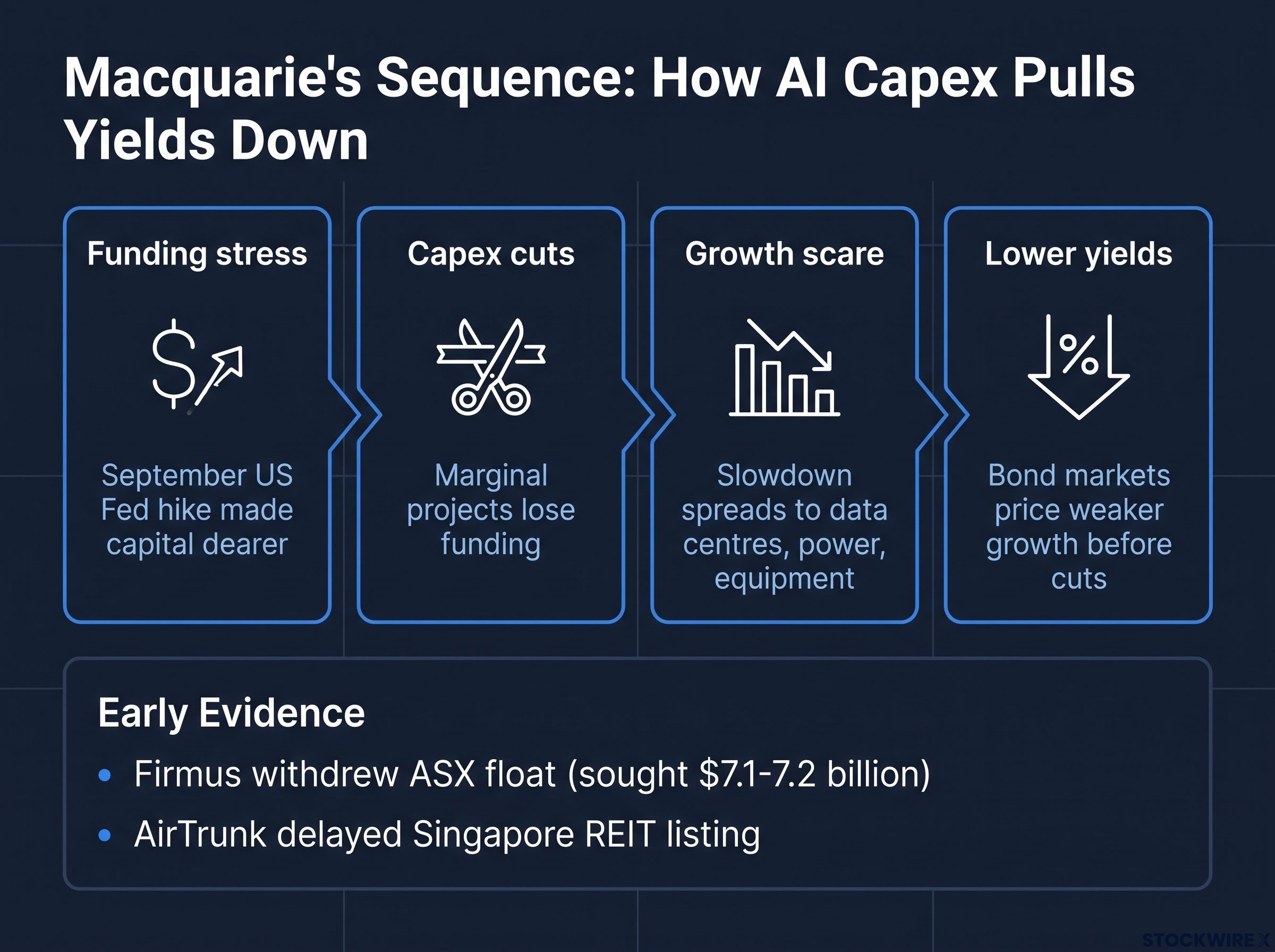
The early evidence is concrete. Firmus withdrew its ASX float, which had sought about $7.1-7.2 billion. AirTrunk reportedly delayed its Singapore real estate investment trust (REIT) listing, and credit spreads, the extra yield lenders demand over government bonds, widened on funding worries.
Macquarie’s core claim Macquarie expects AI investment to slow in 2027, triggering a global growth scare that drags bond yields lower ahead of any rate cuts, and it prefers profitable healthcare, real estate and infrastructure over debt-funded “neoclouds”.
These setbacks point to choosier lenders, not vanished demand. Morgan Stanley takes a more constructive view, estimating AI infrastructure investment could reach about US$1.4 trillion a year by 2028. The disagreement is about timing and funding.
Data already points to AI investment cooling in the growth rate, even as absolute data-centre spending rises, with widening credit spreads suggesting funding stress is building.
What this tells you is that the portfolio risk is wider than AI stocks. If the funding squeeze spreads, your exposure to construction, power, equipment and commodity demand matters just as much.
When big ASX news breaks, our subscribers know first
How do falling yields change sector performance?
To judge Macquarie’s call, you need to know why yields move share prices at all. Three mechanisms do most of the work:
- Discount-rate effect: lower yields raise today’s value of cash flows earned far into the future.
- Bond-proxy behaviour: steady, contracted or regulated income looks more attractive when government bonds pay less.
- Earnings resilience: healthcare and staples depend less on industrial activity, commodities and capex.
Why defensives benefit
Picture a toll road earning predictable income for decades. When bond yields fall, investors apply a lower discount rate to that income, so it is worth more today. At the same time, income seekers leaving bonds look for substitutes, and the toll road’s steady payout becomes one.
Not all bond-proxy defensives offer equal protection, since stretched valuations leave some utilities and staples names just as sensitive to yield moves as the growth stocks investors were trying to avoid.
The backdrop is moving that way. The Australian 10-year yield fell to about 5.22% on 15 October, according to the ABC, while the 3-year hit a five-week low of 4.81%. After the jobs data, markets priced under a 10% chance of a November hike and about 30% for December, down from about 60%.
Where the logic breaks down
REITs are messier. Falling yields lift their valuations, but heavy borrowing and refinancing costs can cancel that out. Resources and energy tend to lag in a growth scare because they hinge on commodity prices, industrial demand, China and capex.
There is a bigger catch. Yields are falling on growth fears, not because inflation has peaked, so they could climb again.
That tells you a defensive rotation is a bet on growth worries and stable credit, not on inflation being solved. Attach your risk accordingly.
What does the historical backtest say about sector rotation on the ASX?
Macquarie tested 12 episodes since 1990 in which the 10-year yield fell by more than 100 basis points (one percentage point), plus the year after the first cut across eight RBA easing cycles. Each sector was scored on an information ratio, a gauge that favours outperformance which is big and also steady.
Sort the results by stage and a pattern appears.
| Stage | Sectors that work | Sectors to avoid |
|---|---|---|
| Both stages | Banks, utilities, pharma and biotech, healthcare equipment and services, staples retail | Mining, materials, energy, capital goods, transport |
| Yields falling (fades after cuts) | REITs, consumer services | Telecom, insurance |
| After first cut | Cyclical retail, gold, financial services, technology; infrastructure borderline | Media, food and beverage |
The defensive core works throughout. REITs do their best work early, then hand over to cyclical retail, gold and technology once cuts begin. The avoid list is consistent across the whole easing period.
Timing still matters. Defensives have tended to outperform once markets believe the rate peak has passed and credit is stable, not necessarily in the first rush of a growth shock.
The 2008-09 lesson As credit seized, property and leveraged infrastructure sold off hard despite falling rates. Lower yields could not offset leverage and refinancing shocks until RBA easing took hold.
What this tells you is that owning a defensive sector is not enough. Match each sector to the stage of the cycle.
Which ASX large caps and small caps fit each stage of the rotation?
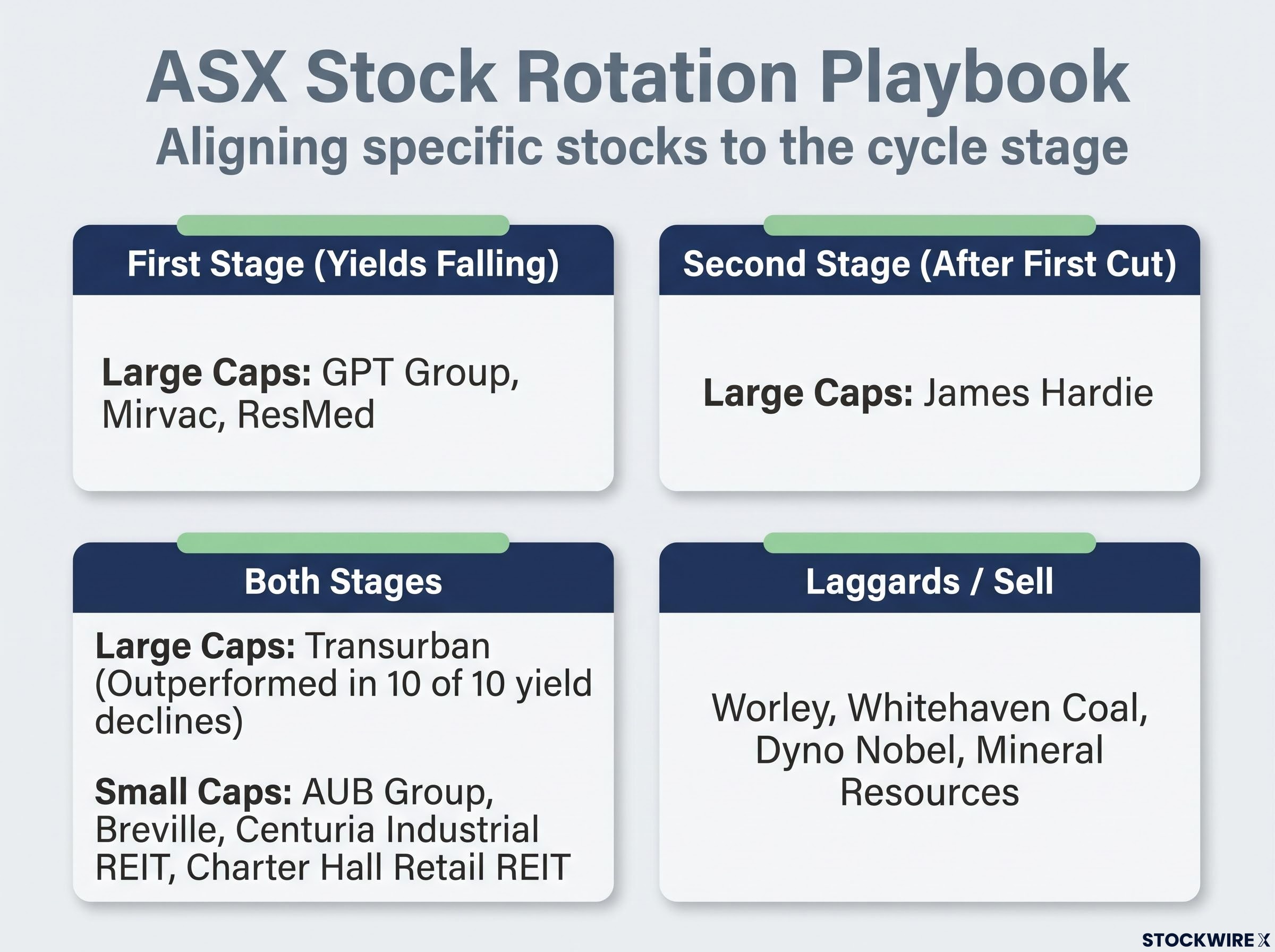
Macquarie’s stock picks follow the same timeline, with early names handing over to later ones.
Large caps: first stage and second stage
For the falling-yield stage, Macquarie rates GPT Group, Mirvac, ResMed and Transurban Outperform. Transurban is the strongest case: its median margin over the market was nearly 29%, it beat the market in 10 of 10 yield declines, and Macquarie says it can stay in a portfolio once cuts start.
GPT and Mirvac are earlier trades, since REITs tend to lose momentum once cuts arrive. Goodman Group should also be helped by falling yields, but its rising exposure to AI takes some of that benefit away. Recent commentary on ResMed, GPT and Mirvac was not available.
The handoff goes to James Hardie. It was top among ASX 100 stocks in the year after the first RBA cut, with lower US yields and mortgage rates helping its US housing exposure. Cyclical retailers follow as the pivot becomes clearer.
Neither stage is risk-free. Transurban reportedly posted June quarter net profit of $68 million against $180 million, and analyst views on James Hardie are mixed after weak guidance, though both data points are less verified. Macquarie accepts near-term downgrades for James Hardie and would use weakness to build a position.
Small caps
Large-cap industrials beat small industrials in both stages, because growth-scare downgrades can outweigh the help from cheaper funding. At the small end, quality and balance sheet strength do the heavy lifting. Property and infrastructure work first and continue after cuts.
| Stock | Cap size | Stage | Rationale |
|---|---|---|---|
| Transurban | Large | Both | Outperformed in 10 of 10 yield declines |
| GPT Group, Mirvac | Large | First | REITs gain as yields fall, fade after cuts |
| ResMed | Large | First | Outperform-rated healthcare exposure |
| James Hardie | Large | Second | Top ASX 100 stock after first cut |
| AUB Group, Breville | Small | Both | Outperform-rated quality names |
| Centuria Industrial REIT, Charter Hall Retail REIT | Small | Both | Property works first and after cuts |
This tells you which holdings could be early beneficiaries and which are later positions you might build gradually, even through weak earnings. These are Macquarie’s research calls, not personal advice.
Investors weighing GPT or Mirvac will find our full explainer on valuing ASX REITs, which stress-tests net tangible assets against a cap-rate shock.
What should you sell, and what could derail the rotation?
A rotation needs funding. Macquarie points to sectors that lag in both stages, several with AI buildout exposure:
- Worley, which had the worst ASX 100 result in the year after the first RBA cut
- Whitehaven Coal
- Dyno Nobel
- Mineral Resources
The risks deserve equal weight:
- Yields rising again on an inflation or energy shock, or another hike
- Sticky inflation, with Morgan Stanley’s stagflation view seeing RBA easing unlikely before 2027 (less verified)
- A continuing AI boom in line with the US$1.4 trillion estimate
- REIT leverage and refinancing if spreads widen
- Crowding into defensives, inflating valuations
- Backtest limits, given today’s different sector weights and AI-capex component
Some of the move may already be priced. Staples are up 18.4% year to date while Discretionary is down 7.5%. Morningstar also favours utilities, consumer defensives and healthcare, forecasting an average yield of 5.6% for its covered group (less verified).
Falling yields do not fix operations Earnings downgrades and company-specific problems can still hit favoured names, as Transurban’s profit decline and James Hardie’s guidance pressure show.
That tells you the rotation is a probabilistic tilt, not a certainty. Sizing and staging the shift matters more than one all-in move. Past performance does not guarantee future results, and these forward-looking views may change with market conditions.
Making the rotation call without overpaying for safety
Macquarie’s thesis only pays off if yields fall for growth reasons while credit stays stable. Stage matters as much as sector: REITs early, the defensive core throughout, cyclicals such as James Hardie after the first cut.
Before shifting weight, watch four signals: the next jobs print and RBA pricing, credit spreads, AI financing news after Firmus and AirTrunk, and inflation and energy prices. If two or more turn against the thesis, the case for leaning defensive weakens.
A sensible next step is to review your sector weights against the stage framework and consider general advice from a licensed adviser.
This article is for informational purposes only and should not be considered financial advice. Investors should conduct their own research and consult with financial professionals before making investment decisions.