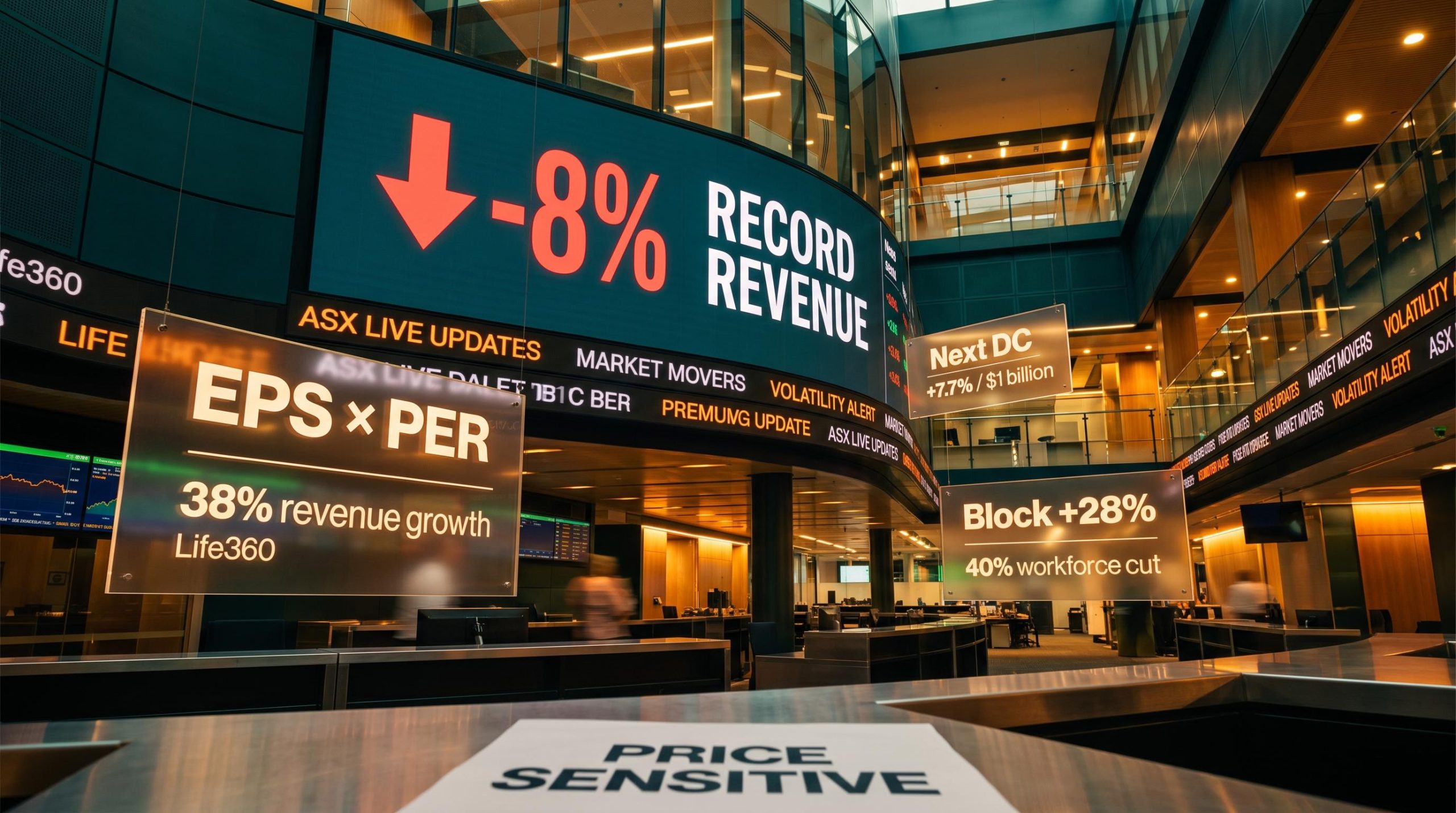
A company reports record revenue. The announcement hits the ASX. Within the hour, the share price drops 8%.
If that sequence makes no sense to you, you are reading the announcement the way most retail investors do: as a headline, not as an expectations adjustment. The disconnect between “good results” and “falling price” is one of the most common sources of confusion for self-directed investors, and it is not random. It follows a logic that, once you see it, changes how you interpret every announcement that crosses the ASX feed.
After this, you will know how to look at any ASX company announcement and ask the question that actually drives the price move: not “is this good news?” but “is this better or worse than what the market already expected?” That single reframe is the difference between reacting to headlines and reading the market.
The real question the market is asking when an announcement drops
Most investors start from a simple assumption: good news should push the price up, bad news should push it down. That assumption is wrong, and understanding why it is wrong is the foundation for everything else in this piece.
By the time a company lodges an announcement with the ASX, professional investors and analysts have already built detailed models forecasting revenue, earnings, margins and guidance. Those forecasts are not sitting in a drawer. They are embedded in the current share price. Every dollar the stock trades at already reflects what the market collectively expects the company to deliver.
The share price does not react to whether the news is good or bad in isolation. It reacts to the gap between the announcement and what was already expected. A company that reports 15% earnings growth sounds impressive in a vacuum. If the market expected 20%, that is a miss, and the price falls.
This means reading a headline result without knowing what the market expected beforehand is a structurally incomplete way to interpret a price move. Once you recognise this, you stop asking “was that a good result?” and start asking “was that result better or worse than what was already priced in?”
The expectations gap framework, drawn from Howard Marks and Aswath Damodaran, applies well beyond individual ASX announcements: it extends to entire sectors where crowded institutional positioning means that even genuinely positive developments fail to generate incremental returns because the optimism is already fully embedded in the price.
Why “beating expectations” is not always enough
Official consensus estimates, the ones compiled from analyst surveys and published on financial terminals, represent the formal benchmark. But sophisticated investors often operate on informal expectations that sit above the official number. These are sometimes called “whisper numbers”: the unofficial, higher bar that circulates among active market participants.
A company can beat the official consensus estimate while still falling short of the whisper number. The result? A sell-off despite the technical beat. The headline reads “Company beats expectations.” Your portfolio tells a different story.
When big ASX news breaks, our subscribers know first
The EPS x PER framework: why record profits can still mean a falling share price
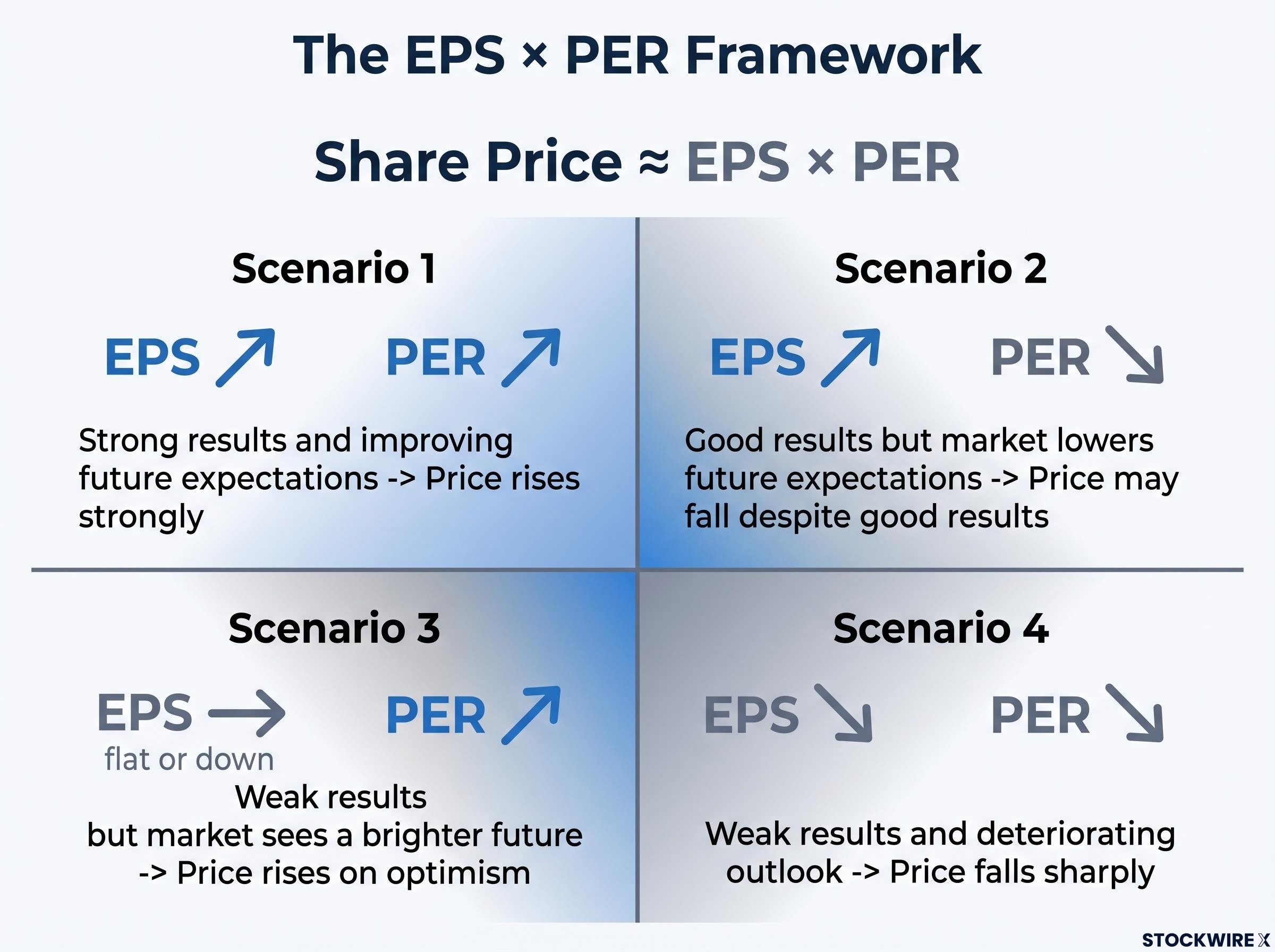
There is a simple but powerful equation that explains most of these counterintuitive moves. It works like this:
Share Price ≈ EPS × PER
Earnings per share (what the company has actually earned) multiplied by the price-to-earnings ratio (what the market is willing to pay for those earnings).
EPS, or earnings per share, is the backward-looking component. It measures what the company delivered. PER, or the price-to-earnings ratio, is the forward-looking component. It captures what the market believes about the company’s future growth, margins and risk profile.
The PER in the EPS x PER equation is itself a product of multiple share valuation methods, including DCF, EV/EBITDA, and comparable transactions, each of which can produce a meaningfully different implied multiple; when these methods diverge, the spread between them is often where the market’s uncertainty about a company’s future is most legible.
The key insight is that these two variables can move in opposite directions. A strong EPS result (the company earned more) can be completely offset by a fall in PER (the market now expects less about the future). The share price follows the product of both, not either one in isolation.
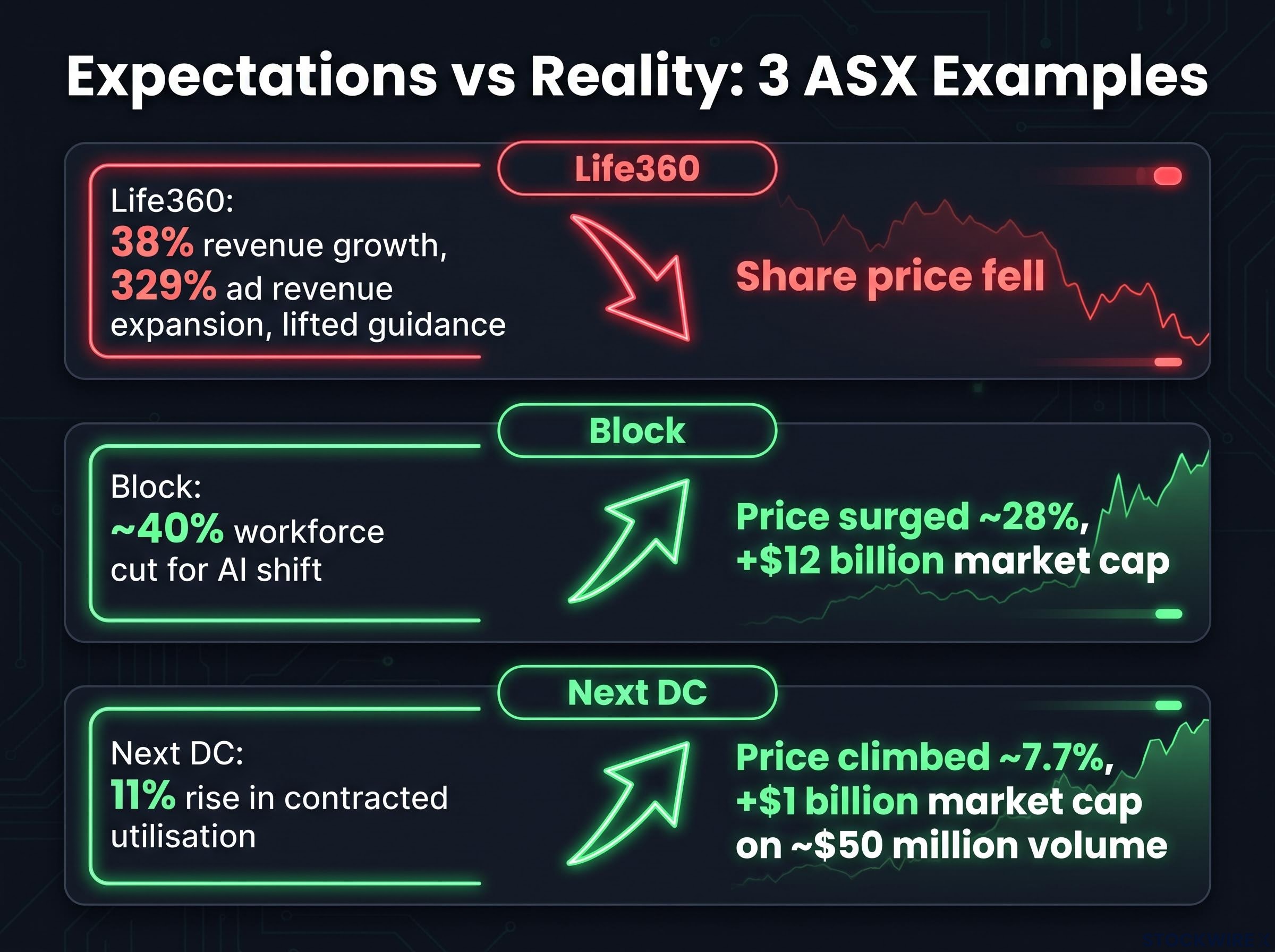
Life360 demonstrated this precisely. The company posted record revenue growth of 38% alongside advertising revenue expansion of approximately 329%, and lifted its guidance for the period ahead. Despite those figures, its share price fell on the day. The reported earnings were strong. But the market’s assessment of what was already embedded in the valuation, what the current PER already assumed about future growth, meant the strong numbers were not enough to justify the price the stock was already trading at.
| Scenario | What it means | Likely price direction |
|---|---|---|
| EPS up, PER up | Strong results and improving future expectations | Price rises strongly |
| EPS up, PER down | Good results but market lowers future expectations | Price may fall despite good results |
| EPS flat or down, PER up | Weak results but market sees a brighter future | Price rises on optimism |
| EPS down, PER down | Weak results and deteriorating outlook | Price falls sharply |
For every announcement you read, the question is not just “did the company earn more?” It is “what does this result imply about the company’s future trajectory relative to what the current valuation already assumed?”
Three ASX announcements that moved the market in ways most investors did not expect
The framework above is not theoretical. Here are three real ASX-linked examples from the past 12 months that only make sense through the expectations lens.
1. Block: layoffs that triggered a rally
Block cut roughly 40% of its global workforce, citing a shift toward AI-driven operations. Most observers would interpret that as a distress signal. Instead, investors saw it as a clear path to a leaner, more profitable cost structure, and the share price surged approximately 28%, lifting the company’s market capitalisation by around $12 billion. PER expanded because investors believed the cost base was about to shrink permanently, lifting future earnings power.
2. Next DC: four lines that added a billion dollars
Next DC published a brief customer contract update, just a handful of lines, disclosing that contracted utilisation had risen by 11%. The accompanying commentary noted that both capital expenditure and underlying earnings metrics were holding steady. Even so, the share price climbed approximately 7.7%, translating to a market capitalisation gain of close to $1 billion against roughly $50 million in trading volume. The announcement was small in absolute terms but massive relative to what the market expected from a routine operational update. It was a signal about future demand, not current earnings, and the PER expanded accordingly.
3. The size comparison that changes how you read percentage moves
A percentage move alone tells you very little without context. Consider two stocks from the same period: Net Wealth Group carried a market capitalisation of around $5.3 billion and saw its share price shift by 6-7% on trading volume of approximately $34-35 million. Vitrify Life Sciences, by contrast, had a market capitalisation of roughly $250 million and recorded an 8% move on only about $1 million in volume.
The percentage moves look similar. The market significance is completely different. The Net Wealth move reflected heavy institutional repositioning. The Vitrify move may have been driven by a handful of participants. When you see a percentage figure on the ASX feed, always check the market cap and volume behind it before drawing conclusions about what the market believes.
What ASX continuous disclosure rules mean for how announcements land
The pattern of sharp, sudden price moves around ASX announcements is not accidental. It is a direct product of regulatory architecture.
ASX Listing Rule 3.1, the continuous disclosure rule, requires listed companies to immediately disclose any information a reasonable person would expect to have a material effect on the price or value of their securities. That means major contract wins, earnings revisions, capital raisings, leadership changes and significant operational events must hit the market as soon as the company knows about them, unless a narrow confidentiality carve-out applies.
ASX disclosure obligations carry real enforcement weight: the Federal Court penalised Electro Optic Systems $4 million in April 2026 for a 14-week delay in disclosing a $48 million revenue shortfall, and ASIC is now pursuing the former CEO personally, a shift that changes the incentive structure around how quickly and completely companies surface material information.
- Major contract wins or losses
- Earnings revisions (upgrades or downgrades)
- Capital raisings or debt arrangements
- Leadership changes (CEO, board appointments)
- Significant operational events (regulatory decisions, asset impairments)
Companies lodging an announcement may flag it as price-sensitive, a designation that shows up as a dollar symbol on most ASX feeds to indicate the company considers the release capable of moving its share price. The ASX retains the authority to accept, remove, or override that classification regardless of what the company has indicated.
The ASX is home to around 2,000 listed companies, meaning the announcements feed can push out several releases within any given five-minute window. No individual investor can realistically track that flow manually, and the licensing cost for third-party access to structured ASX announcement data runs to approximately $50,000 annually, a barrier that gives institutional operators a meaningful speed and coverage advantage over most retail participants.
The information gap between institutions and retail investors
The announcements themselves are public. The speed at which different participants can surface, filter and interpret them is not. Institutional investors use data feeds, algorithmic filters and alert systems to identify price-sensitive releases in real time and assess their implications against existing models within minutes.
Third-party retail tools exist to help narrow this gap, but the core skill remains the same regardless of your toolset: learning to read the announcement itself critically. For smaller and mid-cap stocks with limited analyst coverage, fewer professionals are continuously updating models between announcements. When a genuinely material release lands, the price sometimes has to jump to find a new equilibrium. That creates both risk and opportunity for you if you can read announcements carefully and quickly.
How to read an ASX announcement before the market has fully priced it
Here is a six-step process you can apply to any price-sensitive announcement. It mirrors the sequence a sell-side analyst follows when a release hits their screen, and every step builds on the expectations framework covered above.
- Compare results to expectations. Did revenue, EPS or the key operating metrics beat, match or miss consensus? If you follow the stock, did the result beat or miss your own expectations? The Next DC example shows why this must be your first lens: a four-line contract win was small in isolation but massive relative to what the market expected from a routine operational update.
- Focus on guidance and forward-looking statements. Has the company raised, maintained or cut guidance for revenue, earnings, margins or cash flow? This is often the primary price driver on the day. The Life360 case, where strong results and raised guidance still produced a price decline, tells you the market was already pricing in something even more optimistic than what the guidance delivered.
- Examine margins and cash flow quality. Are gross and operating margins improving or shrinking? Is operating cash flow supporting reported profits? Strong top-line growth with deteriorating margins or weak cash flow is a red flag even in a “record results” announcement.
- Check what is conspicuously absent. Is a known risk or controversy not addressed? Are there missing details about key contracts, regulatory issues or litigation? Silence on important topics can itself be informative about management confidence.
- Look at the scale of the price move relative to market cap and volume. A 7% move in a large-cap, high-liquidity stock reflects a far bigger shift in market conviction than the same move in a thinly traded micro-cap. Compare the day’s turnover to typical volume.
- Consider sector and macro context. Sometimes a company’s strong results are overshadowed by negative developments in its industry or the broader economy: regulatory changes, interest rates, commodity prices. Sector-wide de-rating can drag down even strong performers.
The question is not “Is this good news?” The question is “Is this better or worse than what the market already expected?”
A reader who follows this process replaces an emotional, headline-driven reaction with a structured analytical one. That is the single most practical thing you can do to avoid the most common mistake self-directed investors make around announcement events.
What changes once you understand the expectations gap
Every counterintuitive price move covered in this piece, Block rallying on layoffs, Life360 falling on record results, Next DC gaining nearly $1 billion on four lines, follows the same logic. The market is not reacting to whether the news is good or bad. It is recalibrating to close the gap between reality and the expectations already embedded in the price.
Once you see announcement-driven moves this way, they stop being confusing. They become legible. And in smaller and mid-cap ASX stocks where analyst coverage is thin, the scope for mispricing around announcements is larger. A self-directed investor who reads carefully and knows what to look for has a genuine informational edge in that space.
Before the next announcement drops for any stock you follow, define your framework in advance:
- Know the 2-3 metrics that truly drive value for that company
- Set your own expectations for those metrics before the announcement lands
- Evaluate the result against your framework, not against the headline
That process turns you from someone who reacts to price moves into someone who can anticipate whether the market’s reaction makes sense. It will not make you right every time. But it will make you right for the right reasons, and that is where the compounding advantage sits.
For investors wanting to build the pre-announcement framework referenced in the final section above, our full explainer on earnings reports and pre-earnings decision plans covers the hold, trim, and wait criteria that remove reactive trading from the moment of maximum emotional noise.
This article is for informational purposes only and should not be considered financial advice. Investors should conduct their own research and consult with financial professionals before making investment decisions.