
Figma’s revenue grew 48% year on year in its latest quarter, the third straight quarter of faster growth. Yet the shares closed at $21.49 on 19 October 2026, roughly 35% below the $33 IPO price. Any serious Figma stock analysis has to start with that gap between a business that keeps accelerating and a share price that keeps sliding.
Two very different shocks shaped it. The first was the roughly 15-month regulatory limbo that ended Adobe’s roughly $20 billion takeover attempt in December 2023. The second was the “SaaS apocalypse” narrative that surged after Anthropic launched Claude Design on 17 April 2026.
One of those threats is finished. The other is still live. If you confuse the two, you risk pricing an old story into a current stock, or ignoring a real risk because the latest numbers look comfortable.
Here is a framework for judging whether Figma, and software companies like it, are exposed to AI substitution or protected by specialisation.
What did the failed Adobe deal actually leave behind?
Adobe announced the deal in September 2022. For the next 15 months, Figma operated as a company that might soon belong to its largest competitor, with regulators on three continents deciding its fate.
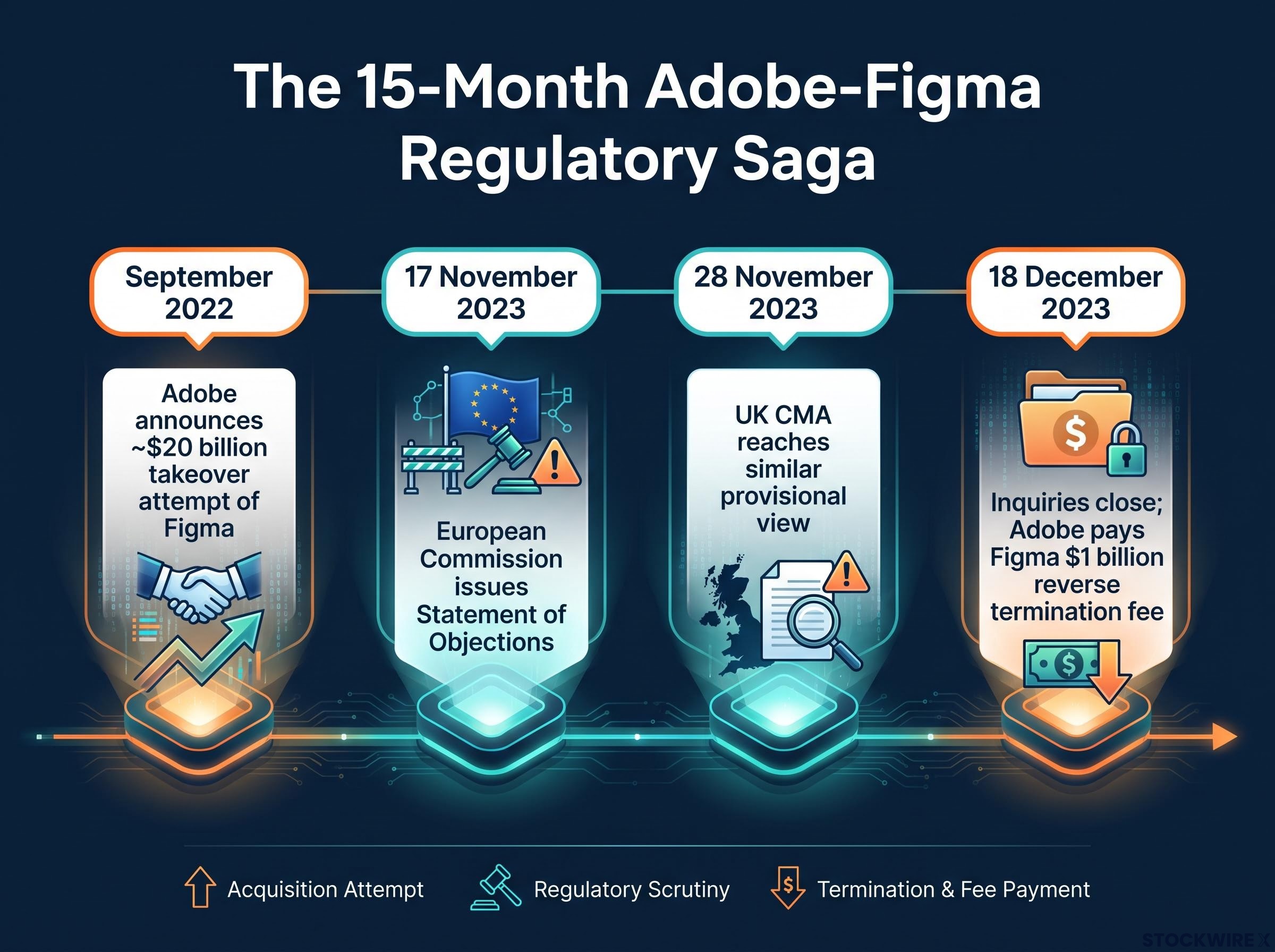
The decisive objections came from Europe and Britain. On 17 November 2023, the European Commission (EC) issued a Statement of Objections, a formal document setting out its preliminary competition concerns. The EC described Figma as the clear leader in interactive product design and Adobe as one of its largest rivals.
The European Commission statement on the termination confirms that regulators feared the deal would end current competition and prevent future rivalry, with large incumbents acquiring successful disruptive innovators at the centre of the concern. That is a point investors should weigh when judging Figma’s standing against incumbents.
The EC’s central concern The likely discontinuation of Adobe XD, Adobe’s own product-design tool, was flagged as a possible “reverse killer acquisition”: a buyer absorbing a rival and then shutting down its own competing product.
Eleven days later, the UK’s Competition and Markets Authority (CMA) reached a similar provisional view.
| Regulator | Date | Main finding |
|---|---|---|
| European Commission | 17 November 2023 | Deal could significantly reduce competition in interactive product design; flagged a possible “reverse killer acquisition” |
| UK CMA | 28 November 2023 | Deal would end competition between two principal rivals, reduce innovation and remove Figma as a threat to Photoshop and Illustrator |
| US agencies (FTC/DOJ) | 18 December 2023 | No separate published merits finding equivalent to the EC or CMA documents |
Both inquiries closed on 18 December 2023, when the companies said they saw no clear path to approval. Adobe paid Figma a $1 billion reverse termination fee. Inside Figma, the news landed at a noon all-hands on the first day of winter break, and the dominant mood was relief. Staff were offered several months of pay to leave, and few took it.
Co-founder and CEO Dylan Field still argues the review was misguided. In his view, regulators looked backward and defined the market too narrowly for an AI era, and prolonged limbo can be destructive in its own right.
Why the Amazon/iRobot comparison only goes so far
Field points to iRobot. Its Amazon deal collapsed in January 2024 after extended scrutiny, and the Roomba maker filed for bankruptcy later that year.
On the cost of limbo, the analogy holds. On outcomes, it breaks: iRobot faded, while Figma is growing at 48%.
What this tells you is that the uncertainty cost was a one-off and sits firmly in the past. It also tells you regulators saw Figma as a genuine threat to an incumbent. That is a very different claim from saying Figma is safe from new rivals.
When big ASX news breaks, our subscribers know first
How do you tell which software companies AI can actually disrupt?
Start with the plain question: what does “SaaS apocalypse” actually claim? SaaS, or software as a service, means software sold by subscription and delivered online. The apocalypse thesis says AI will stop assisting that software and start replacing it.
During the 2026 software selloff, investor thinking shifted from “AI as copilot” to “AI performs the workflow itself.” The fear was that frontier labs, the companies building the most advanced models, would move above the API layer (the plumbing that lets other apps use their models) and build finished applications. Claude Design looked like exactly that move, and Figma shares fell about 7% on launch day.
The useful test is whether a product handles a generation task or a team system-of-record task. A generation task produces a first draft. A system of record is the shared, governed place where a team’s work lives, gets reviewed and is tracked over time.
The durability argument rests on systems of record, since AI agents executing multi-step tasks still depend on authoritative, governed data held in incumbent platforms; that dependence is what a prompt-only first draft cannot replicate.
| More exposed software | More durable software |
|---|---|
| Simple, generic creation or productivity tools | Deeply specialised workflows |
| Main value is generating a first draft | Coordinates an entire production process |
| Weak proprietary data, low switching costs | Structured, accumulated customer data |
| Seat-based pricing where AI cuts users needed | Usage-based expansion or mission-critical volume |
| Easily reproduced through a model interface | Distribution, governance and collaboration advantages |
Claude Design attacks the generation side. Figma’s defence rests on the other column, through assets such as:
- Design systems and component libraries
- Permissions and access controls
- Review and approval workflows
- Version control and history
- Developer handoff
Field argues that model progress is easily mistaken for product progress, because professional tools take years of workflow refinement. He cites Cursor, the AI coding app, as proof that a specialised application can thrive despite competing with the very labs whose models it uses.
The portable lesson: screen any software holding by asking what would remain if a user could produce the first draft by prompt alone. If the answer is “very little”, the exposure is real.
Do Figma’s numbers support the AI scare or contradict it?
On the evidence so far, they contradict it. Q2 2026 revenue reached $370.1 million, up 48%, and net dollar retention (NDR) came in at 136%. NDR measures how much existing customers spend compared with a year earlier; above 100% means they are spending more.
| Metric | Q1 2026 | Q2 2026 | Guidance |
|---|---|---|---|
| Revenue | $333.4M | $370.1M | Q3: $373M-$375M |
| YoY growth | 46% | 48% | Q3: about 36% |
| Net dollar retention | 139% | 136% | Not provided |
| Full-year 2026 revenue | Raised guidance | $1.463B-$1.467B (about 39%) | |
That is not a revenue collapse. The April selloff looks like a repricing of valuation and sentiment, extending a slide that began after the stock closed its first trading day near $115.
Comfort only goes so far, though. Guidance implies growth slowing from 48% to about 36% in Q3, and retention slipped three points between quarters.
Cyclical versus structural readings
The cyclical reading says markets overreacted to a product announcement during broad de-risking, and the accelerating growth backs that up.
The structural reading says AI could permanently reduce the number of seats teams need, weaken pricing power and shift gross profit toward model providers. Figma sells largely by seat, and every AI feature adds inference costs, the expense of running a model each time someone uses it.
Both can be true at once. Near-term revenue can stay strong while the market discounts slower seat growth and thinner margins years out. For you, that means watching seat and margin trends rather than headline growth alone.
Bull case, bear case: where does the value in AI-era design software land?
Nobody serious argues AI is irrelevant to Figma. The fight is over who captures the money.
The real question Does value accrue to the frontier model companies, to application vendors like Figma, or to whoever controls the collaborative workflow and proprietary design data?
The views below come from the research but have not been independently verified, so treat the specific figures and positions with caution.
| Source | Stance | Core reasoning |
|---|---|---|
| Bank of America | Bullish, with conditions | Hybrid seat-and-usage pricing; about 8x estimated 2027 EV/sales |
| SaaStr / 20VC | Long-term bearish | Claude Design could take 20%-30% of some use cases over several years |
| Evan Armstrong, The Leverage | Bearish | Figma rents capability from labs that can attack its app layer |
| Seeking Alpha | Mixed | Solid fundamentals; concerns on valuation, insider selling and dilution |
| Findell report | Critical (activist view) | Governance concern over board resignation timing |
Note: attributions in this table are unverified.
Bull case
Figma becomes the control plane for AI-assisted product creation. Users generate far more designs, prototypes and code, but teams still need one governed, editable place to manage it. Bank of America reportedly values Figma at about 8x estimated 2027 enterprise value to sales (company value divided by expected revenue), above peers, on that expansion thesis.
Bear case
When a model can produce a working interface from a prompt, the canvas matters less. Figma keeps senior design teams but loses casual users, small projects and incremental seats. The Findell report raised concerns about the timing of Anthropic executive Krieger’s board resignation relative to the Claude Design launch, though it is an activist perspective rather than a neutral forecast.
The Figma-specific risks worth tracking:
- Seat-based pricing eroding as AI lets one person do several people’s work
- Dependency on model providers that also compete with it
- Inference costs squeezing margins if AI credits are underpriced
- Pressure from Adobe above and Canva in the mass market
- Valuation compression, insider selling and dilution
Field’s strongest argument is that Figma owns the collaborative workflow and structured design context. His weakest assumption is that those assets stay valuable if users increasingly build directly in code. Your view of Figma depends less on this quarter’s results than on whether you believe design data and collaboration stay necessary once AI generation is commonplace.
Investors exploring how pricing models are shifting will find our deep-dive into how AI is repricing the SaaS seat useful, including a barbell strategy for re-underwriting enterprise software positions.
What to monitor before judging whether Figma’s moat holds
The Adobe saga is resolved. The AI question is not. Right now, the operating data favours the business over the sentiment.
Four signals will tell you which way the balance tips:
- Paid seat growth, especially among non-designers
- Net dollar retention, after slipping from 139% to 136%
- AI-credit monetisation and its effect on gross margin
- Whether AI-generated output flows back into Figma’s collaboration layer
If seats and margins hold while AI usage rises, the cyclical reading gains weight. If they weaken, the structural bears are right, whatever the headline growth says.
This article is for informational purposes only and should not be considered financial advice. Investors should conduct their own research and consult with financial professionals before making investment decisions. Past performance does not guarantee future results. Financial projections are subject to market conditions and various risk factors.