
PolyNovo’s short interest is climbing again. Web Travel Group’s is falling. Both moves landed in the same week, and both tell you something specific about how professional short sellers are managing risk as the ASX heads into August reporting season.
Week 32 short interest data, sourced from ASIC daily short position reports as of 27 July 2026, captures more than two headline names. Rising bearish positioning spans retail, healthcare, property, and resources, while covering activity in a separate cohort reveals a mix of genuine exits and tactical pauses. The breadth of movement suggests institutional participants are actively repricing risk ahead of known catalyst dates, not drifting.
Here is what the data tells you: where professional bearish conviction is building, where it is retreating, and what Web Travel Group’s pre-catalyst cover teaches you about monitoring short interest ahead of upcoming results.
PolyNovo’s cautious bears rebuild after a painful squeeze
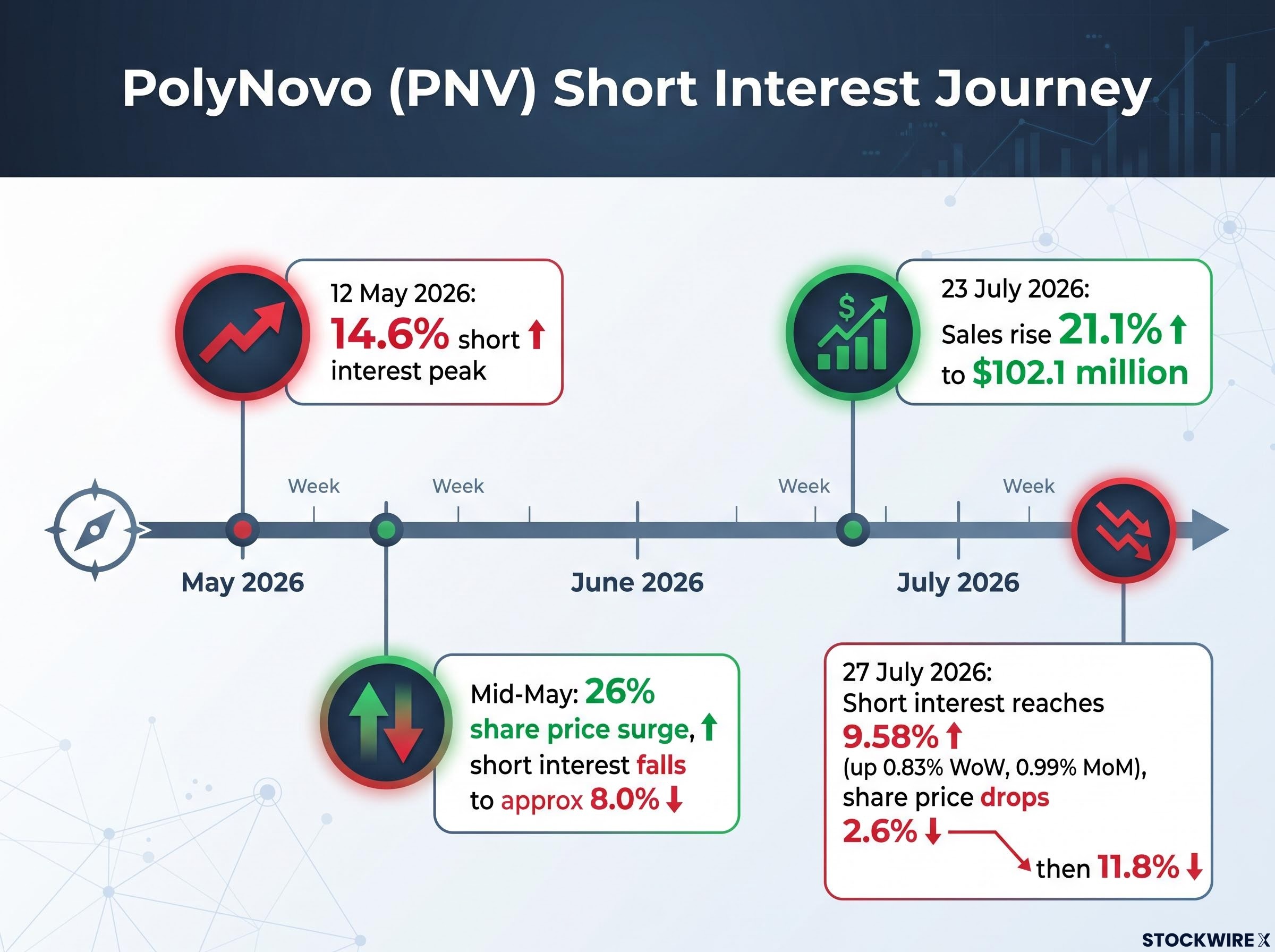
The arc matters more than the snapshot. PolyNovo (PNV) short interest had reached 14.6% by 12 May 2026, before a 26% surge in the share price across three sessions, driven by no discernible news, forced rapid covering and pushed the figure back to around 8.0% by late May.
That squeeze is still shaping how bears approach the stock.
PolyNovo’s May 2026 episode is the most recent live demonstration of how ASX short squeeze signals compound: a crowded position above 10% of issued shares, no material news, and thin daily liquidity created the conditions for a 26% three-session rally that forced rapid covering and reset the entire positioning thesis.
When the 23 July 2026 FY26 trading update arrived, it offered bears a fresh entry point. The result showed total group sales rising 21.1% to $102.1 million, falling short of consensus estimates, with the figures pointing to a deceleration in US sales through the second half of FY26 that sceptics had long anticipated.
The key data points trace the full journey:
- Short interest peak: 14.6% (12 May 2026)
- Post-squeeze low: approximately 8.0% (late May 2026)
- Current short interest: 9.58% (27 July 2026), up 0.83% week-on-week and 0.99% month-on-month
- Share price reaction to the FY26 update: lost 2.6% on the day of the announcement, with a subsequent drop of 11.8% across the two sessions that followed
PolyNovo shares shed 2.6% on the trading update day, with losses extending a further 11.8% across the next two sessions, reinforcing the fundamental disappointment behind the renewed bearish positioning.
The rebuild is real, but it is cautious. Bears are adding incrementally, not restoring the full 14.6% position in a single move. The May squeeze is recent enough to impose discipline. That tells you the stock can still move sharply in either direction on thin news. Short sellers here are trading the fundamental thesis with one eye always on squeeze risk, which keeps positioning tight and the stock volatile around any catalyst.
When big ASX news breaks, our subscribers know first
How Web Travel’s pre-catalyst cover turned into a validated risk call
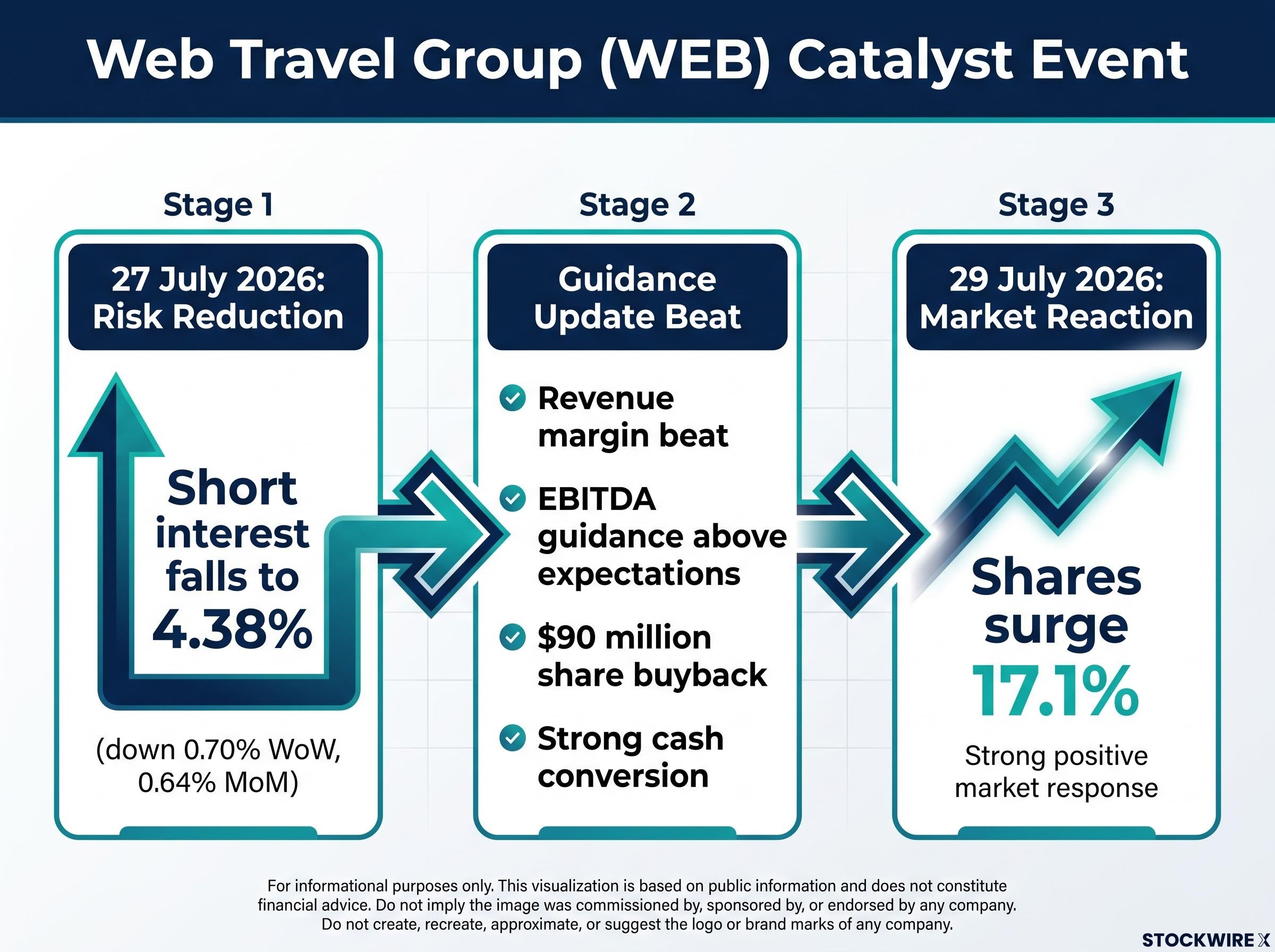
On 29 July 2026, Web Travel Group (WEB) shares surged 17.1% across a single trading session. The short sellers who had reduced exposure in the days prior avoided a painful loss. The ones who held their positions absorbed it.
The covering was visible in the data before the result landed. Short interest fell to 4.38% by 27 July 2026, down 0.70% week-on-week and 0.64% month-on-month.
The guidance update that drove the rally beat expectations across four dimensions:
- First-half revenue margin came in ahead of both the prior comparable period and what analysts had forecast
- The full-year EBITDA guidance range issued by management sat above what the market had been expecting
- Management announced an on-market share buyback of up to $90 million
- Cash conversion held up well relative to seasonal norms
Web Travel Group shares surged 17.1% in a single trading session on 29 July 2026, punishing remaining shorts but validating those who had closed positions ahead of the announcement.
The lesson is not that the short sellers who covered were prescient. They did not know the guidance would beat. What they did know was that a binary event was approaching, and that holding a short position into a potentially positive outcome carried asymmetric risk. They chose to reduce exposure, and the outcome happened to validate that decision.
The transferable principle for you is straightforward: monitoring short interest changes in the days before scheduled guidance updates and trading statements can surface useful signals about how institutional participants are pricing the risk of a binary outcome. A 0.70% weekly reduction, set against a 17.1% share price jump, illustrates why this component of pre-catalyst risk assessment is worth adding to your process.
What short selling data actually measures (and what it does not)
ASX short interest data, published via ASIC daily short position reports, measures the percentage of a company’s issued shares that have been sold short and not yet covered. It is a snapshot of open bearish bets at a point in time. It tells you where professional participants have committed capital against a stock. It does not tell you whether they will be right.
ASIC short position reporting requires disclosure of every on-market short sale regardless of size, a transaction-granular standard that makes Australia’s regime more comprehensive than US or UK equivalents, though the March 2026 Macquarie Securities penalty demonstrated how 15 years of misreported data can silently degrade the accuracy of the public dashboards that investors and fund managers rely on.
Three interpretive limits are worth keeping in mind as you read the sector data that follows:
- A rising short interest number does not mean a stock will fall. It means professional participants have increased their bet that it will, which can be right or wrong.
- Crowded shorts create squeeze risk. PolyNovo’s May 2026 squeeze from a 14.6% peak, which triggered a 26% share price rally, is the live example. Even a well-constructed short thesis can be painful to hold when positioning becomes crowded.
- Covering activity can reflect risk management rather than a change in fundamental view. Web Travel Group’s pre-catalyst reduction illustrates the distinction.
The ASIC data gives you a real-time map of where professional conviction is concentrated. Week 32 data is referenced as of 27 July 2026, with week-on-week comparisons covering 20-27 July 2026 and month-on-month comparisons covering 29 June-27 July 2026. Use the sector-level analysis that follows with appropriate weight rather than treating every rising short figure as a sell signal.
Where bears are building: retail, healthcare, property, and resources in focus
Rising short positions in Week 32 span at least four sectors, suggesting broad pre-reporting-season caution rather than a single thematic trade.
| Company | Ticker | Short % | WoW Change | MoM Change |
|---|---|---|---|---|
| PolyNovo | PNV | 9.58% | +0.83% | +0.99% |
| Stockland | SGP | 4.34% | +0.83% | +0.73% |
| Universal Store | UNI | 5.06% | +0.66% | +1.07% |
| Minerals 260 | MI6 | 5.78% | +0.63% | +2.21% |
| Nick Scali | NCK | 4.23% | +0.60% | +0.11% |
| Alcoa Corp | AAI | 1.65% | +0.57% | +1.12% |
| Alpha HPA | A4N | 5.83% | +0.55% | +0.20% |
| Sonic Healthcare | SHL | 7.21% | +0.50% | +1.19% |
Reading the sector themes behind the numbers
The retail cluster tells the clearest story. Universal Store’s 1.07% month-on-month build reflects growing scepticism around youth-focused discretionary spending as cost-of-living pressures intensify ahead of results. Nick Scali’s build was concentrated in the final week, consistent with its sensitivity to housing turnover and renovation activity. Both names sit squarely in the crosshairs of household budget pressure.
Healthcare positioning centres on post-pandemic earnings normalisation. Sonic Healthcare carries the highest absolute short level in the group at 7.21%, with a 1.19% month-on-month increase. The bearish thesis ties into broader scepticism about the sustainability of post-COVID pathology margins and volumes, a theme that extends to peers including Healius.
In property, Stockland’s rising short interest reflects ongoing concerns around the housing development cycle and affordability pressures. In resources, Minerals 260 stands out with the largest month-on-month build of any name in the cohort at 2.21%, while Alpha HPA’s short interest has reached a substantive level for a development-stage high-purity alumina player.
The clustering of rising short interest across retail and healthcare heading into reporting season tells you that institutional bearish positioning is concentrated in names most exposed to cost-of-living normalisation and post-pandemic earnings pressure. That is where results-season volatility risk is highest.
Post-earnings short positioning on the ASX frequently runs counter to the intuition that bears exit after a stock falls: across four case studies including Accent Group and Generation Development Group, professional short sellers added positions in the same week as the earnings-downgrade selloffs, treating the confirmed fundamental disappointment as a validated entry point rather than a signal to cover.
Where conviction is softening: the week’s notable covers
Not all covering is the same. The six names where short interest declined in Week 32 split into two distinct categories, and the distinction matters for how you interpret the signal.
| Company | Ticker | Short % | WoW Change | MoM Change |
|---|---|---|---|---|
| Web Travel Group | WEB | 4.38% | -0.70% | -0.64% |
| Elevra Lithium | ELV | 2.83% | -0.70% | -0.80% |
| Firefly Metals | FFM | 6.57% | -0.61% | +1.25% |
| Karoon Energy | KAR | 4.21% | -0.55% | +0.43% |
| PWR Holdings | PWH | 7.09% | -0.53% | -0.15% |
| AUB Group | AUB | 4.87% | -0.50% | -0.63% |
Clean exits versus tactical pauses
Elevra Lithium and AUB Group represent clean unwinds. Both show consistent weekly and monthly declines in short interest, with Elevra down 0.70% week-on-week and 0.80% month-on-month, and AUB down 0.50% and 0.63% respectively. These are bears walking away from a position, not pausing.
Firefly Metals and Karoon Energy are different. Firefly covered 0.61% this week, but short interest is still up 1.25% over the month. Karoon covered 0.55% this week, yet remains up 0.43% month-on-month. In both cases, the weekly de-risking has not unwound the broader monthly build. This week’s covering looks more like a tactical pause than a change of thesis.
PWR Holdings sits in between. The absolute short level of 7.09% remains high, but the gradual trimming, down 0.53% week-on-week and 0.15% month-on-month, suggests conviction is softening rather than a position being exited.
Firefly Metals and Karoon Energy are the two names in this cohort where this week’s de-risking does not resolve the bearish thesis. If you hold either stock, monitoring whether the weekly covering trend continues in Week 33 or reverses will help you gauge whether the bear case is being unwound or merely paused.
What Week 32 signals heading into reporting season
Three forward-looking signals emerge from the Week 32 data, and each applies directly to how you approach the August 2026 results season:
August 2026 reporting season arrives with an unusual tension: analysts are forecasting approximately 12% ASX 200 earnings growth, the strongest collective result in nearly four years, while investor sentiment has collapsed to the 95th percentile of all historical survey observations, creating the conditions where short sellers concentrated in retail and healthcare names may face sharper-than-expected covering events if results outperform a deeply pessimistic consensus.
- Squeeze risk in crowded positions remains live. PolyNovo’s current short interest of 9.58%, rebuilding from a May squeeze that punished bears with a 26% rally, demonstrates that heavily shorted stocks carry upside volatility risk around results, not just downside risk. Position sizing should account for this.
- Pre-catalyst short monitoring is a repeatable tool. Web Travel Group’s 17.1% single-session rally, preceded by visible short covering, illustrates why tracking short interest changes in the days before scheduled updates is a useful component of earnings-season risk assessment.
- Sector concentration points to where volatility risk is highest. Rising shorts are clustered in retail (Universal Store’s 1.07% month-on-month build) and healthcare (Sonic Healthcare’s 7.21% absolute level). These are the sectors most exposed to cost-of-living normalisation and post-pandemic earnings pressure, and where results-season surprises will generate the sharpest moves.
Firefly Metals and Karoon Energy warrant specific attention in subsequent short interest reports. Neither name’s weekly covering has resolved the net monthly build, and Week 33 data will clarify whether the bear case is being unwound or merely paused.
Short interest data is one component of a broader investment decision framework, not a standalone signal. Combined with fundamental analysis and price action, it provides a targeted map of where institutional bearish conviction is highest and where it is most vulnerable to rapid reversal, both of which should factor into your position sizing and timing decisions around the named stocks this reporting season.
This article is for informational purposes only and should not be considered financial advice. Investors should conduct their own research and consult with financial professionals before making investment decisions. Past performance does not guarantee future results.
The stocks and sector themes identified in this week’s data are the ones worth monitoring against their upcoming results dates. Not as definitive trade signals, but as context for interpreting share price moves when results land. Week 33 short interest data will update the picture, and reporting season itself will test whether the bears or the bulls had the better read.