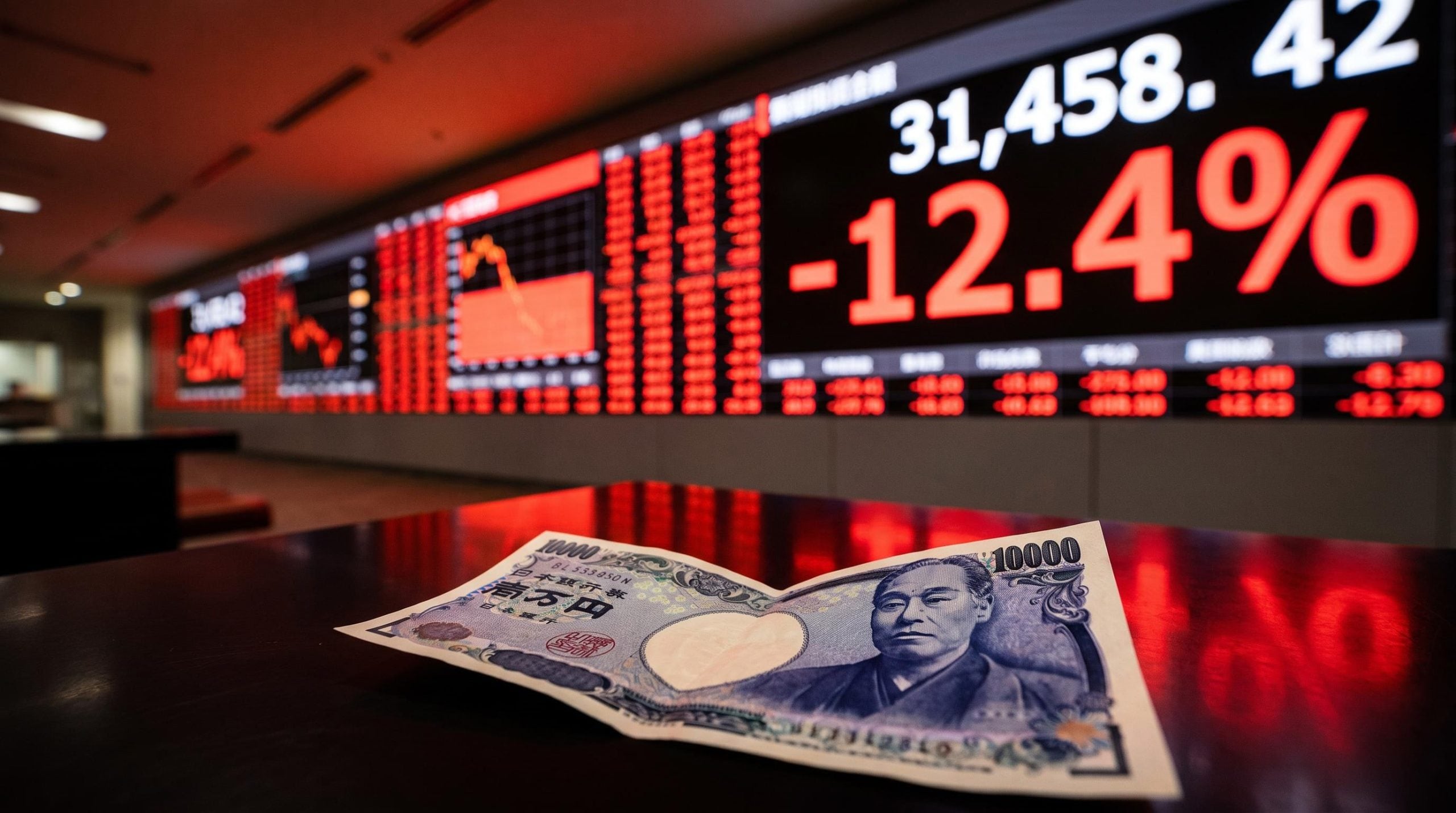
On 5 August 2024, the Nikkei 225 fell 12.4% in a single session, a drop of 4,451 points to close at 31,458.42. It was the index’s worst day since the 1987 Black Monday crash.
There was no war behind it. No banking collapse. No sovereign default. The trigger was a single central bank decision taken weeks earlier, and the manner in which it was delivered.
The Bank of Japan’s July 2024 rate hike was as much a communication failure as a policy choice. It exposed an underappreciated feature of modern monetary policy: in a world of deeply leveraged positioning, how and when a central bank moves can matter as much as the decision itself.
By September 2024, the BoJ had changed not just its rate path but its entire approach to signalling. What follows here unpacks how one surprise decision travelled through global markets, what the Bank learned from the wreckage, and what it means for how you should read central bank signals from now on.
The carry trade that made the July shock possible
To understand why a 15-basis-point move detonated global equities, you have to look at what had been quietly built around the assumption that Japanese rates would stay pinned near zero.
For years, near-zero Japanese interest rates made the yen the cheapest funding currency in the world. That gave rise to the yen carry trade, one of the most durable leveraged positions in global finance.
The yen carry trade mechanics that made August 2024 so destructive have not been dismantled by the BoJ’s subsequent tightening; a roughly 2.5-2.75 percentage point spread between Fed and BoJ policy rates continues to make yen-funded positioning structurally attractive despite the Bank’s highest rate since 1995.
The mechanics are straightforward:
- Investors borrow in low-cost yen, effectively paying almost nothing to fund the position.
- They deploy that capital into higher-yielding assets elsewhere: US Treasuries, emerging market debt, equities, anything offering a wider return.
- The profit is the spread between the near-zero borrowing cost and the yield earned, magnified by leverage.
- The whole structure is acutely sensitive to two variables: the BoJ’s rate trajectory and the USD/JPY exchange rate.
That sensitivity is the point. As long as the yen stayed cheap and the BoJ stayed still, the trade printed money. Any surprise on either front threatened the entire edifice.
Just how large the trade had grown
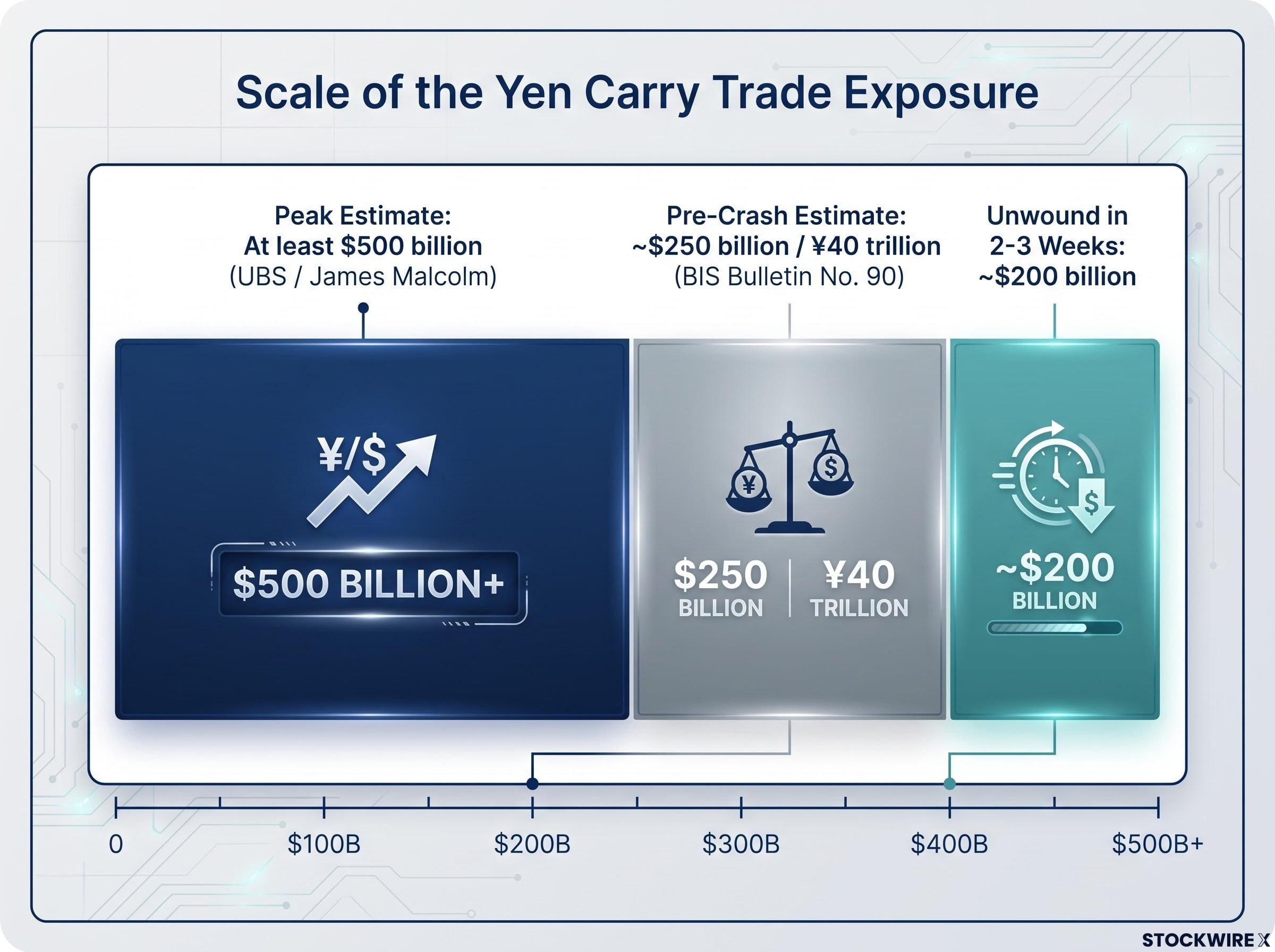
The scale is what turns a policy tweak into a market crisis. The Bank for International Settlements (BIS Bulletin No. 90, 27 August 2024) estimated outstanding yen carry positions at roughly ¥40 trillion, or about $250 billion, entering the episode, while cautioning that data gaps likely bias that figure downward.
The BIS put outstanding yen carry positions at roughly ¥40 trillion (approximately $250 billion) heading into the August 2024 unwind, a figure it warned may understate the true exposure.
UBS Japan macro strategist James Malcolm put the peak considerably higher, at least $500 billion, and estimated that around $200 billion was unwound in the two to three weeks following the policy shift.
Set that against expectations going in. Pre-meeting surveys showed only 24-30% of economists anticipated a July hike, with consensus favouring no change or an October move.
What that scale tells you is that the BoJ’s problem was never about managing expectations at a single meeting. It was about operating inside a system where any surprise carried asymmetric, amplified consequences. The Bank was not simply setting a rate in July 2024; it was pulling a pin from a structure global markets had assembled around its inaction.
When big ASX news breaks, our subscribers know first
How a single press conference became a market crisis
The decision itself looked modest. At its July 2024 meeting, the BoJ raised the short-term policy rate target from 0-0.1% to 0.25%, a move fewer than one in three economists had forecast.
Then the leverage did its work. The yen surged as carry positions were force-closed, and the currency move fed on itself.
The chronology matters because you can watch the communication failure compound in real time:
- The July meeting delivered a hike the market had not been prepared for, breaking the assumption of continued inaction.
- USD/JPY collapsed from around 160-162 in early July toward intraday lows near 141.68 by early August, a yen appreciation of roughly 10-14% in a matter of weeks.
- On 5 August 2024, the Nikkei 225 fell 12.4%, its worst single session since 1987, as forced deleveraging spilled from currency markets into equities.
- In October 2024, Deputy Governor Ryozo Himino acknowledged the Bank’s communication had fallen short ahead of the decision.
| Date | USD/JPY | Nikkei 225 | Event marker |
|---|---|---|---|
| Early July 2024 | ~160-162 | Elevated, near cycle highs | Pre-hike baseline |
| 5 August 2024 | Intraday low ~141.68 | 31,458.42 (-12.4%, -4,451 pts) | Crash day, worst since 1987 |
| Mid-August 2024 | Partial retracement toward mid-140s | Partial recovery | Unwind slows, ~$200B closed |
UBS estimated roughly $200 billion in carry trades were closed out in that two-to-three-week window. That is the transmission chain in full: an unsignalled policy decision, a leveraged unwind, and an equity crash, each stage amplifying the last.
Himino’s admission is not a footnote. When a serving deputy governor concedes there was insufficient explicit communication between board members and the market ahead of the hike, that is institutional confirmation the turbulence was, at least in part, self-inflicted.
The read you should take from that is a durable one. Weigh it against any future BoJ communication you encounter: the danger was not the destination but the absence of a map.
What carry trade mechanics mean for reading policy risk
The signal you actually encounter is rarely labelled “leverage risk.” It arrives as a rate change, or a sudden currency move, and the mechanics sit underneath. Understanding those mechanics is what lets you see why 2024 can happen again.
A carry trade profits under a specific set of conditions: the funding currency stays cheap and stable, and the target asset either appreciates or yields enough to cover the borrowing cost. Break either condition and the trade turns hostile.
The violence comes from how it unwinds. When the funding currency strengthens unexpectedly, leveraged positions must be closed quickly, and the exit itself pushes the currency higher, forcing more exits.
That is the amplification loop the BIS flagged, and it runs in three stages:
- An unexpected currency move (the yen strengthens) puts leveraged positions underwater.
- Those positions are force-closed, which means buying back yen, which strengthens the yen further.
- The stronger yen pushes more positions underwater, triggering another round of closures.
The BIS observed in Bulletin No. 90 that carry-trade deleveraging can violently amplify shocks, and that central banks must monitor how their guidance interacts with cross-border leverage.
This is why USD/JPY at 160 was never just a currency price. It was a signal about how much risk had been embedded in the global system through yen-funded positions, waiting for a trigger.
The asymmetry is the part worth internalising. Carry trades build slowly over months or years; they can unravel in days, as the $200 billion unwound in two to three weeks demonstrates.
What this gives you is a better first question. Instead of only tracking rate probabilities, ask what leveraged structures have been built around a central bank’s expected inertia, and how fragile they are to a surprise. That lens applies to any major central bank, not just Japan.
How the BoJ rewrote its communication playbook after August 2024
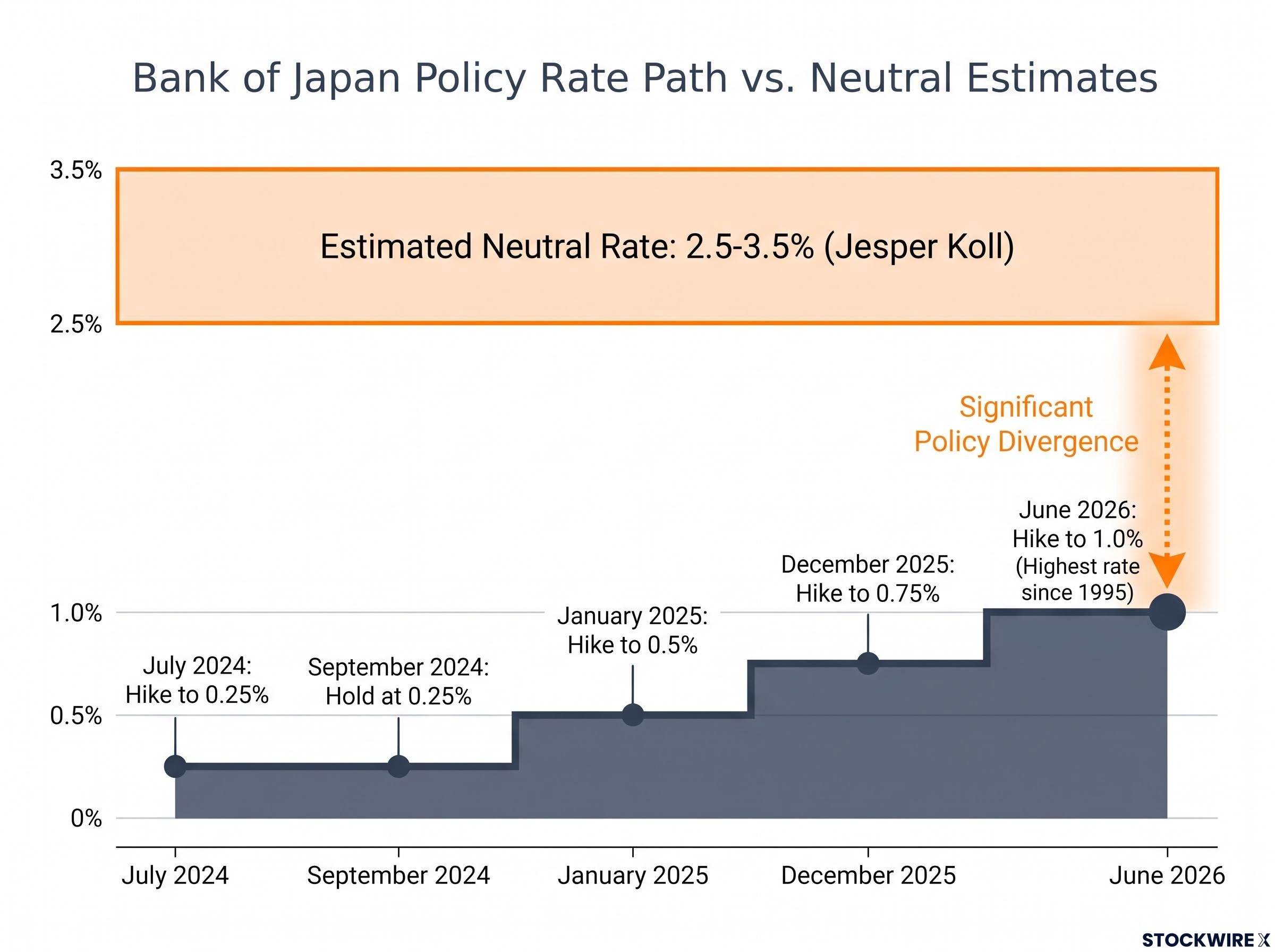
The response came fast. At its September 2024 meeting, the BoJ held rates at 0.25% in a unanimous board decision, with Governor Kazuo Ueda stressing there was “no rush” to hike in a 24 September speech in Osaka.
The restraint was notable given the backdrop. Q2 2024 GDP had expanded at an annualised 3.1% and inflation was holding near the 2% target, conditions that on paper argued for tightening. Ueda instead cited volatile markets and uncertain international growth.
The gradualist sequence that followed
What came next was not a pause but a doctrine: clearly telegraphed, incremental, and explicitly state-contingent tightening.
| Date | Rate decision | Communication signal |
|---|---|---|
| July 2024 | Hike to 0.25% | Surprise, no prior signalling |
| September 2024 | Hold at 0.25% | “No rush” framing, caution on volatility |
| January 2025 | Hike to 0.5% | Pre-telegraphed |
| December 2025 | Hike to 0.75% | Part of a gradual, expected sequence |
| June 2026 | Hike to 1.0% | Highest rate since 1995 |
The Bank formalised the shift in its 2024-2028 Medium-Term Strategic Plan, committing to multilevel engagement with markets to avoid a repeat of the July misstep.
BoJ forward guidance signals now carry more analytical weight than the headline rate decision itself, with Scotiabank strategists identifying press conference tone on the 2027 trajectory as the primary pricing catalyst at any given meeting, a direct institutional lesson drawn from the communication failure the Bank acknowledged after August 2024.
Whether that recalibration was wisdom or weakness divided observers, and the split is worth holding at equal weight:
- The International Monetary Fund (IMF) endorsed the gradualist approach in its April 2024 Article IV report and February 2025 staff statements, arguing clear, state-contingent communication and a measured pace were essential to limiting adverse asset-price reactions and international spillovers.
- Critics, including former US Treasury Secretary Scott Bessent by mid-2025, argued the Bank had effectively handed volatile markets a veto over tightening, risking a slide behind the inflation curve.
External estimates sharpen the second concern. Jesper Koll has suggested a true neutral rate closer to 2.5-3.5%, implying the current 1.0% may still represent meaningful accommodation.
The unresolved tension between market sensitivity and policy credibility
Here is the dilemma in its bare form. A central bank that adjusts its pace around market volatility risks having policy held hostage to sentiment; one that ignores volatility risks destabilising the system it is trying to normalise.
BoJ board members including Deputy Governor Shinichi Uchida and Hajime Takata signalled heavy reluctance to hike during periods of instability, which critics read as institutional risk-aversion rather than analytical discipline.
The renewed carry-trade risk is the live version of this tension. If the tightening path is too predictable and gradual, leveraged positions can simply rebuild, setting up the same dilemma under different macro conditions. The communication fix may have resolved 2024 while quietly seeding a future episode.
What the 2024 episode permanently changed about how markets read central banks
The lasting shift is not about Japan specifically. It is about the interpretive lens anyone following monetary policy now has to use.
Three durable lessons came out of the wreckage:
- Central banks must monitor cross-border leveraged positioning, not just domestic macro conditions. What is built around a rate is now part of the rate’s risk profile.
- The manner of communication is a policy variable in its own right, not a secondary consideration. How a decision is delivered can move markets as much as the decision.
- Overly predictable or rigid forward guidance can create the very conditions, carry-trade buildup, that make future communication failures more dangerous.
The third lesson has an unusual pedigree: the BoJ’s own research arm flagged it.
The BoJ’s shifting communication threshold is visible in Deputy Governor Himino’s explicit statement that the Bank does not need complete information before acting, a structural departure from the data-confirmation-first posture that governed the decade preceding the 2024 surprise and that directly addresses the forward guidance trap its own researchers identified.
Research from the BoJ’s Institute for Monetary and Economic Studies on “The Forward Guidance Trap” concluded that overly rigid guidance delays necessary lift-off and fosters policy errors.
That is the sharpest takeaway for you as a reader. A central bank can trap itself by making its inaction too legible, and you should apply exactly that lens to any central bank currently signalling a prolonged hold.
The BIS reinforced the institutional side, stressing that guidance must be assessed for how it interacts with cross-border leverage. The BoJ’s 2024-2028 Strategic Plan turned that principle into a commitment for multilevel market engagement.
The 2024 episode is now a reference point for other major central banks exiting accommodative stances, particularly where positioning has accumulated around expected inertia. The right first question is no longer only “what is the next move?” but “what has been built around the assumption of no move, and how fragile is it?”
The question the BoJ’s gradualism leaves open
By September 2026, the BoJ sits at 1.0%, the highest policy rate since 1995, reached through a clean, transparent, incremental sequence that has avoided a repeat of August 2024. On its immediate purpose, the communication reform appears to have worked.
The forward question is harder. With the rate still well below the 2.5-3.5% range some analysts, including Jesper Koll, estimate as genuinely neutral, and Daiwa and AMRO suggesting a terminal level above 1.0%, considerable accommodation remains embedded in the system.
The gap between 1.0% and estimated neutral is more than a statistic. It is a measure of how much latent carry-trade incentive still persists for anyone watching global leveraged flows.
The forward risks are worth keeping in view:
Leveraged amplification mechanisms of the kind the BIS documented in the yen carry unwind now extend beyond currency-funded positions: US geared ETF assets reached nearly $198 billion at mid-2026, with daily rebalancing mechanics that require these funds to sell into falling markets, adding a second structural layer of forced selling to any episode of sharp deleveraging.
- A remaining accommodation gap between current rates and estimated neutral.
- The yen’s continued status as a candidate funding currency for global carry trades.
- The IMF’s warning that predictable tightening can itself invite fresh positioning.
The IMF cautioned that a slow, predictable, and heavily telegraphed tightening cycle could ironically encourage leveraged yen carry positions to build up again, setting the stage for a future disorderly unwind.
The lesson of 2024 was never that the BoJ made one bad call. It is that any central bank whose inaction has been absorbed into a global leveraged structure faces a version of this risk. The question for you is which central bank, and which carry trade, is quietly building that structure now.
This article is for informational purposes only and should not be considered financial advice. Investors should conduct their own research and consult with financial professionals before making investment decisions. Past performance does not guarantee future results, and forward-looking statements are speculative and subject to change based on market developments.