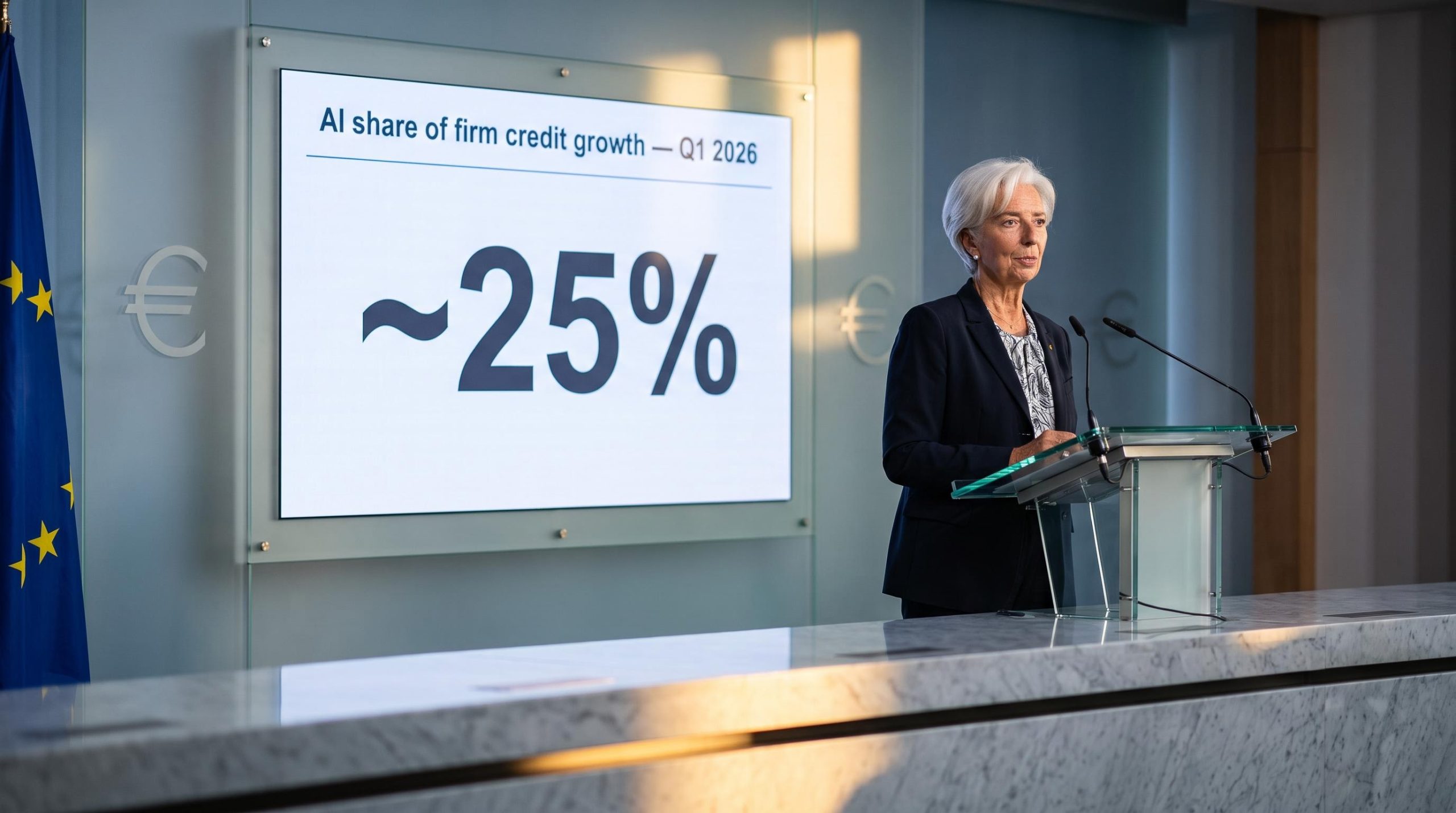
When the head of the European Central Bank puts a number on how much of Europe’s corporate borrowing is now going into artificial intelligence, that number deserves attention. On 28 September 2026, ECB President Christine Lagarde confirmed that AI-related borrowing already accounts for roughly a quarter of credit growth to eurozone firms.
That is not a forecast. It is not a pilot result. It is a Q1 2026 lending figure, which means AI has moved off the strategy deck and onto the balance sheet.
The same evidence picture holds a second, less-noticed signal. Firms investing most heavily in AI are, so far, more likely to hire than to fire. For anyone trying to read where eurozone capital is flowing and what it is doing to the real economy, those two findings sitting side by side are worth working through carefully.
This piece examines what the ECB’s data actually establishes about the AI Eurozone economic impact, where the numbers are provisional and should not be stretched, and what investors watching corporate capital allocation need to understand about the gap between today’s hiring signal and tomorrow’s labour-market risk.
A 10% slice of corporate investment and a quarter of credit growth: how large is AI’s footprint?
Start with the investment share. In her Vienna speech “A new age of capital: growth, sovereignty and AI,” published 14 September 2026, Lagarde put euro area firms on track to direct around 10% of total investment to AI in 2026.
Set that against the baseline. The ECB’s Survey on the Access to Finance of Enterprises (SAFE), published 2 February 2026, had firms planning to allocate an average of 9% of total investment to AI over the following year.
The move from 9% planned to 10% actual is small in isolation, but it points in one direction: AI spending is running ahead of even recent expectations. For anyone judging whether eurozone corporate credit demand is a passing cycle or a structural shift, spending that outpaces its own recent forecast is a mark in the structural column.
Then there is the more striking figure. AI-related borrowing made up roughly a quarter of the growth in credit to firms in the first quarter of the year, an ECB staff estimate Lagarde reaffirmed on 28 September 2026.
Lagarde, 28 September 2026: Euro area firms expect to devote around 10% of total investment to AI in 2026, with AI-related borrowing already accounting for roughly a quarter of credit growth to firms.
Why the credit figure carries more analytical weight than the investment share is straightforward. A budgeting intention says firms are planning for AI. Borrowing at scale says they are funding it with external money and expecting returns high enough to justify the debt.
That borrowing sits inside a longer capital story. According to the ECB Economic Bulletin focus box “From bricks to clicks,” published 31 March 2026 and drawing on Eurostat national accounts, intangible assets such as software, databases, and R&D accounted for around 80% of the cumulative expansion in business investment since Q4 2019.
| Metric | Figure | Source | Date |
|---|---|---|---|
| AI share of corporate investment (2026) | ~10% | Lagarde / ECB | 14 Sep 2026 |
| AI share of firm credit growth (Q1 2026) | ~25% | Lagarde / ECB | 14 Sep 2026 |
| SAFE planned AI investment share | 9% average | ECB SAFE | 2 Feb 2026 |
| Intangibles share of business investment growth (since Q4 2019) | ~80% | ECB Economic Bulletin | 31 Mar 2026 |
For investors reading eurozone credit markets, one category accounting for a quarter of new firm borrowing in a single quarter is a structural marker, not a seasonal wobble.
When big ASX news breaks, our subscribers know first
Who is actually investing, and how concentrated is adoption?
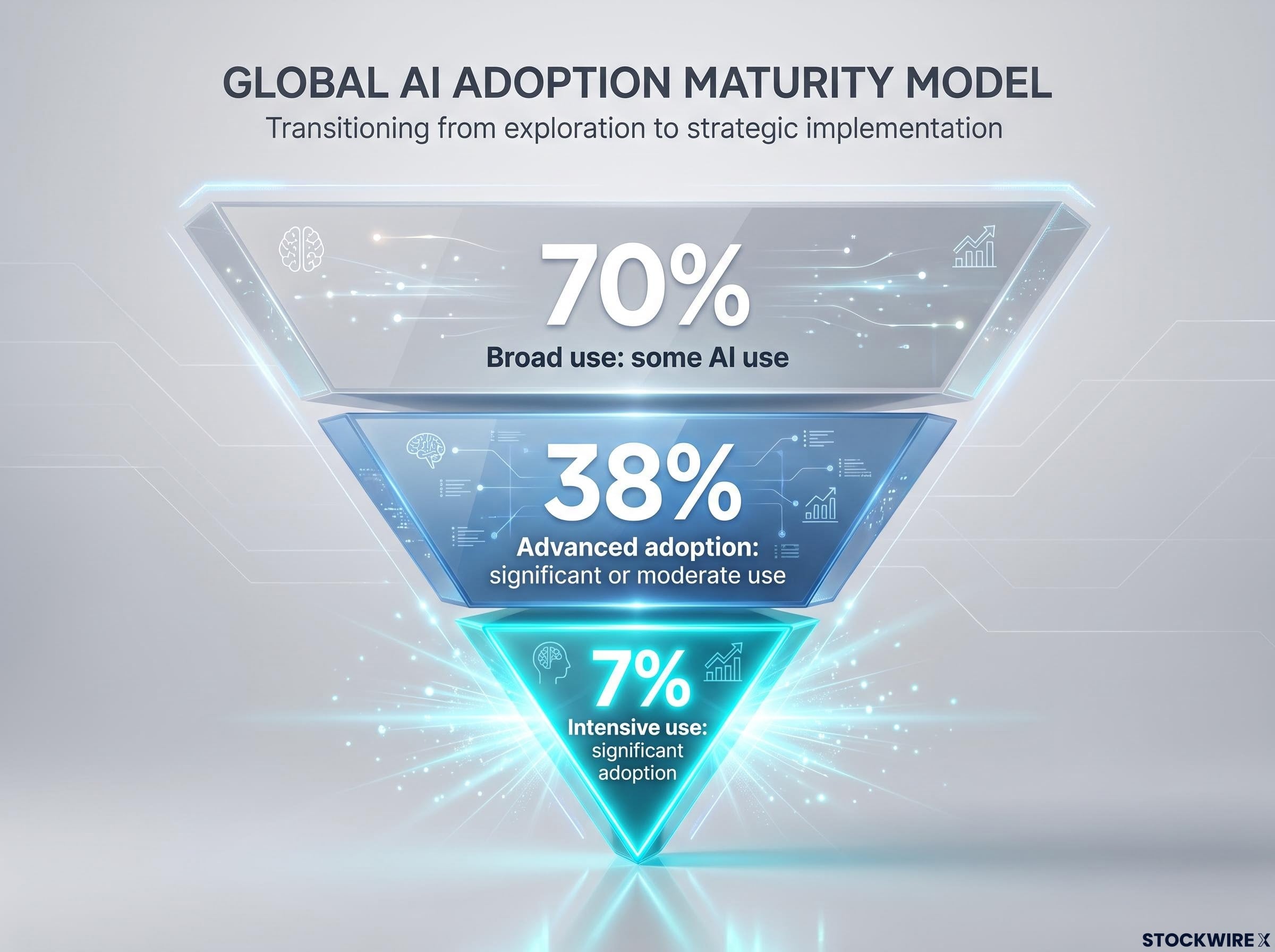
The headline adoption number looks reassuringly broad. The ECB Occasional Paper “Adoption and investment in AI across the euro area,” published 2 February 2026, found that around 70% of firms report some level of AI use.
Look one layer down and the picture narrows sharply. Only 7% classify their adoption as significant, a figure the ECB blog restated on 24 June 2026. Between those poles, the Economic Bulletin of 31 March 2026 placed 38% of euro area firms at an advanced stage of adoption, meaning significant or moderate use.
Three tiers, then, describe very different economic realities:
- Broad use: around 70% of firms report some AI use, much of it infrequent or token.
- Advanced adoption: 38% report significant or moderate use.
- Intensive use: just 7% classify their adoption as significant.
The gap between 70% and 7% is the analytical point of this section. The aggregate investment and credit figures from the previous section are being pulled upward by that small intensive cohort. Macro numbers can look robust while most eurozone firms remain in early or experimental stages, which means the strength of the signal and the breadth of the signal are two separate questions.
The gap between 70% broad use and 7% intensive use in the ECB data mirrors a pattern visible at the firm level: research across Gartner, McKinsey, and Forrester finds that only 12-20% of enterprises achieve meaningful operational embedding of enterprise AI adoption, with the remaining cohort generating surface-level deployments that produce little measurable ROI.
Where in the eurozone is AI adoption actually concentrated?
Adoption is not spread evenly across the map. The ECB Occasional Paper found it highest in the Netherlands, Finland, and Austria, and lowest in Italy and Ireland.
Banque de France research from 2026 sharpens the divergence with a concrete comparison. Some 39% of euro area firms report moderate or significant AI use, against just 23% of French firms, and French firms plan to direct 7.2% of investment to AI versus the 9.1% eurozone average.
The financing pattern helps explain the skew. The ECB Occasional Paper found AI use funded primarily through internal funds, complemented by grants and subsidised bank loans.
That mix tilts adoption toward firms that already carry balance-sheet strength, because internal funding rewards companies with liquidity, and even subsidised credit favours firms with the collateral and cashflow to access it. For anyone mapping AI’s footprint by country or sector, the exposure is real but concentrated by geography and firm size in ways the headline figures alone will not show.
What the ECB’s hiring data actually shows, and what it does not
The positive finding is genuine, and it is worth stating precisely before qualifying it. The ECB blog “Artificial Intelligence: friend or foe for hiring in Europe today?”, published 4 March 2026, found that firms making significant use of AI are about 4% more likely to take on additional staff, and firms investing in AI are nearly 2% more likely to hire than non-investors.
The hierarchy of findings runs like this:
- Significant AI use: linked to a roughly 4% higher likelihood of hiring.
- AI investment: linked to a roughly 2% higher likelihood of hiring versus non-investors.
- Central employment outlook: the SAFE survey reports median expected employment growth of 0% and average growth of about 1%.
- Sectoral split: Banque de France finds a positive AI-employment link in manufacturing and services, but no clear relationship in construction and trade.
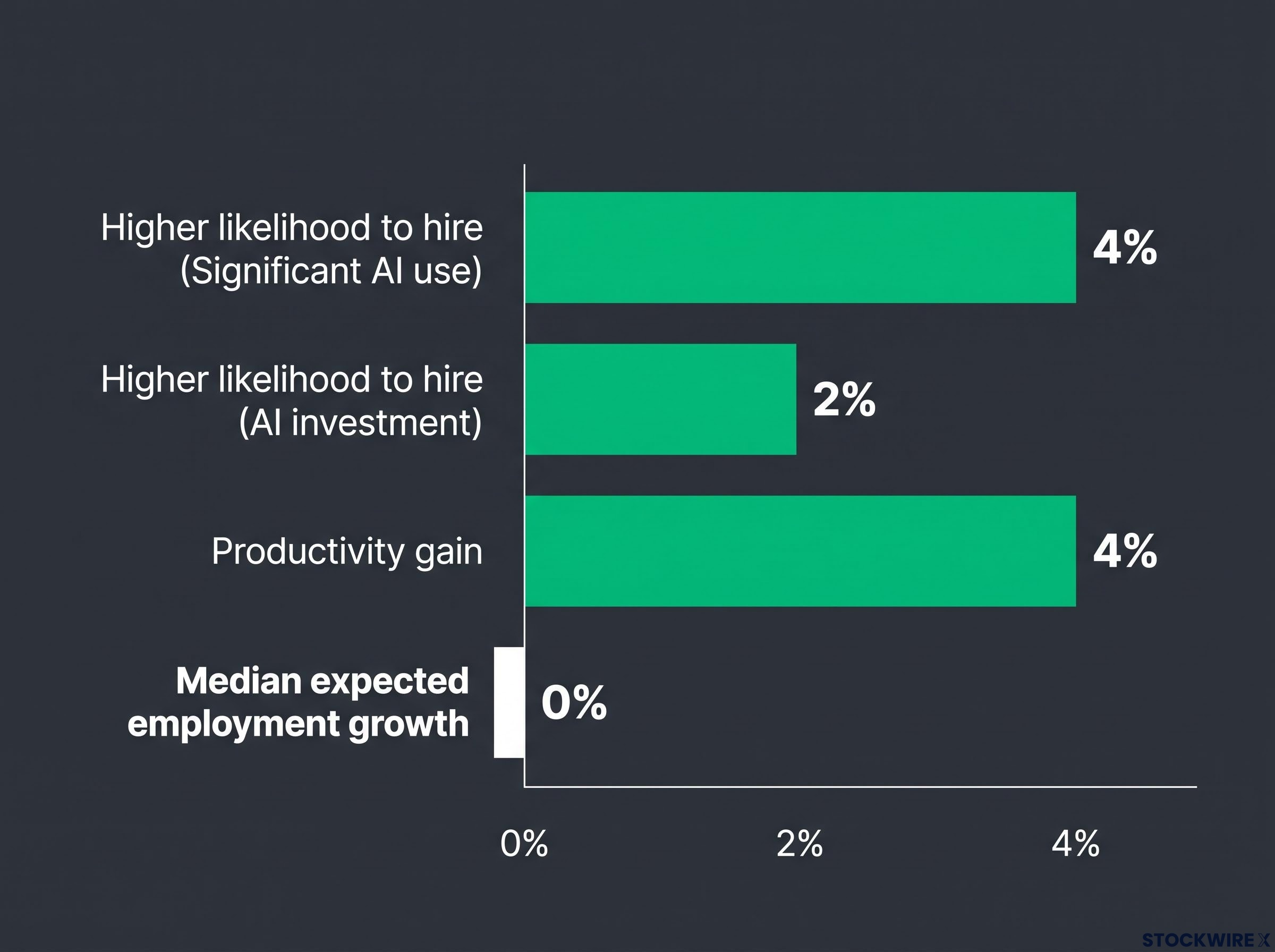
Now the qualification. That hiring premium sits on top of a central expectation of flat employment. Most firms, AI investors included, foresee little to no net headcount change, which reframes the premium as a modest tilt around a flat baseline rather than a broad expansion.
The type of AI use matters too. On 28 September 2026, Lagarde drew the distinction that firms adopting AI for research, innovation, and new products tend to be the ones hiring, while efficiency-focused deployment carries a less certain employment effect.
The complementarity signal the ECB finds in innovation-focused adopters is consistent with firm-level evidence elsewhere: PwC’s analysis of over one billion job postings finds the AI wage premium has compounded from 25% to 62% in two years, concentrated in sectors where AI raises worker output rather than substitutes for it.
Lagarde, 28 September 2026: Major technological developments, including AI, have not so far reduced employment levels overall, and firms adopting AI for research, innovation, and new products are more likely to hire.
Supporting evidence points the same way for now. A SUERF Policy Note of 7 May 2026 found roughly a 4% productivity gain from AI capital deepening in EU firm-level data with no adverse employment effect.
Here is the tension worth sitting with. The ECB speech “AI and the euro area economy” of 23 March 2026 cited survey evidence from the United States, United Kingdom, and Australia in which senior executives expect AI to reduce employment while employees expect it to increase employment.
The backward-looking data says no net loss so far. The people making the capital allocation decisions are not betting that holds. Anyone using today’s hiring figures to reason about AI’s long-run labour impact needs to hold both signals at once: the present evidence is more positive than the prevailing narrative assumes, and the expectations of decision-makers are not.
Five reasons the “no net job loss” finding should be treated as provisional
Employment survey data collected in the early years of a technology cycle has a built-in tendency to understate what comes later. The ECB’s own published caveats explain why, and they are worth reading as five independent limitations rather than a single disclaimer.
Each one constrains what the current evidence can establish on its own terms:
- Timing and measurement lag: The absence of large employment effects reflects an early deployment phase where firms augment existing processes rather than automate them, so displacement may appear only once systems are fully integrated.
- Sectoral heterogeneity: Banque de France finds no clear AI-employment relationship in construction and trade, meaning benign averages conceal industries where the effect is unclear or already negative.
- Firm-concentration selection effect: With only 7% of firms using AI intensively, positive correlations may partly reflect that high-growth firms both adopt AI and hire more regardless.
- Distributional impact: Adoption concentrated in the Netherlands, Finland, and Austria versus Italy and Ireland creates uneven exposure, so some occupations and regions can lose jobs even if the aggregate holds.
- Survey and expectations bias: The SAFE 0% median employment expectation and the executive-versus-employee divergence show these figures capture beliefs and correlations, not long-run causal outcomes.
Structural and distributional limits the aggregate data cannot see
Two of those caveats deserve separate weight because they describe things aggregate statistics are structurally blind to. The firm-concentration effect is the first. When the intensively adopting group is only 7% of all firms, a positive average tells you as much about who chose to adopt as it does about what AI did to their headcount.
The distributional point is the second. The ECB speech of 23 March 2026 warned of significant displacement risks for many occupations that have not yet materialised, and a neutral aggregate can sit comfortably on top of localised losses in specific occupations, sectors, and countries.
The distributional point maps onto a broader global pattern: Bank of America’s research on AI job exposure finds that high-income countries face 33.5% exposure versus 11% in low-income countries, a concentration that mirrors the eurozone’s own geography, where adoption is highest in wealthier, more capital-rich economies like the Netherlands and Finland.
This is the educational core of the analysis: a benign national average and real displacement in particular pockets are not contradictory. They routinely coexist during a technology’s diffusion.
The ECB researchers frame their own findings as conditional and reversible, contingent on adoption patterns, sectoral composition, and labour-market adjustment. For anyone building an investment thesis around AI’s eurozone impact, the distinction between a current observation and a durable structural outcome is exactly the nuance that separates a defensible case from an overreach.
What the capital allocation signal means for eurozone growth dynamics in the near term
Read forward, the current data configuration says something specific about the months ahead. Lagarde described the broader outlook on 28 September 2026 as surrounded by considerable uncertainty, with upside risks to inflation and downside risks to growth tied to energy-price and geopolitical pressures.
Against that cautious backdrop, AI-related credit demand stands out as one of the few clearly positive corporate signals. But the range of that signal is capped by structure, not just sentiment.
Lagarde, Vienna, 14 September 2026: Europe’s fragmented single market and limited capital markets constrain AI investment financing, because businesses rely heavily on bank credit rather than deep equity markets, and deeper integration is needed for Europe to compete in AI at scale.
That constraint matters for how far the credit-growth signal can extend. AI investment in the eurozone is flowing through bank balance sheets into intangible assets, the same category that already drives around 80% of business investment growth since Q4 2019, within a financial system that lacks the deep equity funding available elsewhere.
The financing constraint Lagarde identified compounds into a second-order problem: JP Morgan describes the r* impact on the euro area as modest or indeterminate absent significant catch-up in adoption, meaning the eurozone’s bank-credit-dependent AI investment pathway may widen the neutral rate divergence between it and frontier markets over the coming decade.
For readers positioning around eurozone corporate dynamics, three variables are worth watching from here:
- Adoption diffusion: whether intensive use spreads beyond the current 7% cohort into a broader firm population.
- Capital-market integration: progress on unifying Europe’s fragmented markets to widen AI financing beyond bank credit.
- Credit-growth trajectory: whether AI’s share of firm credit growth holds, rises, or fades after the Q1 2026 reading.
The near-term picture is more AI-influenced than most macro commentary allows. The transmission from concentrated firm-level adoption to broad productivity and employment gains, though, depends on structural conditions that are not yet in place, so the macro figures should not be read as evidence that a broad-based uplift is already arriving.
Reading the eurozone AI signal without overstating what the data can carry
Put the whole picture together and a single frame holds it. AI has crossed from experiment into a material driver of eurozone capital allocation, evidenced by the 10% investment share and the quarter of firm credit growth it now commands. That much the data settles.
What it does not settle is the labour-market verdict. The 4% hiring premium from the ECB blog and the 4% productivity gain from the SUERF note are the best current evidence, and they lean toward complementarity. Both sit against a 0% median employment expectation from the SAFE survey and an adoption base so concentrated that macro benefit is not yet broadly distributed.
The executive-versus-employee expectations divergence is the clearest tell that decision-makers themselves do not expect today’s pattern to persist unchanged.
Lagarde, 28 September 2026: The longer-term verdict on AI’s workforce impact, whether it primarily complements or replaces workers, remains unclear.
The ECB evidence, then, is better than the sceptics assumed and more conditional than the optimists are claiming. The institutions best-placed to track this story describe their own findings as conditional and reversible, and that is the position from which to read it.
This article is for informational purposes only and should not be considered financial advice. Investors should conduct their own research and consult with financial professionals before making investment decisions. Past performance does not guarantee future results, and these findings are speculative and subject to change based on adoption patterns, labour-market adjustment, and broader economic developments.