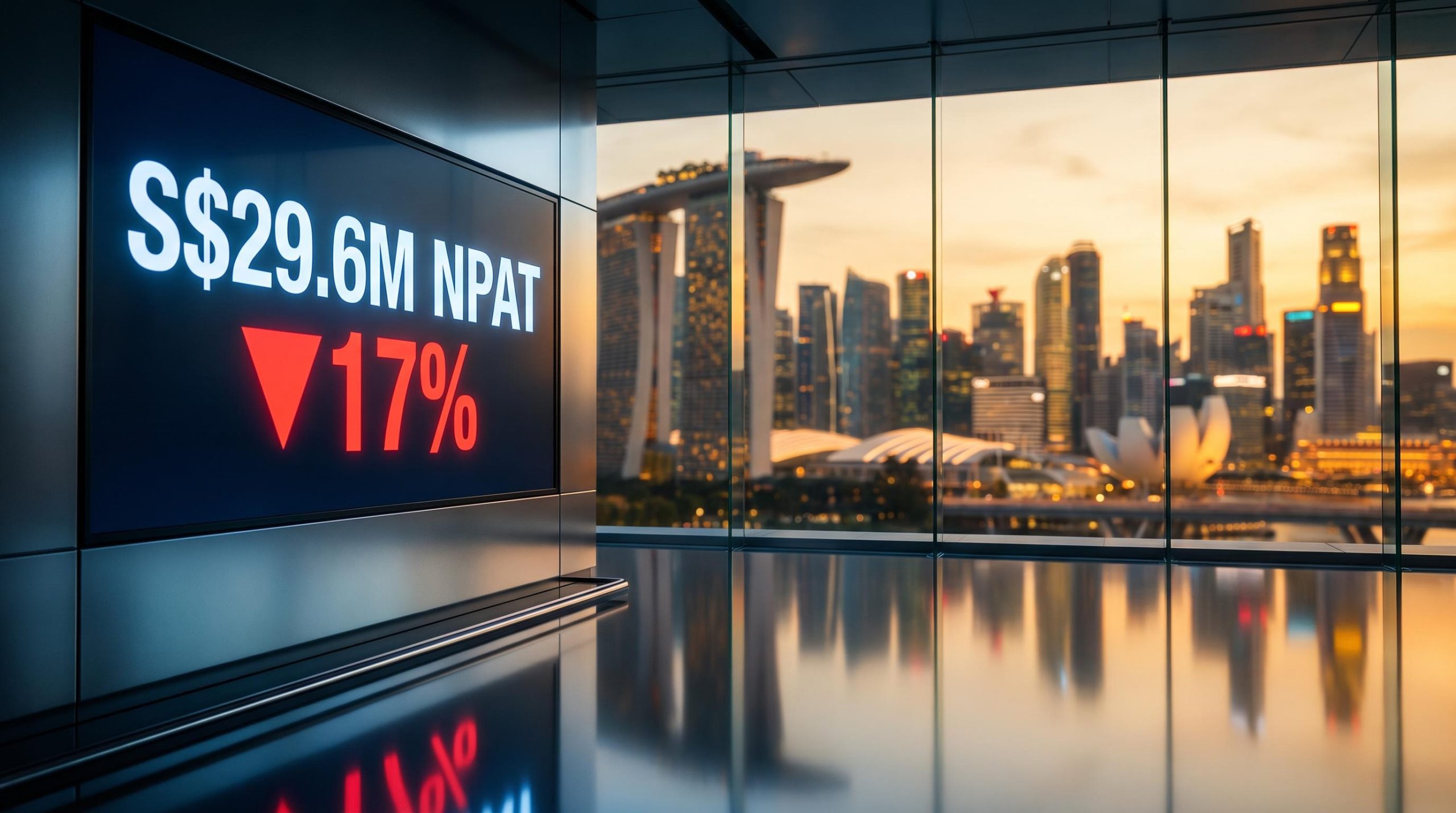
A company beat every analyst forecast on every metric that matters, then watched its share price fall roughly 17% on the day it delivered the news.
That is the puzzle at the centre of Tuas Limited’s (ASX: TUA) FY26 result, released today, 23 September 2026. The session itself read like a market arguing with itself: the stock opened around 6.8% higher, fell as much as 19% intraday, and finished near its 52-week low. That is not a mechanical selloff. That is investors actively weighing competing signals and deciding which one wins.
The stakes are concrete for Australian holders. Those who backed the $5.51 per share capital raise last year are now looking at a stock trading in the A$1.91-2.01 range.
This Tuas share price analysis works through each layer of the story in sequence, the earnings beat, the regulatory probe, the stranded cash, the historical precedents, and the contrarian broker call, so you can decide for yourself whether the market has overreacted or simply repriced Tuas for a risk it was always carrying.
The numbers that should have sent Tuas shares higher
Start with what the business actually did, because on the numbers alone this was a strong year.
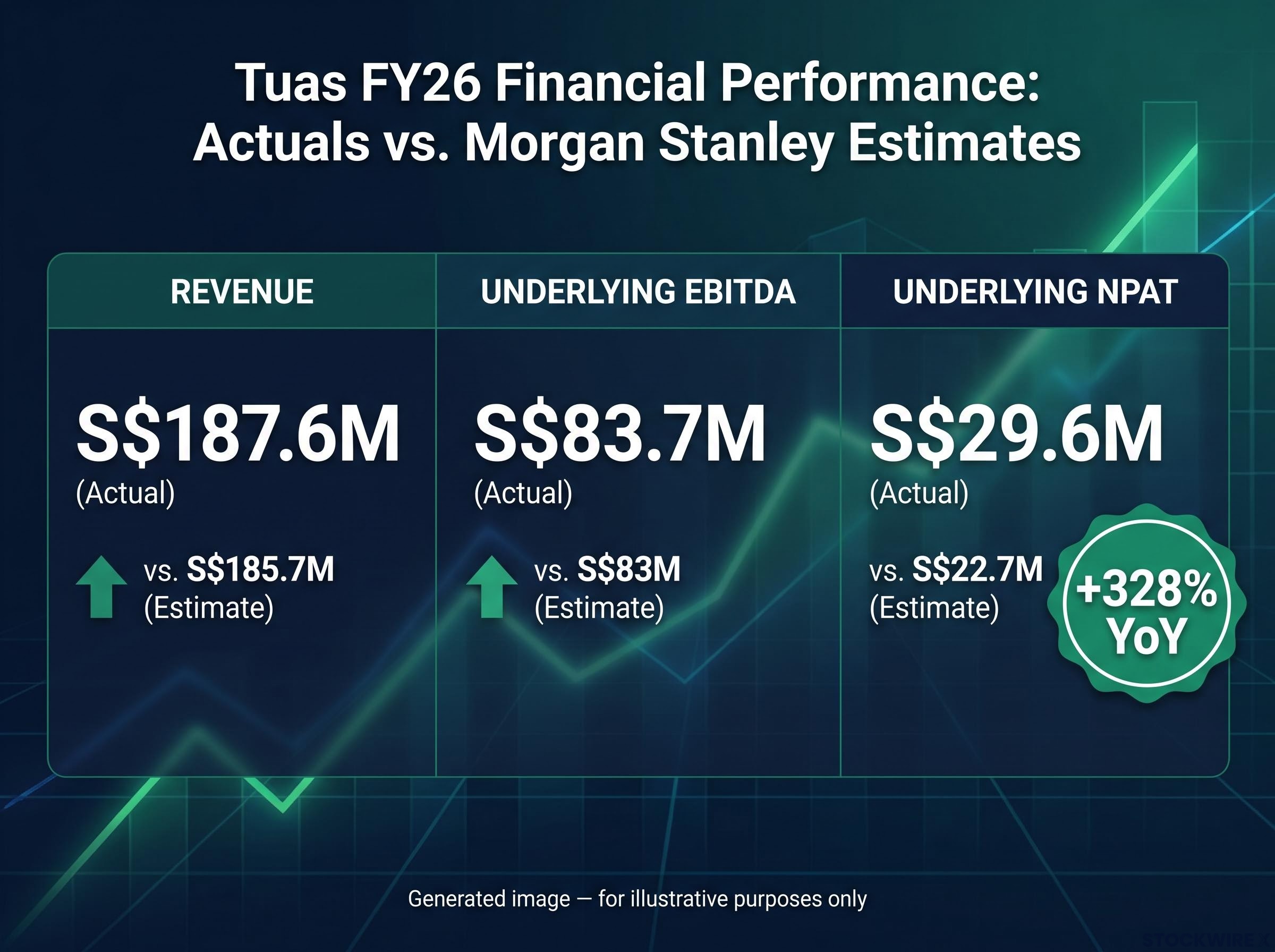
Full-year revenue rose 24% to S$187.6 million, clearing Morgan Stanley’s S$185.7 million forecast. Underlying earnings before interest, tax, depreciation and amortisation (EBITDA, a measure of core operating profitability) climbed 22% to S$83.7 million, edging past the broker’s S$83 million estimate, with the margin holding steady at 45%.
The profit line is where the beat turns from solid to striking. Underlying net profit after tax surged 328% to S$29.6 million, against a Morgan Stanley estimate of S$22.7 million.
That is not a rounding difference. That is a company clearing the analyst bar by roughly 30% on its most closely watched figure.
| Metric | FY26 Actual | Prior Year | Morgan Stanley Estimate | Beat/(Miss) |
|---|---|---|---|---|
| Revenue | S$187.6M | +24% YoY | S$185.7M | Beat |
| Underlying EBITDA | S$83.7M | +22% YoY | S$83M | Beat |
| Underlying NPAT | S$29.6M | +328% YoY | S$22.7M | Beat |
Subscriber growth and cash generation underpin the headline beat
The beat was not an accounting artefact. It was backed by operational reality across both product lines.
- Mobile revenue rose to S$167.5 million from S$144.6 million, with active mobile services up 16% to roughly 1.458 million and gross mobile average revenue per user (ARPU) at S$9.42
- Broadband revenue nearly tripled to S$19.7 million from S$6.4 million the year before, with fibre subscriptions reaching 62,000
- Net operating cash flow came in at S$91.3 million, ending the year with S$498.8 million in cash and term deposits as at 31 July 2026
That cash pile is partly the product of this operating strength and partly the residue of a capital raise, and the origin of it complicates the story considerably. Set that aside for a moment. On the income statement alone, a company generating this much cash and growing subscribers at this pace would ordinarily see its shares climb on results day. The explanation for what happened instead sits entirely outside the numbers.
When big ASX news breaks, our subscribers know first
Why the IMDA investigation is the only thing the market is pricing
The explanation is a regulator in Singapore, where Tuas operates its entire business through subsidiary Simba Telecom.
Singapore’s Infocomm Media Development Authority (IMDA) is investigating whether Simba used radio frequency bands not assigned to it to provide mobile services. If confirmed, that would sit at the intersection of the Telecommunications Act and the conditions attached to Simba’s Facilities-Based Operations (FBO) licence, the legal permission an operator needs to run its own network infrastructure. Tuas has not denied the underlying conduct.
“Simba has been co-operating fully with the IMDA investigation,” the company stated, acknowledging there appears to have been “intermittent use of some spectrum that Simba had previously been authorised to use, but only for specific purposes.”
That admission matters because the probe did not stay contained. IMDA suspended its review of Tuas’s proposed acquisition of M1 Limited because of the spectrum investigation, and without regulatory clearance the roughly S$1.43 billion sale and purchase agreement lapsed on 21 May 2026.
IMDA’s consolidation review had encompassed three distinct concerns, each of which the regulator treated as a reason for caution:
- Competition, given the deal would cut Singapore’s mobile market from four operators to three
- Public interest across M1’s mobile and broadband networks
- Cybersecurity obligations tied to critical information infrastructure
The market’s reaction to all this was not subtle. On 18 May 2026, when IMDA signalled it would suspend the M1 review, Tuas shares fell roughly 63% in a single session.
That collapse is the tell. It shows that investors have always treated regulatory jeopardy as the dominant variable in the Tuas story, not subscriber growth or cash flow. Today’s selloff on a forecast-beating result is simply consistent with that established pattern.
The IMDA suspension of the M1 review on 17 May 2026 was the event that crystallised the regulatory variable into a share price fact, collapsing the stock roughly 63% in a single session and establishing the pattern of regulator-first pricing that persists today.
Here is what the unresolved status means for you. As of late September 2026 there is no determination, no penalty, and no timeline for resolution. That void is not neutral. It prevents any strategic clarity on cash deployment, M1 alternatives, or licence security, which means the overhang compounds with time rather than fading. Tuas has already set aside up to S$30 million for enhanced cybersecurity obligations, a sign the regulator can impose real costs before it ever issues a formal ruling.
What a stranded half-billion dollars tells you about strategic paralysis
Now look at what has not happened, because that is where the deadlock becomes visible.
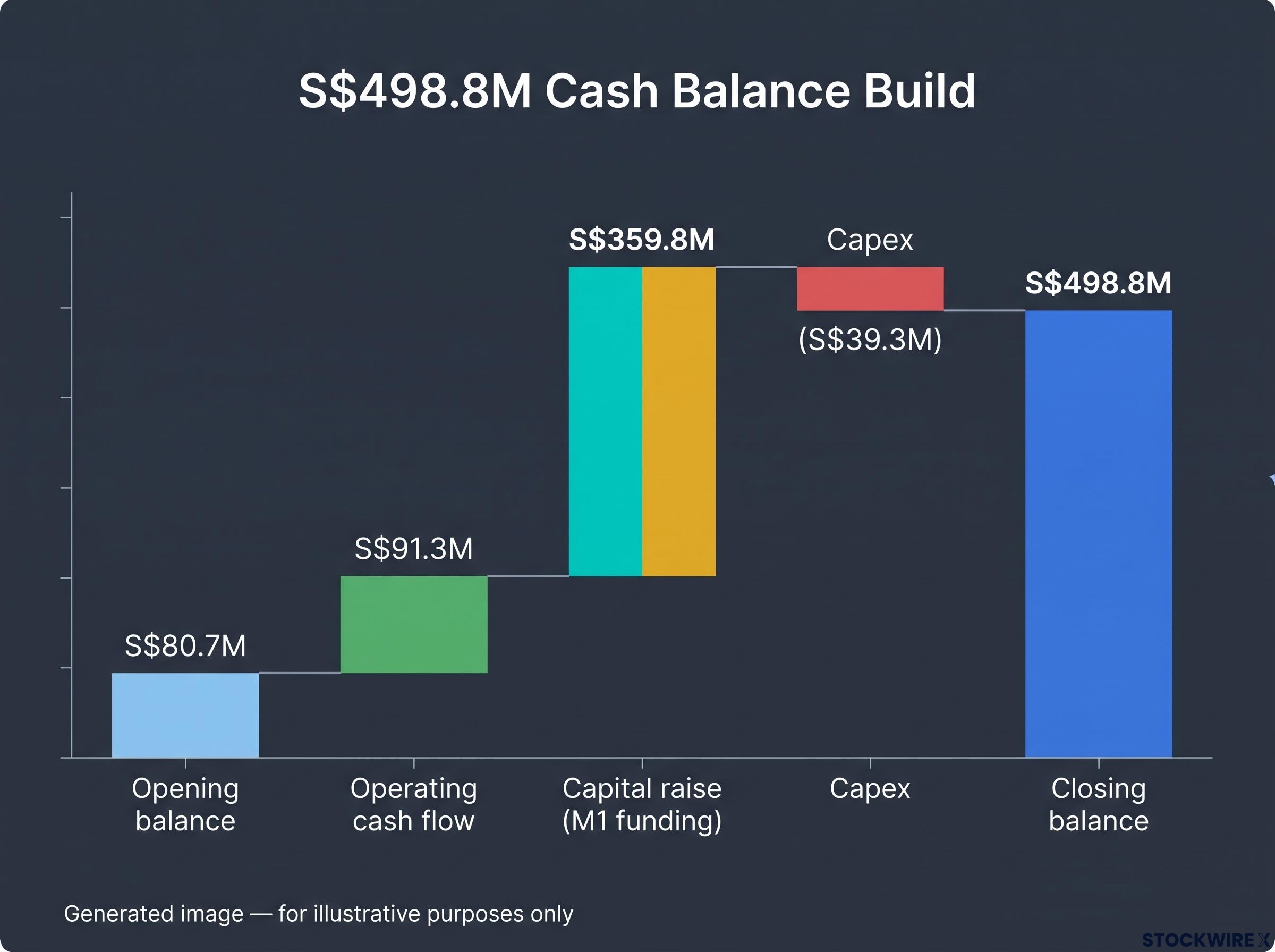
The S$498.8 million cash balance did not appear by accident. It was assembled from a S$80.7 million opening position, S$91.3 million of operating cash flow, and a S$359.8 million capital raise struck at $5.51 per share, less S$39.3 million of capital expenditure. Critically, that raise was conducted for one purpose: funding the M1 acquisition that no longer exists.
The M1 deal termination on 21 May 2026 discharged both parties from their contractual obligations cleanly, with no litigation indicated, but left the IMDA investigation as a fully separate and unresolved proceeding that continues to define the investment risk today.
| Source/Use | Amount (S$M) |
|---|---|
| Opening balance | 80.7 |
| Operating cash flow | 91.3 |
| Capital raise (M1 funding) | 359.8 |
| Capex | (39.3) |
| Closing balance | 498.8 |
For now, that cash is strategically inert. Management has not declared a dividend, continuing a pattern of no distributions stretching back to at least FY22, and has announced no buyback, special distribution, or alternative acquisition target. Chairman David Teoh has explicitly deferred commentary on how the money will be used until IMDA provides clarity.
The gap between what that capital was worth and what the market now values it at is stark.
Capital raise price: $5.51 per share. Current trading range: roughly A$1.91-2.01.
For the investors who funded that raise, the arithmetic is brutal, and it makes the deadlock tangible. The thesis they bought into, scale through consolidation, has evaporated, leaving them holding a stock worth around a third of what they paid.
So here is the question you have to sit with. Is the S$498.8 million genuine balance sheet strength, or a liability that keeps Tuas in suspended animation until regulators move? It is arguably both. It is the most attractive feature of the investment case and the clearest signal of strategic paralysis at the same time, and how management eventually deploys it will define the next phase of the share price far more than any quarterly beat. Weighing on that decision is a further S$15-30 million of cybersecurity spend flagged for FY27.
How regulators have reshaped telecom M&A before, and what it means here
Tuas is not the first cash-rich operator to have a consolidation deal taken off the table by a regulator. Two well-known cases show how these situations tend to unfold, and what typically follows.
In 2011, AT&T’s attempt to acquire T-Mobile USA was blocked by the US Department of Justice and the Federal Communications Commission on competition grounds. AT&T walked away, paying a large breakup fee that included cash and spectrum. T-Mobile took those resources, invested heavily in its network, repositioned as a challenger brand, and eventually became a formidable third player.
The lesson from that outcome is instructive for anyone assessing Tuas now: a blocked deal is not the end, but recovery depends on redeploying the freed-up capital into organic growth rather than waiting.
In 2016, CK Hutchison’s plan to merge Three UK with Telefónica’s O2 UK was blocked by the European Commission, which judged that moving from four operators to three would harm competition. The market stayed fragmented, and regulatory scepticism about four-to-three mergers persisted for years.
| Case | Year | Regulator | Stated Concern | Outcome |
|---|---|---|---|---|
| AT&T/T-Mobile USA | 2011 | DoJ, FCC | Competition | Blocked; T-Mobile pivoted to challenger strategy |
| Three UK/O2 | 2016 | European Commission | Four-to-three competition | Blocked; market stayed at four players |
| Tuas/Simba-M1 | 2026 | IMDA | Competition, public interest, cybersecurity | Review suspended; deal lapsed 21 May 2026 |
The parallel to Singapore is direct. IMDA’s review spanned competition, public interest, and cybersecurity, the same integrity concerns that drove blocks in the US and UK.
What that pattern tells you as an investor is about time. In neither international case did resolution arrive in days or weeks; these situations played out over months and years. The companies that recovered best pivoted early and rebuilt trust with the regulator rather than waiting for clarity to appear. If Singapore follows form, regulatory certainty on Tuas is unlikely to arrive on a quarter-by-quarter schedule, which has direct implications for how patiently you would need to hold.
Morgan Stanley’s contrarian bet and the conditions that would prove it right
Against that backdrop, one institutional voice is leaning in.
As of 14 September 2026, Morgan Stanley held an Overweight rating on Tuas and indicated a willingness to add exposure on price weakness. The core of the thesis is a valuation argument.
Morgan Stanley noted the stock was trading at roughly 4x estimated FY27 enterprise value to EBITDA, against a historical average near 3.4x, describing that as undemanding even under an adverse regulatory scenario.
The logic is that the market has already priced in a bad outcome, so a benign resolution would represent upside rather than the reverse. The FY26 beat, actual NPAT of S$29.6 million against the broker’s S$22.7 million estimate, lends weight to the view that the operating business is intact.
The bull case is real, but it rests on a chain of events the company does not currently control:
- IMDA closing the investigation without a material penalty
- Some form of cash redeployment, whether an acquisition, buyback, or return of capital
- Continuation of the subscriber and revenue momentum FY26 demonstrated
The bear case is equally specific:
- An adverse IMDA determination, such as a penalty, licence modification, or operational restriction
- Prolonged strategic paralysis on the stranded cash
- Any deterioration in the operating metrics currently underpinning the fundamentals
What Morgan Stanley’s Overweight tells you is that at least one sophisticated institutional investor believes the market is overcorrecting on regulatory fear. What it cannot tell you is whether the conditions the bull case depends on will actually occur, because Tuas does not control most of them. That is the honest constraint to hold alongside the rating. With the shares near the 52-week low of A$1.91, the contrarian call is that the fear is overdone, not that the risk has passed.
What has to change before Tuas is priced on fundamentals again
Pull the threads together and the picture is clear. Tuas’s operating business is genuinely strong. The market is not pricing that business. The entire gap between the two is composed of the IMDA investigation, the stranded S$498.8 million, and the absence of a growth narrative to replace the M1 deal.
For the market’s frame to shift from regulatory fear back to operational value, three things need to happen, and in roughly this order:
- IMDA concludes the investigation. Any outcome, even an unfavourable one, provides more certainty than the current void.
- Management makes a credible cash redeployment decision. Organic reinvestment, a new acquisition, or a capital return would each give the stranded cash a purpose.
- Two or three consecutive quarters reassert organic growth. Continued subscriber and revenue gains would rebuild the standalone growth story, and management has flagged intent to grow EBITDA through new product introductions in Singapore.
Satellite-based competitive pressure on established mobile operators is a separate but compounding variable for any telecom rebuilding a standalone growth thesis; the economics of direct-to-cell services remain structurally dependent on terrestrial partnerships, which limits near-term displacement risk for Simba’s Singapore subscriber base.
Be clear-eyed about what remains unknowable. The timing and severity of the IMDA determination, whether management chooses reinvestment, acquisition, or return of capital, and whether Singapore’s regulator would ever permit another consolidation attempt, none of these can be answered from public information today. The S$15-30 million cybersecurity headwind flagged for FY27 is one of the few forward costs that is already visible.
Tuas is not uninvestable on the fundamentals. But acting on those fundamentals today requires either a high tolerance for regulatory uncertainty or a firm view on when and how the IMDA situation resolves, and that view simply is not available yet. With the shares near A$1.91 on 23 September 2026 and the raise-price high-water mark of $5.51 now a distant memory, the framework matters more than the sentiment: apply your own risk tolerance and time horizon to those three conditions.
This article is for informational purposes only and should not be considered financial advice. Investors should conduct their own research and consult with financial professionals before making investment decisions.
Past performance does not guarantee future results. Financial projections are subject to market conditions and various risk factors, and forward-looking statements are speculative and subject to change based on regulatory developments and company performance.