Most people know that interest rates move currencies. That half-understanding is exactly what makes Sterling so confusing.
The Pound regularly ignores rate logic entirely. It moves instead on political risk, on a current-account deficit that never quite closes, or on a single leaked fiscal document that spooks the market overnight.
A currency with more than 1,200 years of history and a daily trading volume measured in hundreds of billions of dollars deserves a fuller explanation than “higher rates, stronger Pound.”
Sterling is the fourth most traded currency in the world, accounting for roughly 10.2% of all global foreign exchange transactions according to the 2025 BIS Triennial Survey. Yet for many UK investors and finance learners, the Pound still feels opaque: something that weakens at the wrong moment and refuses to behave predictably.
Understanding what drives the British Pound requires a layered framework, not a single rule. This guide builds that framework piece by piece, covering the Bank of England’s role, how to read UK data as currency signals, what the major pairs Cable and Dragon actually tell you, and the structural features that make Sterling behave differently from the dollar or euro. By the time you finish, you will have a working map of the forces that move the Pound, and you will understand why no single variable tells the whole story.
Sterling’s place in global FX: older than most nations, busier than most currencies
Before you learn what moves the Pound, it helps to grasp just how much weight it carries. This is not a regional instrument you can safely ignore.
Sterling is the world’s oldest currency still in continuous use. Its origins trace back to silver coins known as sterlings, issued in the Saxon kingdoms around 775 AD, which means the Pound predates most of the nations whose currencies now trade alongside it.
That longevity matters for a practical reason: it underwrites a level of institutional trust and market depth that newer currencies simply cannot match. Centuries of continuous use have built the plumbing that makes Sterling one of the most liquid currencies on earth.
Here is where the Pound sits in the global system, based on the 2025 BIS Triennial Survey:
- GBP accounts for approximately 10.2% of all global FX transactions
- It ranks as the fourth most traded currency worldwide
- GBP/USD (“Cable”) represents roughly 11% of all FX activity
- GBP/JPY (“Dragon”) represents approximately 3%
- EUR/GBP accounts for around 2%
- Average daily GBP trading volume runs into the hundreds of billions of dollars
The BIS Triennial Survey FX turnover data provides the authoritative baseline for these figures, confirming Sterling’s position as the fourth most traded currency and quantifying its share of global daily volume across all major pairs.
That 10.2% figure is the number to hold onto. It tells you Sterling is not a currency you study for academic interest. It moves markets and portfolios worldwide, which means that if you hold a UK equity ISA, own gilts, or have any international exposure at all, you will meet the Pound as a live risk whether you plan to or not.
For you as a UK investor, this global weight has a direct consequence. Sterling’s movements ripple through the returns on your domestic holdings and shape the competitiveness of British exporters you may own. Grasping its scale is the first step toward understanding why it deserves serious analytical attention rather than a passing glance.
When big ASX news breaks, our subscribers know first
How Bank of England policy moves the Pound (and why it is not as simple as “higher rates equal stronger Sterling”)
Bank of England policy is the single most influential force acting on Sterling. But the relationship between rates and the Pound works through two separate channels, and understanding both is what separates a useful framework from a misleading rule of thumb.
The first channel is about yield and capital flows. When UK interest rates rise relative to rates in the United States, the euro area, or Japan, sterling-denominated assets start to offer better returns for global investors.
Higher UK yields make gilts, corporate credit, and money-market instruments more attractive. To buy those assets, foreign investors first have to buy Pounds, and that demand supports Sterling. When UK yields fall relative to others, the flow reverses and the Pound tends to weaken.
This is the intuition behind the phrase “higher rates, stronger Sterling.” It captures something real. It just does not capture everything.
The three BoE monetary policy tools, base rate adjustments, quantitative easing, and quantitative tightening, each transmit to Sterling through different mechanisms and on different timescales, which is why watching only the headline rate decision leaves a significant part of the signal invisible.
Where Sterling stands right now Bank Rate: 3.75% (September 2026 MPC). UK CPI: 3.1% versus the 2% target. MPC vote: 6-3 to hold.
When forward guidance matters more than the rate decision
The second channel is about expectations. Bank of England speeches, meeting minutes, and quarterly Monetary Policy Reports contain forward guidance, meaning signals about where rates are likely to go next.
FX markets price those signals immediately, often before any actual rate change. A hawkish tone in a quarterly report, one that hints at further tightening to control inflation, can push Cable higher even when the Committee has held the rate unchanged that day.
The lesson for you is that watching only the rate decision misses half the story. It is often the language around the decision that moves the Pound.
There is an honest caveat here that professional strategists never ignore. The theory linking rate differentials to currency moves, known as uncovered interest parity, tends to fail over short horizons. Rate gaps are unreliable short-term signals, particularly when global risk sentiment or a geopolitical shock takes over and drowns out the domestic story entirely.
With inflation running at 3.1% against the Bank’s 2% target, and the Monetary Policy Committee split 6-3 in its September 2026 decision to hold, markets are scrutinising every piece of BoE communication for hints of further tightening or an extended pause. For you, that means the framework to watch is not just the announcement itself but the signalling around it, because that signalling can move Sterling as much as the rate ever does.
Reading UK economic data as Sterling signals
Once you understand the policy channel, the next layer is the flow of UK economic data that feeds into it. FX markets watch a handful of releases closely, and each one tells them something about the health of the economy and the pressure on the Bank of England.
The main releases to know:
- GDP: the headline measure of growth. Weakness limits the Bank’s room to keep rates high, which tends to weigh on Sterling.
- Manufacturing and services PMIs: timely surveys of business activity that often move the Pound before official GDP data confirms the trend.
- Employment and wage figures: strong wage growth signals persistent inflation pressure, which markets read as a reason for the Bank to stay tight.
- The trade balance: stronger export demand means more foreign currency being converted into Pounds, which supports Sterling’s value.
Here is the twist that catches most people out. Markets do not react to whether a number is “good” or “bad” in absolute terms. They react to whether it beat or missed the consensus forecast.
A GDP print that is genuinely strong but comes in slightly below what analysts expected can send Sterling lower. A weak number that is less bad than feared can send it higher. The surprise relative to expectations is the signal, not the raw figure.
UK data surprises do not affect Sterling symmetrically: the July 2026 GDP beat of 0.4% against a zero-growth consensus barely moved Cable, confirming that in the current inflation regime, growth prints carry far less weight than CPI and wage releases in determining BoE signalling and Sterling direction.
For you, this changes how you read a data release entirely. The question is not “was this good?” but “did this beat what the market was already pricing in?” That distinction is the difference between a genuine Sterling signal and market noise you can safely ignore.
Two further warnings apply. First, data revisions are real: an initial move on a GDP or employment print can reverse weeks later when a revised figure paints a different picture. Second, negative surprises tend to hit Sterling harder and for longer than positive surprises do, because a bad number raises questions about fiscal or monetary credibility rather than just growth.
And sometimes the data does not matter at all.
The 2022 mini-budget: when credibility trumps the numbers The unfunded tax cuts announced in the UK’s September 2022 “mini-budget” triggered a sharp sell-off in gilts and a steep fall in Sterling. No economic data release caused it. It was a collapse in policy credibility, and it remains the clearest illustration that political and fiscal risk can overwhelm every macro signal on the board.
Cable and Dragon: what the two major pairs tell you about Sterling
If you follow Sterling for any length of time, two nicknames keep coming up. “Cable” is GBP/USD. “Dragon” is GBP/JPY. They are not interchangeable, and understanding the difference between them is more useful than it first appears.
Cable is the primary Sterling pair and one of the most liquid FX pairs in the world. The name dates back to the transatlantic telegraph cable that once carried exchange-rate quotes between London and New York. Today it is the default instrument for institutional hedging and for anyone expressing a mainstream macro view on the UK versus the US.
Dragon is a different animal. GBP/JPY combines a relatively high-beta currency, the Pound, with the Japanese Yen, which has long served as a low-yield funding currency because Japanese interest rates have stayed so low.
That combination powers the carry trade. In risk-on conditions, investors borrow cheaply in Yen and buy higher-yielding assets including Sterling, driving strong GBP/JPY rallies. When sentiment turns risk-off, those trades unwind fast, the Yen is bought back, and Dragon can sell off sharply.
Yen carry trade mechanics explain why Dragon can swing violently on a BoJ policy shift or a global risk-off event that has no connection whatsoever to UK economic data, because the trade is funded in a currency whose cost is set in Tokyo, not London.
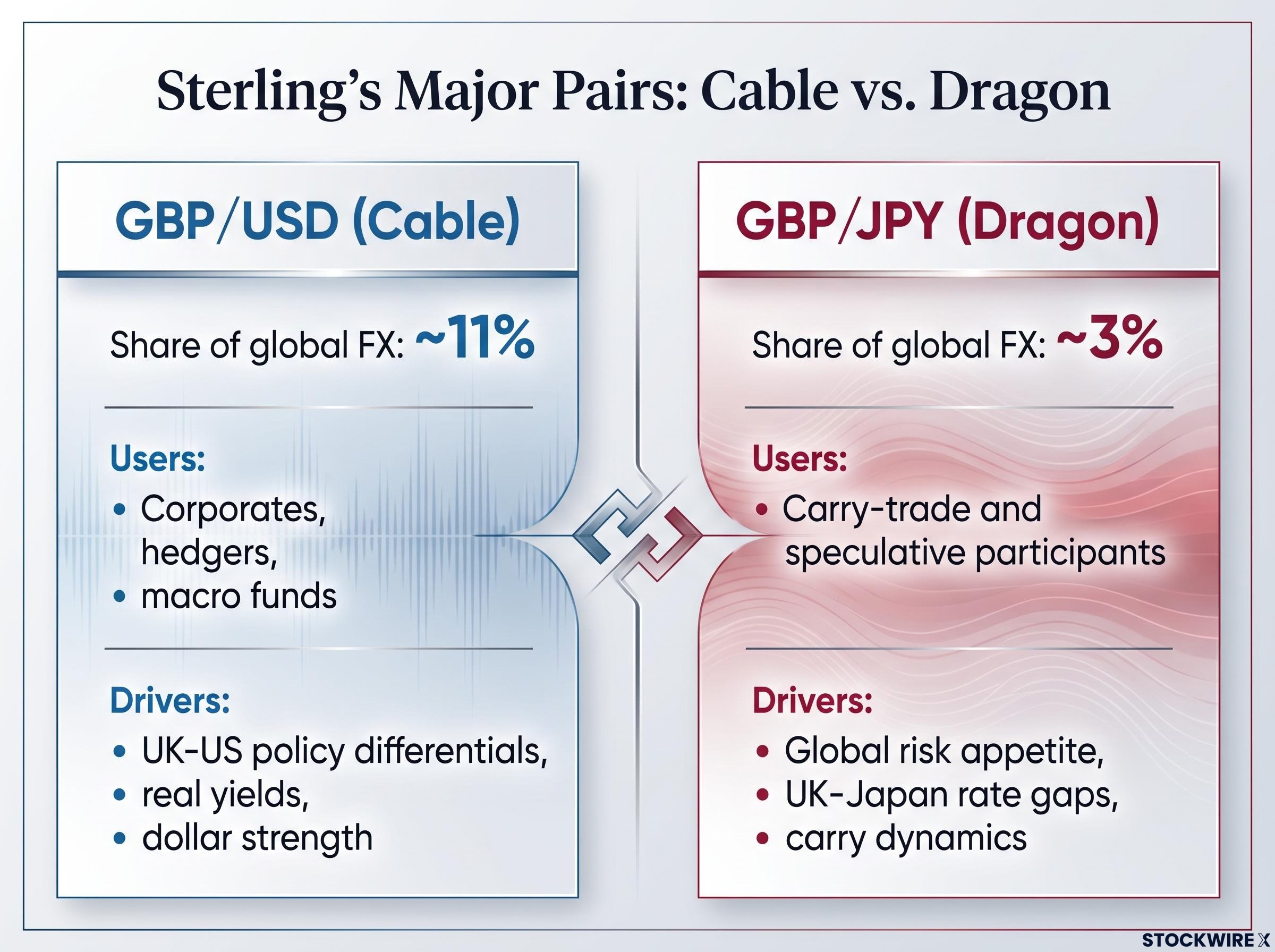
Here is how the two pairs compare:
| Characteristic | GBP/USD (Cable) | GBP/JPY (Dragon) |
|---|---|---|
| Share of global FX | ~11% | ~3% |
| Primary users | Corporates, hedgers, macro funds | Carry-trade and speculative participants |
| Main drivers | UK-US policy differentials, real yields, dollar strength | Global risk appetite, UK-Japan rate gaps, carry dynamics |
| Volatility profile | High liquidity, tight spreads, deep derivatives market | Higher intraday ranges, larger risk-on/risk-off moves |
| Typical use | Hedging cash flows; mainstream macro views | Short-term trading; risk-sentiment proxy |
The practical takeaway for you is this. Dragon’s larger price swings are not simply “more opportunity” dressed up as a livelier chart.
Those swings reflect a different structural driver. Dragon can move dramatically on global risk sentiment and carry dynamics that have nothing to do with anything happening in the UK economy. Treating GBP/JPY as merely a more volatile version of GBP/USD is a common and costly mistake, because the two pairs respond to different conditions and serve genuinely different purposes.
Sterling’s structural vulnerabilities: what makes the Pound behave differently from the dollar or euro
Mastering the rate and data framework is necessary, but it is not sufficient. Sterling carries structural features that make it more exposed to sharp reversals than comparable major currencies, and ignoring them leaves your picture of the Pound incomplete.
Three structural vulnerabilities stand out:
- A persistent current-account deficit that leaves the UK reliant on continuous foreign capital inflows
- A post-Brexit overlay of reduced EU trade integration and long-run growth uncertainty
- A smaller open-economy character that sees Sterling treated more like a risk asset than a safe haven
The current-account deficit is the foundational issue. Because the UK spends more abroad than it earns, it depends on a steady stream of overseas money to balance the books.
That dependence makes Sterling acutely sensitive to shifts in foreign investor appetite. When confidence in UK policy or growth wavers, the Pound can fall faster and further than the currencies of surplus economies, which do not need to attract inflows to stay stable.
Why Sterling is more vulnerable to policy missteps than the dollar or euro
The US dollar enjoys reserve-currency status, and the euro is backed by a large, diversified economic bloc. Both advantages act as a cushion, giving those currencies a broad capacity to absorb policy errors without a violent market response.
Sterling has no such cushion. The 2022 mini-budget episode showed how quickly UK fiscal credibility can be tested, with FX and gilt markets effectively forcing a policy reversal within days. The Pound simply pays a higher price for the same mistake.
The post-Brexit overlay adds a longer-term weight. Reduced trade integration with the EU, the risk of financial-services activity relocating, and uncertainty about long-run growth mean investors sometimes demand a risk premium for holding Sterling even when the near-term data looks healthy.
Layered on top is Sterling’s character as a smaller, open-economy currency. In global portfolios it tends to trade as a risk asset, so it swings more widely than the dollar or euro whenever global uncertainty rises and domestic politics are in focus.
There is a sharper edge to this in the current environment. With CPI at 3.1% against the 2% target, a downside growth surprise would be particularly damaging, because it would limit the Bank of England’s room to tighten while leaving inflation stubbornly elevated.
What this tells you is that Sterling carries a permanent credibility premium requirement. When UK fiscal or monetary credibility comes into question, the Pound pays more than a reserve currency would, and that risk sits in the background even during calm periods. If you hold UK assets or take currency exposure in Sterling, these structural factors explain why the Pound can weaken sharply even when the near-term numbers look broadly positive.
Building a working framework for Sterling: what to watch and why
Pull the five layers together and a clear order of priority emerges. The point of a framework is not to track everything equally. It is to know which signal to reach for first when Sterling moves in a way you did not expect.
Here is the hierarchy, in priority order:
- Bank of England monetary policy and the inflation trajectory. This is the primary driver. Rate decisions and, just as importantly, the signalling around them sit at the top of the list.
- UK macro data surprises. GDP and the PMIs matter most, and always read them against consensus rather than in absolute terms.
- Global risk sentiment and carry dynamics. This is where Dragon lives, and where moves can originate entirely outside the UK.
- Structural and political risk. The current-account deficit, the post-Brexit overlay, and fiscal credibility form the ever-present background condition.
The order matters because it tells you where to direct your attention first. When the Pound moves unexpectedly, your first check should be BoE signalling and the inflation data, not the currency-pair chart itself.
No single variable explains Sterling reliably. What separates informed interpretation from noise is knowing which layer of the framework is dominant in a given moment.
Looking ahead, with UK CPI at 3.1% and the MPC split 6-3, Sterling’s near-term path will hinge primarily on the Bank of England’s ability to navigate the trade-off between growth and inflation. That makes each upcoming MPC meeting and CPI release a genuine focal point. And with the Pound accounting for 10.2% of global FX turnover, this is a framework worth building, because Sterling moves markets at scale.
For readers wanting to see how these framework layers translate into live institutional positioning around an MPC meeting, our full explainer on GBP/USD positioning covers the technical levels, bank forecast divergences, and labour market data conditioning the Pound’s near-term direction in September 2026.
This article is for informational purposes only and should not be considered financial advice. Investors should conduct their own research and consult with financial professionals before making investment decisions. Past performance does not guarantee future results, and forward-looking statements are subject to market conditions and various risk factors.