
Most investors wait for an economy to look healthy before buying its stocks. Ken Fisher argues that instinct is backwards, and that European equities right now are the clearest example of why.
This is not a generic call to buy Europe. It is a structured argument, published by one of the world’s most prominent active asset managers, about how markets actually price information. European equities have underperformed US markets for years. Sentiment toward the region is broadly negative across investor communities in the US, Europe, and Asia. Fisher is treating that negativity as the thesis itself, not a reason for caution.
After working through this, you will understand how to evaluate whether European stocks belong in your portfolio using Fisher’s expectations-versus-reality test, rather than waiting for an economic revival that may never arrive.
The framework behind the call: why “bad” does not mean “avoid”
Fisher’s core principle is deceptively simple. Market outcomes are not driven by whether conditions are good or bad in absolute terms. They are driven by the gap between what investors expect and what actually happens.
The directional logic runs like this: when expectations are depressed, the bar reality must clear to produce positive returns drops. When expectations are elevated, even good news can disappoint if it falls short of what investors already assumed. The mechanism works in both directions, and it applies to every market.
“It is never about whether things will be good or bad but rather if they will be better or worse than anticipated.”
Ken Fisher, Founder, Executive Chairman, and Co-Chief Investment Officer of Fisher Investments, which serves approximately 210,000 clients as of 30 June 2026.
Professional forecasters tend to embed widely held views into their consensus estimates. That means consensus is often already priced into markets by the time the average investor acts on it. What this tells you is that the question worth asking is not “Is Europe’s economy in good shape?” but rather “Is Europe likely to deliver results better than what investors already assume?” That reframe changes the entire analysis.
Fisher’s widely-known-information framework holds that markets price broadly discussed narratives 3-30 months ahead, meaning any concern that has become consensus shorthand, whether seasonal rotation rules or European debt risk, carries limited power to drive further downside once it is universally held.
When big ASX news breaks, our subscribers know first
What makes Europe a case study for this approach right now
What the pessimists are pricing in
The bearish narrative on Europe is not confined to one investor community. It is shared across US, European, and Asian markets simultaneously, making it a structural feature of the current investment backdrop rather than a regional quirk.
The concerns investors apply to Europe are well rehearsed:
- Geopolitical tensions across the continent
- Germany’s structural economic weakness
- Regulatory burden on European businesses
- Competitive disadvantage relative to US technology and growth sectors
Each of these concerns is widely held. That is precisely the point. Widely held concerns get priced into equities. The more universally a risk is understood, the more likely it is already embedded in valuations.
Institutional positioning in Europe remains structurally underweight as of mid-2026, with the June BofA Global Fund Manager Survey showing European equities at their most underweight since December 2024, a gap that Barclays’ July 2026 upgrade characterised as a large pool of latent demand not yet deployed.
What the fundamentals actually show
Fisher Investments’ analysis indicates that European economic performance has been surpassing subdued expectations, contributing to the region’s relative equity stability. The claim is not that Europe is thriving. It is that European fundamentals, including overall economic stability and corporate results, are healthier than the prevailing narrative suggests.
Fisher does not forecast a European boom. His thesis requires only that Europe delivers results modestly better than what a deeply pessimistic consensus assumes. For you as an investor, that means the bearish case is already well represented in prices and sentiment. Adding European exposure is a bet on reality clearing a low bar, not a bet on a continental renaissance.
The 2025 precedent and what it tells investors about 2026
At the start of 2025, professional forecasters expected only low single-digit returns from European equities. Expectations for the US were considerably stronger. Fisher Investments took the opposite view, anticipating “another good-to-great year” for global stocks with non-US markets leading.
That view proved correct. Global stocks returned approximately 21.1% in 2025, with European and other non-US developed markets at the front of the pack.
The scale of that outperformance was striking: Forbes Q1 2025 European equity analysis recorded European stocks surpassing the S&P 500 by 18.4% in dollar terms over the quarter, the widest margin in more than 30 years, lending concrete weight to the argument that the expectations gap was real and measurable.
Fisher carries a similar thesis into 2026, expecting non-US stocks to again outperform. He characterises this year as one for “moderate, patient bullishness,” acknowledging a wide range of possible outcomes while maintaining that the expectations gap still favours international markets over the US.
| Category | 2025 | 2026 |
|---|---|---|
| Consensus expectation | Low single-digit European returns; US to lead | Modest global gains; Europe still viewed cautiously |
| Fisher’s expectation | Non-US stocks to lead; good-to-great global year | Non-US stocks to lead again; positive but more moderate |
| Actual or anticipated outcome | Global stocks returned ~21.1%; Europe outperformed | Wide range; could be negative or above 10% |
| Dominant theme | Pessimism proved wrong; low bar was cleared | Moderate, patient bullishness |
The 2025 cycle does not guarantee 2026 repeats. But it demonstrates that the expectations-versus-reality thesis is not purely theoretical. It produced measurable outperformance when consensus was wrong about Europe in exactly the way Fisher predicted.
Understanding the expectations-versus-reality lens as an investment tool
The framework Fisher applies to Europe is not a one-off call. It is a repeatable analytical tool, and understanding its mechanics lets you apply it to any market, sector, or asset class.
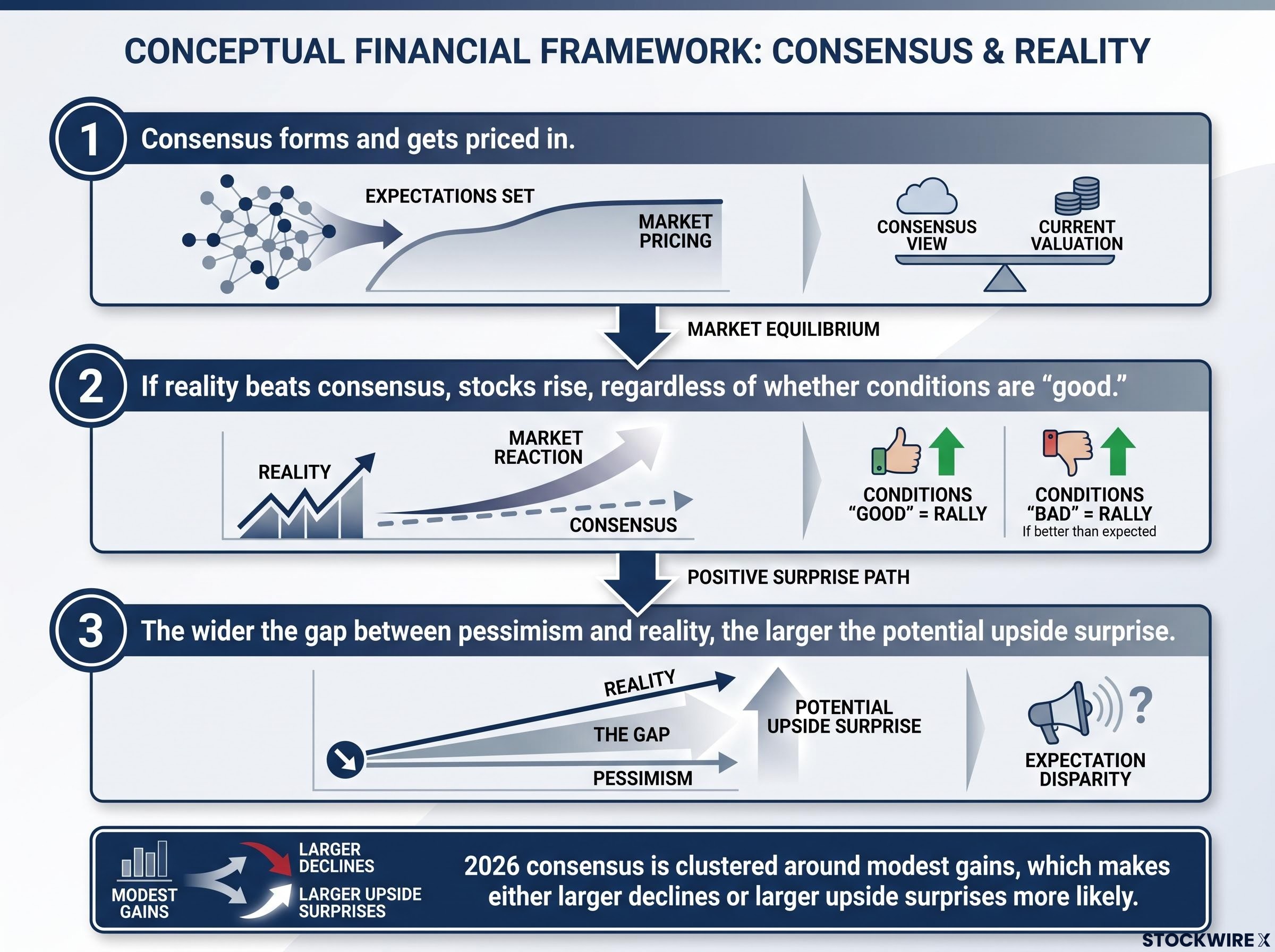
The logic works in three steps:
- Consensus forms and gets priced in. Professional forecasters and institutional investors embed widely held views into stock prices. By the time a view is consensus, it has limited power to drive further returns because markets have already adjusted.
- If reality beats consensus, stocks rise, regardless of whether conditions are “good.” A struggling economy that delivers results slightly better than feared can produce stronger equity returns than a booming economy that slightly disappoints elevated expectations.
- The wider the gap between pessimism and reality, the larger the potential upside surprise. Extreme pessimism leaves limited room for further disappointment but considerable room for upside if reality merely proves “not as bad as feared.”
Fisher notes that 2026 consensus is clustered around modest gains, which he argues makes either larger declines or larger upside surprises more likely than the consensus range suggests.
For you, the practical implication is clear. When evaluating any international market, checking whether sentiment is extreme is a more reliable starting point for identifying return potential than checking whether the economy looks attractive in absolute terms. The gap between sentiment and fundamentals is where the signal lives.
The risks Fisher acknowledges, and why they do not dissolve the thesis
The expectations-versus-reality framework is not a guarantee. If European fundamentals deteriorate enough to undershoot even today’s low expectations, or if new geopolitical shocks emerge that were not priced in, European equities could still struggle.
The specific risks worth weighing:
- Fundamental deterioration that falls below already-low expectations
- New geopolitical shocks that markets have not yet absorbed
- Prolonged sentiment depression, where skepticism persists even as fundamentals improve
- Wide outcome dispersion in 2026, where returns could range from negative to well above 10%
Timing is the trickiest element. Expectations can remain depressed longer than anticipated. Contrarian positioning, by definition, requires accepting interim underperformance while waiting for expectations and reality to realign.
Fisher’s own bullish stance on European stocks from the start of 2026 has not fully materialised as of 23 July 2026. He frames this as consistent with how long-duration contrarian positioning works, not as a missed call.
The question for you is not whether Fisher could be wrong. He could. The question is whether you have the patience and risk tolerance for a thesis that may require holding through a period where it looks wrong before it pays off.
Past performance does not guarantee future results. Financial projections are subject to market conditions and various risk factors.
What this means for investors weighing international exposure today
Fisher explicitly argues against localised investment strategies, positioning non-US international exposure as a structural portfolio decision rather than a tactical trade. After sustained US outperformance, expectations and valuations in American equities are elevated relative to non-US markets, raising the bar for further US upside surprises.
The European valuation discount to US equities sits at roughly 31% on forward earnings multiples as of mid-2026, a gap that has persisted even after European markets rallied in early 2026 and that provides the quantitative foundation for the re-rating thesis Fisher’s expectations framework anticipates.
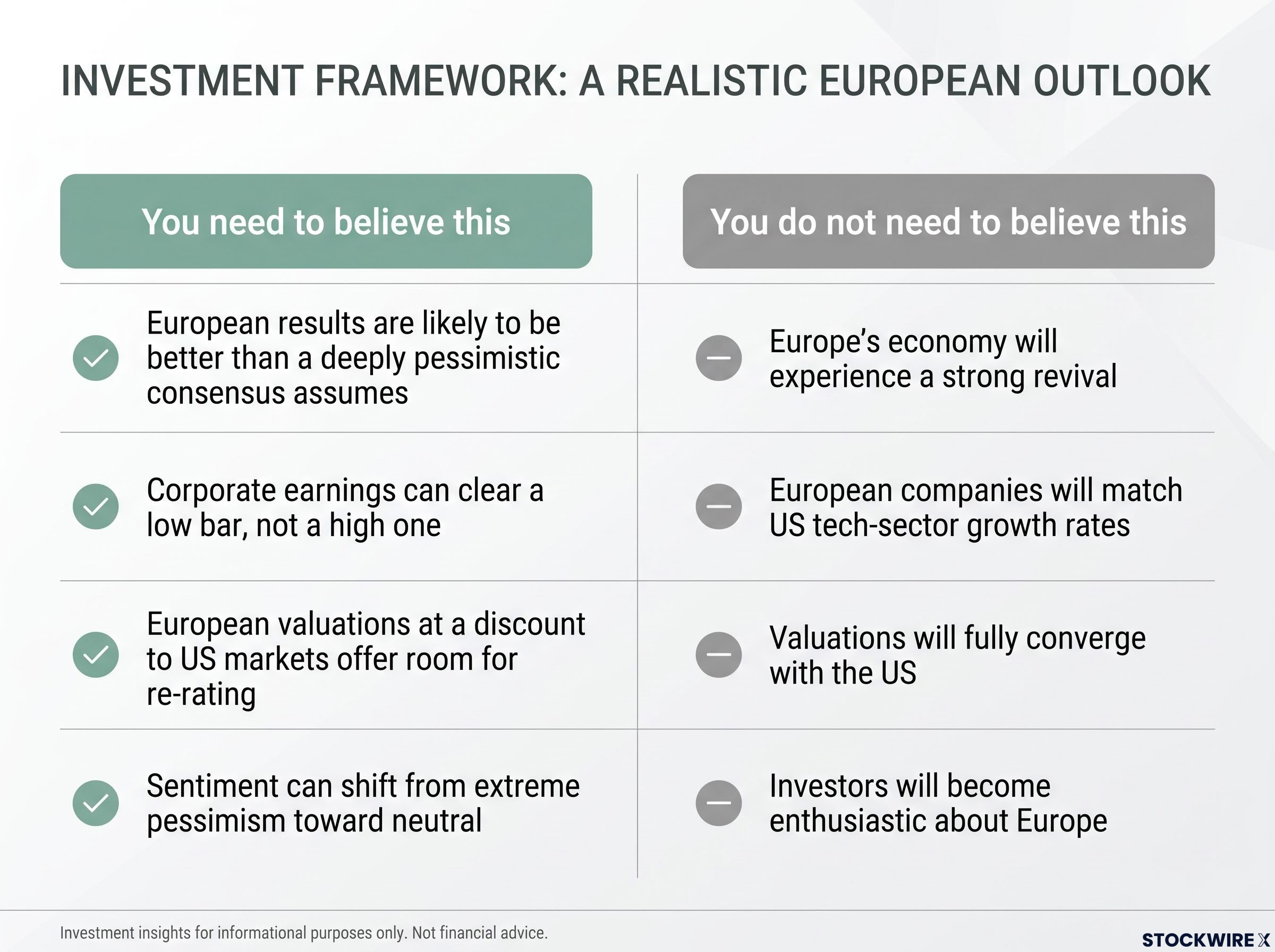
What matters is what you need to believe, and what you do not, to act on this thesis:
| You need to believe this | You do not need to believe this |
|---|---|
| European results are likely to be better than a deeply pessimistic consensus assumes | Europe’s economy will experience a strong revival |
| Corporate earnings can clear a low bar, not a high one | European companies will match US tech-sector growth rates |
| European valuations at a discount to US markets offer room for re-rating | Valuations will fully converge with the US |
| Sentiment can shift from extreme pessimism toward neutral | Investors will become enthusiastic about Europe |
The decision is not “do I believe Europe’s economy will boom?” It is “do I believe European results are likely to be better than what a broadly pessimistic global consensus already assumes?” That is a substantially easier threshold to evaluate, and it removes the paralysis that comes from trying to predict macroeconomic outcomes before acting.
For investors ready to act on the thesis and build a precise European allocation, our dedicated guide to investing in European stocks covers how Switzerland, Spain, and Italy serve three distinct portfolio roles, from defensive anchor to cyclical growth sleeve, with specific market structures and position-sizing considerations for each.
Fisher’s bet is on the gap, not the boom
The bullish case for European stocks, as Fisher frames it, does not require European economic strength. It requires the persistence of the expectations-versus-reality gap that currently favours the region. Depressed sentiment, still-low valuations, and fundamentals that are healthier than widely recognised create a combination where reality only needs to clear a low bar to produce meaningful returns.
The thesis is long-duration and demands patience. Fisher himself has held it through a period of non-materialisation in 2026, signalling the kind of conviction it requires from investors who adopt it. That is not a reason to dismiss the logic, but it is a reason to honestly assess your holding horizon before acting on it.
You now have the framework to evaluate your own portfolio’s international exposure against the diversification and expectations logic laid out here. The question is no longer whether Europe looks good. It is whether Europe looks better than what the world already assumes.
This article is for informational purposes only and should not be considered financial advice. Investors should conduct their own research and consult with financial professionals before making investment decisions.