
Ten-year Treasury yields are back near 5.1%, October inflation ran hotter than forecast, and gold has slumped. Yet Peter Schiff is calling the selloff a buying opportunity. Spot gold traded at $3,977.99 an ounce on 12 November, roughly 29% below its January record near $5,595. That is an uncomfortable fact for anyone who assumes higher rates always mean lower gold.
Traders are treating every hot data point as a signal that the Federal Reserve (Fed) will tighten further, and they are selling bullion accordingly. The more useful question is whether gold follows nominal yields or real rates, and that is where Schiff’s case either stands or falls.
His view is one commentator’s opinion. Here it is tested against evidence from the World Gold Council (WGC), the Congressional Budget Office (CBO) and major banks.
After this, you will have a working framework for judging how gold reacts to macro data. You will also see where Schiff’s argument holds and where it is contested.
Why is gold falling on hot inflation data? The market’s reading versus Schiff’s
The market’s reading
The Bureau of Labor Statistics released October’s consumer price index (CPI) on 10 November. Headline prices rose 0.4% for the month against a 0.3% consensus. Core CPI, which strips out food and energy, rose 0.3% against 0.2%, according to CNBC.
Reuters traced what came next. Hotter inflation lifted expectations of rate hikes and pushed the dollar index to a 19-month high, around 102-103. Higher rates and a stronger dollar make an asset that pays no income less attractive. The 10-year yield reached about 5.07% on 12 November, according to Investing.com, while the original interview source put it near 5.11%. Both figures place it around 5.1%.
Pricing for the 8-9 December Fed meeting is less settled. Investing.com showed roughly 89% odds of a 25 basis point hike, while the interview source said markets were weighing a possible 50 basis point move. The WGC added that October’s decline was probably partly a rotation out of gold and into higher-yielding Treasuries.
Schiff’s counter-reading
Schiff, chief economist and global strategist at Europacific Asset Management, reads the same data differently. In his view, inflation is rising faster than the Fed is hiking, so any hikes are too little, too late. He also links the bond selloff partly to Democrats’ midterm win, which he believes means larger deficits and more money printing. That link is his opinion.
The two chains of reasoning start in the same place and end in opposite places:
- The market’s chain: hot CPI, more Fed hikes, higher yields, stronger dollar, sell gold.
- Schiff’s chain: hot CPI, inflation outrunning hikes, falling real rates, eventual Fed reversal, buy gold.
A gold drop on CPI day mostly tells you that traders are pricing the Fed’s response. It is not a verdict on inflation itself. Which chain wins depends on your time horizon.
Fed officials’ rate projections show a committee still leaning toward further tightening, with sixteen of 18 members pencilling in at least one more hike, which sets the backdrop for how traders read each hot data print.
When big ASX news breaks, our subscribers know first
Nominal versus real rates: the distinction that drives gold
Reading the yield number
The 5.1% on your screen is a nominal yield, meaning the headline interest rate a bond pays before inflation. The real yield is the return left after inflation. Roughly, real yield equals the nominal yield minus expected inflation.
Here is a simple example. Suppose the nominal yield rises by 0.3 percentage points while expected inflation rises by 0.6 points. The headline looks like tightening, yet real yields have fallen by about 0.3 points. That is the core of Schiff’s argument.
| Scenario | Nominal yield | Inflation expectation | Real yield effect and likely gold pressure |
|---|---|---|---|
| Fed out-hikes inflation | Rises | Stable or falling | Real yield rises; pressure on gold |
| Inflation outruns hikes | Rises slowly | Rises faster | Real yield falls; supportive for gold |
| Fed reverses course | Falls | Stable or rising | Real yield falls; supportive for gold |
The one-line rule Gold tracks real rates, not nominal ones.
Why opportunity cost matters
Opportunity cost is the income you give up by holding one asset instead of another. Gold pays no interest, so when real yields rise, holding it becomes more costly.
The live number is the 10-year TIPS yield. TIPS are Treasury bonds whose principal adjusts with inflation, so their yield is a market measure of real rates. It sat around 2.63-2.66% between late October and 6 November, although that figure has not been independently confirmed. Schiff also argues that currency traders are wrong to assume rising rates strengthen the dollar, because yields are rising as bond prices fall and investors step away from bonds.
The WGC warns that inflation alone does not guarantee a gold rally. The dollar, growth expectations, Asian demand and central bank buying all matter too. Before you decide what a rate move means for gold, check real yields and the dollar, not the headline yield on its own.
Oil-driven inflation expectations are one channel that can suppress real yields, which is why energy prices belong on the watchlist alongside the dollar, growth, Asian demand and central bank buying.
Does history back the real-rate thesis? Evidence from the 1970s, 2013 and 2022
The framework sounds tidy. Past episodes show when it actually worked.
| Episode | Real yield and dollar backdrop | Gold outcome | Lesson |
|---|---|---|---|
| Late 1970s | Falling or negative real returns | Gold benefited | Inflation alone was not enough; real rates and the dollar mattered |
| 2013 taper | Rising Treasury yields, stronger dollar | Major decline | Tightening expectations can overwhelm the inflation case |
| 2022 tightening | Rising real yields, stronger dollar | Pressured, damage limited | Central bank and geopolitical demand can cushion the fall |
The pattern is consistent. Gold did well when real returns fell and struggled when real yields and the dollar climbed together. The WGC’s conclusion matches this: hikes tend to hurt gold when they raise real yields and strengthen the dollar.
The 2013 comparison is current. The WGC noted that March 2026 was gold’s weakest month since June 2013, and said in November that speculative positioning had not fully washed out.
The counterarguments to Schiff’s thesis come straight from that history:
- A 10-year TIPS yield around 2.6% is restrictive, not obviously falling.
- A stronger dollar makes dollar-priced gold dearer for foreign buyers.
- Persistent inflation may keep the Fed higher for longer, which would prevent the real-rate decline the thesis needs.
- Heavy Treasury issuance can initially lift real yields and pull capital into bonds.
History supports the conditional version of Schiff’s claim, not the unconditional one. His case depends on real yields actually falling. That gives you a test you can check: if TIPS yields keep rising, the thesis is weakening, whatever CPI prints.
Is this pullback a buying opportunity? Gold, silver, futures and debt in context
The drawdown is steep, and silver’s is steeper.
| Metal | Record (Jan 2026) | Current (12 Nov) | Change |
|---|---|---|---|
| Gold | $5,594.80 | $3,977.99 | About -29% |
| Silver | About $121.60 | About $50-51 | About -58% to -59% |
Schiff frames the pullback against a much longer horizon. He says gold rose from under $300 at the start of the century to over $5,000, outperforming the S&P 500. That comparison rests on his own claim. On silver, he argues that $50 only looks low beside the spike near $120. Silver is still up about 25% year on year, according to the interview source, and its 1980 peak of about $50 equates to roughly $195 in today’s money.
Silver price drivers differ from gold’s because solar demand and by-product supply add industrial forces on top of rates, and its volatility of roughly 37% against gold’s 18% helps explain the steeper drawdown.
Manipulation or positioning?
Schiff treats futures speculation and alleged price suppression as short-term noise that smooths out over time. Institutional voices point instead to positioning. Saxo Bank’s Ole Hansen said recent commodity moves were driven mainly by short covering and position adjustments rather than a shift in supply and demand. The WGC also cited positioning and the rotation into Treasuries. No independently substantiated 2026 finding has emerged showing coordinated manipulation behind the November decline.
Schiff’s debt claim versus CBO
Schiff projects interest on US debt will exceed $2 trillion in 2027. The CBO’s February baseline puts net interest at about $1.039 trillion in FY2026, reaching about $2.144 trillion only by 2036. Its scenario work shows rates 50 basis points higher would add $1.6 trillion over 2026-36. These projections and Schiff’s forecasts are speculative and subject to change as markets and policy develop.
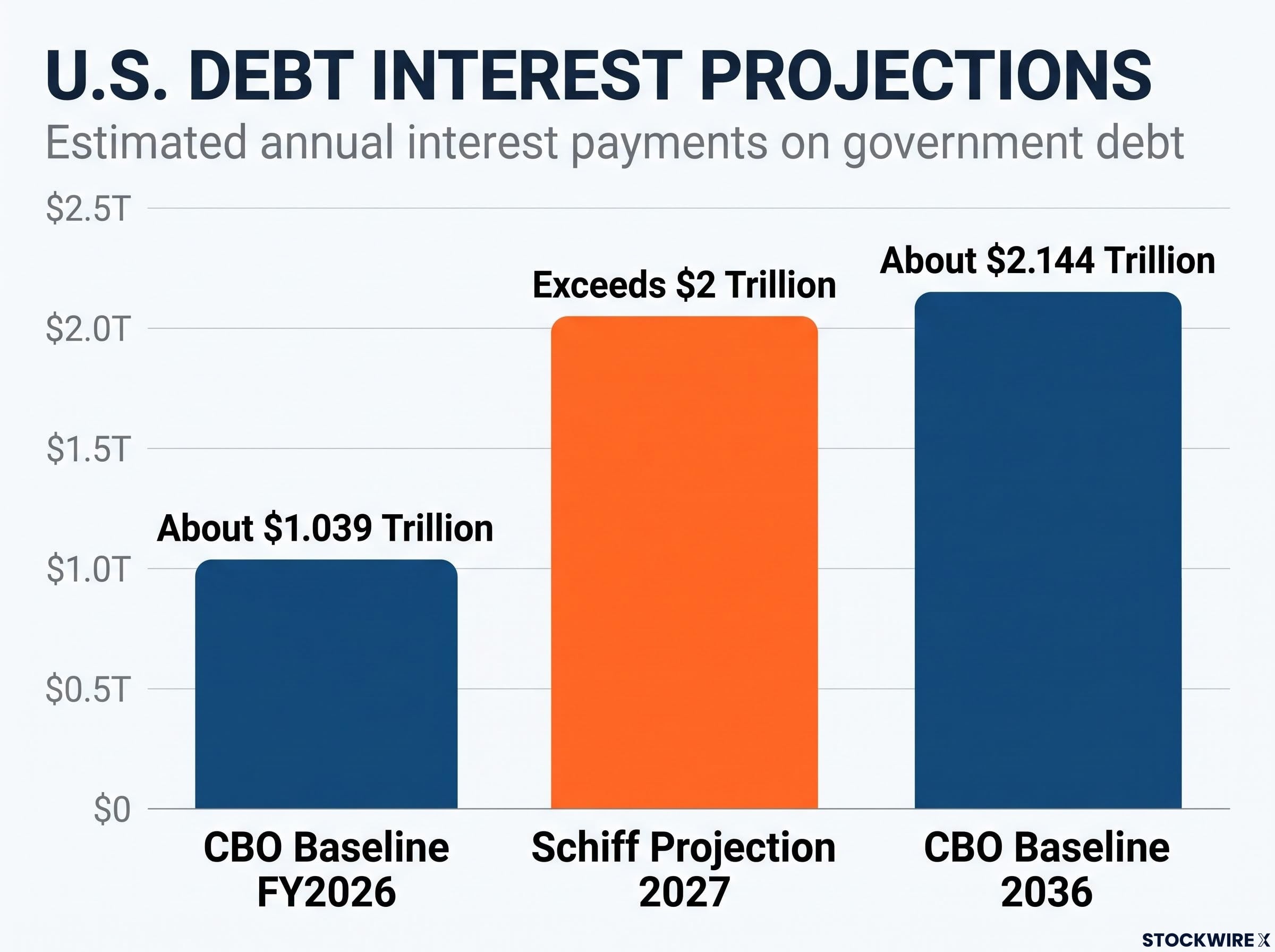
Schiff projects U.S. debt interest exceeds $2 trillion by 2027, well ahead of the CBO baseline of about $2.144 trillion in 2036.
Schiff says he is a long-horizon investor betting on dollar debasement, not a short-term trader. Read “buying opportunity” in that light. It is a conviction call that accepts drawdowns of 29% or more, not a signal about timing.
Equities, midterm politics and recession risk: what could cut both ways for gold
Schiff’s risks
Schiff’s concerns extend beyond bonds. He argues that low-looking price-to-earnings (P/E) ratios depend on optimistic earnings forecasts, and that a recession, a drain from AI capital expenditure (capex, or spending on long-term assets) or a financial shock could cut profits first. He forecasts Democrats taking Congress in 2027 and the White House in 2028, with possible higher corporate and capital gains taxes to follow. That political timeline is his opinion. His interviewer agreed the tax impact is underappreciated.
What institutions say
Mainstream forecasters see risks but describe a milder path:
- Morningstar: post-midterm uncertainty over regulation and fiscal policy; an AI slowdown could bring headwinds without a severe recession.
- Morgan Stanley: strategist Mike Wilson said delayed spending cuts could give a modest near-term growth boost, with continued deficits likely.
- J.P. Morgan Asset Management: about 2% US GDP growth through 2027, containing recession risk.
- Invesco: a slower AI buildout matters because AI capex has become an important contributor to growth and profits.
- InvestmentNews analyst Nyland: a complete halt in AI capex could cause a “pretty deep recession”, while a slower pace carries less extreme risk.
The gold implication runs in both directions. A recession could eventually support gold through lower rates and renewed stimulus. The WGC, however, identified a different first step in the recent correction.
The liquidation phase In an initial selloff, investors may sell both equities and gold to raise cash, while Treasuries and the dollar benefit.
Equity stress is not automatically good for gold in the short run. The sequence matters as much as the direction, so a stock market slide could hit your gold holdings before any safe-haven support arrives.
Which signals would confirm or break the real-rate case
The framework comes down to four inputs: real yields, the dollar, the Fed’s path and speculative positioning. CPI headlines alone will not tell you much. If the 10-year TIPS yield falls from around 2.6% while the dollar eases, Schiff’s thesis gains ground. If real yields and the dollar keep climbing, it loses ground.
The next checkpoint is the 8-9 December Fed meeting, where pricing ranges from a 25 to a 50 basis point hike. After that come the next CPI release and the direction of TIPS yields. Remember that Schiff’s views are one commentator’s opinions, and that the sources disagree on several key figures.
Some analysts argue the broken gold and real yields correlation since 2022-2023 reflects central bank accumulation and doubts over US fiscal credibility, which is a further caveat to treating TIPS yields as a clean test.
This article is for informational purposes only and should not be considered financial advice. Investors should conduct their own research and consult with financial professionals before making investment decisions.