When the largest AI listing in history arrives, the instinct is to treat it as a victory lap for the trade. The chart says otherwise. The iShares Semiconductor ETF (SOXX) sat more than 26% below its June peak in late October, just as the Anthropic IPO was being priced as a triumph.
Anthropic filed its S-1 with the SEC on 26 October 2026. It plans to list under the ticker ANT and is targeting mid-November.
Macro strategist Tony Greer of TG Macro reads that timing differently from most. He sees strain building inside the AI trade and a possible sell-the-news setup, where a long-awaited event marks a top rather than a launch. The figures here are current to the start of November 2026, before a final offering date has been set.
This is one strategist’s thesis, tested against the evidence. You will get the chart setup, the precedent record and both scenarios, so you can decide how much weight Greer’s call deserves in your own portfolio.
What is straining in the AI trade before the Anthropic IPO?
The chart setup around the 200-day average
Start where a trader would: the price chart. Greer describes a semiconductor rally of roughly two months from April into the SpaceX IPO in June 2026. Then momentum stalled. The sector printed two lower highs and drifted down to test its 200-day moving average, which is the average closing price over the past 200 trading days and is widely used to judge a long-term trend.
On 29-30 October 2026, SOXX briefly touched that average near $473-$476. According to CNBC, SOXX and the VanEck Semiconductor ETF (SMH) both traded below their 200-day averages for the first time since 3 June 2025 and 30 May 2025 respectively.
The 200-day is a risk marker, not a forecast. Losing it tells you the trend has weakened. It does not tell you how far prices will fall.
What earnings and credit are saying
Earnings added a second layer. Microsoft beat expectations, with Azure growth of 48%, but capital expenditure (spending on data centres and equipment) of $45.2 billion fell short of a roughly $50.7 billion consensus. Management blamed delayed third-party capacity deliveries, which points to a timing problem.
Alphabet was a different story. The market reacted far more harshly, and that tells you more.
| Company | Latest result or move | Capex or financing detail | Market reaction |
|---|---|---|---|
| Microsoft | Azure growth of 48% | $45.2B capex vs ~$50.7B consensus | Initial disappointment; delay cited |
| Alphabet | Free cash flow of about -$9.1B | $51.36B capex vs $55.09B expected | Shares fell about 12% |
| CoreWeave | Down about 24% year to date (30 October) | Bonds yielding near 15% | Distressed credit pricing |
CoreWeave‘s bonds are the more direct signal. A bond yielding close to 15% means lenders are demanding a heavy premium to fund AI infrastructure, which is harder evidence of financing stress than any moving-average breach. Greer argues that sellers of tech rallies are finally being rewarded and that reflexive dip buying is ending.
Put together, the market is separating AI revenue growth from AI investment returns. If you hold semiconductor exposure, that distinction now drives the price.
Free cash flow, return on invested capital and borrowing costs now decide how the market prices AI spending, which explains why cash-rich spenders and leveraged builders such as CoreWeave are being treated so differently.
When big ASX news breaks, our subscribers know first
How can a mega-IPO move the broader market?
A huge listing can pressure existing stocks through four channels:
- New-equity supply: A very large issue creates a new security that competes for the same pool of capital.
- Liquidity drain and rebalancing: Funds may sell existing tech holdings to buy the newcomer.
- Price-discovery reversal: Underwriters price for a strong first day; if gains fade, the debut becomes a negative signal for the whole theme.
- Benchmark substitution: Once listed, the new stock competes with established peers for growth allocations.
Those mechanisms sound decisive. History is less tidy.
| Precedent | What happened | Relevance to Anthropic |
|---|---|---|
| Facebook 2012 | Traded poorly after listing | A celebrated debut can expose valuation pressure |
| Alibaba 2014 | Raised about $25B; no lasting selloff | Strong demand can absorb massive supply |
| Uber 2019 | Traded below its IPO price | A weak debut can hurt unprofitable growth names |
| Saudi Aramco 2019 | Raised $25.6B; markets stayed steady | Size alone does not destabilise equities |
| 2021 IPO wave | Excess issuance repriced as rates rose | A supply glut can mark a sentiment peak |
SpaceX shows how messy this gets. It priced at $135 on 11 June 2026, raising about $85.7 billion with the greenshoe (an option letting underwriters sell extra shares). It closed about 19% higher on day one, hit $225.64 intraday on 16 June, then slid back to around $134.72 in a late-October report.
The precedent record: History does not support a mechanical rule that a mega-IPO causes a market decline.
Anthropic is larger still: Nasdaq Global Select Market, 22 underwriters led by Goldman Sachs, and a raise that media reports, not the S-1, put at $100 billion or more. Sell-the-news risk rises when the sector is technically weak, valuations are stretched, positioning is crowded and financing problems are exposed. Several of those conditions are already present, so treat the offering as a possible catalyst acting on a fragile setup, not an automatic cause.
Is the dot-com comparison fair, and what does the Anthropic filing show?
Greer reaches for 1999 with a vivid scene: a 74-year-old woman at a music festival talking up her Nvidia holdings. It is a memorable sentiment marker. It is not evidence.
The comparison holds up in some places and weakens in others:
- Where it fits: concentrated market leadership, aggressive infrastructure spending, promotional narratives and circular financing, with Reuters describing CoreWeave as caught in a loop involving Nvidia and major AI customers.
- Where it is weaker: Microsoft, Alphabet, Amazon and Meta generate substantial operating cash flow, and one 2026 analysis argued much hyperscaler spending is funded by that cash rather than fragile debt.
The financing chain is real. CoreWeave’s debt and lease obligations were reported at about $50 billion or more, and Nvidia has agreed to buy its unused capacity through April 2032. Greer also points to promotional behaviour: a Goldman buy initiation on CoreWeave after its slide, and JPMorgan’s Doug Anmuth lifting his SpaceX target from $240 to $500 on 21 October with the stock near $135. Goldman’s Eric Sheridan moved to $245 the same day.
Reading the S-1 without the headline distortion
Greer cited a $2 trillion valuation, $4 billion of revenue, a $40 billion loss and $70 billion of debt. Those are his characterisation, and they differ from the filing.
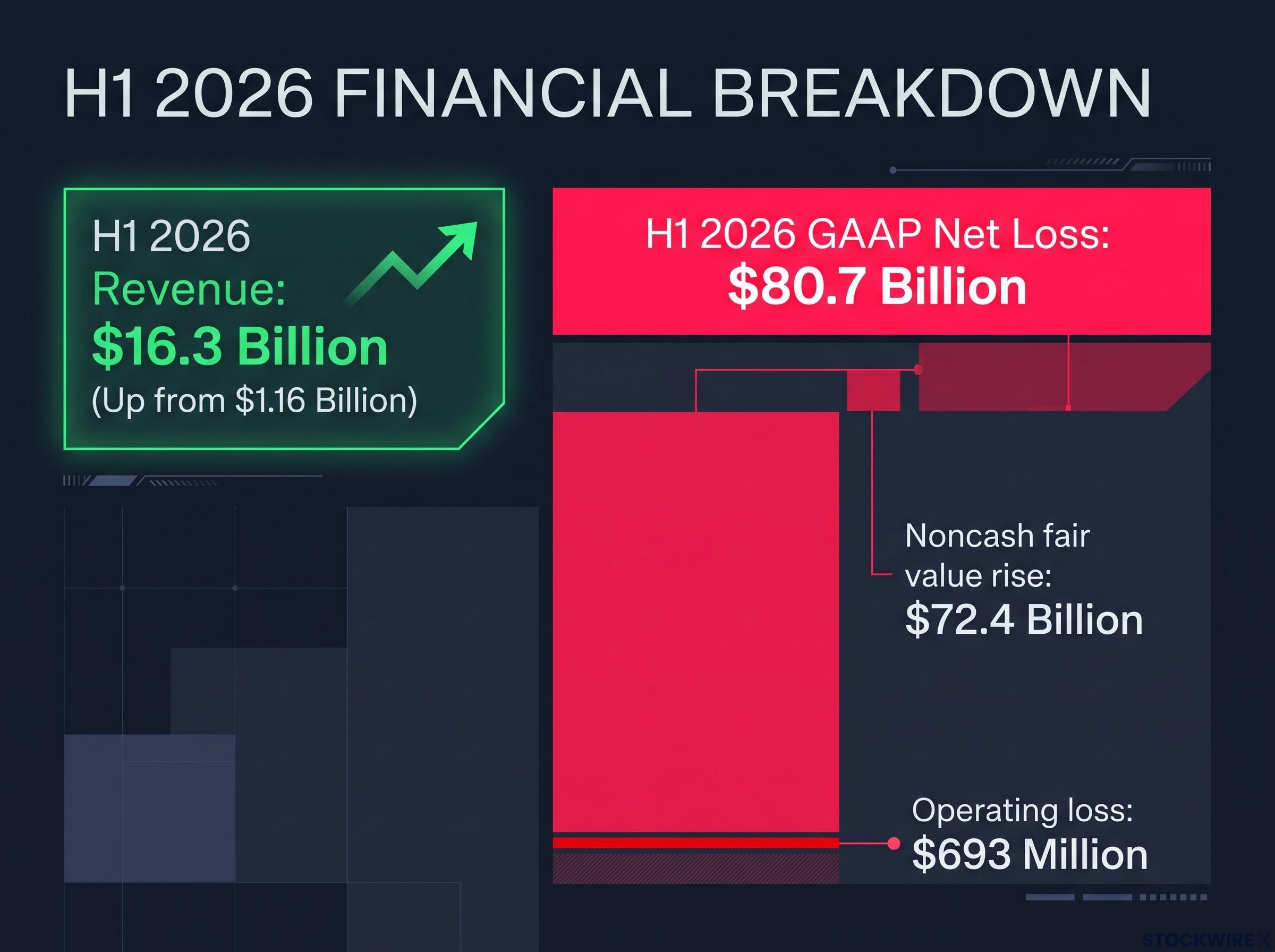
The S-1 shows first-half 2026 revenue of $16.3 billion, up from about $1.16 billion a year earlier.
The headline loss, in context: Anthropic reported an $80.7 billion GAAP net loss for H1 2026, but about $72.4 billion came from a noncash rise in the fair value of convertible securities.
The operating loss was $693 million, with a first operating profit reported in Q2. Anthropic also has more than $100 billion of long-term computing commitments, according to the filing coverage, though some reports cite far larger figures defined differently. The risk sits less with the cash-rich giants than with leveraged intermediaries, so the question for your holdings is where they fall on that spectrum.
For readers weighing how fragile the financing chain really is, our deep-dive into hyperscaler capex funding examines who ultimately pays if two loss-making labs stumble.
Bearish and bullish scenarios: how might a trader position for each?
Greer is mostly flat, holding the Energy Select Sector SPDR Fund (XLE) and gold, and recently added the VanEck Oil Services ETF (OIH) after a breakout. He says he is ready to short semiconductors.
Bearish path
Greer’s bear case has a sell-the-fact event pushing semiconductors decisively below the 200-day average and down roughly 20%, with shorts exiting into strength. That figure was not independently verified and is not a base rate.
Prior semiconductor drawdowns exceeding 20% have occurred inside longer bull markets without ending them, which is why a roughly 20% decline in chips, even if it arrives, does not by itself settle the broader market question.
Bullish path
If Anthropic does not derail tech, Greer sees a broad rally across industrials, financials and tech, possibly a thousand-point S&P 500 gain.
| Scenario | Trigger | Likely market behaviour | Positioning concepts |
|---|---|---|---|
| Bearish | Weak pricing or fading debut | Semiconductors lose the 200-day | Trim concentrated exposure; index puts or put spreads |
| Bullish | Strong offering, credible cash path | Broad relief rally | Rotate toward cash-generative tech; keep small diversifiers |
These are risk-management concepts described by practitioners, not recommendations, and no sector is guaranteed to outperform.
What can invalidate either
- Short squeezes: a crowded short can reverse violently if the offering prices strongly.
- IPO volatility: limited float and underwriter stabilisation can distort early prices.
- Earnings: hyperscaler results could easily overpower the listing itself.
- Credit spreads: bond markets may flag trouble before charts do.
Timing is still loose. The week of 16 November is targeted, Greer has mentioned Thanksgiving week, and the S-1 sets no final date. Valuations of about $1.5-$2 trillion are media estimates only. The useful question is what you would do at each outcome, using the 200-day level and the offering’s reception as your decision markers.
Three signals to watch before the Anthropic offering prices
The likeliest mechanism is not that a giant IPO causes a crash. It is a large new supply event landing on a sector that is already technically weak and sensitive to financing costs.
Three signals will tell you which way that resolves. Watch the price range and first-day follow-through, whether semiconductors reclaim or lose their 200-day average, and whether credit spreads at CoreWeave-style borrowers keep widening.
If all three deteriorate together, Greer’s case gains weight. If they hold, his bullish alternative comes into play. Either way, his roughly 20% decline scenario remains one strategist’s view, not a forecast to build a portfolio around.
Past performance does not guarantee future results. Scenarios discussed are speculative and subject to change based on market developments and company performance.
This article is for informational purposes only and should not be considered financial advice. Investors should conduct their own research and consult with financial professionals before making investment decisions.