Markets give roughly 81% odds that the Reserve Bank of Australia (RBA) lifts rates this afternoon, and 25 of 28 economists surveyed expect it. With the RBA rate hike that close to certain, the move itself is unlikely to surprise anyone. The surprise risk sits in what the bank says about 5.10%.
A 25 basis point move (one basis point is one hundredth of a percentage point) would take the cash rate from 4.60% to 4.85%. That would be the fifth increase of 2026 and the highest cash rate in 18 years, a level not seen since 2008.
The timing adds weight. The decision lands at 2:30 pm AEDT today, Tuesday 3 November, alongside the quarterly Statement on Monetary Policy, which carries the RBA’s updated forecasts for inflation, growth and unemployment.
Here is how to read the decision, the forecasts and the commentary, and what each outcome could mean for your ASX holdings, bank shares, mortgage repayments and the Australian dollar.
Why is the debate about the peak, not the November hike?
The consensus on today’s move formed fast. The RBA began the year with a hike in February and has added three more since, pausing only in June and August before resuming in September.
The RBA delivered its third consecutive hike in May, taking the cash rate to 4.35% when headline CPI reached 4.6%, and futures at the time already pointed to one further move before the end of the year.
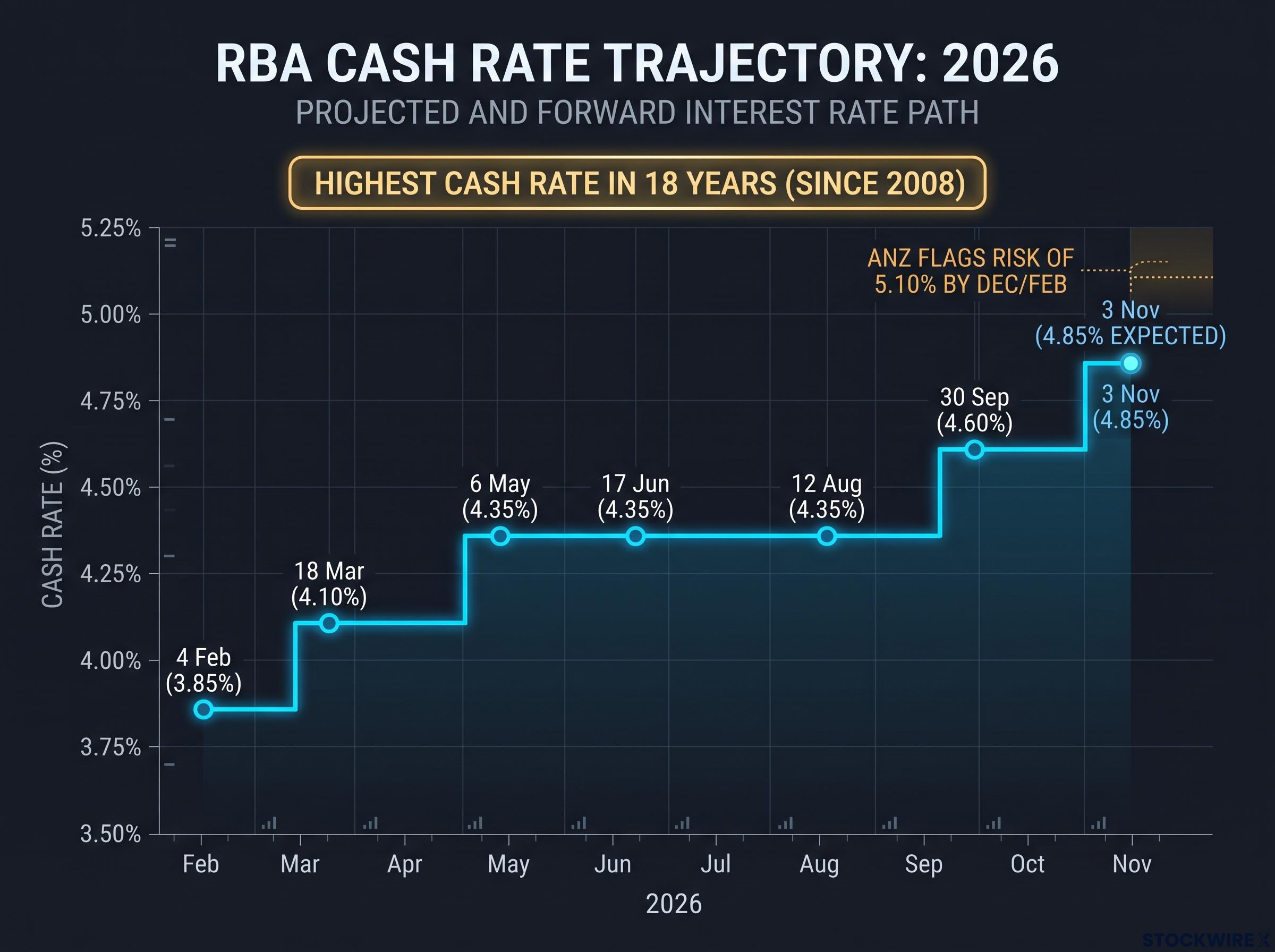
| Date | Move | Cash-rate target |
|---|---|---|
| 4 February 2026 | +25 bp | 3.85% |
| 18 March 2026 | +25 bp | 4.10% |
| 6 May 2026 | +25 bp | 4.35% |
| 17 June 2026 | No change | 4.35% |
| 12 August 2026 | No change | 4.35% |
| 30 September 2026 | +25 bp | 4.60% |
| 3 November 2026 (expected) | +25 bp | 4.85% |
The inflation data sealed it. The Australian Bureau of Statistics (ABS) reported on 28 October that annual CPI reached 4.3% in the year to September, with trimmed mean inflation (a measure that strips out the most extreme price moves to show the underlying trend) at 3.6%. Both sit well above the RBA’s 2-3% target band, and the monthly CPI rose 0.8% in original terms and 0.6% seasonally adjusted.
The labour market has softened, but not enough to calm the bank. Unemployment rose to 4.7% in September, and the Wage Price Index grew 3.2% in the year to the June quarter.
Where the forecasters disagree
Agreement on November quickly gives way to a split on where rates top out.
- CBA (Belinda Allen): Called today’s move an “insurance hike”, arguing data-centre and AI investment, defence and public infrastructure could keep demand pressure high even as households slow. Sees 4.85% as close to the peak.
- Westpac (Luci Ellis): Kept its November call because inflation is too high, and sees a further rise in February as an increased risk but not the base case.
- NAB: Argued higher energy costs and a reassessment of domestic capacity pressure would force upward revisions to the RBA’s underlying inflation forecasts.
- ANZ: Views the move as necessary rather than insurance, flagging a material risk of 5.10% in December or February.
The Melbourne Institute also expects 4.85% but has not ruled out more, saying monthly data will guide later decisions.
That split is what you should be watching. Because today’s 25 basis points are largely priced, the tone of the RBA’s commentary on further increases is what is likely to move markets and your mortgage expectations.
When big ASX news breaks, our subscribers know first
How does a higher cash rate flow through to banks, housing and mortgages?
The intuitive assumption is that banks win when rates rise. Yet on 2 November, three of the big four fell.
The explanation lies in how a rate rise travels through the economy over time:
- Margins widen first. Loan rates tend to reprice faster than some deposit costs, which can lift net interest margins (the gap between what a bank earns on loans and pays on deposits).
- Deposit competition follows. Banks raise savings rates to hold funding, eating into that early gain.
- Refinancing pressure builds. Borrowers rolling off fixed rates face payment shock and shop around.
- Credit growth slows. Higher repayments reduce how much households can borrow.
- Arrears rise. Stretched borrowers fall behind, lifting bad-debt charges.
Investors price that whole chain, not just step one. A hike may help margins this quarter, but if it leads to housing losses and slower lending, the share price can fall.
Investors price that whole chain, and the bank earnings season showed that guidance on net interest margins, deposit competition and the bad-debt trajectory moved share prices far more than headline profit beats did.
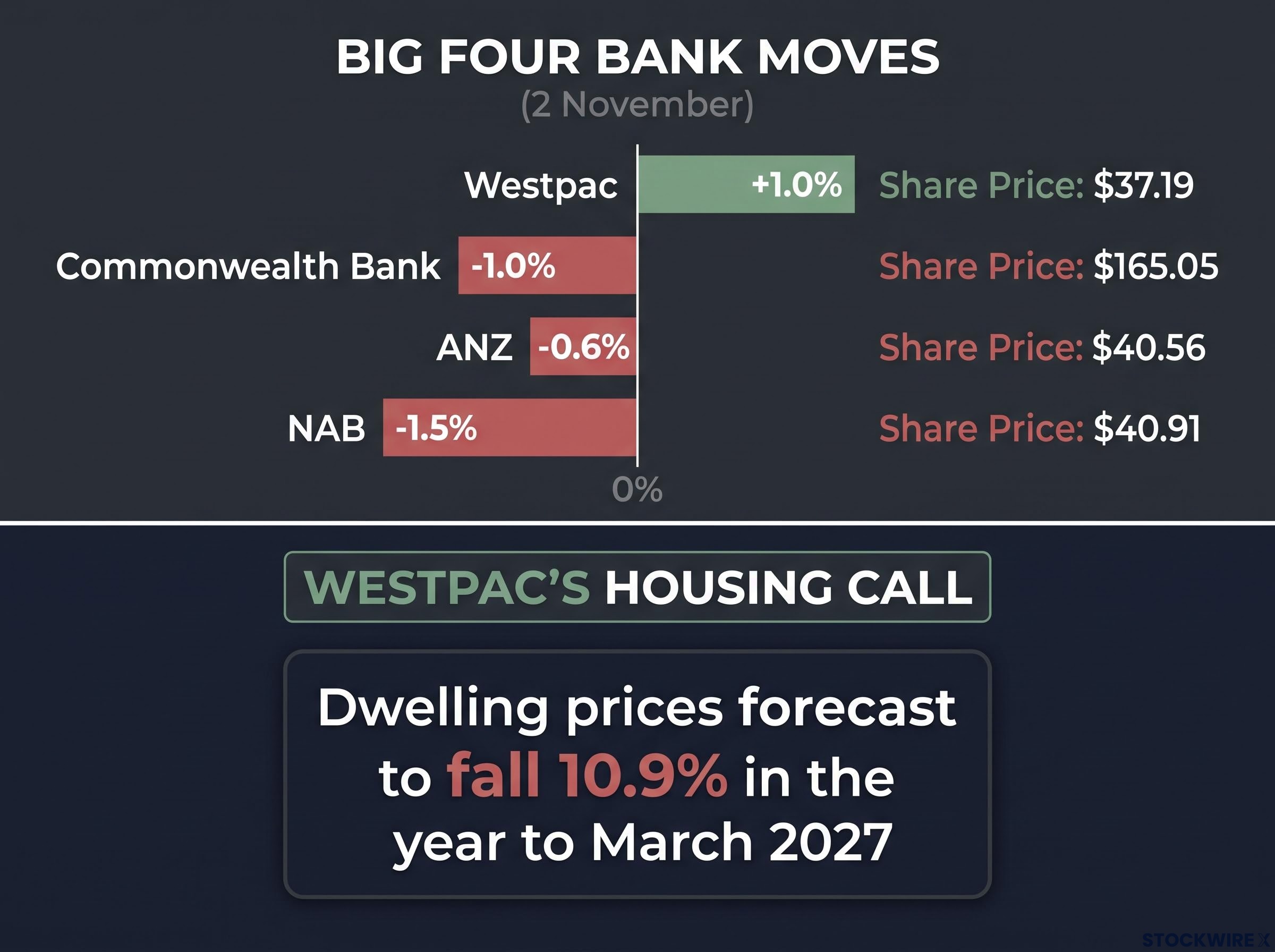
| Bank | 2 November move | Close |
|---|---|---|
| Westpac | +1.0% | $37.19 |
| Commonwealth Bank | -1.0% | $165.05 |
| ANZ | -0.6% | $40.56 |
| NAB | -1.5% | $40.91 |
Why Westpac rose while the other three fell
Westpac posted a $6.8 billion full-year result, enough to offset rate concern in a risk-off session.
The same result carried a warning that weighed on the whole sector. Westpac roughly doubled its credit-impairment charges and forecast housing credit growth slowing to 3.8% in the coming financial year.
Westpac’s housing call Dwelling prices are forecast to fall 10.9% in the year to March 2027, deeper than any downturn since 2008.
CEO Anthony Miller said a further rise beyond November was possible, while Westpac economists expect two cuts in the second half of 2027. These are forecasts and remain subject to market conditions; past performance does not guarantee future results.
History suggests repayments keep climbing after the headline move. In 2022, the RBA raised rates by 3 percentage points to 3.10%, and the average outstanding mortgage rate rose almost 2 points to 4.7% as loans repriced. On a $600,000, 30-year loan, the current cycle adds about $500 to monthly repayments if today’s move goes ahead.
If you hold bank shares or a variable mortgage, the lesson is the same: one hike can lift margins and deepen the housing and credit strain that later hits earnings and your household cash flow.
What does the hike mean for the ASX 200, the Australian dollar and global markets?
The local market went into the decision cautious. The ASX 200 fell 51.6 points, or 0.58%, to 8,856.5 on Monday, with miners down 1.5% after recent softness in gold and copper.
Overnight, the picture shifted. Futures pointed to the index opening about 0.7% higher, and the thread tying that rebound together was oil.
Oil, gold and the Australian dollar
Hopes of an end to the roughly eight-month US-Iran conflict pushed crude sharply lower as Iran held talks with Qatari officials:
- Brent crude: down 8% to US$104.98 a barrel
- Gold: up 1.8% to US$3,969 an ounce, rebounding from a one-year low
- Copper: up 1.3%
- Iron ore: up 0.4% to US$91.25 a tonne
- Australian dollar: about 70 US cents
Cheaper oil eases inflation fears, which helps gold and risk appetite. Yet the Australian dollar was an exception as most currencies firmed against the US dollar.
Higher local rates can support the currency by improving its yield. It can still lag if US yields stay high, with the US 10-year Treasury at 4.90%, or if markets read the hike as a response to stubborn domestic inflation rather than strong growth. The US Federal Reserve held its range at 3.75%-4.00%, though two members preferred a hike.
| Asset | Move | Level |
|---|---|---|
| ASX 200 (2 November) | -0.58% | 8,856.5 |
| Brent crude | -8% | US$104.98 |
| Gold | +1.8% | US$3,969 |
| US 10-year yield | Down 3 points | 4.90% |
Wall Street and Europe
Wall Street was mixed late in its session: the Dow up 0.8%, the S&P 500 flat and the Nasdaq down 0.3%. Lower oil helped, but AI-spending worries hit growth stocks, which are sensitive to yields because higher rates reduce the present value of earnings far in the future. Oracle fell 8.5% after flagging a US$20 billion debt and equity raise for AI infrastructure, and Intel kept sliding.
Europe, a heavy energy importer, liked cheaper oil more. The Euro STOXX 300 rose 0.4%, the FTSE 100 0.3%, and travel and leisure jumped 3%.
The takeaway for you: global yields and oil can move Australian equities and the dollar as much as the RBA, so read today’s decision alongside them.
For readers wanting the wider picture, our full explainer on what moves the Australian dollar weighs RBA policy against iron ore, China and risk sentiment.
What are the scenarios, and which events could change the picture this week?
The RBA’s message this afternoon is likely to fall into one of three shapes:
- A hike with a “finished” signal. Markets could rally, bank shares could steady and mortgage expectations could ease.
- A hike with the door open to 5.10%. Mortgage and equity markets could tighten further even without an immediate move.
- An upside surprise in the forecasts. Higher inflation projections in the Statement on Monetary Policy would strengthen the ANZ case for more.
Each carries counter-risks. Commentary suggests oil is pricing diplomacy rather than a completed deal, so the inflation impulse could reverse quickly either way. The bank could also overshoot into housing and unemployment, and earlier 2026 hikes are still working through the economy with a lag. These outcomes are speculative and subject to change as markets develop.
The calendar to watch
- Tuesday 3 November, 2:30 pm AEDT: RBA decision, Statement on Monetary Policy and commentary on further hikes
- Tuesday 3 November, after the US close: Apple earnings
- This week: US September JOLTS job openings, factory orders and durable goods orders
- Wednesday 4 November, mid-morning to early afternoon AEDT: US midterm results begin arriving
- Ongoing: US-Iran talks, including Iran’s discussions with Qatari officials
Treat the statement’s wording on further hikes, together with oil and US yields, as the variables most likely to shift mortgage, bank and currency expectations from here.
Reading the decision beyond the 25 basis points
The move to 4.85% is largely priced. What remains open is whether the RBA stops there, and how much the housing and credit chain absorbs before it does.
Three signals matter most before you weigh any change to your exposure. First, the RBA’s language on further increases: a closed door and an open one point bank shares and borrowers in different directions. Second, oil, which now carries much of the inflation story on its own. Third, US yields, which can override local rate settings for growth stocks and the Australian dollar.
Read together, those three tell you more than the headline number.
This article is for informational purposes only and should not be considered financial advice. Investors should conduct their own research and consult with financial professionals before making investment decisions.