The US Dollar Index sits almost exactly where it started the week, and that stillness is misleading. Near 101.80, the dollar index forecast for the coming days depends on a contest between safe-haven buying on one side and political and growth doubts on the other, with both sides pulling hard.
The index held steady near 101.80 in Asian trade on Tuesday 3 November 2026, according to Standard Chartered, after easing on Monday and briefly touching 101.43. The Dollar Index (DXY) measures the US dollar against a basket of six major currencies, led by the euro.
Three catalysts now land within days of each other: the US midterm vote, reported US strikes on Iran’s Qeshm Island and the October payrolls report on 6 November. Each could move the dollar in a different direction.
Here is a way to judge which force is likely to win on each event, ending with a currency scorecard and the week’s risk map.
Why is the dollar stuck near 101.80 when the news flow is so loud?
On the surface, little has happened. FXStreet put the index at 101.72, down 0.24%, on 2 November, a small gap from Standard Chartered’s figure that reflects different publication times. Underneath that narrow range, the forces stack up on both sides.
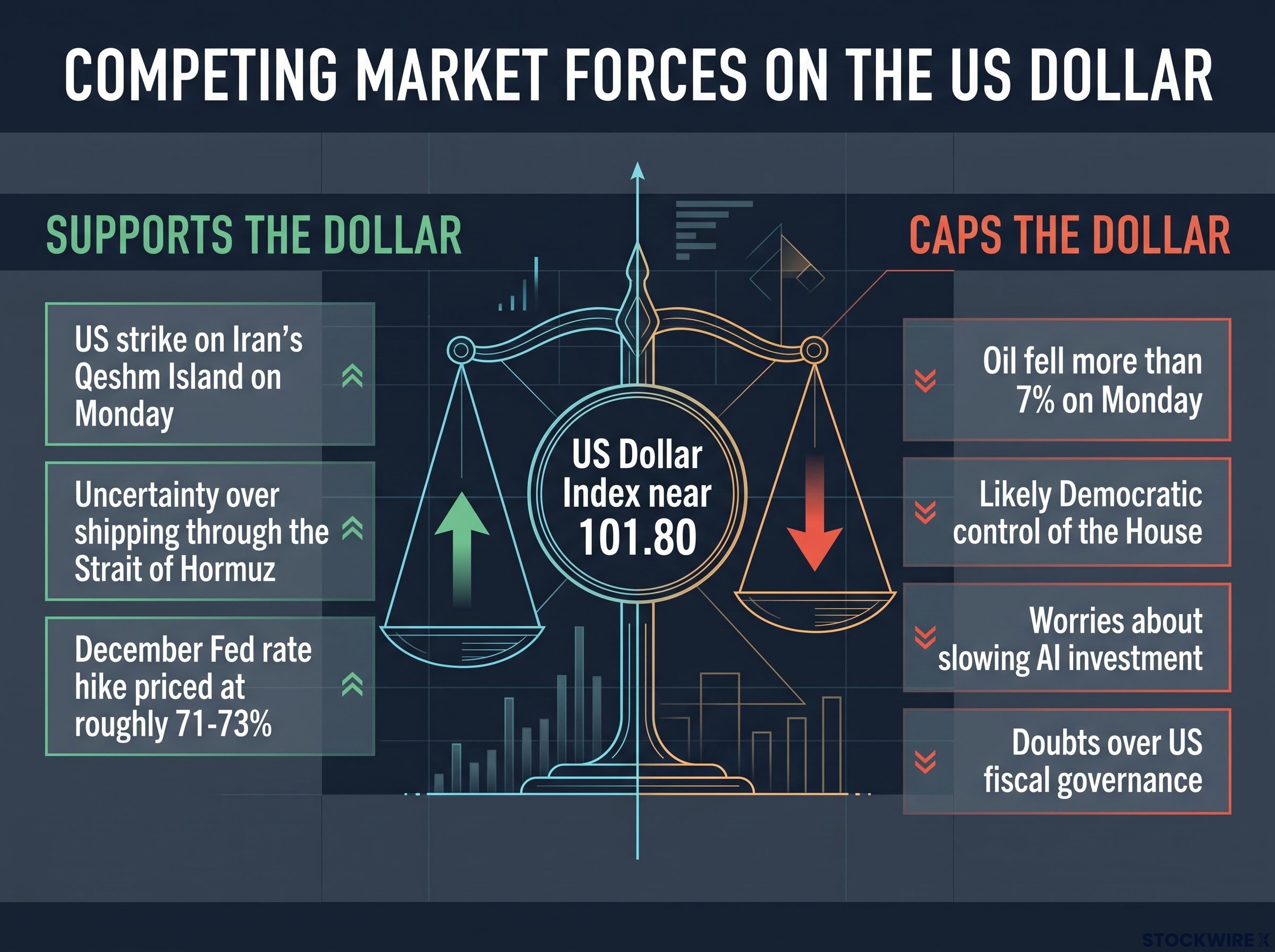
Supports the dollar
- The Wall Street Journal, citing US officials, reported a US strike on Iran’s Qeshm Island on Monday, adding to safe-haven demand.
- Uncertainty over shipping through the Strait of Hormuz.
- A December Fed rate hike priced at roughly 71-73%.
Caps the dollar
- Oil fell more than 7% on Monday on hopes of Iran negotiations.
- Prediction markets point to likely Democratic control of the House.
- Worries about slowing AI investment weigh on the US growth outlook.
- Doubts over US fiscal governance.
Some officials described the strikes as defensive, aimed at stopping Iranian attacks on commercial shipping in Hormuz, according to Reuters and Al Jazeera. Reuters also noted the eight-month conflict had already raised concern about prolonged disruption to Middle Eastern oil supplies.
Oil captures the tension best of all.
Two-sided oil pricing Brent settled at $104.77 after falling $8.66 (7.63%), then rebounded to $105.25 (up 48 cents, 0.5%) in early Asian trade on Tuesday. WTI rose 47 cents to $96.93, according to Reuters.
A flat index, in other words, is a standoff rather than calm. The market has not decided which force dominates, so for your positioning, the next catalyst matters more than today’s price.
Dollar index strength in October rested on Fed-driven yields, energy-led inflation and Iran-related safe-haven demand, three partly independent pillars that explain why the current standoff near 101.80 is being contested rather than abandoned.
When big ASX news breaks, our subscribers know first
How do safe-haven demand, Fed pricing and election outcomes actually move the dollar?
Each driver works through a distinct channel, and each can flip direction depending on how long an event lasts.
The safe-haven channel is the most familiar. In a crisis, investors buy dollars for safety and liquidity. Higher oil adds a second layer: it can raise inflation, which can push up expectations of tighter US policy. A diplomatic breakthrough reverses both, removing the defensive bid and easing price pressure.
The rate-differential channel runs through the Federal Reserve. A rate differential is the gap between interest rates in two countries; when US rates rise relative to others, holding dollars pays more. Stronger payrolls and wages would reinforce the Fed’s hawkish bias and widen that gap in the dollar’s favour.
Readings of the Fed itself diverge. Brown Brothers Harriman (BBH) said the dollar and short-term yields softened last week after Fed Chair Kevin Warsh struck a patient tone, and that AI-investment worries trimmed hike expectations. Another market report read his 29 October remarks as reinforcing those expectations.
Part of the divergence in readings stems from the fact that Warsh has removed forward guidance entirely, which concentrates repricing risk into single speeches and data releases and leaves analysts interpreting the same remarks differently.
Politics adds a third channel. Conflict in Washington can lift the dollar at first through demand for liquidity, but a prolonged shutdown or debt-ceiling fight can erode confidence in US assets, a risk flagged in MUFG/BTMU commentary. ING’s Francesco Pesole, quoted by Morningstar on 2 November, said a Democratic sweep could be mildly negative for the dollar.
| Outcome | Dollar/yield read | Mechanism | Source |
|---|---|---|---|
| Republican control of both chambers | Potentially dollar-positive initially; higher yields | More fiscal support and permissive energy policy could lift expected Fed rates | Convera; Standard Chartered |
| Democratic House, Republican Senate | Mixed; yields could rise initially | Gridlock may restrain spending, but funding disputes could hurt confidence | Reuters, 2 Nov |
| Democratic control of both | Potentially dollar-negative | Shutdown and debt-ceiling risk, AI-investment concerns | ING via Morningstar; MUFG/BTMU |
| Divided government generally | No dependable direction | Deficit restraint versus funding-battle volatility | OCBC, updated 28 Oct |
| Bipartisan energy/infrastructure legislation | Modestly positive for growth and yields; dollar uncertain | Room for approvals including nuclear power | UBS via Reuters, 2 Nov |
Fiscal restraint or political dysfunction?
The central question for divided government is which story markets choose. Read as restraint, gridlock means lower yields and less dollar support. Read as dysfunction, it brings temporary safe-haven demand, then confidence damage if a crisis drags on.
Reuters said higher Treasury yields might help the dollar initially, while stressing that a split Congress has mixed fiscal implications. OCBC found no statistically reliable post-midterm pattern in the dollar or Treasury yields, so the label on the result matters less to you than its effect on fiscal expectations, the Iran conflict and rates.
Can the October jobs report tip the December hike odds?
If the election offers no dependable rule, the payrolls report offers a measurable one. It lands Friday 6 November at 8:30 a.m. ET.
The setup starts with September’s soft print of +29k jobs. CME FedWatch put the December hike probability at 71.4% on 30 October, and market reports on 1-2 November described pricing near 73%.
| Indicator | October consensus | September actual |
|---|---|---|
| Nonfarm payrolls | +65k (BBH/FXStreet); +55k (another survey) | +29k |
| Unemployment rate | 4.2% | 4.2% |
| Avg hourly earnings m/m | +0.3% | +0.1% |
| Avg hourly earnings y/y | +2.9% | +3.0% |
Unemployment at 4.2% already sits slightly above the FOMC’s 2026 projection of 4.1%. BBH’s Elias Haddad called the report a key test, with data pointing to stabilising labour demand.
- Strong surprise: a print well above 55-65k, especially with monthly wages above 0.3%, would strengthen the hike case and lift yields and the dollar, particularly against low-yielding currencies.
- Weak surprise: a figure near zero or negative would revive hike doubts, pull yields lower and weaken the dollar, while challenging the “stabilising” reading.
Pricing of 71-73% is not certainty. On release day, judge the headline against both payrolls and wages, because a strong jobs number with soft pay tells a weaker story than either figure alone.
Fed rate hike odds have proved volatile this year, swinging from nearly 70% to a coin flip in under 48 hours ahead of September, so the 71-73% December pricing is a snapshot rather than a settled view.
How did the dollar trade against the majors, and what should you watch this week?
Monday’s session shows the dollar was not rallying uniformly.
| Currency pair | Move (Mon 2 Nov) | Dollar effect |
|---|---|---|
| EUR/USD | +0.33% | Weaker vs euro |
| GBP/USD | +0.16% | Weaker vs pound |
| USD/JPY | +0.21% | Stronger vs yen |
| USD/CAD | +0.10% | Marginally stronger |
| AUD/USD | -0.49% | Stronger vs Aussie |
| NZD/USD | -0.19% | Stronger vs kiwi |
| USD/CHF | -0.88% | Sharply weaker vs franc |
The franc delivered the standout move, with USD/CHF falling from about 0.8250 to 0.8182.
Different session, different pattern Tuesday’s FXStreet heat map, cited by analyst Akhtar Faruqui, showed the dollar modestly firmer against most majors and strongest against the franc (0.19%), with only CAD (-0.01%) slightly weaker.
That reversal tells you to watch the franc, yen and euro for the clearest reads on safe-haven versus rate-driven flows, rather than assuming a broad trend.
- Midterm results: prediction markets implied a 74% chance of a Democratic Senate; Bloomberg-referenced reporting put Democratic control of both chambers near 73% and a Republican sweep at 5.8%; Kalshi/Polymarket priced a Democratic House at roughly 91-93% on 30 October. These measure different things, and Reuters said the Senate race is tighter than the House.
- Iran headlines and oil: escalation favours the dollar; de-escalation removes the bid.
- 6 November payrolls: the clearest test of December hike pricing.
Reading the dollar’s next move without chasing a single headline
The dollar is balanced between safe-haven and rate support on one side, and falling oil, likely Democratic House control, AI worries and fiscal-governance doubts on the other. Friday’s payrolls, with consensus around 55-65k jobs, 4.2% unemployment and 0.3% wage growth, are the next decisive catalyst.
The scenarios that matter most for you are Iran escalation versus de-escalation, and strong versus weak payrolls. No reliable mechanical midterm effect exists, so let the vote’s impact on fiscal expectations, rather than the result itself, shape your read.
For readers wanting the chart context behind the 101.80 level, our deep-dive into Dollar Index technical analysis maps support and resistance zones and moving-average levels.
These statements are speculative and subject to change based on market developments. This article is for informational purposes only and should not be considered financial advice. Investors should conduct their own research and consult with financial professionals before making investment decisions.