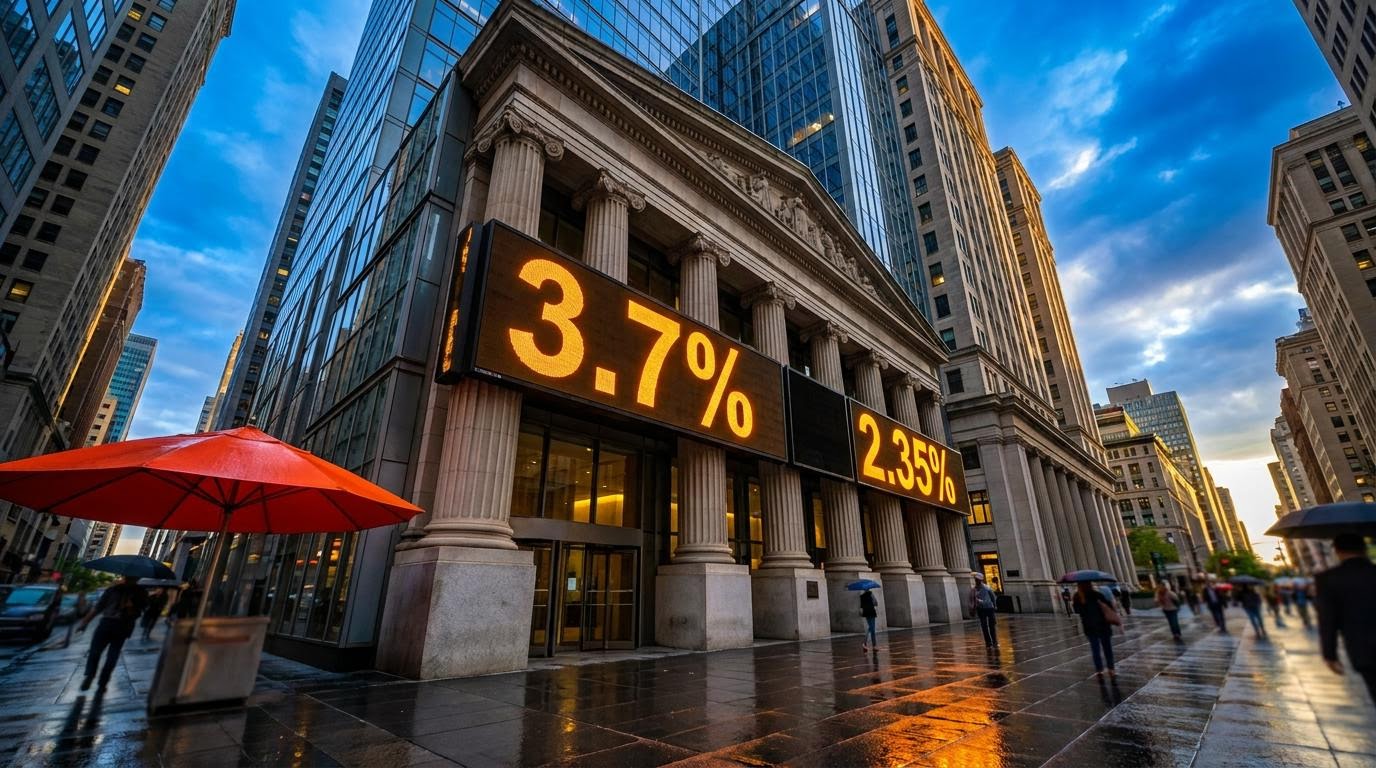
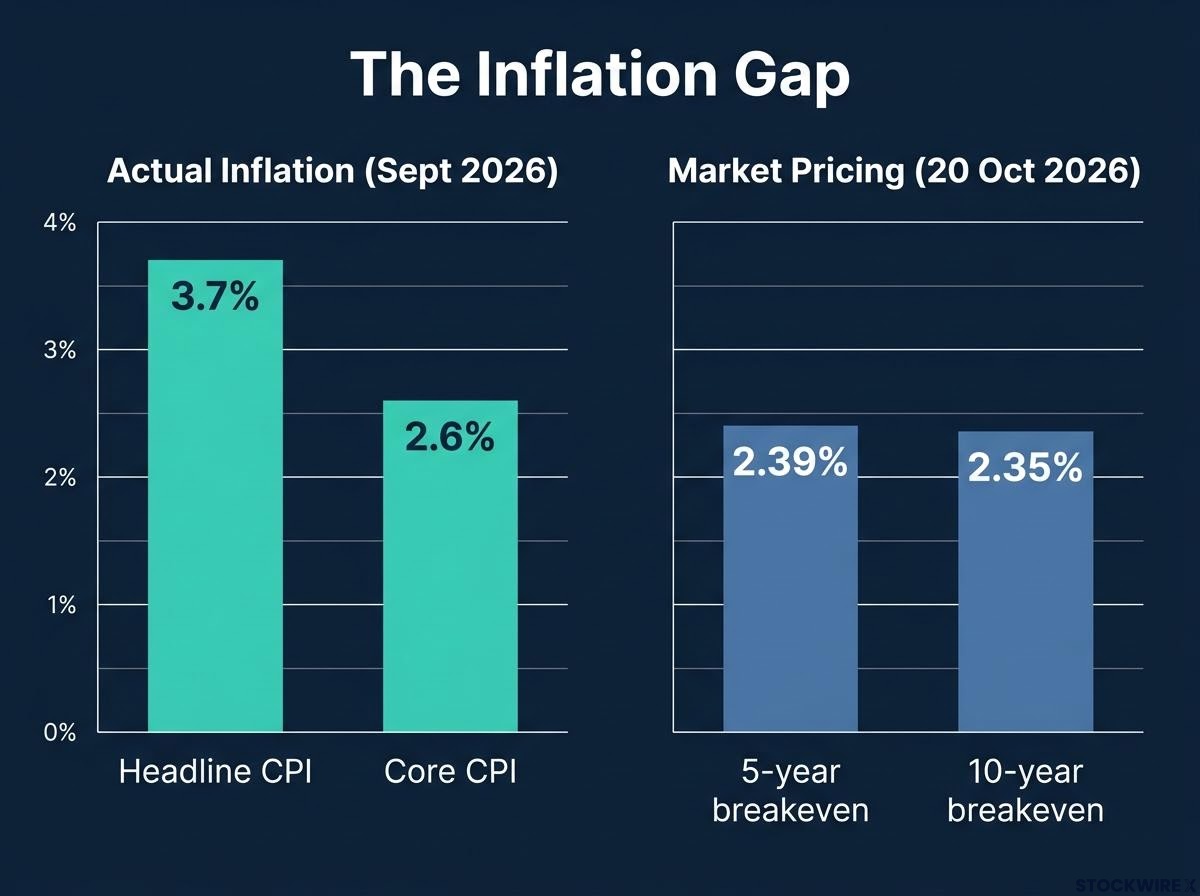
Headline inflation hit 3.7% in September 2026, yet the bond market is pricing average inflation of only about 2.35% over the next decade. That gap is the core of the case for TIPS inflation protection, and most investors never look at it.
The bond selloff is not just an American story. Nancy Davis, founder of Quadratic Capital, argues that inflation protection is cheap partly because most US institutions never hold it at all.
The reason is structural. The Bloomberg US Aggregate, the main benchmark for US bonds, does not include Treasury Inflation-Protected Securities (TIPS) at all.
Here is why the benchmark leaves TIPS out, how that shapes the way big money behaves, and which low-cost routes to inflation protection you can use now, along with the risks each one carries.
Why does inflation protection look cheap while CPI runs at 3.7%?
The numbers do not line up neatly. The Bureau of Labor Statistics reported on 14 October 2026 that consumer prices rose 3.7% year on year and 0.6% in September alone, with core CPI (which strips out food and energy) at 2.6%. The Federal Reserve raised its policy rate to 3.75%-4.00% in September, its first hike since 2023.
Yet the market’s inflation pricing has barely moved.
| Measure | Latest figure | As-of date |
|---|---|---|
| 5-year TIPS real yield | 2.55% | 21 October 2026 |
| 10-year TIPS real yield | 2.76% | 21 October 2026 |
| 5-year breakeven inflation | 2.39% | 20 October 2026 |
| 10-year breakeven inflation | 2.35% | 20 October 2026 |
| Headline CPI (year on year) | 3.7% | September 2026 |
| Core CPI (year on year) | 2.6% | September 2026 |
Davis reads contained inflation expectations and a small term premium (the extra yield investors demand for holding longer bonds) as an opportunity. She sees the US as an outlier, pointing to fiscal worries, Japan and French bonds trading above German bonds as signs of stress elsewhere.
Rising bond yields are not unique to the US; the same repricing has shown up in Japan, Germany, France and the UK, which suggests a global rate adjustment and not only an American fiscal story.
Nancy Davis, Founder, Quadratic Capital Davis considers inflation a real risk and views protection as good value at current prices.
PIMCO agrees in part, running an overweight to 5-year US TIPS this year. The counterweight matters just as much. Markets price about 75 basis points of hikes across this year and next, CME FedWatch shows roughly 86% odds of a December hike, and BBVA Research says markets price three to four more hikes by September 2027. BBVA also found that much of this year’s rise in nominal yields came from real rates repricing, not from higher expected inflation.
That tells you the market is charging little for inflation insurance, but you are still exposed to real-yield swings if the Fed keeps tightening.
What breakevens do and do not tell you
A breakeven is the average inflation rate at which a TIPS bond and a regular Treasury of the same maturity would return the same amount. It covers the whole life of the bond, not a single month.
Breakevens also carry liquidity and risk-premium effects, so treat them as a rough market price, not a clean forecast.
When big ASX news breaks, our subscribers know first
How TIPS work, and why the tax bill arrives before the cash
Start simple. A TIPS bond is a Treasury whose principal rises and falls with the Consumer Price Index for All Urban Consumers (CPI-U). Your interest is paid on that adjusted principal, so the payments grow when inflation runs hot.
Treasury first auctioned TIPS in January 1997 with a $7 billion 10-year issue. BlackRock puts the market at more than $1.5 trillion as of 30 June 2026, and SIFMA estimates TIPS at about 7.0% of $31.1 trillion in marketable Treasuries. Other estimates, such as Meketa’s $1.71 trillion for June 2025 or Treasury’s $2.087 trillion at 30 September 2025, use different bases and dates, so they are not directly comparable.
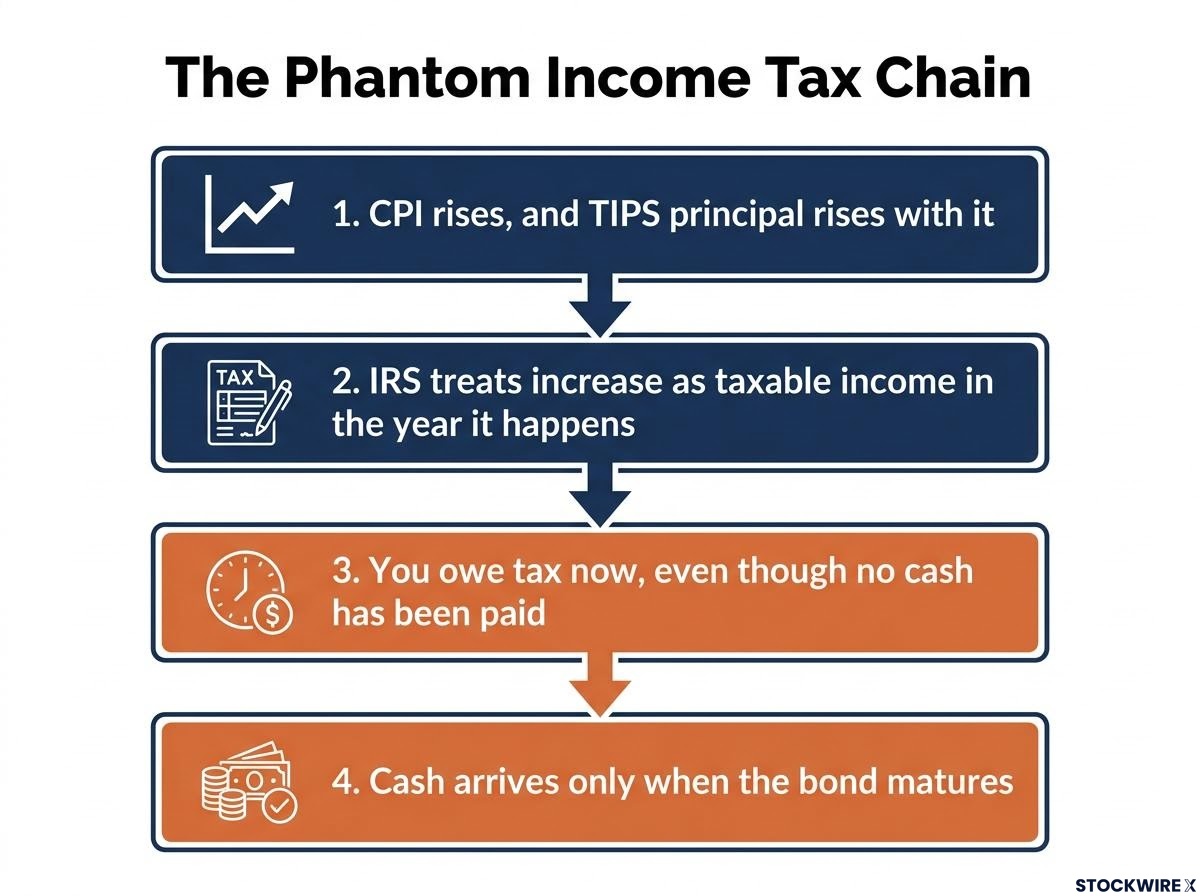
The tax treatment is where the design bites. Here is the chain:
- CPI rises, and your TIPS principal rises with it.
- The IRS treats that increase as taxable income in the year it happens.
- You owe tax now, even though no cash has been paid for that increase.
- The cash arrives only when the bond matures.
This is called phantom income: taxable income you have not actually received. It is built into the product, not an oversight.
That is why holding TIPS in an IRA or 401(k) is usually more efficient than a taxable account, where you could owe tax on money still locked inside the bond.
Cash and short bills can leave you with a negative real after-tax return at every common federal bracket when CPI runs this hot, which is part of why TIPS and other fixed income alternatives deserve a look.
Funds versus individual bonds
A TIPS ETF can pass the inflation adjustment to you as monthly distributions. An individual bond holder normally receives it only at maturity.
Individual TIPS held to maturity repay at least their original principal, even after deflation. Funds offer no such guarantee. Vanguard notes that a fund’s yield-to-maturity blends the real yield with a trailing inflation adjustment, so your realised return depends on inflation that has not happened yet.
Why the Aggregate leaves TIPS out, and what that does to institutions
That phantom-income problem has a history, and it reaches all the way to the benchmark.
The 1997-1998 episode
TIPS joined the Lehman Aggregate, the predecessor to today’s Bloomberg index, in 1997. They lasted about a year before being removed in 1998.
The commonly cited reason is the same tax quirk described above: inflation adjustments created taxable income without matching cash. The original index notice could not be located, so treat that rationale as widely reported rather than documented.
Benchmark design drives behaviour
Today the Bloomberg US Aggregate is built to represent the nominal investment-grade bond market. Any manager who adds TIPS is making an active bet, which creates tracking error (the gap between a portfolio’s returns and its benchmark’s).
If inflation surprises upward, TIPS may beat nominal bonds and the Agg. If inflation falls or real yields rise, they may lag, and duration, sector weights and the return pattern all drift away from the index.
The benchmark trade-off Inflation protection can make a portfolio more resilient in the real world while making its reported tracking error worse.
US pensions, insurers and other institutions are largely judged against nominal benchmarks. So TIPS end up as satellite, liability-hedging or tactical holdings, even where liabilities rise with inflation.
Other markets frame this differently, though current methodology details were not confirmed:
- United States: the main bond benchmark is nominal only, with no TIPS.
- United Kingdom: pension benchmarks often use CPI-plus targets, and inflation-linked gilts tied to RPI or CPI are a standard liability hedge.
- Australia: CPI-plus benchmarks are common, and the CPI reference index is published quarterly rather than monthly.
The lesson for you: thin institutional demand for TIPS reflects how managers are measured, not proof that protection is unnecessary. That is the opening Davis says individual investors can use, because you answer to no benchmark.
How can US investors hold inflation protection cheaply, and what can go wrong?
Your main decision is duration, which measures how sensitive a bond’s price is to interest rate changes. Morningstar found long-maturity TIPS were nearly twice as volatile as 5-10-year TIPS over a recent 20-year period.
Your exposure here comes down to real-rate duration: a 30-year TIPS carries roughly 29 years of it, so a one percentage point rise in real yields can cut its price by close to 29%, whatever CPI is doing.
| Method | Example | Advantage | Trade-off |
|---|---|---|---|
| Short-term TIPS fund | VTIP | Low cost, liquid, lower duration; largest TIPS fund at about $55B (March 2025) | No maturity guarantee; falls when real yields rise |
| Broad TIPS ETF | TIP, VTP | Diversified, inexpensive, easy to trade | More real-rate risk |
| Individual TIPS ladder | Staggered 5-, 7-, 10-year+ bonds | Known maturities; principal floor | More capital and management; spreads |
| I bonds | Series I Savings Bonds | CPI-linked; federal tax deferral; no state or local income tax | Purchase limits; first-year lockup |
A practical order of preference
- Short- or intermediate-term TIPS fund in a tax-sheltered account: the cheapest effective route for most people.
- Individual TIPS ladder: when you have specific spending dates and can hold to maturity.
- I bonds: for eligible savers within purchase limits, accepting a three-month interest penalty if redeemed before five years.
- Breakeven or steepener trades: only if you understand basis, leverage and liquidity risk. Davis’s IBAL ETF, holding about 75% TIPS plus options on a yield curve steepener, shows what a hybrid looks like; it is an example, not a recommendation.
Where TIPS can still hurt you
- Real-rate risk: prices fall when real yields rise, even with high CPI. Morningstar warns this can overwhelm the inflation benefit.
- Tax drag: adjustments and coupons are generally ordinary income in taxable accounts.
- CPI mismatch: CPI-U may not match your own spending on housing, food or healthcare. Critics say it understates some households’ inflation, though it remains the legal reference.
- Liquidity: about 53 issues outstanding as of June 2025, a far smaller market than nominal Treasuries.
- Deflation: selling individual bonds early can mean losses, and funds have no principal floor.
Even the simplest route can lose money if real yields keep climbing. Past performance does not guarantee future results, and projections are subject to market conditions.
What the benchmark gap changes, and what it does not
The Aggregate leaves TIPS out by design and because of an old tax problem. That keeps institutions underweight and may leave protection modestly priced. It does nothing to remove real-rate risk.
Your takeaways are practical: hold TIPS where the tax treatment works for you, match duration to your purpose, and treat breakeven and steepener trades as outside the default toolkit.
Weighing TIPS against gold is a common next step, and the two hedge different risks: gold has tracked geopolitical and monetary regime fears, while TIPS pay out against measured CPI, with 30-year real yields near 3.05%.
The timing matters. Markets expect a hold at the 27-28 October Fed meeting, but December hike odds sit near 86%. Settle your duration and account placement before the next repricing, not after it.
This article is for informational purposes only and should not be considered financial advice. Investors should conduct their own research and consult with financial professionals before making investment decisions.