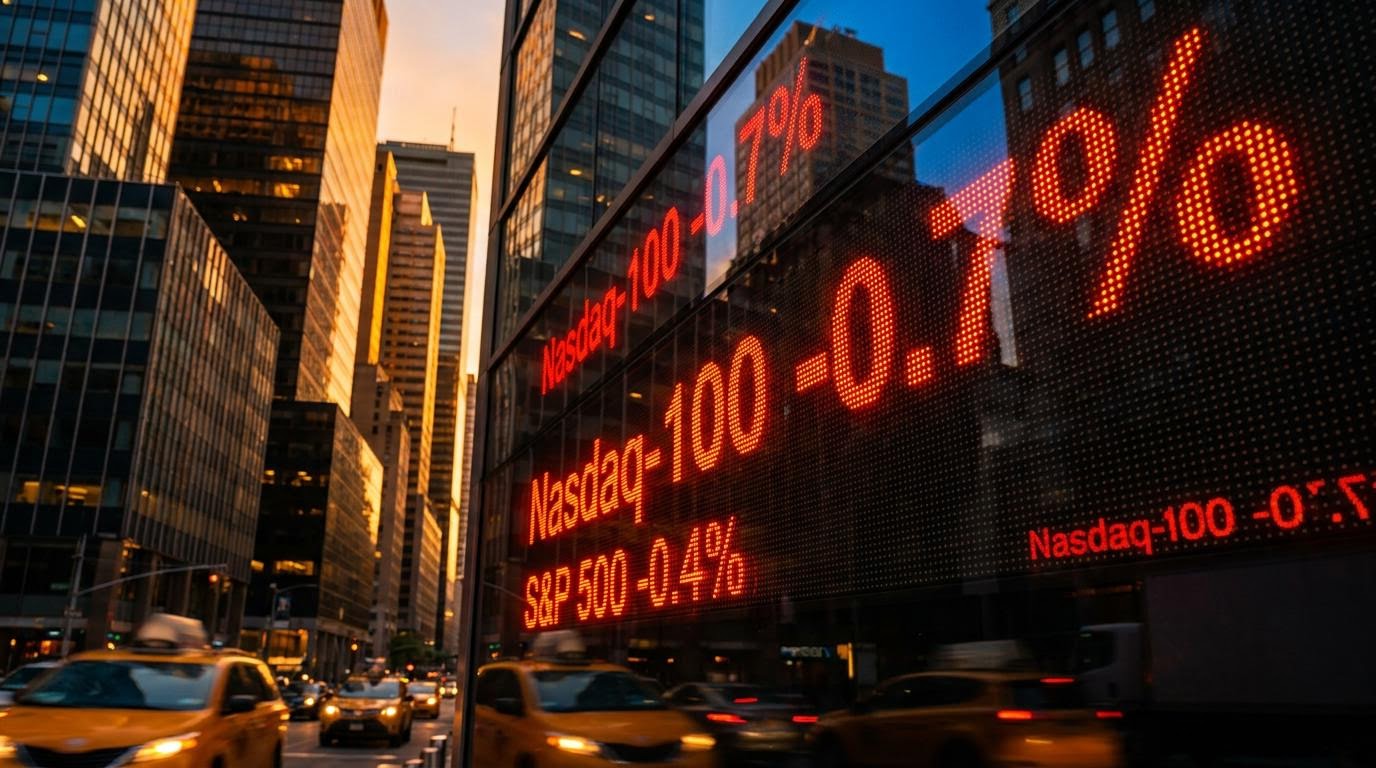
Wall Street’s AI rally lost momentum on Thursday, 22 October 2026, as US index futures slipped after a strong Wednesday session. Nasdaq-100 futures fell roughly 0.6% to 0.7%, S&P 500 futures dropped about 0.4% and Dow futures eased around 0.3%, with results from Tesla and Meta Platforms driving the pause.
The retreat followed a confident close. On Wednesday, the Dow finished at 52,856.09, the S&P 500 at 7,757.17 and the Nasdaq Composite at 26,702.86, up 1.05%, as earnings from SpaceX and Super Micro Computer gave traders fresh reasons to back AI demand.
Overnight, the question changed. A market that rewarded AI demand on Wednesday is now asking what that demand costs to build.
Here is how to judge why a stock can fall on an earnings beat, and what Tesla’s smaller spending plan does and does not reveal about the pace of AI and robotics investment.
Why did Tesla fall on an earnings beat while Meta’s gain faded?
On the headline numbers, both companies delivered. Tesla’s adjusted earnings per share (EPS, the profit attributed to each share) came in at $0.48, ahead of the roughly $0.44-$0.45 consensus. Meta’s revenue reached $64.60 billion, beating the $63.37 billion forecast and rising 26% year over year.
Then investors read past the first line.
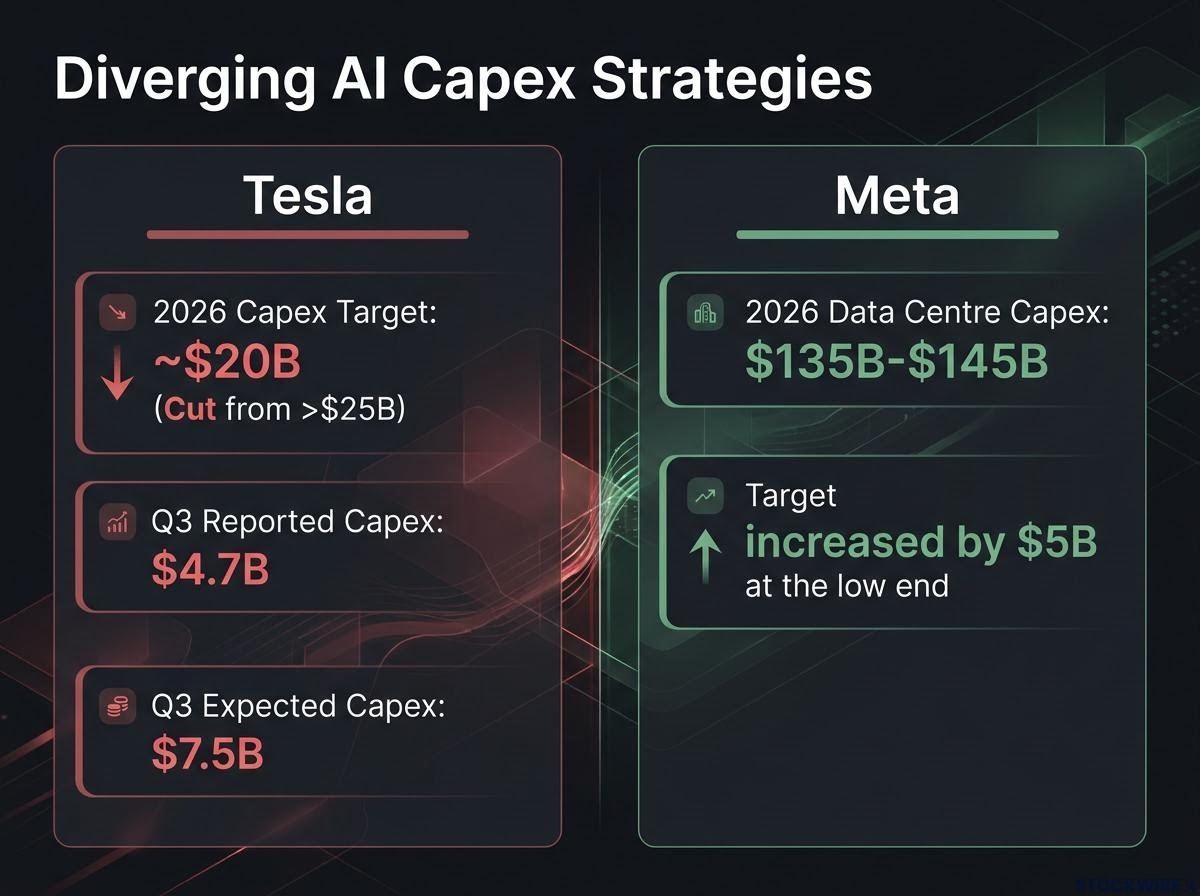
Tesla’s revenue of $28.05 billion was roughly in line with, or slightly below, consensus estimates of about $28.06-$28.13 billion, depending on the data provider. The bigger surprise was capital expenditure (capex, money spent on long-term assets such as factories and data centres): about $4.7 billion in Q3 2026, against roughly $7.5 billion expected by LSEG analysts. Shares, which had climbed about 3.5% before the report, fell more than 3% after hours and stayed lower pre-market.
Meta’s second layer pulled the other way. EPS of $3.83 absorbed a $9.89 billion litigation charge, while Q4 guidance of $73-$76 billion came alongside a 2026 data centre capex range of $135-$145 billion, with the low end raised by $5 billion. The stock rose more than 2% after hours, then drifted to near flat or marginally lower pre-market. These figures are snapshots and shift through the session.
| Metric | Tesla reported | Tesla expected | Meta reported | Meta expected |
|---|---|---|---|---|
| EPS | $0.48 (adjusted) | $0.44-$0.45 | $3.83 (incl. litigation charge) | Above reported (Visible Alpha) |
| Revenue | $28.05B | $28.06B-$28.13B | $64.60B | $63.37B |
| Capex | $4.7B (Q3) | $7.5B (LSEG) | $135B-$145B (2026) | Prior range $130B-$145B |
The lesson is that a headline beat tells you little on its own. Before judging a reaction, check what was already priced in, then guidance, cash flow and spending.
The expectations gap between reported results and what was already priced in explains why Tesla fell on a beat, since a pre-report run-up of about 3.5% left little room for an in-line quarter.
Why a beat can still be sold
- Priced-in gains: Tesla’s pre-report run-up meant some upside was already in the price.
- Valuation: high-growth stocks need evidence that new businesses are accelerating, not just a solid quarter.
- Guidance outweighs the quarter: forward spending plans can matter more than past results.
- Thin after-hours liquidity: fewer traders means modest selling can produce outsized moves.
What does Tesla’s lower capex target say about the pace of AI and robotics spending?
Tesla cut its 2026 capex target to about $20 billion from more than $25 billion, a reduction of roughly 20%. It did not name the projects affected. The market took the bearish view first.
The bearish reading
- Q3 spending of about $4.7 billion fell well short of the $7.5 billion expected.
- Investors may infer delays to data centre capacity, robotics production or robotaxi deployment.
- Tesla’s valuation leans heavily on future businesses in autonomy, robotics and AI services.
Bloomberg-based coverage framed the concern directly:
Market read The lower spending plan “cloud[ed]” Elon Musk’s effort to turn Tesla into an AI and robotics company.
The charitable reading
- Tesla said the target would be funded primarily from operating cash flow, which points to discipline rather than distress.
- Lower spending helped produce unexpectedly positive free cash flow (cash left after operating costs and investment) in the quarter.
- The company may be avoiding premature capacity until autonomous service economics are clearer.
Neither reading settles the question. The evidence supports less near-term deployment than Wall Street expected, not an abandoned strategy.
Tesla’s valuation, which sat near a 188x forward P/E after the first quarter, rests on autonomy and robotics timelines that a smaller capex plan makes harder to underwrite.
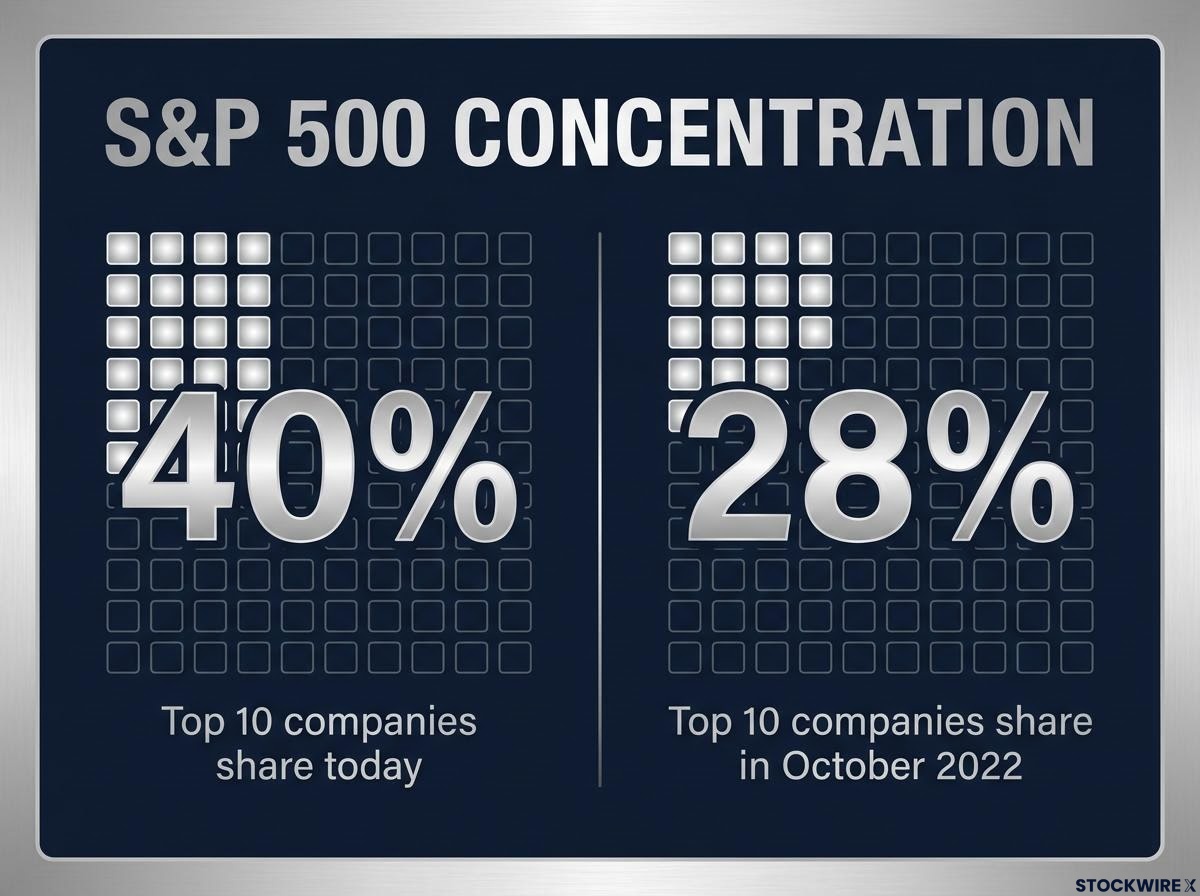
Meta sits at the opposite end of the spending range, yet its plan drew scrutiny too. Reuters reported investors increasingly questioning how the AI build-out will be financed and whether it will pay off. Concentration raises the stakes: the top 10 companies make up about 40% of the S&P 500, against about 28% in October 2022, and Edward Jones strategist Angelo Kourkafas warned of outsized portfolio impact if the dominant theme falls out of favour.
If you hold or watch AI-linked names, spending is now being treated as evidence of conviction. Cuts and increases are both under the microscope.
Which earnings on Thursday could test the market, and how should you read the pre-market signals?
Before reacting to the early tape, remember that futures and pre-market prices are indications, not forecasts of the close. Index futures readings also vary slightly by source, with the Nasdaq-100 cited at -0.6% and about -0.7%.
- Thin liquidity: small orders can move prices sharply.
- Institutional flow at the open: IG notes a stock up 8% at 7 a.m. can open flat or lower once institutional selling arrives.
- Headline-only reactions: first moves often reverse after traders read guidance and margins.
- Overnight shifts: moves in Treasury yields or oil can change direction before the bell.
Three reports will test that filter today, according to the Investing.com earnings calendar.
| Company | Expected EPS | Expected revenue | Timing |
|---|---|---|---|
| Procter & Gamble | $1.88 | $22.79B | Before the open |
| Lockheed Martin | $7.52 | $20.48B | Before the open |
| Western Digital | $4.08 | $4.14B | After the close |
Because P&G and Lockheed report before the bell, their early moves deserve the most caution. Wait for the opening auction and the full details before drawing conclusions.
Western Digital, the AI-adjacent name after the close, speaks to the larger test: whether AI revenue and productivity catch up with the capital being committed.
What Thursday’s pause does and does not change for the AI trade
One day of softer futures after a strong Wednesday is a pause in sentiment, not a verdict on the AI trade. What has shifted is the lens. Tesla’s cut and Meta’s expanded budget show investors now weigh the cost of AI as closely as the demand for it.
The variable to watch is evidence that AI revenue and productivity are keeping pace with spending. Today’s reports from P&G, Lockheed Martin and Western Digital offer the next data points, and the opening auction will say more than the pre-market tape.
Investors exploring whether spending growth is already slowing can read our deep-dive into AI investment cooling signals, which examines the projected $600 billion hyperscaler cash gap.
This article is for informational purposes only and should not be considered financial advice. Investors should conduct their own research and consult with financial professionals before making investment decisions. Past performance does not guarantee future results. Financial projections are subject to market conditions and various risk factors.
—