
UBS is raising its forecasts for European company profits while the European Central Bank (ECB) tightens policy and energy prices stay high. The bank’s wealth management arm now expects eurozone earnings to grow about 15% in both 2026 and 2027, a stance that runs against the usual assumption that costly money and costly energy squeeze margins.
The timing matters. Third-quarter reporting season is about to begin, and consensus expects STOXX 600 earnings to rise about 19.4% year-on-year. Matthew Gilman, head of European equity strategy at UBS Global Wealth Management’s Chief Investment Office (CIO), remains constructive on the region’s stocks.
If you hold European equities, or are deciding whether to, the source of that growth matters as much as its size. A recovery driven by revenue and broad demand behaves very differently from one inflated by a single sector.
Here is where the profit growth is coming from, which sectors UBS favours and why, and which risks would break the bullish case.
Why is UBS raising profit forecasts while rates and energy costs climb?
The forecast path from 7% to 15%
The 15% figure did not arrive in one step. In late 2025, UBS forecast eurozone earnings growth of 7% for 2026, nudged up from 5%, and 18% for 2027.
By the June 2026 House View, the bank had settled on 8% for 2026 and 15% for 2027 for the Euro Stoxx 50. It held those numbers in August, even after a strong first-quarter reporting season. Then, in September, it lifted the 2026 forecast to match.
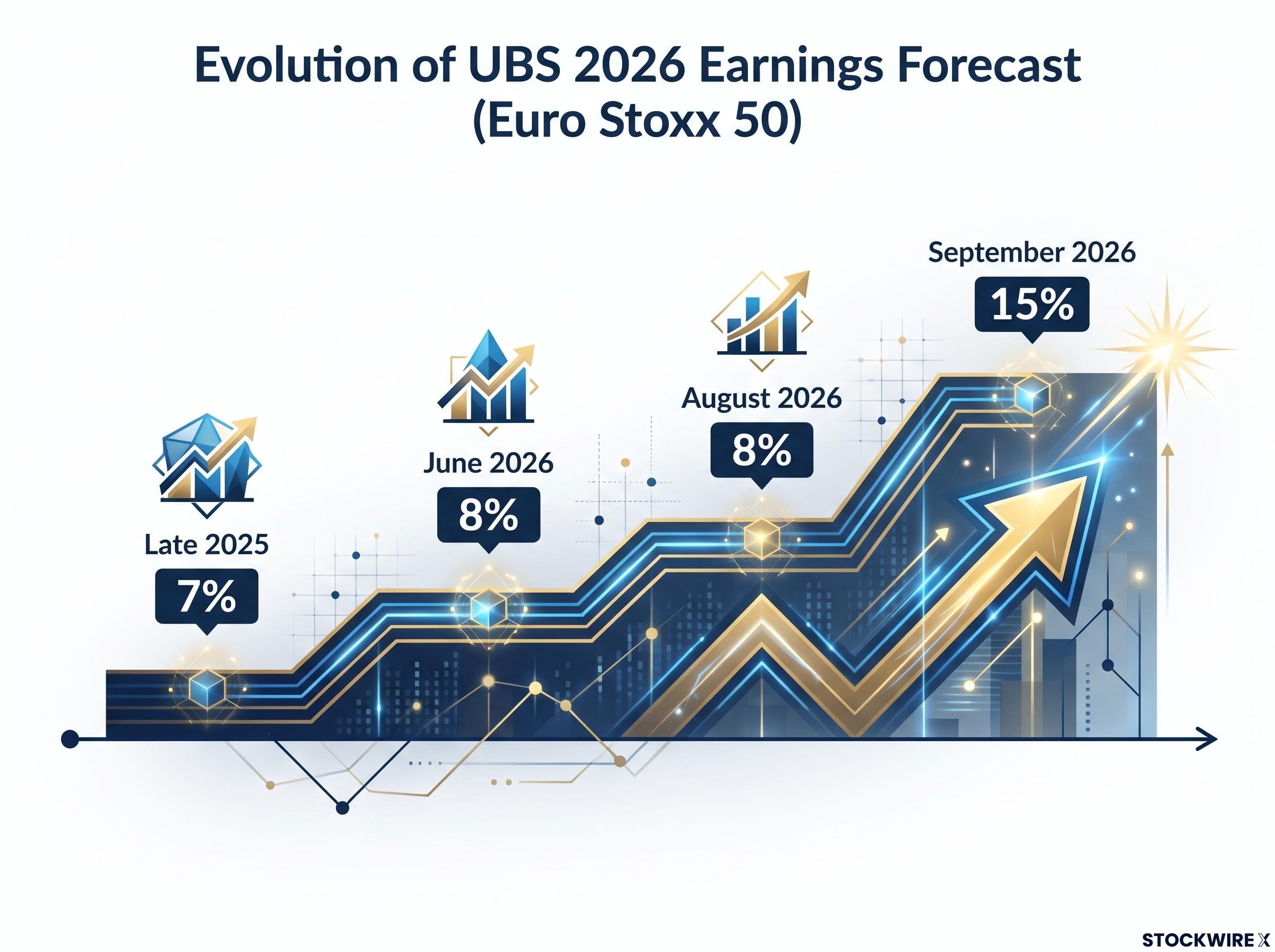
UBS House View, September 2026 UBS said it would lift its earnings growth forecast to 15% and continues to expect roughly the same in 2027.
| Period/Source | 2026 growth forecast | 2027 growth forecast | Context |
|---|---|---|---|
| Late 2025 eurozone note | 7% (from 5%) | 18% | Eurozone equities upgraded to Attractive |
| June 2026 House View | 8% | 15% | Euro Stoxx 50 basis |
| August 2026 House View | 8% | 15% | Held after strong Q1 season |
| September 2026 House View | About 15% | About 15% | Earlier 2026 figures superseded |
Compounded, 15% a year comes to roughly 32% over two years. An earlier mid-2026 UBS note cited about 25% cumulative growth, but that figure reflected the lower forecast in place at the time and has been overtaken.
The sequence tells you something useful. UBS waited for delivered results before moving its 2026 number, which makes the 15% call a response to evidence rather than a one-off burst of optimism.
Revenue and currency as the new drivers
Gilman’s framing is that revenue is gaining weight as a profit driver, adding to cost control that companies already have in place. This is a volume story, not a cost-cutting story.
He also says currency movements are turning from a drag into a benefit for earnings. The research does not quantify the exchange-rate move behind that view.
UBS’s macro team expects eurozone growth to accelerate from 1.0% in 2025 to 1.5% in 2026, supported by healthy household balance sheets, a strong labour market and German fiscal spending. Double-digit revenue growth combined with faster earnings growth points to operating leverage, which means profits are growing faster than sales.
When big ASX news breaks, our subscribers know first
What does the Q3 earnings season setup actually show?
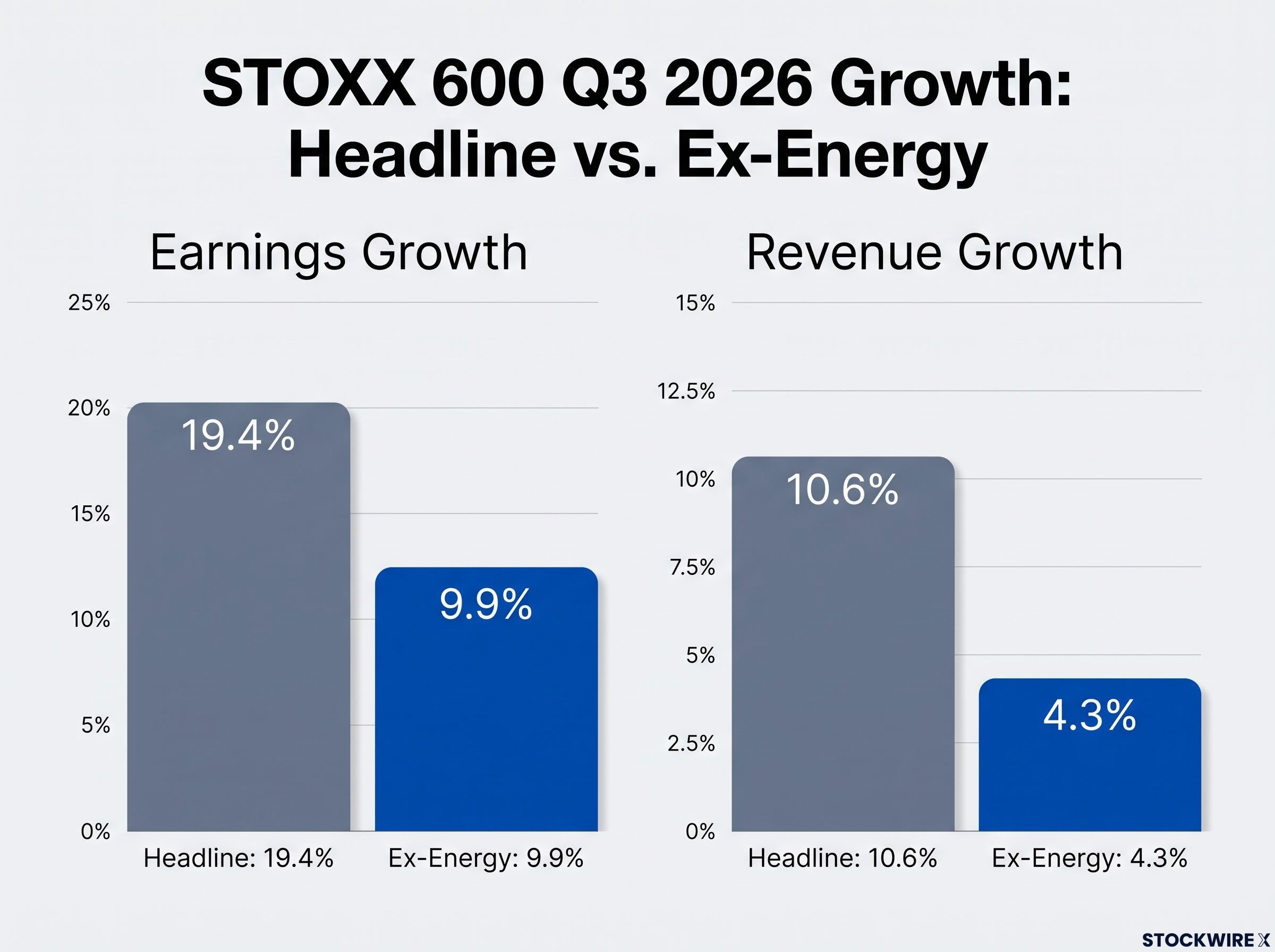
On the surface, the numbers look exceptional. According to LSEG I/B/E/S consensus data compiled by Exante on 5 October 2026, STOXX 600 earnings are expected to climb 19.4% in Q3 2026, with share-weighted earnings reaching €156.8 billion against €131.3 billion a year earlier.
Strip out energy, and the picture changes.
| Metric | Headline | Ex-Energy | Gap |
|---|---|---|---|
| Q3 2026 earnings growth | 19.4% | 9.9% | 9.5 points |
| Q3 2026 revenue growth | 10.6% | 4.3% | 6.3 points |
The energy effect Headline Q3 earnings growth of 19.4% shrinks to 9.9% once energy companies are removed.
Energy accounts for roughly half the headline growth. That means you should judge this season on ex-Energy growth and on how many sectors beat expectations, not on the top-line figure.
The reassurance sits in the breadth. Nine of ten STOXX 600 sectors expect improved earnings, and fifteen of sixteen countries expect positive growth. The research does not include sector-by-sector percentages, so the exact spread remains unclear.
The prior quarter offers a useful precedent: the ex-energy figure for Q2 STOXX 600 earnings growth came in near 10%, with eight of ten sectors positive, which is the benchmark Q3 breadth now has to confirm.
The September macro data supports that breadth:
- Eurozone flash composite Purchasing Managers’ Index (PMI) rose to 53.1 from 52.0 in August (a reading above 50 signals expansion)
- Germany’s flash composite PMI jumped to 53.8 from 51.8
- German services returned to growth at 52.9
- German manufacturing eased to 53.8 from 54.3
- The ECB Bulletin showed the composite PMI averaging 52.0 over July-August, up from 49.1 in Q2
All of this came after the ECB raised its key rate by 25 basis points to 2.5% on 10 September. Activity is holding up despite tighter policy, which is the backdrop the UBS thesis needs.
Where is UBS positioned, and why?
The preferred areas
UBS’s favoured areas within the eurozone are information technology, industrials, banks, Germany and health care. Read as a list, they look scattered. Read by driver, they form one pro-cyclical bet on investment and capital spending.
Germany and industrials share a source: German fiscal spending on infrastructure feeds directly into capex-linked industrial demand. IT rides the same investment cycle through digitalisation and automation, and Gilman argues that AI investment is limited more by supply than by funding.
Banks, upgraded to Attractive alongside Germany in November 2025, benefit from the same recovery. UBS cites reasonable valuations, rising loan growth and capital-market activity, ongoing repricing of assets after the ultra-low-rate decade, and ECB cuts that are largely behind them.
Gilman adds that expensive energy makes a stronger argument for spending on electrification and defence, areas he views as mostly shielded from broader economic anxieties. Exante’s finding that nine of ten sectors expect improvement fits a broad capex cycle. Health care is the defensive anchor, offering secular demand with less cyclical sensitivity.
| Area | UBS stance | Core rationale | Key sensitivity |
|---|---|---|---|
| IT | Preferred | AI and digitalisation investment | Supply constraints |
| Industrials | Preferred | Capex, electrification, fiscal spending | Trade and export demand |
| Banks | Preferred | Loan growth, asset repricing, valuations | Economic slowdown |
| Germany | Preferred | Fiscal stimulus | Inflationary pressure |
| Health care | Preferred | Defensive growth | Lower cyclical upside |
| Consumer discretionary | Selective | Rebound once energy flows improve | Rates, oil, weak demand |
Why consumer discretionary is the exception
The sector has slid as borrowing costs and oil prices have climbed. Gilman anticipates a recovery as prospects for energy supply brighten, but he is not buying the whole sector.
UBS leans towards premium-end spending via its “Luxury & Lifestyles” theme, which it believes will hold up better. Mass-market consumer businesses face weak demand, limited pricing power and pressure on real incomes.
That split shows you how UBS is positioning: for continued recovery, with a hedge against the very demand and margin risks it names. You can apply the same framework to your own European allocation.
How do UBS’s preferences work, and what is an “Attractive” rating?
Broker commentary relies on shorthand. Here are the terms used throughout:
- Attractive rating: UBS’s positive rating for equities it expects to outperform over the next 12 months
- STOXX 600: an index of the 600 largest European companies by free-float market value across 17 countries
- Euro Stoxx 50: an index of the 50 largest eurozone blue-chip companies
- LSEG I/B/E/S: a provider of institutional consensus estimates, meaning the average of analysts’ earnings and revenue forecasts
- Operating leverage: the effect where profits grow faster than revenue because some costs stay fixed
Operating leverage in one line When revenue grows faster than costs, profit margins widen and earnings outpace sales.
The Q3 consensus shows how this works. Revenue growth of 10.6% alongside earnings growth of 19.4% illustrates the effect, though energy distorts both numbers.
Real-world cases show how operating leverage works at company level: a disciplined cost base can turn single-digit revenue growth into earnings expansion several times larger, which is the same mechanism UBS expects to lift European margins.
The valuation link matters just as much. UBS’s case rests partly on “reasonable valuations”, meaning share prices are not stretched relative to expected profits.
That support only holds if the profits arrive. If earnings disappoint, valuations look less reasonable at the same time as growth falls short, so a miss would hurt you twice.
What could break the thesis, and what should you watch?
Gilman frames the central question himself: will higher input costs and interest rates erode demand or margins? Consumer-facing companies, with weak demand and limited pricing power, are the most exposed.
Policy is the next layer. After September’s hike to 2.5%, Bundesbank President Joachim Nagel flagged oil as an increasingly important factor in rate decisions. ING’s Carsten Brzeski said strong PMIs make it hard for even dovish ECB members to rule out another hike.
Markets are already pricing close to 40 basis points of further tightening before year-end, so another hike in December is the base case rather than the surprise, which raises the stakes for rate-sensitive cyclicals.
UBS’s own EMEA outlook concedes that energy disruptions and higher rate expectations are near-term headwinds. It argues earnings growth can more than offset them, but the 15% forecast depends on an improving backdrop.
The data points to further pressure. Export sectors have been beleaguered, with relief expected only as trade headwinds ease, and German firms face rising inflationary pressure even as activity expands.
| Risk | Transmission channel | Most exposed | Warning sign |
|---|---|---|---|
| Margin squeeze | Input costs outpace pricing | Mass-market consumer firms | Cut margin guidance |
| Further ECB hikes | Higher borrowing costs | Cyclicals, levered firms | Hawkish ECB commentary |
| Energy shock | Costs and weaker demand | Consumer discretionary | Renewed oil spike |
| Trade tensions | Lower export volumes | Exporters, industrials | Weaker order books |
| Earnings quality | Energy-heavy headline | Broad index | Soft ex-Energy growth |
UBS points to offsets: cost discipline and investment-driven demand should cushion most companies. Context helps too, since earnings stagnated from 2022 to 2024 and the PMI has climbed from 49.1 to 52.0.
Your watchlist, ranked by relevance to the thesis:
- Margin commentary from consumer-facing companies
- Demand guidance for the coming quarters
- The ECB’s next rate decision
- Ex-Energy earnings growth against 9.9%
- Export and industrial order trends
These forecasts are speculative and subject to change. Past performance does not guarantee future results.
Reading Q3 results against UBS’s thesis
UBS’s constructive view rests on three supports: revenue-led growth, a currency effect turning favourable and genuine breadth across sectors and countries. Its limits are equally clear, with an energy-heavy headline and real risks to demand and margins.
As results arrive, a few readings will confirm or challenge the call. Ex-Energy growth near or above 9.9%, steady margins at consumer-facing firms, rising bank loan growth and firm industrial order books would all support it. Margin warnings or a hawkish ECB would weaken it.
Treat the headline number as noise and these signals as the real test of where European profits are heading.
Investors tracking results line by line can use our deep-dive into Goldman’s earnings season watchpoints, which shows how to test AI cost-saving claims against specific income statement items.
This article is for informational purposes only and should not be considered financial advice. Investors should conduct their own research and consult with financial professionals before making investment decisions.