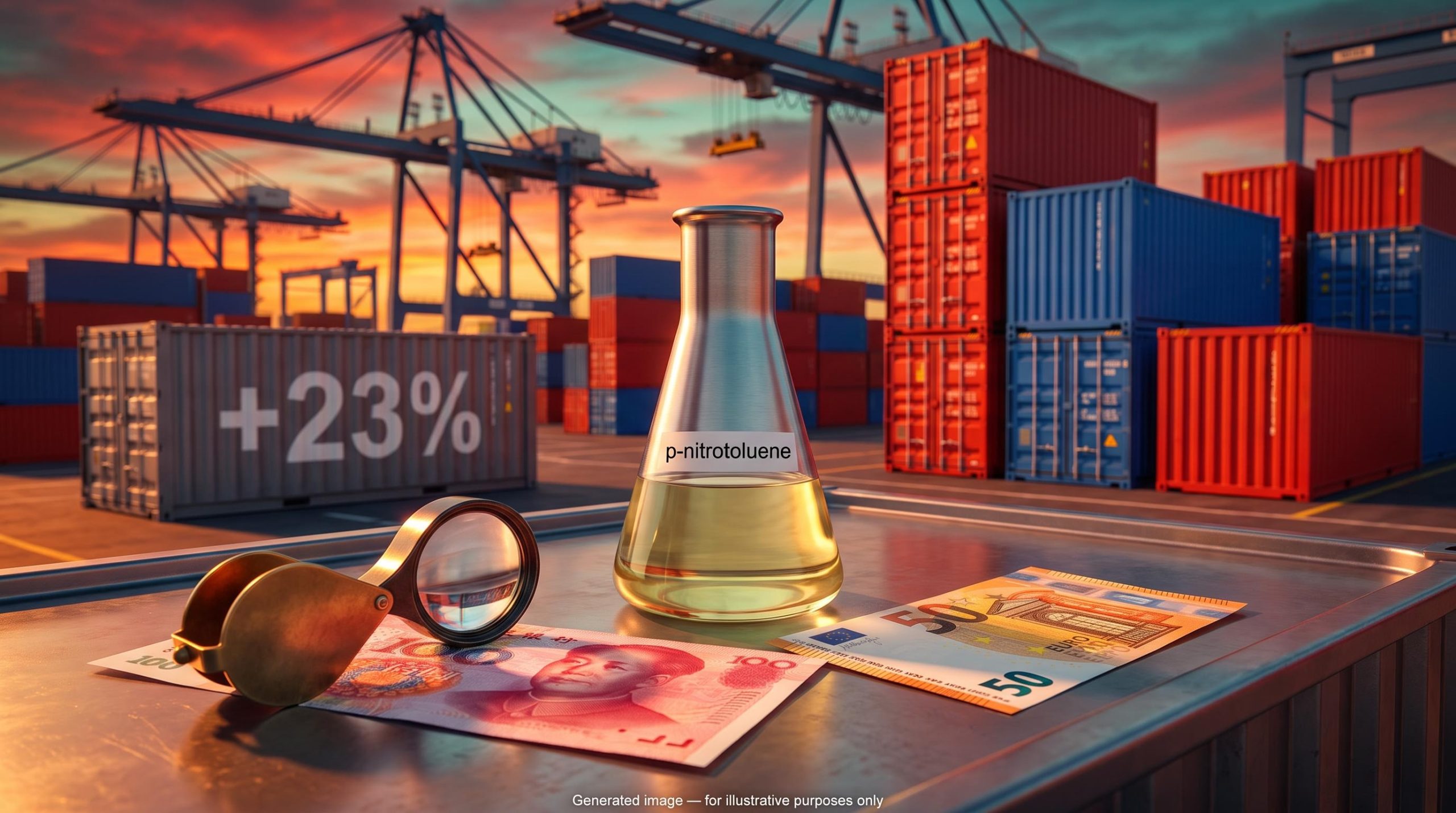
China’s commerce ministry opened an anti-dumping case into a single European chemical, p-nitrotoluene, on 3 October 2026. On paper it is a niche dispute over a dye and pharmaceutical input. Its timing, days before the EU’s own early-October deadline for results from Beijing, makes it a more useful signal for the euro, the yuan and the wider currency impact of an EU-China trade war than its trade value suggests.
Commerzbank economist Volkmar Baur warns that the imbalance between the two blocs, left unresolved, could escalate into a trade war with real currency consequences for both the euro and the yuan.
The pressure has a deadline attached. EU leaders want “initial Chinese action” by early October, and a European Council discussion of the issue sits close behind.
You will leave knowing which currency channels are plausible, which are genuinely contested, and which specific signals deserve your attention over the coming weeks.
What do the trade numbers and the October deadline actually show?
The pressure starts in the trade data. According to the Commerzbank analysis, Chinese exports to the EU rose 15% in the first eight months of the year, while China’s surplus with the bloc widened by 23% over the same stretch.
Goldman Sachs found the same pattern earlier in the year. Chinese exports to the EU climbed about 16% in the first five months of 2026, while EU exports to China grew by less than 10%.
The 2025 baseline China’s surplus with the EU reached €360.6 billion (about US$412 billion) in 2025, up 15% on 2024, according to Reuters.
| Metric | Figure | Period | Source |
|---|---|---|---|
| Chinese exports to the EU | +15% | First eight months of the year | Commerzbank |
| China’s surplus with the EU | +23% | First eight months of the year | Commerzbank |
| Chinese exports to the EU | About +16% | First five months of 2026 | Goldman Sachs |
| EU exports to China | Under +10% | First five months of 2026 | Goldman Sachs |
| EU deficit with China | €360.6 billion | Full year 2025 | Reuters |
These windows differ, so the figures are not directly comparable. The direction, though, is the same in every series.
That widening gap is what set the political clock running. In late June, Trade Commissioner Maroš Šefčovič and Chinese Commerce Minister Wang Wentao agreed to seek a solution by October, and EU leaders asked the Commission to secure “initial Chinese action” in that window.
As of 6 October 2026, no concrete Chinese measures under that target have been documented.
That is the point to hold onto. A widening deficit with no delivered concessions turns escalation from rhetoric into a live risk, and it gives you the baseline against which any next move should be judged.
When big ASX news breaks, our subscribers know first
Is the p-nitrotoluene probe retaliation, and what else is straining the relationship?
The probe itself is narrow. Here is what the official record shows:
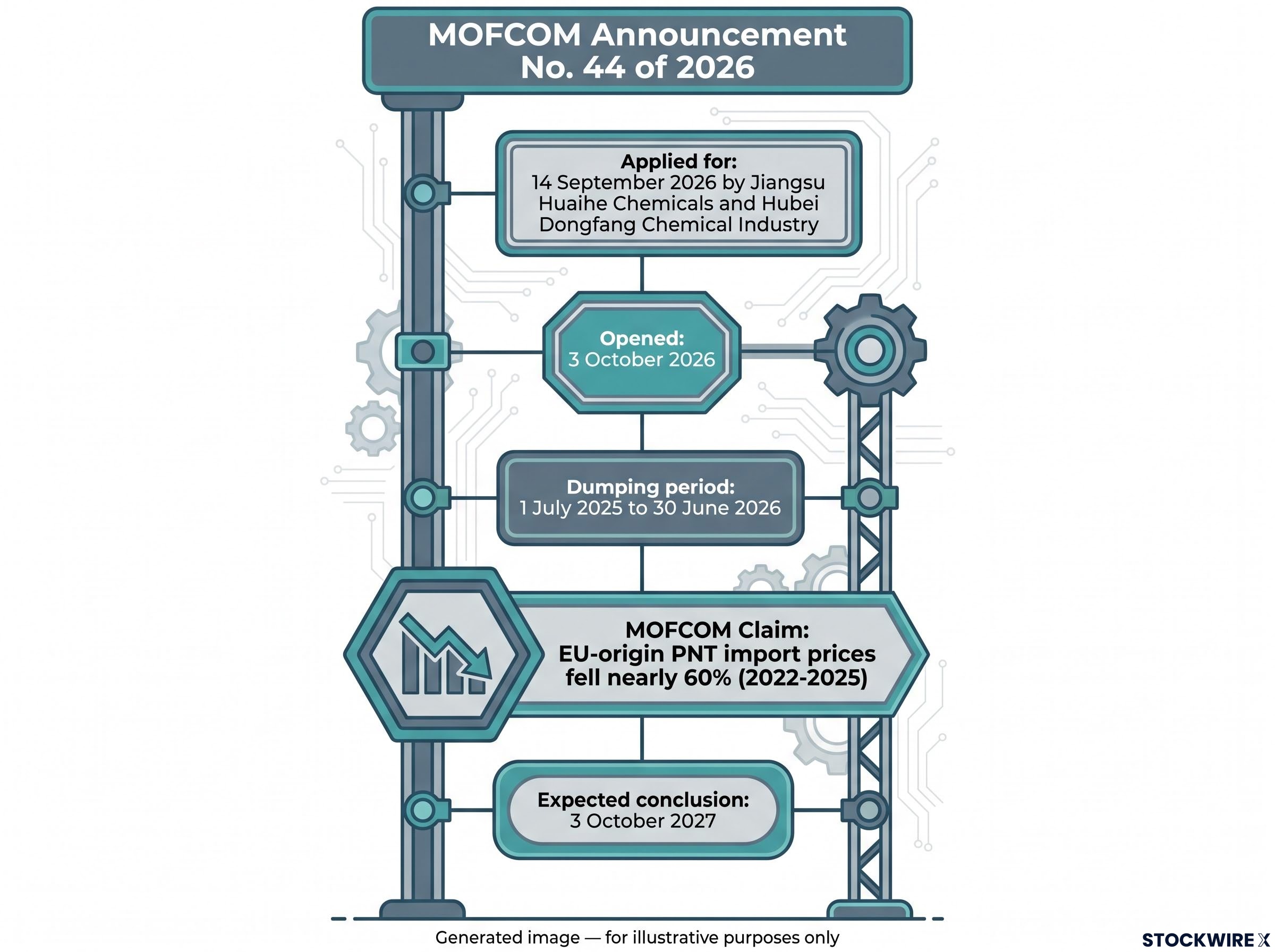
- Applied for: 14 September 2026, by Jiangsu Huaihe Chemicals and Hubei Dongfang Chemical Industry
- Opened: 3 October 2026 (MOFCOM Announcement No. 44 of 2026)
- Dumping period examined: 1 July 2025 to 30 June 2026
- Expected conclusion: 3 October 2027, with a possible six-month extension
- Status: no duties imposed; interested parties have 20 days to register
China’s Ministry of Commerce (MOFCOM) claims EU-origin PNT import prices fell nearly 60% cumulatively between 2022 and 2025 while volumes stayed high.
Retaliation or routine remedy?
MOFCOM says the case rests on complaints from domestic producers and preliminary evidence of dumping, meaning goods sold abroad below fair value. On that reading, this is a standard trade-remedy filing.
Commentators point instead to the calendar. The probe landed just before Šefčovič’s trip to Beijing and follows earlier Chinese investigations into European brandy and pork, which came after the EU’s own probe into Chinese electric vehicles. Baur’s view is that the PNT case is probably tied to the wider friction.
The evidence does not settle the question either way.
The friction runs in both directions. According to the original Commerzbank source, French President Emmanuel Macron and German Chancellor Friedrich Merz circulated a non-paper (an informal EU diplomatic document) pressing for stronger action on dumping, subsidies and currency manipulation. Its full text has not been independently confirmed.
The PNT case sits within a much larger toolkit: the EU has 172 trade-defence measures in force, with more than three-quarters aimed at Chinese firms, so the bloc is far from passive on dumping.
For you, the probe matters less for the trade it touches than as a gauge of how readily both sides reach for trade remedies while still talking. One sector-limited case is not a trade war, but a run of them is how escalation tends to begin.
How does a trade conflict move the euro and the yuan?
Why should a dispute over chemicals and surpluses touch exchange rates at all? Because currencies price expectations, and a trade fight changes several expectations at once.
Four channels do most of the work:
- Growth expectations: weaker trade means weaker growth, and currencies tend to soften with growth outlooks.
- Risk sentiment: uncertainty pushes money toward perceived safe havens.
- Capital flows: investors pull money from economies they see as more exposed.
- Interest-rate differentials: the gap between two central banks’ rates shifts if one has to ease policy to cushion the blow.
For the yuan, these channels mostly point the same way. Weaker growth, damaged confidence and capital-flow pressure all weigh on it, and Beijing might tolerate a softer yuan to support exporters.
The yuan’s downside bias also depends on how Beijing manages the daily yuan fixing, since the gap between the published rate and market-implied levels is the closest real-time readout of whether policymakers will tolerate a softer currency.
The 2018-2019 precedent During the US-China tariff war, the yuan tended to weaken on escalations while safe-haven currencies gained, according to the IMF. Currency moves partly offset the tariffs.
The euro is harder to call. Safe-haven flows and an improving trade balance could support it, but weaker growth pulls the other way. Goldman Sachs adds that Chinese import competition can suppress European inflation and margins, which could push the European Central Bank (ECB) toward easing and cap any gains.
There is also a paradox. A crackdown that narrows the gap and lifts the euro could hurt the German manufacturers it was meant to protect.
| Channel | Effect on yuan | Effect on euro | Confidence level |
|---|---|---|---|
| Growth expectations | Negative | Negative | Moderate to high |
| Risk sentiment | Negative | Possibly supportive | Moderate |
| Capital flows and policy tolerance | Negative | Mixed | Moderate |
| Interest-rate differentials | Uncertain | Negative if ECB eases | Low to moderate |
No EUR/CNY or EUR/USD levels tied to this dispute appear in the available reporting, so this framework rests on mechanisms rather than market data. What it tells you is that the yuan carries a clearer downside bias if things escalate. The euro depends on which force wins, so treat any confident one-way euro call with scepticism.
Will this become a full trade war? Scenarios and signals to watch
Economists disagree on the root cause. Some see the surplus as structural, driven by Chinese savings and industrial capacity, while others see cyclical factors such as diverted exports that might partly fade on their own.
The forces on each side look like this:
- Toward escalation: a widening surplus, Chinese exports diverted from the US toward Europe, a hawkish France, and a retaliation pattern running from brandy to pork to chemicals, with agri-food, luxury goods and autos flagged as possible next targets
- Holding it back: mutual dependence, EU reliance on Chinese intermediates (some available almost only from China), a divided Germany, cautious member states and active negotiation channels
The supply-chain point carries weight. Shortages or price spikes in intermediates could damage EU production even if the headline balance improved.
The overall picture is that a full trade war is possible but not inevitable.
The diversion of Chinese exports toward Europe has a clear precedent: after US tariffs cut bilateral trade by more than 25%, China rerouted supply chains through third countries and kept a large overall surplus.
What to watch next
As of 6 October 2026, no concrete Chinese measures under the EU target have been documented. These are the triggers that would change that picture:
- Chinese action by the early-October target, or a visible miss
- The European Council discussion and any mandate for tougher trade defences
- The PNT registration window, closing 20 days after 3 October
- Any new Chinese probes into EU agri-food, luxury goods or autos
- ECB and People’s Bank of China (PBOC) signals on easing or currency tolerance
For your positioning, escalation is a risk to price in gradually rather than a base case. Tracking these named triggers is more useful than betting on an outcome.
What the probe changes, and what it does not, for euro and yuan outlooks
The PNT probe and a widening surplus raise the odds of escalation. They do not make a trade war the default, because mutual dependence and ongoing talks still give both sides reasons to compromise.
The currency asymmetry holds: the yuan’s downside bias is clearer, while the euro’s response is genuinely two-sided. Whether Beijing delivers anything under the October target, and the next trade-remedy move from either side, are the variables that would shift that balance.
Keep the limits in view. No currency levels tied to the dispute were found, and the non-paper’s text remains unconfirmed.
Investors wanting to translate trade friction into allocation decisions can use our deep-dive into geopolitical fragmentation and portfolio risk, which shows how to build a fragmentation-aware portfolio.
This article is for informational purposes only and should not be considered financial advice. Investors should conduct their own research and consult with financial professionals before making investment decisions. These statements are speculative and subject to change based on market developments and policy decisions.