The S&P 500 closed at a record 7,818.93 on 6 October 2026, and the Nasdaq Composite set its own high at 27,599.79. One veteran trader looked at the same tape and called it a thin, retail-driven bubble. He is still fully invested, and his trader hedging strategy shows why believing in a bubble does not automatically mean selling or shorting.
The backdrop is uneasy. The 10-year Treasury yield sits near 5.28%. Institutions are split on whether artificial intelligence (AI) valuations are justified, with some warning of excess and others calling AI a technology that earns its premium.
The case study is Horowitz, a trader who started when the Dow Jones Industrial Average stood around 800. It now trades near 52,000.
Here is how one experienced investor separates his view of the market from the way he positions in it, and which parts of that approach you can borrow.
Why would a trader who calls this market a bubble stay fully invested?
If you think a market is in a bubble, getting out feels like the obvious move. History suggests that instinct can be expensive.
On 6 October 2026, the S&P 500 rose 0.58% and the Nasdaq gained 0.45%, both to records. The Dow added 0.49% to 51,521.28, still below its 2026 high near 54,349, while the Russell 2000 slipped 0.6% to 2,830.30. Horowitz says he would not be surprised to see the S&P 500 reach 8,000.
The Shiller CAPE ratio near 40 puts US equities among the most extreme valuation episodes in 155 years, which is the kind of evidence behind the bubble argument even though valuation alone says little about timing.
Horowitz’s stance He expects the rally to end in a drop, but says he will not short the market until a clear trigger appears.
Precedent supports the patience. In 1999-2000, traders who shorted overvalued tech too early watched many names double or triple again. In 2021, GameStop and AMC squeezed short sellers until Fed tightening and fading retail interest finally arrived.
Experienced traders tend to wait for one of these triggers:
- A hawkish pivot from the Federal Reserve
- Deteriorating market breadth, meaning fewer stocks joining the rally
- Concrete earnings disappointments
- Regulatory shocks
Horowitz names higher interest rates as the most likely rally-ender. The lesson for you is that being right about a bubble is not the same as profiting from it. Timing, not opinion, is the costly variable.
What thin volume does and does not tell you
Horowitz says volume is about 50% of normal, with buying coming from IRAs and 401(k)s rather than institutions. Indices that rise on light volume can signal a shortage of sellers and dominance by price-insensitive buyers, such as retirement accounts and passive funds.
The evidence is contested. Other data showed 6 October volume above average on some measures, and comparisons change depending on whether you count all US exchanges or Nasdaq-listed shares only. No single clean comparison exists, so treat thin volume as one signal, not proof.
When big ASX news breaks, our subscribers know first
How does the options overlay work, and where does zero-DTE fit?
Start with the simple version. Horowitz holds a long-term portfolio that is hedged automatically with options, which works like insurance he pays for. Separately, he runs a short-term trading book where he sells options to collect income.
The hedge is sized to roughly 5% risk. That number matters more than any single stock he owns.
The income layer uses zero-DTE options. Zero-DTE stands for “zero days to expiration,” meaning contracts that expire on the same trading day they are traded, mainly on the SPX index and the SPY fund. Horowitz sells them daily and never holds them overnight.
Traders use zero-DTE contracts to hedge event risk around Fed decisions, CPI inflation data and earnings, to adjust exposure quickly, and to express short-term views cheaply. The income version relies on realised volatility (how much prices actually move) staying below implied volatility (how much movement option prices assume). Spreads, which pair a sold option with a bought one, cap the worst-case loss.
| Layer | Purpose | Holding period | Main risk | Sizing |
|---|---|---|---|---|
| Long-term hedge | Protect the core portfolio | Ongoing, applied automatically | Cost of protection over time | Roughly 5% risk |
| Daily zero-DTE | Generate income | Same day, never overnight | Sudden intraday moves | Worst-case daily loss near 5% of capital |
The risks sellers underestimate
Gamma measures how fast an option’s sensitivity to price changes speeds up. Sellers are short gamma, so a quiet morning of small gains can turn into large losses within minutes.
- Gamma: deltas shift rapidly, and dealer hedging can amplify intraday swings.
- Tail risk: after a shock there is no time for prices to revert before expiry.
- Liquidity gaps: gap moves can exceed modelled scenarios when trading thins.
Professionals stress that this is not safe income in a bubble market. Selling daily premium looks steady until one bad session, so treat the hedge size and the loss cap as the real strategy, not the income.
For readers wanting to build a similar hedge, our dedicated guide to building a bearish options overlay shows how a four-legged SPX structure can be entered for a small net credit.
Why hold gold, silver, Bitcoin and the dollar alongside stocks?
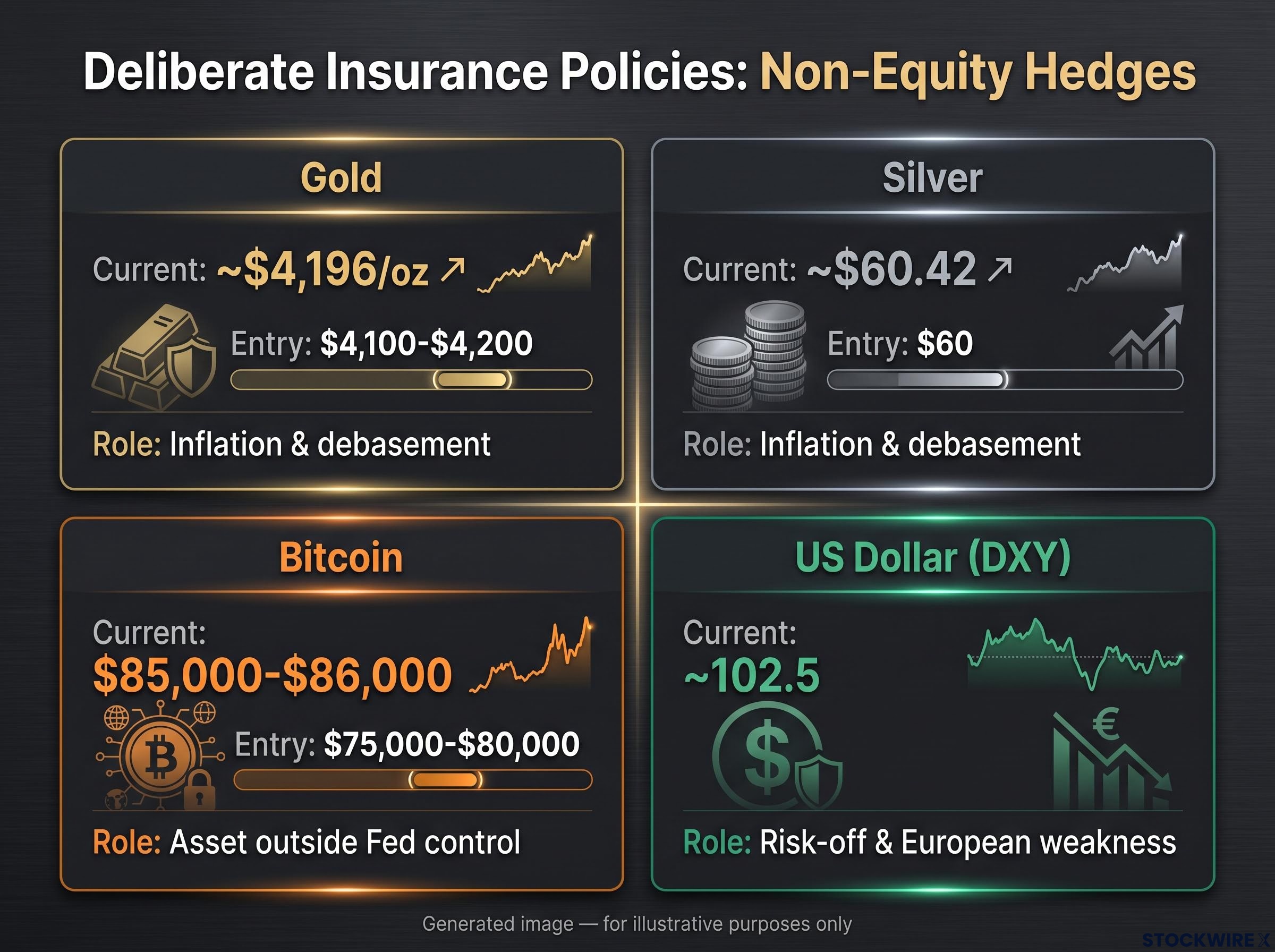
Each of Horowitz’s non-equity holdings answers a different threat. Read together, they look less like favourite assets and more like a set of deliberate insurance policies.
Gold and silver cover inflation and currency debasement. Gold trades around $4,196/oz after a 35% fall from its highs, and Horowitz says it has held above $4,000; he argues the selloff already priced in higher rates. Silver sits near $60.42.
Bitcoin, near $85,000-$86,000, appeals to him because it is not controlled by the Fed. He sees an $80,000-$90,000 range and calls $100,000 by year-end a “strong maybe,” dependent on greater volatility.
The dollar is his risk-off hedge and a bet against European weakness. With the dollar index (DXY) near 102.5 and EUR/USD around 1.12, reported near multi-year lows, he targets 104-105 or higher and thinks the euro could reach parity.
| Asset | Hedge role | Trader’s entry | Main caveat |
|---|---|---|---|
| Gold | Inflation and debasement | $4,100-$4,200 | Depends on real interest rates |
| Silver | Inflation and debasement | $60 | He sees possible further downside in metals |
| Bitcoin | Asset outside Fed control | $75,000-$80,000 | High volatility can dominate portfolio risk |
| US dollar | Risk-off and European weakness | Not disclosed | Can hurt if the Fed eases |
His equity core includes Tesla and SpaceX, which he bought at $113 and added to at $150. He regards SanDisk, up over 100% this year by his account, as overbought but will not fight the trend. Independent 2026 data on these names was not available, so treat them as his stated positions only, not recommendations.
Where the diversification story breaks down
Correlations are unstable. In major stress, gold, Bitcoin and equities can fall together, just when you need the cushion most.
Bitcoin adds custody, liquidity and regulatory risks, and even a small weight can dominate your portfolio’s swings. Over-hedging also has a cost: too much in macro hedges can drag on long-term growth. Each diversifier only earns its place if you can name the risk it covers, so be wary of copying the list without the reasoning.
What do his best and worst 2026 trades teach about position sizing?
Horowitz’s best trade of 2026 was Ethereum, bought at $11 by his own figure, which he says doubled. His worst was Rigetti (RGTI), sitting at about half his purchase price.
The Rigetti position was hedged.
That detail changes the story. The hedge did not stop the loss, but it limited the damage, which is exactly what a hedge is for. Both results are self-reported, and current data on Ethereum and Rigetti was not available to verify them.
Sizing to a risk limit works mechanically when you divide your maximum dollar risk by the distance between entry and stop, so a volatile name automatically earns a smaller position than a calm one.
He applies the same caution to AI broadly, pointing to off-balance-sheet debt he puts at “over a billion dollars.” No independent sizing of that figure was found.
Five lessons carry over to almost any portfolio:
- Size to a risk limit. Decide your maximum loss before you enter.
- Hedge speculative names. A hedged loser is survivable.
- Tie each diversifier to a named risk. If you cannot name it, question the holding.
- Wait for triggers. Do not fight overbought trends without a plan.
- Match strategy to skill. Daily options selling is not a beginner’s tool.
Horowitz’s advice to non-traders He suggests that people who are not active traders hold equities rather than attempt to time the market.
A single unhedged loser can sink a portfolio. Judge any strategy by its worst position, not its best.
Borrowing the logic without copying the trades
The thread running through Horowitz’s approach is that an opinion about valuation and a positioning decision are two separate things. His discipline lives in the sizing, the hedges and the trigger he waits for, not in the call that the market is a bubble.
To apply that frame yourself, watch three things. Keep an eye on whether the 10-year Treasury yield holds above 5%, track breadth to see whether more stocks join the rally or fewer, and check volume data against consistent definitions, since current figures conflict.
This is one trader’s approach, and selling zero-DTE options carries high risk. Any hedge you use should match your own risk tolerance and experience.
This article is for informational purposes only and should not be considered financial advice. Investors should conduct their own research and consult with financial professionals before making investment decisions. Past performance does not guarantee future results. Statements about price targets and market direction are speculative and subject to change based on market developments.