Most people assume a polished dashboard, weekly videos and a team with “institutional” credentials add up to an edge. The evidence says otherwise: in India’s regulator studies, roughly 9 in 10 retail derivatives traders lose money.
That context explains why an options trade alert subscription appeals to so many people. It promises to remove the hardest part of options trading, which is finding and structuring the trade. The Options Edge, a new offering from three traders, is used throughout as a worked example of how these services present themselves. It is not a recommendation, or a warning about any one provider.
Here is a practical way to separate promotional claims from verifiable ones, plus a checklist of questions to ask before you pay anyone for trade alerts. This guide is educational and is not investment advice or an endorsement.
What does an options alert service actually sell?
Start with the product as its sellers describe it. Everything below comes from The Options Edge’s promotional material, and none of it is independently verified.
The team says it reviews the market daily, identifies high-level trade setups, works out how to express each one through an options contract, then sends an alert. Each alert reportedly names the stock, the contract, the expiration and the entry price. That makes the service individualised and time-sensitive: you are being told to act on a specific trade, now.
Before you judge any alert, make sure you know how call and put options work, because every alert names a contract, and your maximum loss on a bought option is the full premium you pay.
- Team: three professional traders with stated institutional backgrounds; the lead trader claims 20+ years of experience.
- Alerts: real-time, by app, phone notification and email, sent when each trade is executed.
- Dashboard: a proprietary live dashboard said to show every position, including purchases, sales and status.
- Weekly video: explanations of why trades were taken, what the chart showed and how contracts were chosen.
Note: All descriptions in this section are promotional statements from the provider and are unverified.
The service says it targets both experienced options traders and beginners. A feature list like this answers “what is offered.” It tells you nothing yet about “what is proven,” and that is the question that decides whether subscribers make money.
How the real-time alert flow works
The sequence is simple. The team enters a trade, the alert goes out at that moment, and you receive it on your phone, then decide whether to act. By the time you place your own order, the provider has already filled theirs.
That built-in gap between their fill and yours matters, and a later section shows how much.
What the dashboard and videos promise
The stated purpose is transparency and skill-building: you can see every position and learn the reasoning behind it. What these tools show, and what they leave out, is covered below. A tool can be real and still not tell you what you need to know.
When big ASX news breaks, our subscribers know first
How do retail options traders actually fare?
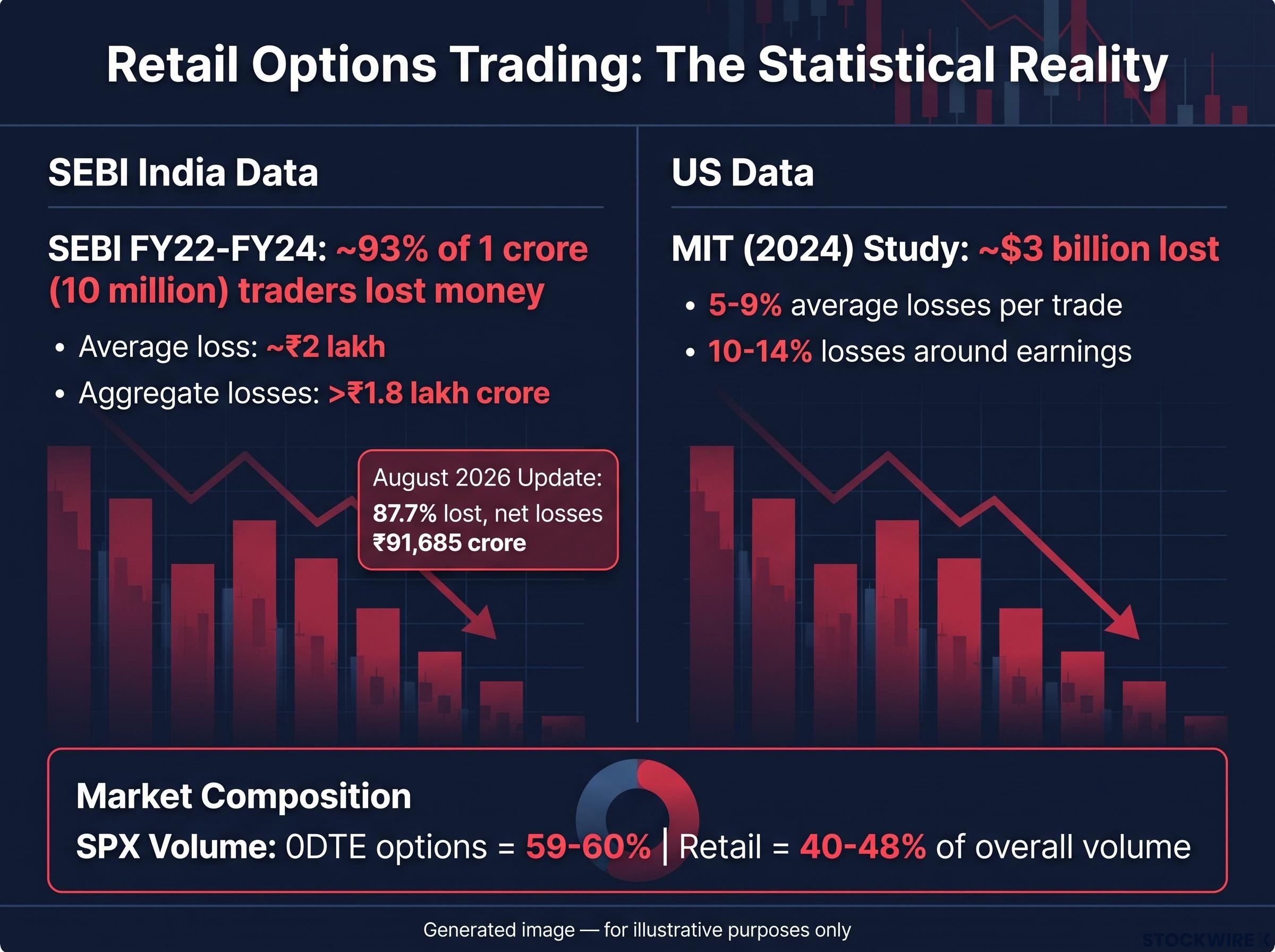
The numbers start in India, where the regulator has published the most detailed data. The Securities and Exchange Board of India (SEBI) found that about 93% of more than 1 crore (10 million) individual futures and options traders lost money across FY22 to FY24. The average loss was about ₹2 lakh including costs, and aggregate losses exceeded ₹1.8 lakh crore.
For FY24 alone, more than 91% lost money. SEBI’s own communication cited 91.1%, while press summaries reported 91.5%; the gap is small and the message is the same.
Latest SEBI figure: 87.7% of individual traders lost money, according to the most recent study reported in August 2026. Aggregate net losses were ₹91,685 crore, and options accounted for about 92% of them.
Other research points the same way. MIT’s “Losing is Optional” (2024) found average losses of 5-9% on typical retail option trades and 10-14% around events such as earnings, with roughly $3 billion lost over its sample.
| Source | Market/Sample | Key Finding | Date |
|---|---|---|---|
| SEBI | India, individual F&O traders, FY22-FY24 | About 93% lost money; average loss about ₹2 lakh | 23 September 2024 |
| SEBI (latest) | India, individual traders | 87.7% lost; net losses ₹91,685 crore | August 2026 |
| MIT, “Losing is Optional” | US retail options | Average losses 5-9% per trade; 10-14% around earnings | 2024 |
| “Striking Out” (Tinbergen) | Finland, 15 years of account data | Biases such as the disposition effect drive poor results | 2 February 2024 |
| LSU-hosted paper | Retail option trades | Average trade about -0.9%; spreads about 5-10% | 2025 |
The disposition effect is the tendency to sell winners too early and hold losers too long. Spreads, the gap between the buying and selling price, can push retail options trading into loss territory on their own.
The US picture is busy rather than benign: 0DTE options (contracts expiring the same day) make up roughly 59-60% of SPX volume, and retail traders account for about 40-48% of overall options volume.
These studies cover retail traders generally, not alert subscribers specifically, and no public evidence shows paid alerts reliably escape the pattern. So treat any service as having to beat a very hard default, not as starting from neutral.
Why do subscribers often get worse results than the provider reports?
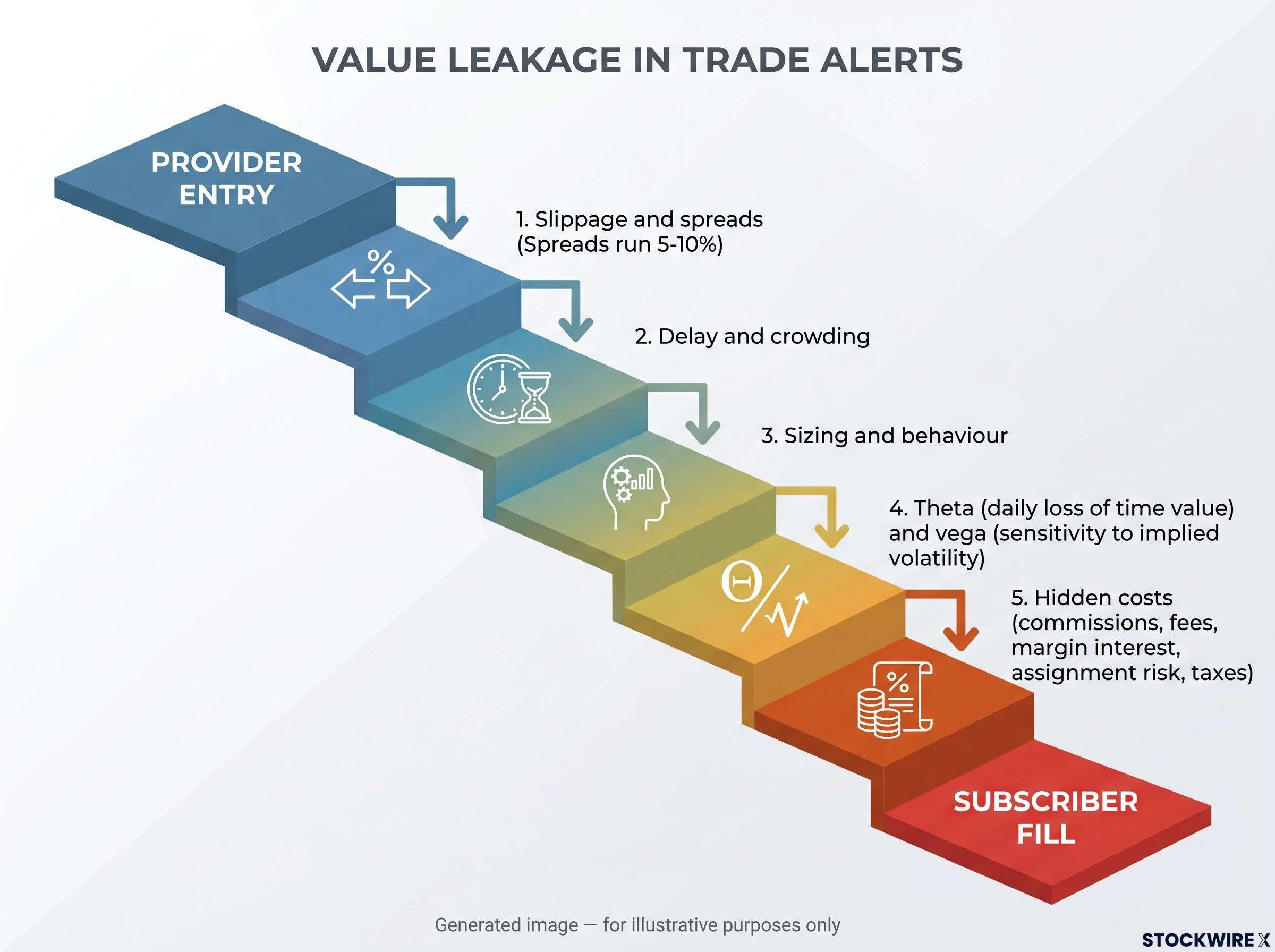
Follow one alert from the provider’s screen to your account. Value can leak at every step, before any question about strategy even arises.
- Slippage and spreads. Option spreads run about 5-10%. A provider may log an entry near the mid-market price, while you, acting minutes later, fill nearer the ask when buying or the bid when selling.
- Delay and crowding. The app, phone and email alerts all take time to reach you. When many subscribers pile into one contract, thin liquidity moves the price against the later arrivals, and MIT found retail losses are higher around high-volatility events.
- Sizing and behaviour. A model account follows set sizing rules. Your own account has its own capital, leverage and nerves, and biases such as doubling down persist even among people following alerts.
- Theta and vega. Theta is the daily loss of an option’s time value; vega is its sensitivity to implied volatility. Enter late on a short-dated trade and more time value has already decayed, while a volatility drop can hurt you in ways the provider avoided.
- Hidden costs. Advertised returns may leave out commissions, fees, margin interest, assignment risk and taxes, all of which you bear.
These frictions are structural. They apply to any alert service, honest or not.
The relationship between implied volatility and premium is nonlinear, so a volatility drop after you enter can erase value that the provider never experienced at their earlier, cheaper fill.
Even a perfectly honest track record may overstate what you personally would have earned. Ask for results net of realistic costs and delays.
Does contract selection or institutional flow give you an edge?
The proponents’ case, in its strongest form, goes like this. Heavy volume or open interest (the number of contracts still outstanding) in short-dated or out-of-the-money contracts can reveal informed trading, and traders with institutional backgrounds may read it better. The Options Edge makes a parallel claim: contract selection matters, and institutional activity can leave traces there.
Contract selection in plain terms
An option contract has three main choices. The strike is the price at which you can buy or sell the stock, the expiration is the date the contract ends, and moneyness describes how far the strike sits from the current price.
Say a stock trades at $100 and you expect it to rise. A contract with a $100 strike expiring in three months costs more but has time to work; a $120 strike expiring next week is cheap and usually expires worthless. The same view carries very different risk, and contract choice does matter mechanically, because expiration, moneyness and strike all change time decay and sensitivity to price moves.
What the evidence says about flow
The “smart money” thesis runs into documented retail behaviour. “Striking Out” found traders gravitate toward lottery-like, short-dated, deep out-of-the-money options. The LSU-hosted paper put the average option trade at about -0.9% after costs, so any flow edge has to clear a high hurdle.
- Claim: unusual volume reveals informed traders. Counter-evidence: retail outcomes remain negative after spreads and costs.
- Claim: the right contract improves results. Counter-evidence: no independently verified trade-level record has been identified for this service type.
Regulators also warn against claims of “inside information,” “secret signals” or guaranteed profits.
So “we choose the right contract” is a hypothesis. You can and should test it with trade-level evidence, rather than treat it as a reason to trust the provider.
How to evaluate an options trade alert subscription before you pay
Turn the evidence into a checklist you could apply this week to The Options Edge or any similar provider.
Questions to ask the provider
- Verified record: Can you show complete, time-stamped trade histories with independent audit, not selected examples?
- Actual or hypothetical: Are results executed trades, a model portfolio or a simulation?
- Cost treatment: How do results handle commissions, slippage and the delay between alert and fill?
- Risk disclosure: What are the realistic drawdowns, losing streaks and margin requirements?
- Strategy fit: Is the approach (long out-of-the-money calls, short-dated premium selling, spreads) suited to your experience and risk tolerance?
- Conflicts: Do you receive broker payments or affiliate fees?
- Registration: Are you registered, or does a claimed publisher exemption genuinely fit?
On the last point, in the US, paid individualised advice generally requires investment adviser registration, with a publisher’s exclusion for impersonal, regularly published content. Similar principles reportedly apply under FINRA, the FCA and ASIC. These details are unverified here, so confirm current rules in your own jurisdiction.
Real-time alerts naming exact contracts and entries sit uneasily with an “impersonal publication” framing, so registration status is worth checking.
| Claim type | Example | How to verify |
|---|---|---|
| Credentials | Institutional background | Employment records, role and responsibilities |
| Experience | 20+ years, refined across crashes | Full-history, audited record |
| Status | Registered or exempt | Regulator registers, such as Investor.gov |
Regulator red flags: pressure to act fast, secrecy around “proprietary signals,” and guaranteed or low-risk high returns. The SEC, CFTC, FINRA and NASAA issued a joint alert on 10 September 2024 urging checks on registration and scepticism toward high-return pitches. The CFTC’s “Spot and Avoid Fraud” advisory (7 October 2024) is reportedly along similar lines, though its detail is not confirmed here.
Reading dashboards and weekly videos critically
Judge them by what they show, not by production value. A dashboard earns trust if it displays closed losers, fees and drawdowns. Weekly videos earn it if they discuss risk seriously rather than showcasing wins.
No public enforcement actions targeting alert services’ credential claims were identified, and public data on pricing and performance disclosure is limited. That leaves the checking to you.
Treat missing answers as informative: no audited record, vague registration, only winning examples. If a provider cannot answer these questions directly, walk away.
Weighing the promise against the odds before you commit
The logic runs in three steps. The base rate for retail options traders is poor, structural frictions erode what subscribers earn compared with what providers report, and contract and flow claims are testable rather than proven.
Your decision rule follows: subscribe only if the provider supplies independently verified, full-history, cost-adjusted results and clear risk disclosure, and only with money you can afford to lose.
Investors weighing premium-selling alerts will find our full explainer on selling options tail risk shows how a high win rate can hide one catastrophic loss.
This article is for informational purposes only and should not be considered financial advice. Investors should conduct their own research and consult with financial professionals before making investment decisions. It is not an endorsement or criticism of The Options Edge or any named provider. Past performance does not guarantee future results.