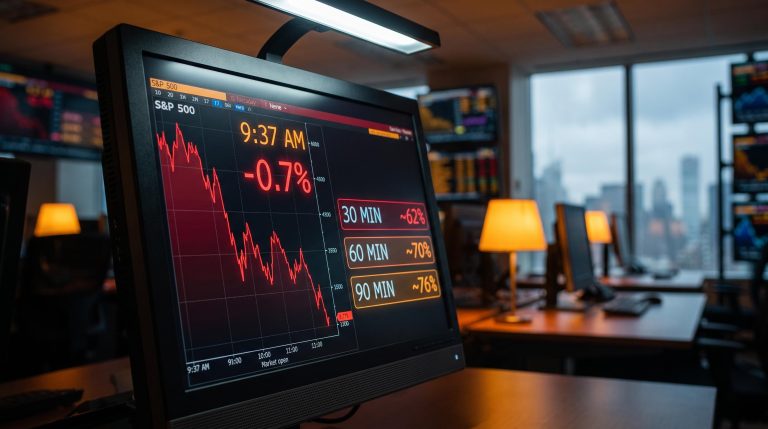
A Treasury can never default, yet a popular long-term Treasury fund lost 31.41% in a single calendar year, 2022. “Backed by the US government” protects you from one kind of loss, and it says very little about whether your money will be there on the day you need it.
For a dated goal, such as a home deposit in five years, the question is not whether Washington pays. It is whether the price of your bond will hold up when you sell. With yields sitting well above the zero-rate era, the choice of which Treasury to buy feels more urgent than it has in years.
Here is how three investors with the same $50,000 and the same five-year deadline ended up in very different places, and how you can avoid landing in the wrong one. The figures below illustrate mechanics using yields from a high-yield period, not current market quotes.
Default risk versus duration risk: the idea most investors miss
Most people hear “Treasury” and file it under “safe.” That belief is half right, and the half that is wrong is the part that costs money.
Bonds carry two separate risks that investors routinely collapse into one:
- Default risk: the chance the borrower fails to pay interest or principal. Treasuries effectively eliminate this.
- Duration risk: the chance that rising interest rates push down the market price of a bond you already own. Treasuries do nothing to remove this.
Rates and prices move in opposite directions. When rates rise, existing bonds lose value because new bonds pay more; when rates fall, existing bonds gain.
Duration measures how sensitive a bond’s price is to those rate changes, and longer bonds have higher duration. It also works as a rough guide to how long it takes the extra interest you reinvest after a rate rise to make up for the price loss.
A 5-year Treasury has a modified duration of about 4.5-4.8 years, close to its maturity. Long-term Treasury funds typically carry durations of about 16-18 years.
Each year of modified duration translates to roughly a 1% price move for every 1 percentage point change in rates, which is why a 16-18 year fund can lose a third of its value when rates jump quickly.
The horizon rule When a bond’s duration is longer than the time until you need the money, you are no longer buying safety. You are making a bet on interest rates.
That is the test to carry forward: the label on the bond tells you almost nothing until you know your deadline.
Why a fund behaves differently from a single bond
An individual bond held to maturity returns full principal, so price swings along the way do not matter. A fund never matures. It keeps rolling into new long bonds, so its sensitivity to rates never burns off.
That matters if you have to sell early. A forced sale after a drop turns a paper loss into a permanent one.
When big ASX news breaks, our subscribers know first
Three investors, one $50,000 goal: how Curtis, Nathan and Jasmine each chose
Each of the three needs $50,000 in five years for a home deposit, and each has a reasonable-sounding plan. You may recognise your own instinct in one of them.
Curtis wants the highest yield on offer and buys a long-term Treasury fund. Nathan values certainty that his balance cannot fall, so he parks the money in a money market fund. Jasmine starts with her date, then buys a 5-year Treasury to hold to maturity.
The yields come from a high-yield period: the 30-year at 5.59%, the 5-year at 5.06%, and money market funds at about 3.66%. Curtis’s modelled duration is about 14.87 years, using a single 30-year Treasury as a stand-in for his fund. The real fund is more rate-sensitive, so these figures flatter him.
| Investor | Vehicle | Illustrative yield | Duration | Hidden rate bet |
|---|---|---|---|---|
| Curtis | Long-term Treasury fund | 5.59% | About 14.87 years (modelled) | Rates will not rise |
| Nathan | Money market fund | About 3.66% | Very short | Rates will rise |
| Jasmine | 5-year Treasury held to maturity | 5.06% | About 4.5-4.8 years | None: duration matches date |
Nathan’s choice is the one most people overlook. Cash suits needs within a few months, but holding it for five years while 5-year Treasuries yield more is a choice, not a neutral position. His return falls when rates fall, so he is implicitly betting they will rise.
Jasmine accepts a lower yield than Curtis in exchange for certainty. Doing nothing clever is still a rate position, and every one of these choices carries a view on where rates go.
What happens to each investor when rates rise, hold or fall?
The table shows each investor’s five-year gain on the $50,000 under four scenarios. Read across the rows before reading the commentary.
| Scenario | Curtis | Nathan | Jasmine |
|---|---|---|---|
| Rates +1 | $10,153 | $12,788 | $14,522 |
| Flat | $15,870 | $9,845 | $14,192 |
| Rates -1 | $22,901 | $7,013 | $13,870 |
| Rates +2 | $5,491 | $15,845 | $14,861 |
Curtis wins if rates stay flat or fall. Jasmine wins if rates rise 1 point, and Nathan wins if they rise 2.
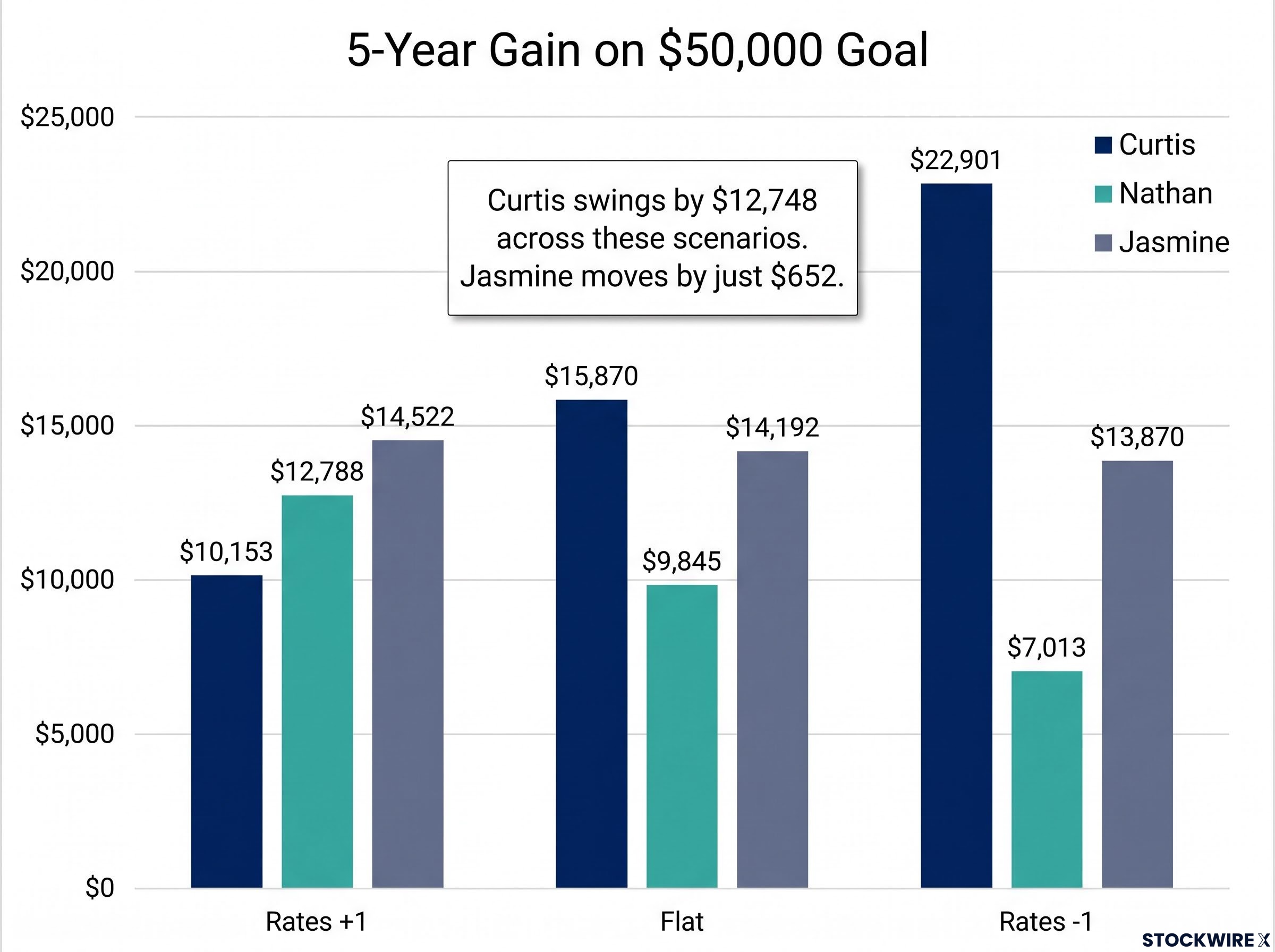
The range matters more than the winners. Curtis’s result swings by $12,748 across the three middle scenarios; Jasmine’s moves by just $652.
A 1-point rise cuts Curtis’s value by just over 13% (a $6,585 loss), and a 2-point rise drops it by more than 23%. A 1-point fall adds about 16.2%, or $8,100. Recovering from the 1-point rise would take about 15 years, against a 5-year need.
The arithmetic is unforgiving: a 100-basis-point yield rise can erase roughly 24-26% of the value of a 30-year zero-coupon bond, which is why long-dated sovereigns can destroy more capital than equities in the same window.
Jasmine’s bond does dip 4.26% on a 1-point rise. She holds, and she receives full principal.
The 2022 reminder A popular long-term Treasury fund lost 31.41% in one calendar year, with zero default risk. Major long-duration Treasury ETFs lost roughly 30% or more.
Judge a bond by its worst plausible outcome relative to your deadline. A dated goal punishes the bad scenario far more than it rewards the good one.
The model simplifies by having every rate shift in step and at once. In practice, markets behave less tidily.
Where the matched approach gives something up
Jasmine is not a winner in every row. She trails Curtis if rates fall, and she trails Nathan if rates rise 2 points.
Reinvestment risk is the mirror image of duration risk: short instruments avoid price swings but leave future income uncertain. Over long periods, longer maturities have often paid a term premium, so truly long-horizon money can reasonably hold long bonds. PIMCO and BlackRock also describe long Treasuries as recession hedges, though 2022-2023 showed stocks and long Treasuries falling together, so the hedge depends on the regime.
Before you buy: a four-step Treasury checklist for a dated goal
A few minutes of checking one published number against one date can show whether you are buying safety or a rate forecast. Run these steps in order:
- Pin the exact year you need the money. Everything else depends on it.
- Check duration. Funds usually publish it on their main page. Vanguard and Fidelity guidance is to keep effective duration at or below the goal timeframe for date-certain goals.
- Separate individual bonds from funds. A bond held to maturity returns principal; a fund never does.
- Weigh tax treatment. The next subsection covers it.
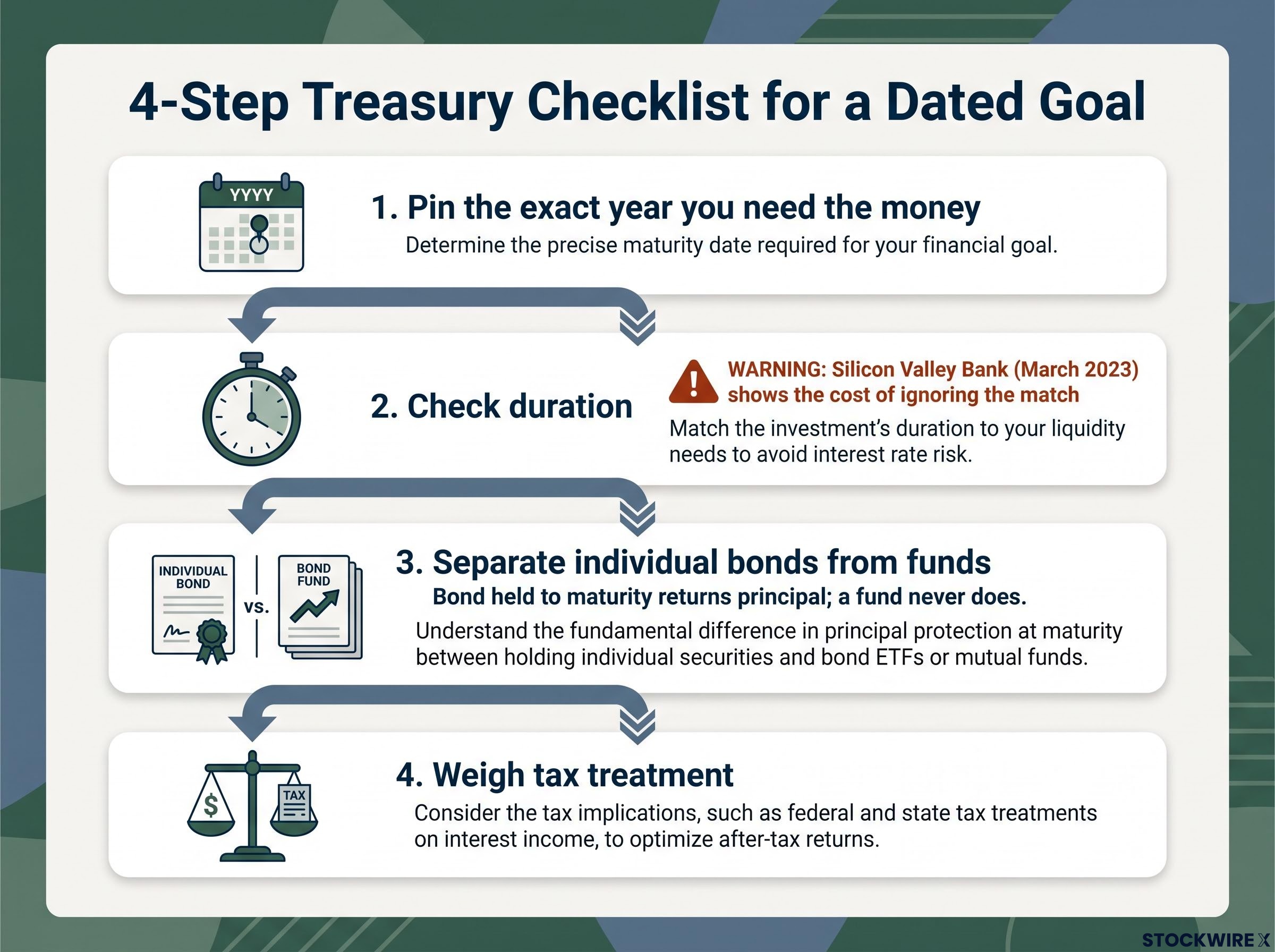
Common guidance points to Treasury bills, short-term funds or money markets for roughly 1-3 years, and intermediate bonds for 3-10 years. Silicon Valley Bank in March 2023 shows the cost of ignoring the match: it held longer-duration securities against short-term deposits, and rate rises produced large unrealised losses that funding stress forced it to crystallise.
For money needed within 1-3 years, the choice among T-bills, CDs and high-yield savings often comes down to your state tax rate and liquidity timeline, since a lower headline T-bill yield can beat a higher CD yield after tax in high-tax states.
A note on taxes and state exemptions
- Treasury interest is federally taxable but generally exempt from state and local income tax, which helps in high-tax states.
- Capital gains realised on an early sale are fully taxable federally.
- Treasury-focused fund distributions generally follow the pro-rata exemption, though state treatment varies.
Confirm fund-level treatment with a tax professional. This article covers Treasuries only: corporate bonds add default risk, and inflation-protected Treasuries behave differently.
Safe from default, matched to your date: the principle to carry forward
Default safety and price safety are different things. The duration of what you buy should match the date you need the money.
Curtis and Nathan each made a rate bet without realising it, while Jasmine removed the bet by matching. Forecasting rates is unreliable, and long-duration bonds can suit genuinely long-term money. None of this is a rate prediction.
Write down your goal date and compare it with the duration of the bond or fund you are considering.
This article is for informational purposes only and should not be considered financial advice. Investors should conduct their own research and consult with financial professionals before making investment decisions. Check current yields and consult a tax professional; past performance does not guarantee future results.
—