Every developed government in the world has quietly reached the same conclusion: its citizens are sitting on too much cash. The policy machinery to change that is now running in 10 countries at once, and it functions less like a set of national experiments than a single coordinated one.
The urgency is arithmetic, not ideology. Aging populations are shrinking the working-age base that funds pay-as-you-go pension systems, and the public finances of most developed economies cannot absorb the retirement income shortfall that cash-heavy household portfolios are on track to produce.
The Morningstar Investor Journeys Around the World study, published across 10 developed markets, gives readers something rare: a cross-country scorecard, with every market graded between B and C. It is a report card on how well each government is turning savers into investors, and none of them is passing with distinction.
Here is what the evidence actually shows. After this piece, you will know which policy combinations are genuinely shifting household behaviour, which interventions look decisive on paper but stall in practice, and where durable investing cultures are taking root rather than just being legislated into existence.
The demographic clock driving the policy urgency
Start with the mechanism, because it explains everything that follows. Pay-as-you-go pension systems fund today’s retirees from today’s workers. When the ratio of workers to retirees falls, the maths stops working, and the only way to plug the gap is to have households build their own capital market wealth over decades.
That is why cash allocation figures have become a policy obsession. They are the clearest measure of the distance between where household wealth sits now and where it needs to sit for pension systems and public finances to stay solvent. Governments are measuring exactly this gap, and in several major economies it is enormous.
The arithmetic behind cash allocation costs is stark: at 3% average annual inflation, $50,000 held in a low-yield account retains only the purchasing power of roughly $20,600 after 30 years, which is precisely the scale of wealth destruction governments are trying to arrest at the household level.
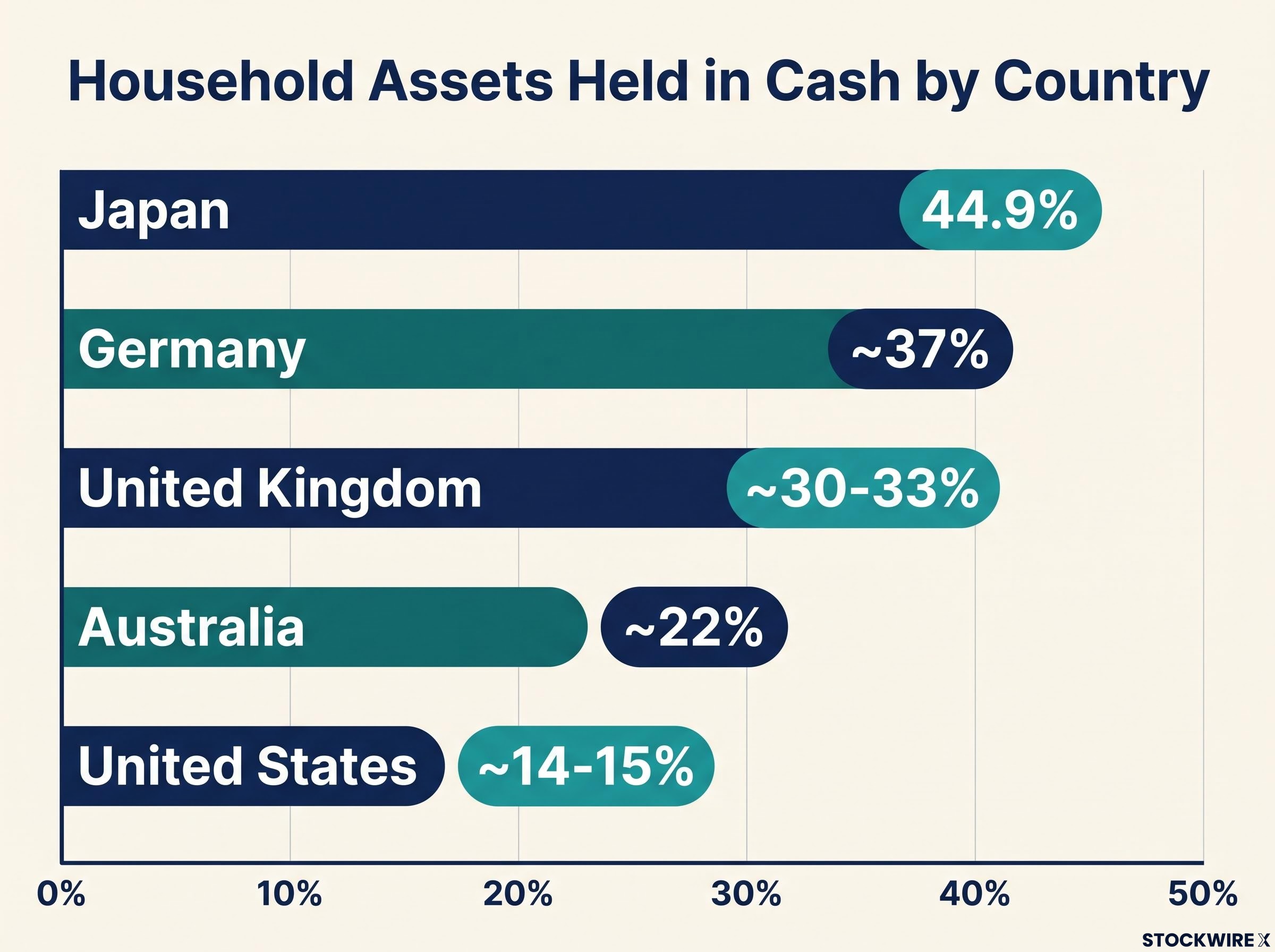
Japan is the sharpest case. As of end-June 2026, Japanese households held 2,519 trillion yen in total financial assets, of which 1,132 trillion yen, or 44.9%, sat in cash and deposits. This in a country with an exceptionally high proportion of retirees, precisely the population that a self-funding system needs to have accumulated market exposure years earlier.
The United Kingdom tells a milder version of the same story: currency and deposits account for roughly 30-33% of household financial assets, while shares represent just 12.3% of the total. Germany holds approximately 3,540 billion EUR in cash and deposits against total household financial assets of around 9,500 billion EUR.
Now look at what a mandatory system produces over time. In Australia, net equity in pension and insurance reserves reached 4,217.6 billion AUD of 8,654.9 billion AUD in total household financial assets as of September 2025, close to half of everything households own. That is the outcome governments in Tokyo, London, and Berlin are trying to engineer.
| Country | Total Financial Assets | Cash and Deposits | Cash as Percentage | Notable Feature |
|---|---|---|---|---|
| Japan | 2,519 trillion yen | 1,132 trillion yen | 44.9% | Exceptionally high retiree share |
| United Kingdom | Not specified | Not specified | ~30-33% | Shares just 12.3% of assets |
| Germany | ~9,500 billion EUR | ~3,540 billion EUR | ~37% | Reform package pending |
| Australia | 8,654.9 billion AUD | 1,875.7 billion AUD | ~22% | Pension reserves near 50% of assets |
| United States | Not specified | 20.3 trillion USD | ~14-15% | Equities ~50-55% of assets |
All figures exclude residential property. The picture is consistent: outside the mandatory and quasi-mandatory systems, households are parking wealth in a form that cannot fund a 30-year retirement. That gap, not any abstract preference for equity ownership, is what makes government intervention rational.
When big ASX news breaks, our subscribers know first
What the 10-country scorecard actually reveals
The Morningstar study grades all 10 markets between B and C, and the temptation is to read it as a league table. The more useful finding is buried a layer down.
Six countries earned a B: the United States, the United Kingdom, Canada, Australia, the Netherlands, and Japan. Four sit at C: Italy, France, Germany, and Spain. What makes the B cohort worth studying is that its members got there through completely different routes.
The Netherlands leads EU peers on workplace pension coverage, built through sector-wide collective schemes that enrol workers by default. Australia’s B rests on mandatory superannuation combined with the rise of low-cost exchange-traded funds (ETFs), pooled investment products that track an index at minimal cost. The United States scored well on portfolio disclosure standards rather than retirement coverage, which remains patchy. Canada earned marks for its “Fund Facts” presale disclosure documents and a regulatory push toward fewer fee-bundled products. Japan’s B reflects early traction from its revamped tax-advantaged NISA scheme.
Here is the pattern worth internalising:
- Netherlands: high workplace pension coverage through sector-wide collective schemes.
- Australia: mandatory superannuation plus a low-cost ETF ecosystem.
- Japan: an overhauled NISA wrapper showing early account growth.
- United States: strong portfolio disclosure and investor communication standards.
- Canada: fund disclosure innovation and fee-structure reform.
Five countries, five distinct mechanisms, one grade. That tells you there is no single template for building an investing culture. The winning combination depends on what a country’s existing institutional infrastructure can actually support, which means importing another nation’s policy wholesale is unlikely to travel well.
Japan’s NISA numbers show what early-stage traction looks like: 28.21 million accounts as of end-December 2025, against a government target of 34 million by end-December 2027. The scheme is working, but it is not yet finished proving itself.
The C-grade countries are earlier in the reform cycle. Germany is the most active, with its Rentenpaket 2025 having entered into force on 1 January 2026, stabilising the statutory pension at 48% of the average wage until 2031. The deeper structural change, the Altersvorsorgereformgesetz reforming private pensions, is scheduled to apply from 1 January 2027.
The IMF Germany 2025 Article IV consultation confirmed the Rentenpaket 2025’s core objective of stabilising the statutory pension replacement rate, situating the German reform within the broader fiscal pressures that make household capital market participation a structural necessity rather than a policy preference.
Retail equity ownership across the 10 markets ranges from Italy at 7% to the United States at 55-62%. That is the participation gap every one of these reforms is trying to close.
Why incentives alone never close the gap
If tax breaks and investment wrappers were enough, the UK and Germany would not be sitting on a third of household wealth in cash. They offer generous tax-advantaged accounts, and the money still stays put. That fact should reset a common assumption: incentives are necessary but nowhere near sufficient.
Three additional conditions have to be in place for incentives to do their job:
- Accessible, low-cost products that let ordinary households invest without prohibitive fees.
- Advisory channels free from conflicts of interest, so advice is not steering savers into expensive products.
- Systemic trust in the financial system itself.
Start with the participation illusion. The UK’s auto-enrolment programme lifted workplace pension participation among eligible private-sector workers by 37 percentage points, to around 88%. On paper, a triumph. Underneath it, roughly 99% of members remain at the minimal default contribution level and make no active fund choice at all.
That gap between participation and engagement matters enormously. It means getting people into a scheme and building an investing culture are two different achievements, and the first does not automatically produce the second.
The trust and fee layer
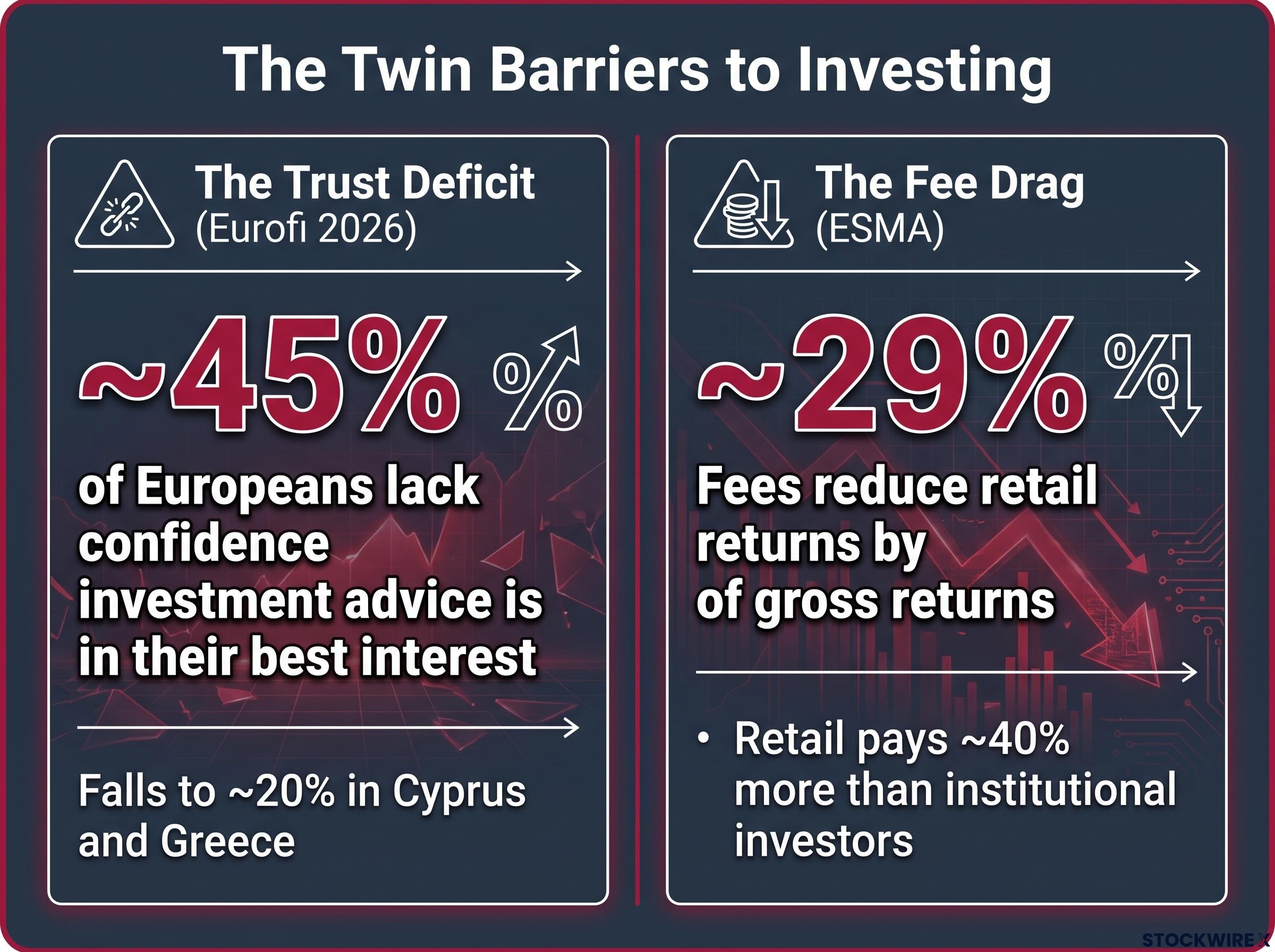
The trust deficit is the deeper barrier. A Eurofi policy paper published in 2026 found that roughly 45% of Europeans lack confidence that investment advice is provided in their best interest, a figure that falls to around 20% in crisis-affected markets such as Cyprus and Greece. The OECD notes that fear of being cheated, reinforced by high-profile fraud cases, consistently drives households back to deposits as a perceived safe haven.
The trust deficit is compounded by structural misalignment at the product level: fund manager incentives built around assets under management fees and benchmark-relative bonuses mean the advice and distribution layer can actively work against the long-term accumulation goals that governments are trying to promote.
Then there is what investing actually costs the retail saver. Analysis from the European Securities and Markets Authority (ESMA) puts a hard number on it.
ESMA found that fees and charges reduce retail investors’ returns by roughly 29% of gross returns, with retail investors paying about 40% more than institutional investors across asset classes.
Put the two findings together. A 29% fee drag and a 45% trust deficit are not marginal frictions layered on top of otherwise sound policy. They are the primary reason tax incentives underperform their design intent. When you evaluate any country’s reform trajectory, you should weight these structural barriers as heavily as the headline incentive package, because a wrapper offered inside a broken distribution and trust environment mostly ends up being used to shelter cash.
The EU’s Retail Investment Strategy targets exactly this, with mandated value-for-money benchmarks and restrictions on inducements for execution-only sales. Whether that fixes the trust problem is the open question, but the diagnosis is now official: the distribution and advice layer is as important as the product and incentive layer.
The levers that are actually moving behaviour
Move from what fails to what works, because the evidence separates the two cleanly. Some interventions produce measurable behavioural change. Others produce engagement in name only, defaults set so low they barely count, or wrappers used mainly to park cash tax-efficiently.
Ranked by demonstrated behavioural impact, three levers stand out:
- Structural defaults and mandatory systems. These move the most people because they bypass inertia entirely, enrolling savers unless they actively opt out.
- Inducement reform. Banning sales commissions protects the value of participation by aligning advice with the client rather than the seller.
- Low-cost product access. Cheap ETFs and index products sustain participation by keeping the fee drag survivable.
The defaults evidence is the most striking. UK Nest Insight opt-out payroll savings trials boosted savings participation by around 50 percentage points, with up to 7 in 10 employees saving. The same trials showed that educational messaging nudged stated intentions but that structural default mechanics drove the actual gains. Telling people to invest does little. Changing the default does almost everything.
Nest Insight found opt-out approaches boosted savings participation by around 50 percentage points, dwarfing the effect of any educational intervention tested.
Inducement reform tends to trigger an industry warning that regulating fees will shrink the market. The evidence from the Netherlands and the UK, both of which restricted sales commissions, contradicts it. Neither market shrank. In both cases, cleaner distribution coincided with healthy, and arguably stronger, retail participation.
Product structure completes the picture. Australia’s steady shift toward ETFs as the dominant retail vehicle, rather than the pricier open-end funds that lead comparable markets, is a quiet reason its system compounds so effectively.
Low-cost ETF ecosystems have become the infrastructure layer that makes retail participation viable at scale: global ETF assets reached $21.24 trillion by February 2026, a 31% year-on-year increase, and their in-kind creation mechanism gives retail investors a cost and tax efficiency that open-end active funds cannot match.
None of these levers is free of side effects, though. IOSCO warns that gamified trading apps and social media finfluencers push retail investors toward impulsive, high-risk behaviour, a conduct risk that arrives alongside the participation gains. There is a distributional catch too: policies that penalise cash can disproportionately hurt pensioners and low-income savers who genuinely need guaranteed liquidity. Shifting deposits out of banks at scale also carries a liquidity spillover risk for mortgage funding.
The hierarchy is clear even so. Defaults move people, inducement reform protects the value of participation, and low-cost products sustain it. The unintended consequences are real, but they are management problems, not reasons to abandon the levers that demonstrably work.
Which countries are best positioned, and what the study leaves unanswered
Pull the evidence together and a usable filter emerges. The best-positioned markets combine at least three of five structural conditions, and you can apply the checklist to any country’s reform trajectory yourself:
- Mandatory or quasi-mandatory participation that enrols savers by default.
- Low-cost product access, ideally an established ETF or index ecosystem.
- Clean distribution incentives, meaning inducements restricted or banned.
- A systemic trust environment where households believe advice serves them.
- Financial literacy infrastructure that makes incentives actually usable.
By that test, Australia and the Netherlands are the strongest cases: mandatory or high-coverage systems paired with clean distribution and low-cost products. They are compounding advantages the C-grade markets are still trying to legislate.
For readers wanting to see what mandatory accumulation produces in practice at the individual level, our dedicated guide to Australian superannuation benchmarks shows where the average Australian sits against the ASFA comfortable retirement threshold at each age decade, and which contribution strategies can close the gap.
The genuine unknowns sit with the reformers mid-experiment. Japan’s NISA target of 34 million accounts by end-2027 is really a test of whether tax incentives plus product access can overcome an entrenched cash preference without a mandatory backstop, and whether new account holders stay invested through the first serious market correction. Germany’s Altersvorsorgereformgesetz provisions do not begin until 1 January 2027, with some tax changes deferred to 2028, so meaningful outcome data is years away. The open question there is whether the reforms produce genuine risk-taking or simply move cash from bank deposits into capital-guaranteed products that barely improve retirement outcomes.
The scorecard’s blunt finding frames all of it: no country in a 10-market study of the world’s most developed financial systems earned above a B. This is a hard, unsolved policy problem, and the next five years of results in Japan and Germany will be the clearest test of which model travels.
There is an honest tension at the centre of the whole agenda. The stated goal is informed, long-term investors who hold their nerve through volatility. Yet the interventions that most reliably move people into markets, structural defaults above all, do so precisely by bypassing their active engagement. What happens to that participation when markets fall sharply remains the question no country in the study has answered.
This article is for informational purposes only and should not be considered financial advice. Investors should conduct their own research and consult with financial professionals before making investment decisions. Past performance does not guarantee future results, and forward-looking policy outcomes are subject to market conditions and various risk factors.