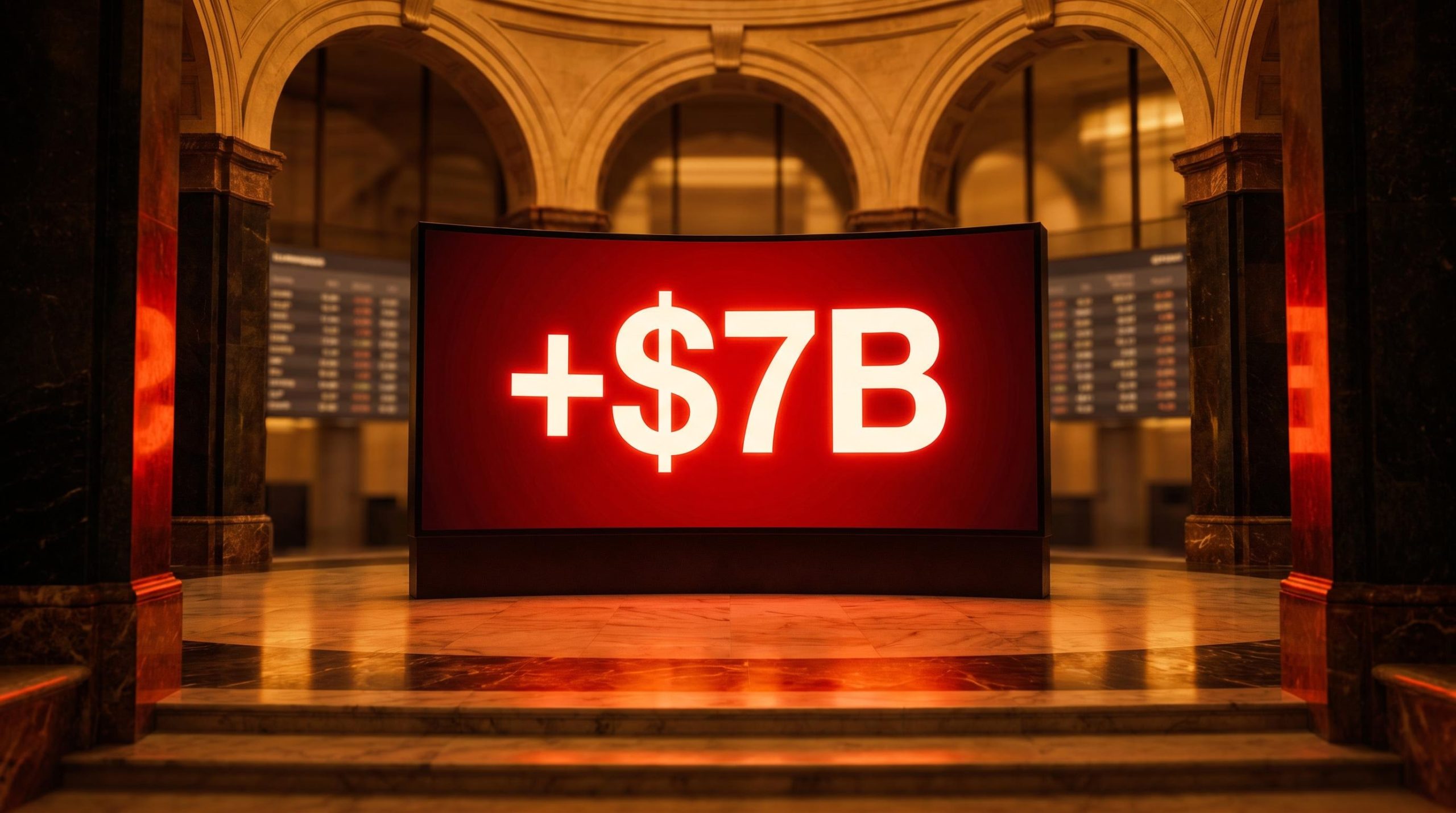
In a single trading day in May 2024, Jensen Huang’s net worth increased by more than $7 billion. Not over a quarter. Not over a year. In one session, the value of the Nvidia CEO’s stake moved by a figure larger than the entire market capitalisation of most listed companies.
That number raises a question that has almost nothing to do with whether AI will replace jobs or threaten humanity. The question is narrower and more urgent for anyone holding equities: can the institutional architecture of American democracy absorb this speed and scale of wealth concentration without breaking?
Economic historian Joel Mokyr of Northwestern University frames the real risk not as machines becoming too clever, but as innovation outpacing the ability of institutions to manage it. That gap, he argues, is the systemic risk. It is also the lens through which this piece reads the entire situation.
What you get here is a historically grounded framework for assessing the regulatory and political risks embedded in AI and big-tech equity positions. Not a prediction of outcomes. A map of the terrain, and the specific variables worth tracking.
The last time capital moved this fast, Congress broke up the railroads
The comparison to the Gilded Age gets made so often it has almost lost its meaning. That is a mistake, because the interesting part is not the nostalgia. It is the mechanism.
In the 1880s, railroads controlled the physical chokepoints of the American economy: the tracks, the depots, the freight rates that every farmer and manufacturer had to pay. At their peak, railroads accounted for roughly 60% of total U.S. stock-market value. Control the infrastructure, control the pricing, and the market has no choice but to follow.
Today’s AI platforms occupy structurally identical ground. Instead of tracks and depots, the chokepoints are compute, cloud platforms, and foundational models. The firms that own that infrastructure set the terms for everyone building on top of it.
The scale of that control now shows up directly in the index. The “Magnificent Seven” saw their combined market cap rise from $1.1 trillion in December 2012 to $17.6 trillion by the end of 2024. By 5 December 2025, a TheTradable analysis reported that seven major AI-exposed firms (Nvidia, Apple, Alphabet, Microsoft, Amazon, Broadcom, and Meta) had reached a combined market capitalisation of about $22 trillion.
That $22 trillion figure is the part that matters for your portfolio, whether or not you have ever deliberately bought an AI stock. These firms now constitute such a structural weight on broad index funds that most U.S. portfolios cannot avoid the exposure. If you hold an S&P 500 tracker, you already own this concentration, and you already carry the regulatory risk attached to it.
That structural weight is not optional for most American investors: passive index exposure now accounts for approximately 50% of S&P 500 holdings via ETFs, meaning the regulatory risk attached to seven mega-caps is embedded in portfolios that were never designed to express a view on AI governance.
| Dimension | Dominant infrastructure | Market concentration | Wealth pace | Primary regulatory response |
|---|---|---|---|---|
| Gilded Age (1880s-1900s) | Railroads, freight networks | ~60% of U.S. stock value | Rapid for its era | Interstate Commerce Act 1887, later antitrust |
| AI era (2024-2025) | Compute, cloud, foundational models | ~$22 trillion across seven firms | Exceeding the original Gilded Age | Fragmented antitrust, no federal statute |
Why the mechanism matters more than the metaphor
Mokyr’s core argument is simple to state and hard to dismiss. Innovation moves fast; the institutions built to manage it move slowly; and the widening space between the two is where systemic risk lives. The Gilded Age eventually closed that gap with antitrust law and progressive taxation, but it took decades.
Historian Margaret O’Mara adds a complication. Today’s tech fortunes are vastly larger and more globally integrated than the steel and rail fortunes of the 19th century, reaching worldwide audiences in real time. That does not make the regulatory challenge easier. It makes it harder, because the wealth and the influence it buys are no longer contained within a single national jurisdiction.
When big ASX news breaks, our subscribers know first
What the numbers inside the wealth surge actually reveal
Follow the money and the political consequences start to feel less like ideology and more like arithmetic. Tech billionaires collectively added roughly $750 billion to their fortunes in the year to April 2024. That is the headline. The detail is where the story lives.
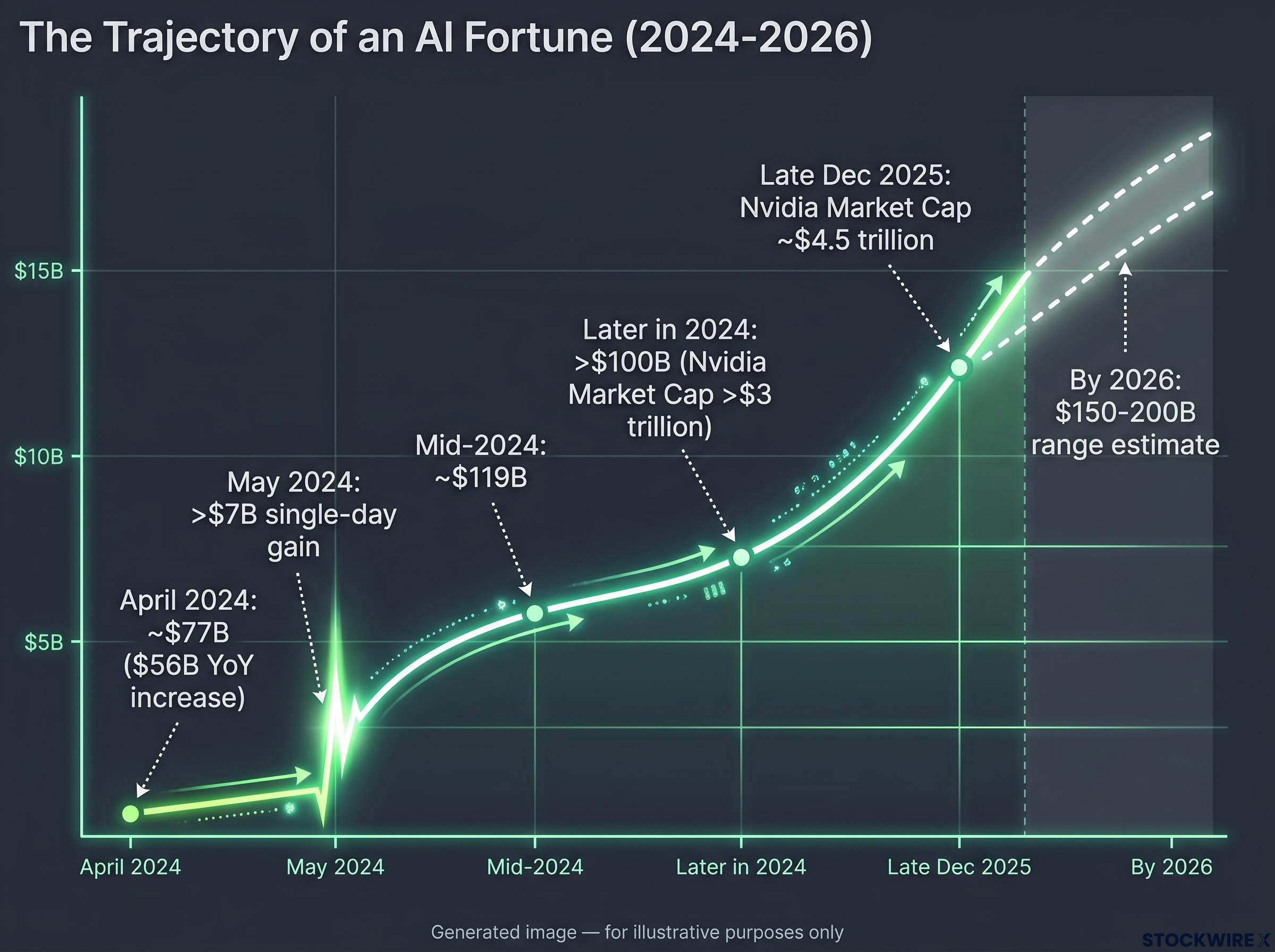
Jensen Huang’s trajectory functions as the clearest single reading of the trend:
- April 2024: net worth of approximately $77 billion, a $56 billion year-over-year increase
- May 2024: a single-day gain of more than $7 billion
- Later in 2024: crossed $100 billion as Nvidia’s market cap passed $3 trillion
- Mid-2024: estimated near $119 billion
- By 2026: estimated in the $150-200 billion range, with Nvidia’s market cap reaching approximately $4.5 trillion by late December 2025
Elon Musk and Mark Zuckerberg posted comparable year-on-year gains, and together with Huang they accounted for the bulk of that $750 billion sector-wide increase.
Mokyr’s argument sharpens here. Beyond a certain threshold, wealth stops being about personal consumption; there is no yacht large enough to absorb it. What it converts into instead is political power. And political power directed by individual preference rather than democratic priority is precisely the institutional strain his framework describes.
The pace of accumulation is itself the signal.
According to a PitchGrade analysis published in December 2025, founders and major shareholders of the top five AI firms grew their wealth by approximately $1.2 trillion between January 2024 and March 2026, a rate exceeding the original Gilded Age.
When a single executive can add more than $7 billion to a fortune in one trading session, the question is no longer whether this wealth attracts political and regulatory scrutiny. It is when that scrutiny arrives, and through what mechanism. If you are waiting for legislation to be formally filed before you reprice the risk, the historical record suggests you are already late.
How the regulatory machinery actually works, and where it is breaking down
Here is the uncomfortable starting point for anyone trying to price regulatory risk: the United States has no comprehensive federal AI statute. Governance instead runs on a patchwork of state measures, voluntary frameworks, and agency-level enforcement of laws written long before any of this existed.
The governance vacuum left by the EO 14110 rescission
For a brief period there was something closer to a unifying instrument. Executive Order 14110, issued in October 2023, assigned more than 100 actions to over 50 federal entities and invoked Defense Production Act authorities to require reporting from developers of the most powerful AI models. By September 2024, a watchdog report confirmed six major agencies had fully implemented the talent and management requirements due that year.
Executive Order 14110, published in the official Code of Federal Regulations, required developers of the most capable AI models to share safety test results with the federal government and established the inter-agency coordination structure that the Biden administration used as its primary governance instrument before the January 2025 rescission.
That structure was rescinded on 20 January 2025 by Executive Order 14148, and federal policy has since shifted toward a more deregulatory, innovation-focused posture. The rescission removed the central coordinating framework, leaving the governance vacuum that now defines the environment.
Legislative intent exists, but it has not converted into law. In May 2024, a bipartisan Senate working group led by Chuck Schumer released a roadmap calling for roughly $32 billion per year in non-defence AI funding alongside consumer and worker protections. A roadmap is not a statute, and the gap between the two is exactly the institutional lag Mokyr describes.
The antitrust cases already in motion
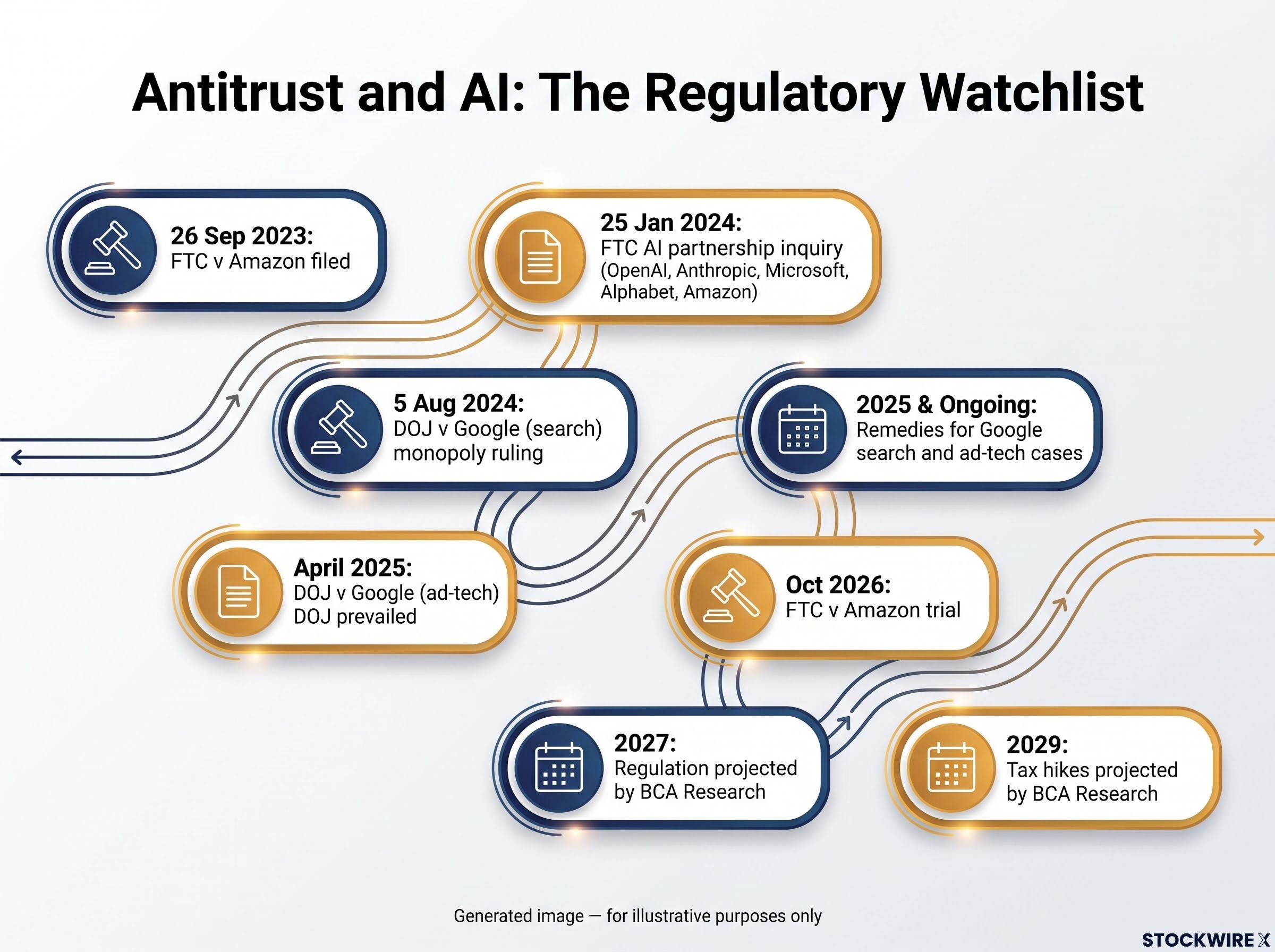
The absence of a statute has not meant the absence of enforcement. It has meant the enforcement runs through targeted antitrust action instead, and these cases are the most trackable regulatory variables you have.
| Case | Filed / ruled | Court | Status | Investor-relevant date |
|---|---|---|---|---|
| DOJ v Google (search) | Ruling 5 Aug 2024 | D.C. District | Monopoly found, Sherman Act s.2 | Remedies issued 2025 |
| DOJ v Google (ad-tech) | April 2025 | E.D. Virginia | DOJ prevailed | Remedies phase ongoing |
| FTC v Amazon | Filed 26 Sep 2023 | W.D. Washington | Core claims proceeding | Trial October 2026 |
| FTC AI partnership inquiry | Launched 25 Jan 2024 | FTC administrative | Information-gathering | Targets OpenAI, Anthropic, Microsoft, Alphabet, Amazon |
The October 2026 Amazon trial and the 2025 Google remedies are not background legal noise. They are active repricing events for large-cap tech positions, and an investor holding these names without a view on likely outcomes is navigating without a map.
There is also a subtler mechanism to watch. A May 2026 study from Trinity College Dublin identifies 27 patterns of corporate capture in AI governance, most notably “narrative capture,” where firms promote framing that casts regulation as an enemy of innovation. For governance assessments, that is a risk factor in its own right: the technique by which meaningful regulation is delayed rather than defeated.
The takeaway is that regulatory risk here is asymmetric. It is not spread evenly across the sector; it is concentrated in specific legal outcomes and specific timelines. That fragmentation is the institutional lag in action, and it means the risk is trackable if you know where to look.
Political backlash as a priced risk, not a tail event
Professional asset managers have already moved this from soft concern to structured variable. The clearest statement of that shift comes from BCA Research.
A June 2026 report by BCA Research concluded that “the investment risk is political, not technological,” forecasting scenarios in which mass layoffs, inflation, or AI-related incidents mobilise voters to support aggressive bipartisan regulation by 2027 and tax hikes from 2029.
This is not fringe analysis. It is consensus among the institutions that set capital allocation. And the incorporation of political backlash into formal risk frameworks confirms it:
- BlackRock’s 2024 annual report treats evolving AI regulation as a material factor capable of affecting growth, reputation, and assets under management
- The World Economic Forum’s 2024 “Responsible AI Playbook for Investors” builds regulatory-risk and value-alignment ratings into due diligence
- MSCI’s 2024 sustainability trends feed data-protection and AI governance practices into ESG ratings that determine index inclusion
- A 2024 KPMG report urges asset managers to define generative-AI operational and reputational risk appetites explicitly
When BlackRock and MSCI are wiring this into index inclusion and ESG scoring, the question for you is whether your own position-sizing reflects the same probability weighting, or whether you are still treating regulation as a background concern.
Data centres as the visible flashpoint
The reason political backlash is becoming concrete rather than abstract is physical. AI model development happens invisibly; data centre construction does not.
By August 2026, Barclays warned that the relentless build-out of AI data centres had become a source of bipartisan voter anger, introducing midterm election risk into its custom AI Data Center Index and citing firms including Super Micro Computer and Arista Networks. Local opposition, driven by permitting delays, strained electrical grids, and withdrawn tax incentives, has become politically potent in a way model development never was, as reported by Tekedia in September 2026.
Data centre permitting risk has moved from theoretical to legally concrete: New York’s Executive Order No. 62 created the first statewide moratorium on hyperscale construction in US history in July 2026, while Texas hosts an effective interconnection freeze through queue saturation alone, confirming that state-level politics can constrain the capex cycle without any federal legislation.
The market has shown how sensitive it is to the narrative. In September 2026, public calls by Anthropic and OpenAI leaders to slow “reckless” AI development immediately triggered a selloff in AI-linked stocks. The signal is already visible in filings, too: Best Law Firms reported in September 2026 that Anthropic, OpenAI, and data-centre developer SB Energy have begun listing public opposition and permitting scrutiny as explicit risk factors in their prospectuses.
Knowing which specific triggers, permitting fights, earnings misses, or AI-linked job losses, are most likely to accelerate legislation puts you in a position to manage the risk before it reprices, rather than after.
Where the historical precedent leaves today’s investor
The Gilded Age analogy carries a lesson, but not a stopwatch. The Progressive Era response, antitrust enforcement and progressive income taxation, took roughly two decades to materialise after railroad concentration peaked, with the federal income tax established in 1913. The current cycle may compress that timeline or stretch it.
The two-decade lag from railroad peak to Progressive Era enforcement is not a reassurance. When the institutional response finally arrived, it arrived comprehensively and reshaped the entire investment environment, not just a handful of individual stocks.
You do not need to predict the exact timing to act on this. The framework is a watchlist:
- The outcome of the October 2026 Amazon antitrust trial
- Implementation of the 2025 Google search and ad-tech remedies
- The midterm election cycle and data centre permitting fights
- Whether AI-linked job losses generate the mass voter mobilisation BCA Research projects
- The tax legislation calendar against BCA’s 2027 regulation and 2029 tax-hike scenarios
The counter-argument deserves a hearing. Critics, drawing on Milton Friedman, warn that taxing the ultra-wealthy dampens innovation. Yet Sweden and other European economies run progressive tax structures while maintaining genuine economic dynamism, and Mokyr’s framing turns the argument around: unbound capital converting into political power is itself a threat to the innovation environment. A 2025 UBS Wealth Management note adds a further dissent, arguing clearer regulatory rules could reduce uncertainty and support long-term investment. IMF and MIT research cited in the underlying analysis, meanwhile, suggests AI will widen the capital-labour income gap further, sharpening the pressure for a policy response.
The practical move is to size your AI equity exposure with an explicit view on how the portfolio performs if BCA’s 2027 scenario arrives on schedule.
Investors wanting to convert the regulatory watchlist into specific portfolio adjustments will find our dedicated guide to AI stock concentration risk, which covers position-sizing disciplines, the four distinct layers of the AI investment stack, and how UBS has framed structural risk-reduction as a portfolio management move rather than a bearish call on AI.
This article is for informational purposes only and should not be considered financial advice. Investors should conduct their own research and consult with financial professionals before making investment decisions. Past performance does not guarantee future results, and the forecasts referenced here are speculative and subject to change based on market and political developments.